
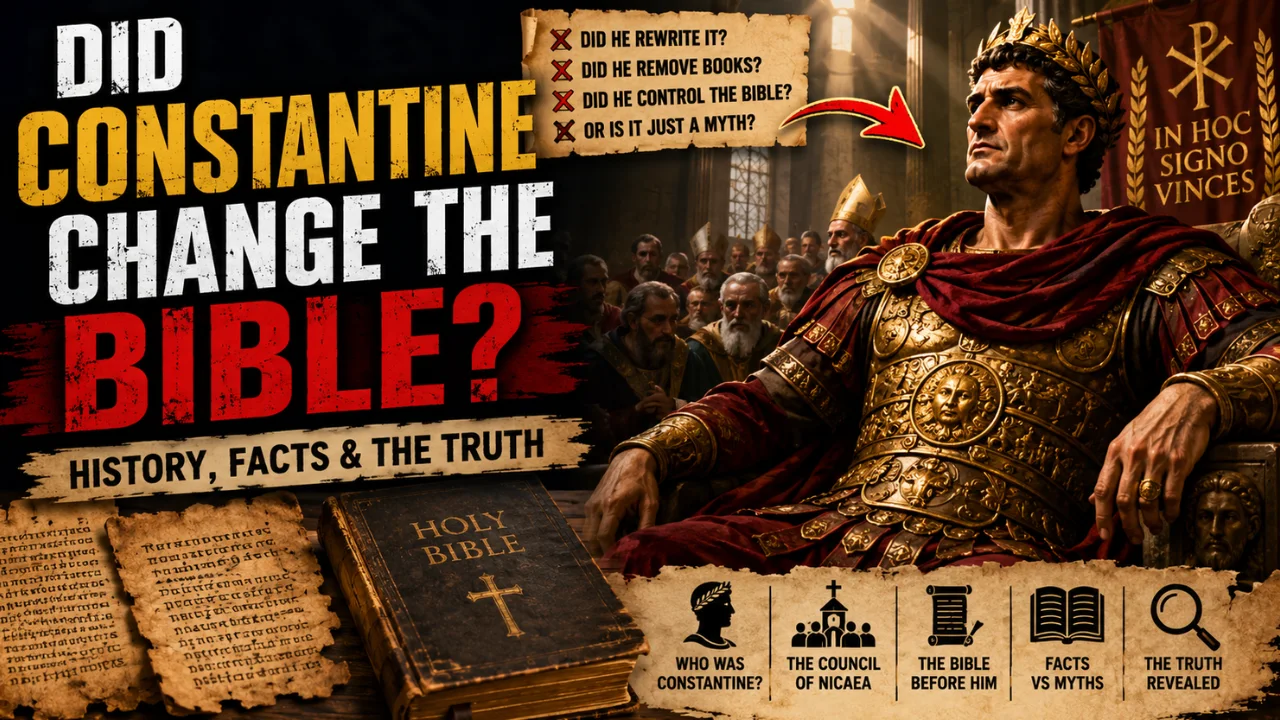

Did Constantine change the Bible? No, history does not support the claim that Constantine rewrote the Bible, personally chose its books, or used the Council of Nicaea to create Christian doctrine from nothing. Constantine influenced the public position of Christianity in the Roman Empire, but that does not mean he changed the biblical text.
This claim sounds powerful because it connects religion, politics, empire, and control. Many people hear it online and assume a Roman emperor edited the Bible for power.
But the timeline creates a serious problem for that claim.
The New Testament writings existed before Constantine. Christians quoted Scripture before Constantine. Many churches already recognized the four Gospels and Paul’s letters before Constantine. The Council of Nicaea did not meet to choose the biblical canon.
So the real question is not, “Did Constantine affect church history?”
He did.
The better question is, “Did Constantine rewrite the Bible or create the Bible Christians read today?”
The evidence does not support that claim.
Also Read: Was the Bible Changed Over Time? A Clear Answer
Why Do People Think Constantine Changed the Bible?
Many people connect Constantine with the Bible because his name appears in discussions about early Christianity, the Roman Empire, and the Council of Nicaea.
The claim usually appears in simple forms:
- Constantine changed the Bible.
- Constantine removed books from the Bible.
- Constantine invented Christianity.
- Constantine made Jesus divine.
- Constantine controlled the Church for political power.
- Constantine decided what Christians must believe.
These claims spread easily because they sound dramatic. They also appeal to people who already distrust religious institutions.
But a dramatic claim still needs historical evidence.
Constantine had influence. He gave Christianity legal protection. He involved himself in church disputes. He called the Council of Nicaea in AD 325. He also supported Christian leaders and sponsored church projects.
Those facts matter.
But none of those facts prove that he rewrote the Bible.
Who Was Constantine?
Constantine was a Roman emperor who ruled during a major turning point in Christian history.
Before his time, Christians often faced suspicion, pressure, and persecution in different parts of the Roman Empire. After Constantine came to power, Christianity gained legal recognition and public protection.
That changed the Church’s social position.
Christianity moved from a persecuted minority faith toward a legally protected religion. Bishops gained more public visibility. Church disputes became more politically important. Imperial support gave Christian institutions more stability.
That explains why Constantine matters.
But political support does not equal biblical authorship.
Constantine lived centuries after the books of the New Testament had already entered Christian life through reading, copying, preaching, and worship.
Timeline Makes the Claim Difficult to Defend
The strongest answer to the Constantine Bible myth comes from the timeline.
| Period | What Matters |
|---|---|
| 1st century | The New Testament writings begin circulating among Christians. |
| 2nd century | Christian writers quote the Gospels and apostolic letters. |
| Late 2nd century | The four Gospels already receive strong recognition in many churches. |
| Early 3rd century | Christian scholars discuss accepted and disputed writings before Constantine. |
| AD 313 | Christianity gains legal protection under Constantine. |
| AD 325 | The Council of Nicaea addresses the Arian controversy, not the biblical canon. |
| AD 331 | Constantine commissions Scripture copies for churches in Constantinople. |
| Later 4th century | Canon lists and regional councils continue discussing biblical books. |
This timeline matters because Constantine appears late in the story.
The Bible did not suddenly appear at Nicaea. Christians already had Scripture, worship, doctrine, and recognized writings before Constantine entered the scene.
If Constantine had invented or rewritten the Bible, historians would expect a clear before-and-after break. They would expect earlier Christian writings to show one faith and later imperial Christianity to show a completely different one.
But Christian writings before Constantine already show deep commitment to the Gospels, apostolic teaching, the Old Testament, the worship of Jesus, baptism, communion, prayer, repentance, and resurrection hope.
That does not mean every canon question had already ended. It means Constantine did not create the Christian Bible out of nothing.
Did Constantine Write or Rewrite Any Part of the Bible?
No serious historical evidence shows that Constantine wrote or rewrote any part of the Bible.
The New Testament books existed long before him. The Gospels, Paul’s letters, Acts, and other New Testament writings had already circulated among Christian communities for generations.
Christians quoted these writings before Constantine. Church leaders discussed them before Constantine. Different Christian communities copied and used them before Constantine.
So the claim that Constantine rewrote the Bible faces a major problem:
The biblical writings were already there.
If Constantine had rewritten them, historians would expect earlier manuscript traditions and early Christian quotations to expose a major shift. They would expect strong evidence that Christians before Constantine believed one message and Christians after Constantine suddenly believed another.
The evidence does not show that kind of complete replacement.
Did Constantine Choose the Books of the Bible?
Constantine did not personally choose the books of the Bible.
This myth often comes from confusion about the Council of Nicaea. People hear “Nicaea” and imagine bishops gathering to vote on Matthew, Mark, Luke, John, Romans, Revelation, and the rest of the New Testament.
That picture does not match the main issue at Nicaea.
The Council of Nicaea focused mainly on the Arian controversy. The central question involved the relationship between Jesus Christ and God the Father. Arius and his supporters argued that the Son did not share the same eternal status as the Father. Other church leaders argued that this teaching contradicted the faith Christians had received and the way Scripture speaks about Christ.
The council produced theological language about Christ. It did not act as a Bible-selection meeting.
The canon process took longer. Christians had already treated many writings as authoritative before Constantine, especially the four Gospels, Paul’s letters, Acts, and several other apostolic writings.
Some books received debate in certain regions, but that debate does not mean Constantine invented the canon.
A council can recognize authority without creating that authority.
Did the Council of Nicaea Change the Bible?
No, the Council of Nicaea did not change the Bible.
This is one of the most common misunderstandings in popular discussions. Many people imagine bishops sitting in a room, editing verses, removing books, and voting Jesus into divinity.
That image works well in online arguments, but it does not match the historical issue.
Nicaea addressed a theological crisis. Church leaders argued over how Christians should speak about the Son’s relationship to the Father. The council used doctrinal language to reject Arian teaching and defend the belief that the Son truly shares divine identity with the Father.
That discussion involved Scripture, but it did not rewrite Scripture.
Nicaea did not create the Gospels. It did not remove verses. It did not finalize the entire biblical canon. It did not invent the New Testament.
What About Constantine’s 50 Copies of the Bible?
Some people point to Constantine’s order for Bible copies and claim this proves he changed the Bible.
This argument needs context.
The church historian Eusebius records that Constantine requested fifty copies of Scripture for churches in Constantinople. This shows that Constantine sponsored Scripture production for church use.
But commissioning Bible copies does not prove rewriting.
A ruler can fund book production without changing the book. A church can receive new copies without accepting a new text. A copy project can support worship and teaching without inventing Scripture.
The important question is this:
Did Constantine’s commissioned copies replace earlier Christian writings with a new imperial Bible?
The evidence does not support that.
Those copies show imperial support for Christianity. They do not show that Constantine edited the biblical text, removed books, or created a new message.
Were Any Books Still Debated After Constantine?
Yes, some books still received debate in some regions after Constantine.
This point actually weakens the claim that Constantine personally settled the whole Bible.
If Constantine had chosen the Bible by imperial decree, later Christians would not continue discussing certain books. But debates and canon lists continued after him.
Some writings received more discussion in some regions, including:
- Hebrews,
- James,
- 2 Peter,
- 2 John,
- 3 John,
- Jude,
- Revelation.
At the same time, many books already had strong recognition much earlier, especially the four Gospels and Paul’s major letters.
This gives a more balanced picture.
The early Church did not treat every writing the same way. Christians recognized some books widely and early. They questioned others longer in certain places. They rejected writings that appeared late or taught ideas far outside apostolic faith.
That process does not fit the myth that Constantine simply chose the Bible in one political moment.
Did Constantine Remove Books From the Bible?
The claim that Constantine removed books from the Bible also lacks strong evidence.
People often point to “lost books,” apocryphal writings, or Gnostic texts and assume church leaders removed them because they contained dangerous truth. That idea sounds interesting, but it oversimplifies history.
Early Christians did not accept every religious text simply because it mentioned Jesus, apostles, angels, or secret teaching.
They asked important questions:
- Did this writing connect to apostolic teaching?
- Did churches widely use it?
- Did it agree with the faith Christians already received?
- Did it appear early enough to carry serious authority?
- Did it reflect the same message found in recognized Christian teaching?
Some writings failed these tests. Many appeared later. Some promoted ideas very different from the teaching found in the Gospels and apostolic letters.
So the issue was not simply, “Constantine removed books.”
The better question is, “Why did early Christians recognize some books and reject others?”
That question gives a much more accurate path into the canon discussion.
Did Constantine Make Jesus God?
No, Constantine did not invent the belief that Jesus is divine.
Christians worshiped Jesus, prayed in His name, baptized in the name of the Father, Son, and Holy Spirit, and confessed Him as Lord long before Constantine.
The New Testament itself contains high claims about Jesus. John presents the Word as divine. Paul speaks of Christ with language connected to divine honor and lordship. Hebrews presents the Son in exalted terms. Revelation portrays Jesus receiving worship and authority.
The Council of Nicaea did not create Jesus’ divinity. It responded to a dispute about how Christians should speak about the Son’s relationship to the Father.
That distinction matters.
Nicaea clarified doctrine. It did not invent Christ.
What Did Constantine Actually Do?
Constantine did several important things in church history, but changing the Bible was not one of them.
He gave Christianity legal protection
Constantine supported religious tolerance for Christians after years of persecution in parts of the empire. This gave Christians more freedom to worship openly.
He supported church leaders
He gave attention to bishops and church disputes because Christianity now mattered to imperial unity.
He called the Council of Nicaea
He wanted church unity during a major theological dispute. The council addressed the Arian controversy and produced a creed to clarify Christian belief about Christ.
He sponsored Christian projects
He supported churches, Christian leaders, and Scripture-copying efforts. These actions strengthened Christianity’s public presence.
These actions show influence.
They do not show secret Bible editing.
Why Did Constantine Care About Church Unity?
Constantine cared about church unity partly because he ruled an empire.
Religious division could create social and political instability. As emperor, he wanted peace and order. When Christian leaders disputed deeply about doctrine, he wanted the conflict settled.
This does not mean Constantine personally invented every theological decision. Bishops debated doctrinal language. Church leaders argued from Scripture and Christian tradition. Constantine used imperial power to support unity, but he did not function as the author of Christian doctrine.
His role involved politics, administration, and religion.
Readers should avoid two extremes.
One extreme treats Constantine as harmless and irrelevant. The other treats him as the secret inventor of Christianity.
Both views flatten the story.
Did Christianity Change After Constantine?
Yes, Christianity’s public position changed after Constantine.
This part needs honesty.
After Constantine, Christianity gained social protection, public influence, imperial favor, and institutional strength. That changed church life in many ways.
Some changes helped Christians. Persecution decreased. Churches grew. Public worship became safer. Christian leaders gained resources.
Other changes created concerns. Political power entered church affairs more strongly. Leaders faced new temptations. Faith and empire became more closely connected.
So yes, Constantine changed the Church’s place in society.
But that is different from changing the Bible.
A person can criticize the mixing of church and empire without claiming Constantine rewrote Scripture.
Why the Myth Still Spreads Today
The Constantine myth spreads because it gives people a simple explanation for a complex history.
It tells a neat story:
Christianity began one way. Then an emperor changed it. Now the Bible cannot be trusted.
That story feels easy to understand. It also gives skeptics a quick argument against Christian faith.
But simple stories often hide important facts.
The New Testament writings existed before Constantine. Christians quoted Scripture before Constantine. Christian beliefs about Jesus appeared before Constantine. The four Gospels had already become central in Christian worship and teaching.
So when people say Constantine changed the Bible, they often rely on a timeline that does not work.
What Would Count as Evidence That Constantine Changed the Bible?
A serious claim needs serious evidence.
If Constantine changed the Bible, historians would expect evidence such as:
- earlier manuscripts with one message and later manuscripts with a clearly different imperial message,
- records from opponents accusing Constantine of rewriting Scripture,
- council documents showing biblical books being selected or removed at Nicaea,
- major changes in Christian teaching immediately after Constantine,
- widespread evidence that pre-Constantine Christianity believed something completely different.
That kind of evidence would matter.
But the usual arguments do not provide it. They usually point to Constantine’s political power, the Council of Nicaea, later canon discussions, or rejected writings.
Those points raise historical questions, but they do not prove Constantine changed the Bible.
Why This Matters for Bible Reliability
The Constantine myth matters because it affects how people view Scripture.
If someone believes an emperor created the Bible for political control, they may dismiss Scripture without reading it carefully. They may assume Christian faith rests on imperial manipulation rather than apostolic teaching, early Christian witness, and historical transmission.
That is why this topic needs a careful answer.
The goal is not to defend every political decision Constantine made. The goal is to separate the Bible’s textual history from a popular myth.
Constantine’s influence on church history was real.
The claim that he changed the Bible is not.
How Should Christians Respond to This Claim?
Christians should respond calmly and clearly.
A good answer starts with a question:
What do you mean by “Constantine changed the Bible”?
That question helps separate different claims.
- If someone means Constantine legalized Christianity, the answer is yes.
- If someone means Constantine influenced church politics, the answer is yes.
- If someone means Constantine called the Council of Nicaea, the answer is yes.
- If someone means Constantine personally rewrote the Bible, chose its books, removed hidden books, or invented Jesus’ divinity, the answer is no.
Clear definitions prevent confusion.
Final Answer
Constantine changed the public position of Christianity in the Roman Empire, but he did not change the Bible in the way many people claim.
He did not write the New Testament. He did not personally choose the biblical books. He did not remove hidden books from Scripture. He did not make Jesus divine by political decree. He did not use the Council of Nicaea as a Bible-editing meeting.
The timeline makes the myth difficult to defend.
Christians used biblical writings before Constantine. They quoted Scripture before Constantine. They worshiped Jesus before Constantine. They debated some books after Constantine. These facts do not fit the claim that one emperor suddenly created the Bible by political command.
A better conclusion is this:
Constantine changed the Church’s place in the empire, but he did not rewrite the Bible.
