
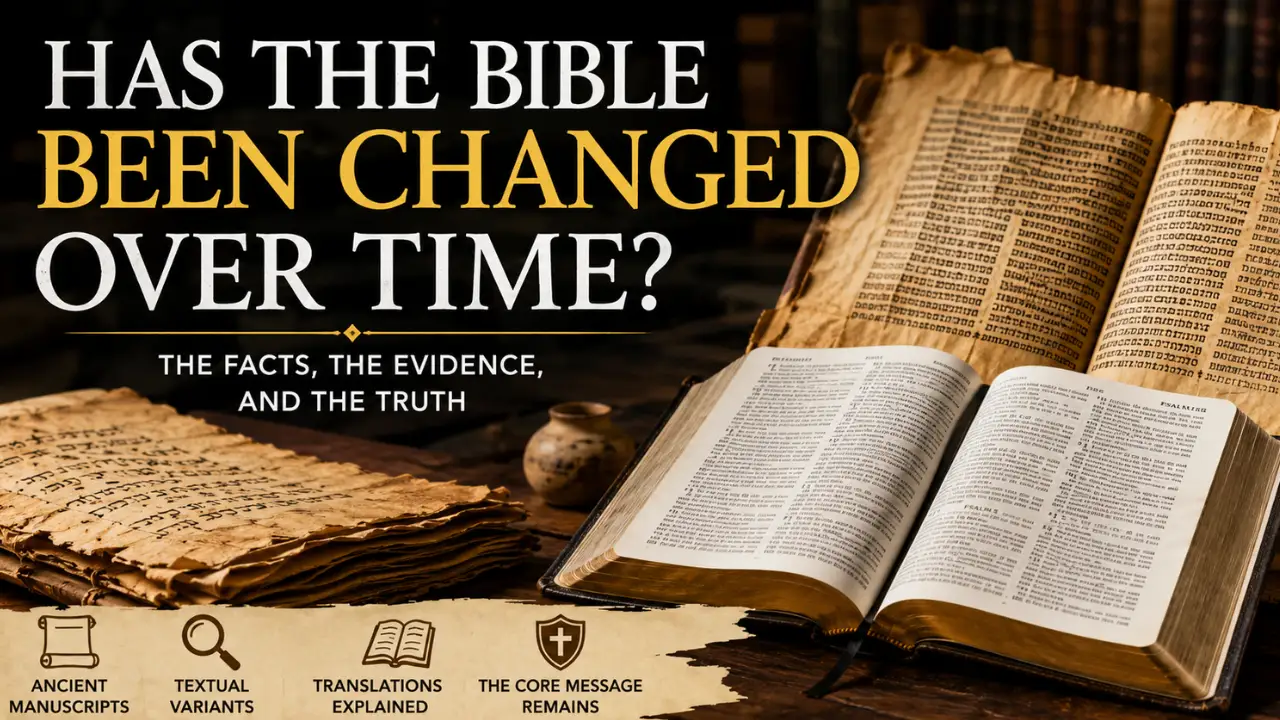

Has the Bible been changed over time? The honest answer depends on what people mean by “changed.” The Bible has passed through handwritten copying, translation, manuscript comparison and modern publishing, but that does not mean people secretly rewrote its central message.
Many people use this claim without defining it. Some mean Bible translations use different words. Some mean ancient scribes made copying mistakes. Some mean certain verses appear in footnotes. Others mean church leaders deliberately edited the Bible to control people.
Those claims do not all mean the same thing.
A fair answer must separate real historical issues from popular myths. The Bible does have manuscript differences, spelling variations, word-order changes, and debated passages. But those facts do not automatically prove that the Bible lost its message.
The serious question is not, “Are there any differences in manuscripts?”
The serious question is, “Do those differences show that the Bible was rewritten in a way that destroys its central message?”
Why Did This Question Become So Popular?
The claim that “the Bible has been changed” became popular because it sounds simple and powerful. People repeat it in online debates, short videos, documentaries, novels, comment sections, and casual conversations.
Many people first hear the claim in this form:
- “The Bible was translated too many times.”
- “Church leaders removed books.”
- “Constantine changed the Bible.”
- “Modern Bibles removed verses.”
- “We do not have the original manuscripts.”
- “Every copy is different.”
Each statement contains a question worth examining. But when people combine them into one slogan, the discussion becomes confusing.
A careful reader should not accept or reject the Bible based on a slogan. The better approach asks what kind of change someone means and what evidence supports that claim.
What Do People Mean When They Say the Bible Was Changed?
Most people use the word “changed” too broadly. They often mix several different issues into one accusation.
They may mean:
- Different Bible translations use different wording.
- Some manuscripts contain copying differences.
- Some modern Bibles place certain verses in footnotes.
- Catholic, Orthodox, and Protestant Bibles do not all contain the same Old Testament books.
- Church councils discussed which books belonged in Scripture.
- Skeptics believe religious leaders edited the text for power.
These points need separate answers.
A translation difference does not automatically prove corruption. A copying mistake does not automatically change doctrine. A canon debate does not prove someone rewrote the words of Jesus. A disputed passage does not make the whole Bible unreliable.
The word “changed” creates fear because it sounds like someone took the original Bible and secretly replaced it. History gives a more careful picture.
Was the Bible Copied by Hand Before Printing?
Yes. For many centuries, scribes copied biblical texts by hand.
Before the printing press, people preserved books through handwritten manuscripts. Scribes often worked carefully, but they remained human. A tired scribe could skip a word, repeat a phrase, spell a name differently, or place words in a slightly different order.
That sounds serious at first, but handwritten copying also created a visible trail.
Because scribes copied manuscripts across different regions and centuries, scholars can compare surviving copies. When many manuscript lines agree in most places and differ in some places, those differences help scholars identify earlier readings.
So manuscript differences do not only create a problem. They also give historians evidence to study.
Did Scribes Make Mistakes While Copying the Bible?
Yes, scribes made mistakes. Honest Christian scholarship does not need to deny that.
Common copying differences include:
- spelling variations,
- repeated words,
- skipped lines,
- reversed word order,
- added clarifying notes,
- harmonized phrases between similar passages.
Most of these differences do not change the meaning of the passage.
For example, if one manuscript says “Jesus Christ” and another says “Christ Jesus,” the order changes, but the meaning remains clear. If one copy includes a small explanatory phrase and another does not, scholars examine the manuscript evidence and note the difference.
This explains why many modern Bible footnotes say things like “some manuscripts do not include…” or “other manuscripts read…”
Those notes do not prove deception. They usually show transparency.
What Evidence Do Historians Actually Use?
Historians and textual scholars do not answer this question by guessing. They compare evidence.
The main evidence includes:
- ancient biblical manuscripts,
- early translations into other languages,
- quotations from early Jewish and Christian writers,
- manuscript families from different regions,
- archaeological discoveries,
- patterns of scribal copying.
This matters because the Bible did not survive through one hidden copy controlled by one group. It survived through many witnesses across different times and places.
If someone claims that the Bible was deliberately rewritten everywhere, they need to explain how that rewrite replaced different manuscript streams without leaving stronger evidence of the change.
That does not mean every question becomes easy. It means historians have real material to examine.
Why Do Many Manuscripts Help Instead of Hurt?
Many people assume that more manuscripts mean more confusion. In textual study, many manuscripts often help.
One manuscript gives no comparison. Many manuscripts allow scholars to compare wording, dates, locations, and copying habits.
For example:
- If one later manuscript has a longer phrase, but earlier manuscripts from different regions lack it, scholars notice that pattern.
- If one region preserves a unique reading, but many independent witnesses preserve another reading, scholars weigh that evidence.
- If a scribe commonly harmonized similar passages, scholars consider that habit when reviewing a variant.
More manuscripts can create more visible variants, but they also give scholars more tools to identify earlier wording.
This is why the claim “there are many variants” needs context. Variants exist because many manuscripts exist. The number sounds alarming until readers understand that most variants involve small differences and that comparison helps scholars work carefully.
What Are Textual Variants?
Textual variants are differences between manuscripts.
A variant can involve one letter, one word, one phrase, one sentence, or a longer passage. Some variants matter more than others, but most do not affect major teaching.
Textual criticism studies these manuscript differences. Scholars compare manuscripts by age, location, wording, and copying patterns. Their goal is not to invent a new Bible. Their goal is to understand the earliest recoverable wording.
This field exists because ancient copying produced differences. It also exists because those differences can be examined instead of ignored.
A reader should not confuse textual criticism with an attack on the Bible. In many cases, textual criticism helps explain why modern Bible translations include footnotes and why translators make certain decisions.
Has the Bible Been Rewritten?
The Bible has not been rewritten in the simple way many people imagine.
A rewrite would mean someone substantially replaced the original message with a different message. That is not the same as copying differences, translation differences, or footnotes about disputed verses.
From a historical perspective, the evidence shows a complex transmission history, not a total replacement of the Bible’s message.
From a Christian theological perspective, believers also see God’s providence in the preservation of Scripture. But even when someone looks only at the historical side, the broad manuscript evidence does not support the idea that the entire Bible became a secretly rewritten book.
People can debate particular passages. They can discuss canon differences. They can compare translations. But those issues do not equal a full rewrite.
Was the Bible Edited?
The answer depends on what someone means by “edited.”
If “edited” means scribes sometimes added clarifying notes, harmonized wording, or copied phrases differently, then yes, manuscript history shows changes at the copy level.
If “edited” means later religious leaders successfully replaced the message of Scripture with a different faith, then the evidence does not support that broad claim.
Modern editors and translators also make decisions when they prepare Bible editions. They choose punctuation, paragraph breaks, footnotes, headings, and translation wording. But those editorial tools help readers navigate the text. They do not mean the original message changed.
So the better question is not, “Was the Bible edited?”
The better question is, “What kind of editing happened, and did it change the core message?”
Did Constantine Change the Bible?
Many people repeat the claim that Constantine changed the Bible, but that claim usually confuses history.
Constantine influenced early Christianity politically after his conversion and after Christianity gained legal status in the Roman Empire. But the idea that he personally rewrote the Bible or decided which books Christians must read oversimplifies the evidence.
Christians already read, copied, quoted, and circulated many biblical books before Constantine. The four Gospels, Paul’s letters, and many other writings had a life in the Church long before the fourth century.
Church councils later discussed canon questions, but recognizing books that communities already used differs from inventing Scripture.
A council can recognize authority without creating that authority.
Who Changed the Bible?
This question assumes a single person or group changed the Bible in a unified way. History does not give such a simple answer.
Many people participated in the Bible’s transmission:
- scribes copied manuscripts,
- translators rendered texts into new languages,
- communities preserved and read Scripture,
- scholars compared manuscripts,
- publishers produced editions for readers.
Some scribes made mistakes. Some copyists may have made small clarifying changes. Some translators made different wording decisions. But that is not the same as one group secretly changing the entire Bible.
When someone asks, “Who changed the Bible?” they should first define the kind of change they mean.
Is the Bible Different From the Original Manuscripts?
We do not possess the original physical manuscripts, often called autographs. That is true for many ancient writings.
But not having the original physical documents does not mean historians know nothing about the original text. Scholars work from surviving manuscript copies, early translations, quotations, and patterns of transmission.
The Bible we read today comes through this long process of preservation and comparison.
So yes, surviving manuscripts differ in places from one another. But no, that does not automatically mean the Bible we have today carries a different message from the original biblical writings.
The real question is whether the available evidence allows scholars to recover the text with meaningful confidence. In the main message and central teachings, the answer remains strong.
Do Different Bible Translations Prove the Bible Changed?
No. Different translations usually prove that language requires interpretation.
The Bible was not originally written in English. The Old Testament came mainly through Hebrew, with some Aramaic. The New Testament came through Greek. Every English Bible must translate ancient words into modern language.
Translation always involves choices.
One translation may aim for word-for-word accuracy. Another may aim for thought-for-thought clarity. Another may balance both.
That is why one Bible may say “steadfast love,” another may say “lovingkindness,” and another may say “faithful love.” The English wording changes, but translators try to communicate the same underlying idea.
Readers should not confuse translation variety with textual corruption.
How Do Modern Bible Committees Translate Ancient Texts?
Modern Bible translations usually involve teams, not one person working alone.
Translation committees often include scholars trained in Hebrew, Aramaic, Greek, theology, history, and linguistics. They compare ancient manuscripts, review difficult wording, debate translation choices, and revise drafts.
The process usually involves several layers:
- examining the original-language text,
- comparing manuscript evidence where needed,
- choosing the best English wording,
- checking theological accuracy,
- reviewing readability,
- adding footnotes for important textual issues.
This does not make every translation perfect. It does show that serious Bible translation involves careful review, not casual rewriting.
When translations differ, readers should ask what translation philosophy the committee used and what original-language issue stands behind the wording.
Which Bible Passages Receive the Most Discussion?
Some passages receive more attention because manuscript evidence raises serious questions about whether they belonged to the earliest text.
Common examples include:
- the longer ending of Mark,
- the woman caught in adultery in John 8,
- certain wording in 1 John 5:7 in later traditions,
- smaller verse differences across the New Testament.
Modern Bibles often mark these passages with footnotes or brackets. That can surprise readers, but it shows honesty.
The important point is this: these debated passages do not create the core Christian faith. The resurrection of Jesus, the call to repentance, salvation by God’s grace, the lordship of Christ, and the moral teachings of Scripture do not depend on one disputed verse.
A person can take manuscript questions seriously without concluding that the Bible lost its message.
Why Do Some Bibles Have More Books Than Others?
This question usually relates to the Old Testament and the books often called the Deuterocanonical books or Apocrypha.
Catholic, Orthodox, and Protestant traditions do not all arrange or recognize the same Old Testament books in the same way. This difference matters, but it does not mean someone changed the entire Bible’s message.
The debate comes from different historical traditions about which Jewish writings belonged in the Old Testament canon.
So when someone sees that a Catholic Bible has more books than a Protestant Bible, they should not immediately assume fraud. They should understand that this reflects a canon difference, not a hidden rewrite of Genesis, Psalms, Matthew, John, or Romans.
Why Do Skeptics and Christians Often Talk Past Each Other?
Skeptics and Christians often use the same words while meaning different things.
A skeptic may say, “The Bible changed,” meaning some manuscripts have different wording.
A Christian may say, “The Bible did not change,” meaning the core message remained preserved.
Both statements can talk past each other.
The better conversation asks:
- Which passage are we discussing?
- Which manuscripts differ?
- Does the difference affect meaning?
- Does it affect doctrine?
- Does it prove deliberate rewriting?
- Does it change the central message?
This kind of discussion moves the topic away from slogans and toward evidence.
What Would Count as Real Evidence That the Bible Was Deliberately Changed?
A serious claim needs serious evidence.
If someone argues that religious leaders deliberately changed the Bible’s message, historians would expect stronger proof than translation differences or footnotes.
They would look for evidence such as:
- early manuscript lines showing one message later replaced by another,
- clear historical records of coordinated rewriting,
- widespread independent witnesses preserving the older “original” message,
- contradictions between early quotations and later manuscripts,
- signs that a central doctrine appeared only after the alleged editing.
This kind of evidence would matter.
But the usual arguments people give often do not reach that level. They usually point to translation differences, disputed passages, canon debates, or the absence of original physical manuscripts.
Those issues deserve study, but they do not prove a successful rewrite of the Bible’s central message.
Has the Core Message of the Bible Changed?
The core message of the Bible has not changed in the way many critics suggest.
From a historical perspective, central Christian claims appear across multiple writings, authors, and traditions. They do not rest on one isolated verse.
The Bible repeatedly teaches that:
- God created and rules over all things.
- Human beings need redemption.
- Sin separates people from God.
- God called Israel for His covenant purpose.
- Jesus Christ stands at the center of the Christian faith.
- Jesus died and rose again.
- God calls people to repentance, faith, obedience, and love.
- God will judge evil and restore what is broken.
These themes appear across many books and passages. That matters because a single disputed verse cannot erase a message repeated throughout Scripture.
From the perspective of Christian theology, this repeated witness shows that God preserved the message people need for faith and obedience.
A serious reader should avoid two extremes. One extreme denies every manuscript issue. The other treats every manuscript issue as proof that the Bible collapsed.
Neither approach handles the evidence carefully.
Why Do Modern Bibles Include Footnotes About Manuscripts?
Modern Bible footnotes often make readers nervous, but they help readers.
Footnotes show where translators made important decisions. They alert readers when manuscripts differ. They also prevent publishers from hiding difficult information.
A Bible with manuscript notes does not weaken confidence. It invites careful reading.
When a Bible says, “Some manuscripts do not include this verse,” it does not mean the translators hate Scripture. It means they want readers to know the evidence.
Transparency builds trust more than silence does.
Is the Bible Reliable If It Has Manuscript Differences?
Yes, the Bible can remain reliable even though manuscripts contain differences.
Reliability does not require every surviving copy to look identical in every letter. It requires enough evidence to know what the text says and whether its message remains stable.
The large number of manuscripts, quotations, translations, and historical witnesses gives scholars a wide field of comparison.
This does not remove every difficult question. It does show that the Bible’s text did not come to us through blind guessing.
Christian faith does not rest on the idea that no scribe ever made a copying mistake. It rests on God’s revealed message preserved through history with enough clarity for people to read, understand, believe, and obey.
What Should Christians Say When Someone Claims the Bible Was Changed?
Christians should not respond with fear or anger. They should ask a better question:
What do you mean by changed?
That question usually reveals the real issue.
If the person means translation differences, explain how translation works.
If the person means copying mistakes, explain manuscript comparison.
If the person means disputed passages, discuss them honestly.
If the person means church leaders invented the Bible, explain the difference between recognizing canon and creating Scripture.
A calm answer often works better than a defensive one.

1 thought on “Was the Bible Changed Over Time? A Clear Answer”