
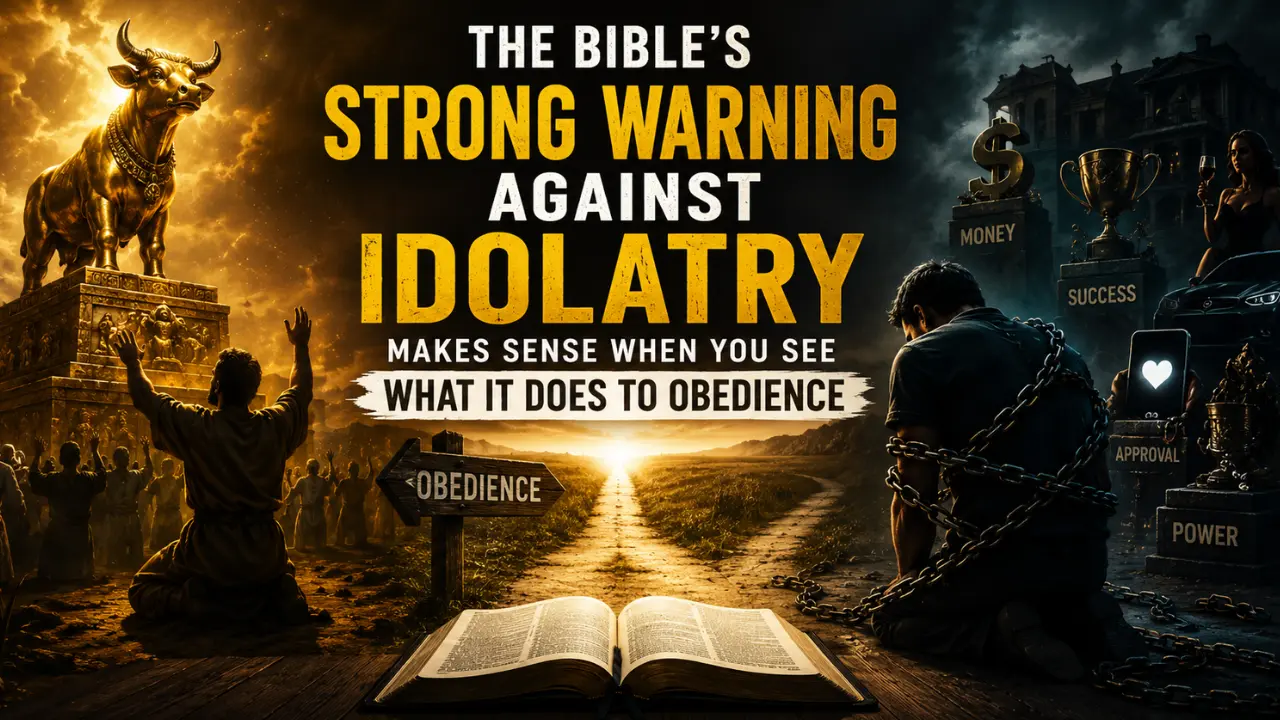

What is idolatry in the Bible? Idolatry is the sin of giving worship, trust, loyalty, love, fear, or obedience to anything in a way that belongs to God alone. In Scripture, idolatry includes bowing before false gods but it also reaches deeper than statues, images and pagan altars.
Idolatry is a sin because it replaces true worship with false devotion. It gives ultimate value to something lesser than God and allows that thing to shape the heart, decisions, desires, and obedience.
The Bible treats idolatry seriously because worship is never a small matter. What people worship shapes how they live. When worship is corrupted, the heart becomes divided, obedience becomes weak, and life begins to move away from God’s truth.
What Is Idolatry in the Bible?
Idolatry in the Bible means worshiping, serving, trusting, or depending on anything as though it has divine authority. In the ancient world, idolatry often appeared through carved images, golden statues, pagan gods, household idols, high places, and altars to false deities.
But the Bible also shows that idolatry is not only external. A person or nation can become idolatrous by trusting wealth, military strength, political alliances, human wisdom, pleasure, success, or personal power more than the Lord.
Visible Idols and Heart-Level Idolatry
Visible idolatry is easy to recognize. It includes bowing before images, offering sacrifices to false gods, and practicing worship that God forbids. This form of idolatry appears many times in the Old Testament, especially when Israel copied the religious practices of surrounding nations.
Heart-level idolatry is more hidden. It happens when something becomes the main source of identity, security, satisfaction, or control. The idol may not be physical, but it still directs the heart.
This is why idolatry is not only about what someone does in a temple. It is also about what rules the inner life. The body may never bow before a statue, but the heart can still serve money, approval, comfort, power, or self.
Why the First Two Commandments Matter
The first two commandments help explain why idolatry is so serious. The first commandment says, “You shall have no other gods before me.” This protects the object of worship. God alone must be worshiped as God.
The second commandment forbids making images for worship. This protects the purity of worship. God must not be reduced to something shaped by human imagination or controlled by human hands.
Together, these commands show that idolatry is not a minor religious mistake. It challenges God’s holiness, His authority, and His right to define true worship.
For a more practical guide, you can grow your Catholic faith in a more practical way through simple daily disciplines.
Is Idolatry a Sin?
Yes, idolatry is a sin. It breaks God’s command, corrupts worship, and leads the heart away from obedience. In the Bible, idolatry is not treated as a harmless misunderstanding. It is treated as rebellion against the true God.
Idolatry Breaks God’s Command
God is the Creator, Sustainer, Redeemer, and Judge. Nothing else has the right to receive worship as God. When people serve idols, they give sacred devotion to something that has no divine authority.
This is why Scripture speaks so strongly against idolatry. It is not simply choosing another religious style. It is rejecting God’s rightful place and replacing His truth with something false.
Idolatry also creates a false centre of life. Instead of God shaping worship, morality, identity, and hope, something else begins to take control.
Idolatry Corrupts Worship and Obedience
Worship and obedience are closely connected. What a person worships will influence what they love, fear, pursue, defend, and excuse. False worship does not stay limited to religious practice. It spreads into behaviour.
This is why the Bible often connects idolatry with other sins such as pride, injustice, greed, sexual immorality, oppression, and spiritual blindness. When worship becomes distorted, life also becomes distorted.
A person may still use religious language, but if the heart is ruled by something else, obedience becomes unstable. Idolatry divides loyalty and makes compromise easier.
Why Is Idolatry So Offensive to God?
Idolatry is offensive to God because it gives His honour to something unworthy. It treats the living God as though He can be replaced, managed, or ignored.
It Replaces the Creator With Lesser Things
God is not one spiritual option among many. He is the Maker and Lord of all creation. Idolatry reverses the proper order by placing something made, imagined, desired or controlled above the One who rules all things.
This does not offend God because He is insecure. It offends Him because idolatry is false and destructive. It trains people to depend on what cannot save, forgive, judge righteously, or give eternal life.
Every idol promises more than it can give. That is why the Bible exposes idols as powerless. They may be valued by people, but they cannot carry the soul.
It Breaks Covenant Faithfulness
In the Bible, God’s relationship with His people is often described through covenant faithfulness. He delivers, provides, commands, corrects, and remains faithful. Idolatry breaks that covenant loyalty.
For Israel, this was especially serious. God rescued them from Egypt, gave them His law, provided for them in the wilderness, and formed them as His people. When they turned to idols, they were not only copying foreign customs. They were betraying the God who had already shown, they were not only copying foreign customs. They were betraying the God who had already shown faithfulness to them.
That is why Scripture sometimes describes idolatry with the language of adultery. It is not merely a wrong religious choice. It is spiritual unfaithfulness.
It Makes Worship Man-Made
Idols are attractive because they can be shaped around human desire. They do not confront sin with holiness. They do not demand repentance. They do not speak with living authority.
The true God cannot be controlled that way. He commands, corrects, forgives, judges, and reigns according to His own holiness.
This is one reason idolatry remains tempting. It offers religion without surrender. It allows people to feel spiritual while avoiding the authority of God.
Before studying obedience, repentance or eternal life, it helps to see why salvation stands at the centre of Christian belief.
What Are Examples of Idolatry in the Bible?
The Bible gives many examples of idolatry to show how easily people turn from God when fear, impatience, compromise, or desire begins to guide them.
The Golden Calf
The golden calf is one of the clearest examples of idolatry in the Bible. While Moses was on Mount Sinai, the Israelites became impatient and asked Aaron to make a god for them.
This happened after they had seen God’s power in Egypt, crossed the Red Sea, and received His provision in the wilderness. Their sin showed how quickly fear can weaken spiritual memory.
The golden calf was not only a statue. It represented impatience, unbelief, and the desire for something visible when trusting God felt difficult.
Baal Worship
Baal worship was another major form of idolatry in Israel’s history. Baal was associated with fertility, weather, and agricultural success. When Israel turned to Baal, they were looking to a false god for provision.
This shows that idolatry often grows from fear about survival. Israel lived in a land where rain and harvest mattered deeply. Instead of trusting the Lord over creation, they were tempted to seek security from the gods of surrounding nations.
Baal worship revealed a deeper question: who did Israel really trust for life, blessing, and provision?
High Places and Compromised Worship
High places, Asherah poles, household gods, and pagan altars appear often in the Old Testament. These examples show that idolatry sometimes enters gradually.
Israel did not always reject God openly at first. Sometimes the people tried to mix worship of the Lord with practices borrowed from nearby nations. That mixture was still idolatry because God does not accept divided worship.
Compromised worship is dangerous because it can keep religious language while changing the loyalty of the heart.
Trusting Political Power More Than God
The Bible also shows idolatry through misplaced political trust. Israel and Judah sometimes depended on foreign alliances, military strength, and human kings more than the Lord.
This proves that idolatry is not always connected to statues or temples. A nation can become idolatrous when power, strategy, or security becomes more trusted than obedience to God.
What Are Modern Examples of Idolatry Today?
Modern idolatry often appears without carved images or pagan altars. The outward form may change, but the inner pattern remains the same. Something becomes more important than God in trust, identity, desire or obedience.
- Money: Money becomes an idol when financial security becomes the main source of peace, confidence or identity.
- Success: Success becomes an idol when achievement defines a person’s worth more than faithfulness to God.
- Relationships: Relationships become idols when people are expected to provide ultimate security, meaning, or approval.
- Comfort: Comfort becomes an idol when ease becomes more important than obedience, sacrifice, or spiritual growth.
- Approval: Approval becomes an idol when fear of people becomes stronger than reverence for God.
- Self: Self becomes an idol when personal desire, personal truth, personal control or personal happiness becomes the highest authority.
- Religious reputation: Religious reputation becomes an idol when visible spirituality matters more than humility, repentance, and surrender.
These examples show that idolatry is not always obvious. Many idols begin as good things in the wrong position. Money, work, family, influence, comfort, and service can be received as gifts but they become dangerous when they begin to rule the heart.
How Did God Punish the Israelites for Idolatry?
God punished the Israelites for idolatry through covenant discipline, foreign oppression, loss of protection, exile, and national judgment. These consequences came after repeated warnings, not without mercy or patience.
Covenant Discipline
Israel’s relationship with God was covenantal. Their worship and obedience were tied to their identity as God’s people. When they turned to idols, they were breaking the covenant that shaped their life with the Lord.
God’s discipline exposed the emptiness of the idols they trusted. False gods could not protect them, provide for them, or rescue them when judgment came.
This discipline was severe, but it also served a corrective purpose. God exposed idolatry so His people could see the danger of their rebellion.
Oppression and Exile
During the period of the judges, Israel repeatedly turned to false gods, suffered under enemies, cried out to God, received deliverance, and then returned to the same pattern. This cycle showed how deeply idolatry can become rooted when repentance remains shallow.
Later, idolatry became one of the major reasons for the downfall of Israel and Judah. The people adopted the gods and practices of surrounding nations, ignored the prophets, polluted worship, and hardened themselves against correction.
Eventually, exile became the severe result of long-term rebellion. It showed that idolatry never remains private. It affects worship, families, leadership, justice, national life, and future generations.
A Call to Return
God’s judgment was also a call to return. He warned before He judged. He sent prophets before exile. He called His people back before allowing consequences to fall.
This reveals an important truth about God’s correction. He confronts idolatry not because He wants His people destroyed, but because idols are already destroying them.
What Are the Effects of Idolatry?
Idolatry affects more than religious practice. It reshapes the heart, weakens obedience, and changes how a person sees God, self and life.
- Divided loyalty: Idolatry pulls the heart in two directions. A person may claim God is first while protecting something else as ultimate.
- False security: Idols promise stability but they fail under pressure. Wealth, success, beauty, power and human approval cannot carry lasting hope.
- Spiritual blindness: Repeated compromise makes the idol feel normal. What once troubled the conscience begins to feel harmless.
- Moral compromise: When something becomes ultimate, truth is often bent to protect it. The idol begins to shape decisions.
- Distance from God: Idolatry weakens intimacy with God because affection, trust, and obedience are being directed elsewhere.
These effects show why the Bible warns so strongly against idolatry. It does not only change what a person worships. It changes what a person becomes willing to follow.
Why Do People Still Fall Into Idolatry?
People still fall into idolatry because idols often feel visible, immediate, and manageable. They offer quick relief to fear, desire, insecurity, ambition, loneliness or the need for control.
Fear makes idols attractive because the heart wants something it can hold. Israel made the golden calf during uncertainty because waiting on God required patience and trust.
Desire also makes idols persuasive. An idol often promises satisfaction without surrender. It tells the heart that obedience can be delayed, softened, or avoided.
Pride strengthens idolatry because the true God requires humility. Idols allow people to remain in control while still feeling protected, important or justified.
Forgetfulness also opens the door. When people forget God’s past faithfulness, present fear begins to look larger than His promises. This is why Scripture repeatedly calls God’s people to remember His works, His word, and His covenant mercy.
How Can a Believer Defeat Idolatry?
A believer defeats idolatry by identifying what has gained ruling power, repenting honestly, and returning to God through worship, Scripture, prayer and obedience.
Identify What Is Ruling the Heart
The first step is honest examination. The question is not only, “What do I value?” The deeper question is, “What controls me?”
An idol often reveals itself through fear, obsession, compromise, defensiveness or refusal to surrender. It may be something good that has moved into the wrong position.
A believer should pay attention to what receives the most sacrifice, what creates the most fear, and what feels hardest to entrust to God.
Ask Questions That Expose Idolatry
These questions can help reveal hidden idolatry:
- Trust: What do I depend on most when I feel afraid?
- Love: What am I most unwilling to lose?
- Identity: What makes me feel valuable or worthless?
- Obedience: What do I obey even when it leads me away from God?
- Fear: Whose opinion controls my decisions more than God’s truth?
- Time: What receives my attention while God is neglected?
- Compromise: What am I willing to bend truth to protect?
These questions are not meant to create despair. They help the believer see where worship has become disordered.
Repent Without Excusing It
Repentance means naming the idol honestly. It does not hide behind personality, ambition, culture, emotional need, or normal desire.
True repentance recognizes that something has received a place it should not have. It turns from false dependence and returns to the Lord with humility.
This is not only regret over consequences. It is a change of worship.
Return Through Scripture, Prayer and Obedience
Scripture renews the heart by restoring a clear view of God. Idols grow stronger when God becomes small in a person’s mind. The more clearly a believer sees God’s holiness, mercy, wisdom, power and faithfulness, the less convincing idols become.
Prayer matters because idols often hold the heart through fear. Prayer brings those fears before God and teaches dependence again.
Obedience completes repentance. If money has become an idol, generosity may be needed. If approval has become an idol, truthful courage may be needed. If comfort has become an idol, discipline may be needed. If control has become an idol, surrender may be needed.
Turning from idolatry is not only rejecting something false. It is returning to God’s rightful authority.
The Christian life requires honest self-examination, especially when studying why these sins are more than outward behaviour.
What Does Idolatry Teach Us About True Worship?
Idolatry teaches that worship is revealed by what rules the heart. It is not only shown by religious words, songs, or outward habits. A person’s true devotion is often revealed by fear, hope, identity, sacrifice and obedience.
The Bible exposes idols because they cannot carry the weight people place on them. They may offer temporary comfort, but they cannot forgive sin, heal the heart, give eternal life, or provide lasting peace.
The answer to idolatry is not rejecting every earthly desire. The answer is restoring proper order. When God is first, His gifts can be received without becoming gods. Money can be used faithfully. Relationships can be loved rightly. Work can be done with purpose. Comfort can be enjoyed without ruling the soul.
Idolatry begins when something lesser receives ultimate devotion. True worship begins when God is honoured above every desire, fear, gift, and loyalty.

1 thought on “What Is Idolatry in the Bible? Meaning and Examples”