
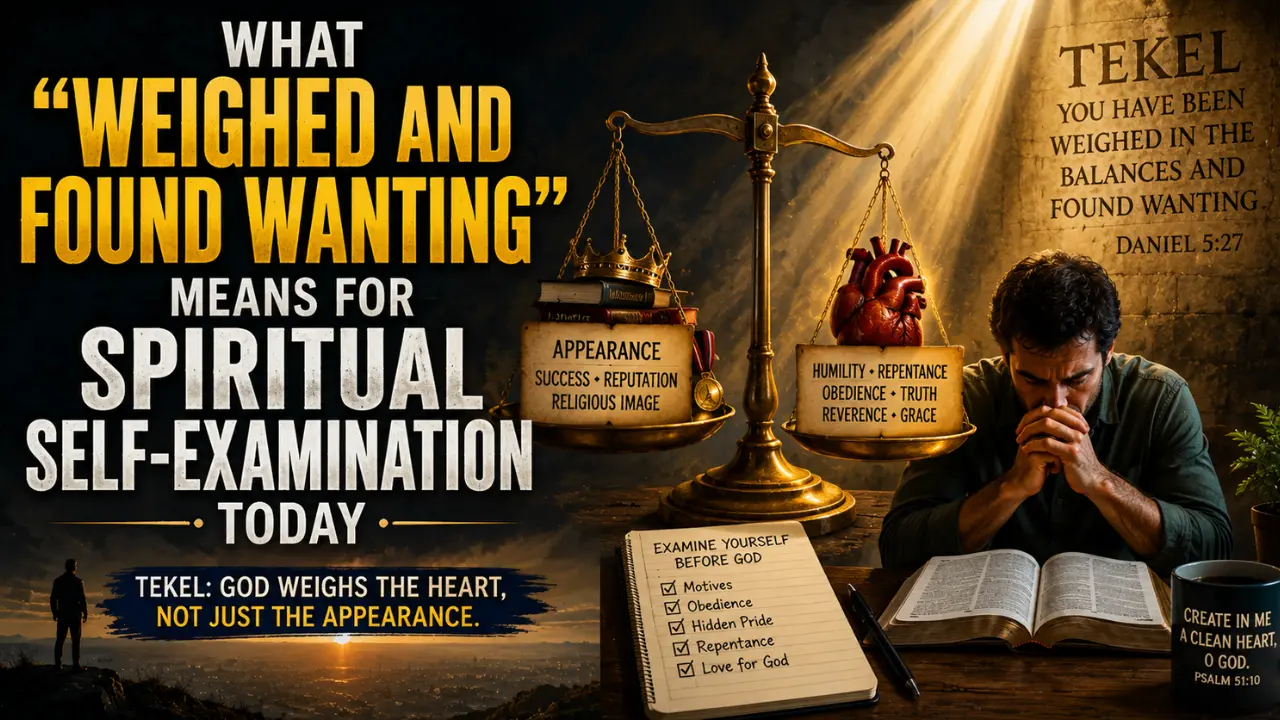

“Weighed and found wanting” is one of the most serious phrases in Daniel 5 because it speaks about a life measured by God, not by human reputation. For spiritual self-examination today, the warning is not only that Belshazzar was judged, but that a person can appear confident, religious, successful, or secure while still lacking humility, reverence, repentance, and honest dependence on God.
“Weighed and found wanting” means that a person, kingdom, or life has been measured by God’s standard and found lacking in what truly matters. For modern believers, it calls for honest self-examination in areas where outward confidence may be hiding pride, shallow repentance, religious appearance, private compromise, or resistance to correction.
For believers, this kind of examination is not meant to produce despair. It is meant to bring the heart into truth so that pride can be surrendered, sin can be confessed, and confidence can rest on God’s mercy instead of religious appearance.
This article focuses only on the spiritual application of “weighed and found wanting.” The full meaning of Mene, Mene, Tekel, Upharsin belongs in a separate Daniel 5 study.
What Does “Weighed and Found Wanting” Mean?
“Weighed and found wanting” comes from the warning given to Belshazzar in Daniel 5. The word “Tekel” carries the idea that the king had been weighed in the balances and found deficient. His kingdom looked powerful from the outside, but before God it lacked the weight of humility, reverence, and righteousness.
In simple terms, to be “weighed in the balances” means to be measured by God’s judgment, where outward appearance cannot hide inward deficiency. Human beings could see a banquet, a throne, royal authority, gold vessels, and public honor, but God weighed the heart behind the display.
For spiritual self-examination today, the phrase warns that outward strength can hide inward emptiness. A person may look established, confident, respected, or religious, yet still be spiritually lacking if the heart is proud, unrepentant, careless with holy things, or unwilling to submit to God.
Also Read: 7 Differences Between Belshazzar and Nebuchadnezzar
Why This Warning Still Matters for Believers Today
The warning still matters because believers can easily become confident in things that do not prove spiritual health. Bible knowledge, church attendance, ministry activity, public respect, moral comparison, and religious language can create a sense of security, but none of these replaces humility before God.
A believer may be active in church, fluent in spiritual language, respected by others, and familiar with Scripture while still avoiding private repentance, honest confession, or obedience in the exact area God is addressing. This is why “weighed and found wanting” is not only an ancient phrase from Daniel 5. It becomes a serious mirror for anyone who wants to know whether their confidence has real weight before God.
Self-examination is necessary because the heart can learn how to look faithful while avoiding the deeper work of repentance. A person may know the right words, defend the right doctrines, and appear serious about spiritual things, yet still ignore pride, bitterness, hidden compromise, or a refusal to be corrected.
God Weighs the Heart, Not the Image
People often measure life by visible signs. They look at reputation, success, influence, intelligence, possessions, religious identity, or how well someone appears to be doing compared with others. God’s weighing is deeper because He examines what human eyes cannot fully see.
God weighs the heart, not merely the image built around the heart. He weighs motives, humility, obedience, repentance, reverence, truthfulness, mercy, and whether a person is willing to be corrected when confronted by His word.
One of the easiest ways to avoid self-examination is to compare ourselves with someone who appears worse. Belshazzar’s warning does not allow that kind of escape. The question is not whether a person looks better than another person, but whether the heart stands truthfully before God.
Also Read: How Babylon Fell Overnight in Daniel 5
A useful way to understand this warning is to compare what people often measure with what God examines more deeply:
| What People Often Measure | What God Weighs More Deeply |
|---|---|
| Public reputation | Private integrity |
| Religious appearance | Humble obedience |
| Bible knowledge | Truth practiced with reverence |
| Self-confidence | Dependence on God’s mercy |
| Success | Faithfulness before God |
| Being admired | Being honest before God |
| Avoiding shame | Receiving correction with humility |
| Comparing with others | Standing truthfully before God |
This is why the phrase has such lasting spiritual force. A life can look heavy with achievement and still be light in the balances of God if it lacks humility, truth, repentance, and obedience.
Hidden Pride Can Make a Life Spiritually Light
Hidden pride is one of the main reasons a person may be spiritually “found wanting.” Pride is not always loud, boastful, or easy to recognize. Sometimes pride hides behind confidence, knowledge, independence, religious correctness, or the refusal to admit weakness.
A proud person may still speak respectfully about God while resisting what God is exposing. That kind of pride is dangerous because it allows someone to keep the language of faith without the posture of surrender. The person may still pray, read, teach, serve, or speak about truth, but inwardly avoid correction.
Hidden pride often appears in ordinary spiritual habits. It can appear when someone refuses to apologize, excuses a repeated sin, becomes defensive when corrected, looks down on others, or uses religious knowledge to feel superior. It can also appear when a person assumes that past spiritual experiences are enough to cover present disobedience.
This is how a person becomes spiritually light before God: not by lacking religious activity, but by lacking humility under the truth they already know. “Weighed and found wanting” presses the believer to ask whether spiritual confidence is resting on real surrender or only on the appearance of strength.
False Confidence Can Hide What God Is Weighing
Belshazzar’s feast is a picture of false confidence. He had royal status, wealth, influence, sacred vessels in his possession, and a room full of people gathered around his authority. From the outside, he looked powerful and secure, but the warning on the wall revealed that his confidence had no true weight before God.
The danger was not only that Belshazzar held a feast. The deeper issue was that he exalted himself while dishonoring the God who held his life and kingdom. He acted as though position, luxury, and public celebration could protect him from divine accountability.
Modern believers may not sit in a Babylonian banquet hall, but false confidence can still take many forms. A person can feel safe because they know Scripture, belong to a church, teach others, avoid public scandal, appear morally better than someone else, or have a respected spiritual image. None of these things proves that the heart is humble before God.
False confidence becomes especially dangerous when it replaces honest repentance. A person begins to think, “I am fine because I look fine,” while God is addressing matters that appearance cannot excuse.
Also Read: 9 Historical Details Behind Belshazzar’s Feast
How to Examine Yourself Without Falling Into Fear
Spiritual self-examination must be handled carefully. The goal is not to live in constant panic, always wondering whether God is angry over every weakness. The goal is to stand honestly before God so that pride, compromise, and false confidence do not remain hidden.
There is a difference between conviction and condemnation. Conviction brings a person into truth so they can repent, return, and grow. Condemnation traps a person in despair and makes them believe there is no room for mercy, correction, or restoration.
Biblical self-examination should make a believer more humble, not hopeless. It should lead to prayer, confession, obedience, and deeper dependence on God’s grace. The danger is not that a sincere believer sees weakness. The danger is seeing weakness clearly and still refusing to bring it before God.
This is why the phrase “weighed and found wanting” should be received with seriousness, but not with despair. It reminds believers that God’s standard is real, while also inviting them to examine themselves before their hearts become hardened.
Questions That Help with Honest Self-Examination
Self-examination becomes more useful when it moves beyond vague guilt and asks specific questions. The purpose is not to create fear, but to help the believer stand truthfully before God.
- Am I more concerned with looking right than becoming right before God? This question exposes the difference between image management and real transformation.
- Do I excuse what God is asking me to confront? This question helps identify areas where conviction has been delayed, softened, or explained away.
- Have I confused Bible knowledge with obedience? This question matters because knowing truth is not the same as submitting to it.
- Do I receive correction with humility or defensiveness? This question reveals whether pride is controlling the heart’s response.
- Is my confidence resting in God’s mercy or in my own image? This question separates humble dependence from religious self-protection.
- Am I using comparison with others to avoid repentance? This question exposes the habit of feeling safe because someone else appears worse.
- Are there hidden areas I would rather explain away than surrender? This question brings secret compromise into honest prayer.
- Have I become familiar with holy things while losing reverence for God Himself? This question connects directly with the seriousness of Belshazzar’s misuse of sacred vessels.
These questions should not be used as a tool for spiritual anxiety. They should be used as a doorway into honest prayer, repentance, and renewed humility.
Also Read: What “Mene Mene Tekel Upharsin” Means in the Bible
False Confidence vs Spiritual Weight Before God
A person can appear spiritually strong and still lack true weight before God if confidence is built on the wrong foundation. This contrast helps show the difference between outward assurance and inward substance.
| False Confidence | Spiritual Weight Before God |
|---|---|
| I know the truth | I obey the truth with humility |
| I look better than others | I stand honestly before God |
| People respect me | God sees my private life |
| I have religious activity | I have repentance and reverence |
| I can explain my sin | I am willing to surrender it |
| I have past spiritual experiences | I remain humble and teachable now |
| I appear strong publicly | I allow God to correct me privately |
This is the heart of the warning. “Weighed and found wanting” does not ask whether a person has built a convincing image. It asks whether there is real spiritual substance beneath the image.
What Makes a Life Spiritually Weighty Before God?
A spiritually weighty life is not a life without weakness. It is a life that responds to God with humility, reverence, truth, repentance, and obedience. Spiritual weight is not created by image, title, confidence, or public respect. It is formed when the heart takes God seriously.
Humility gives weight to a life because it keeps a person teachable before God. A humble believer does not pretend to be above correction. They recognize that God sees clearly, and they do not treat conviction as an enemy.
Repentance gives weight to a life because it proves that a person is not merely sorry about consequences but willing to turn from what God exposes. Repentance is not a performance of regret. It is a real change of direction before God.
Obedience gives weight to a life because truth is not meant to remain only in the mind. A believer who knows what is right but refuses to practice it becomes spiritually lighter, not stronger. The weight of truth increases responsibility.
Reverence gives weight to a life because it keeps holy things from becoming common. Belshazzar’s feast warns that sacred things can be handled wrongly when the heart loses fear of God. Reverence does not mean distance from God’s mercy, but it does mean refusing to treat God casually.
Dependence on grace gives weight to a life because it places confidence in God rather than self-image. A believer does not become spiritually weighty by pretending to be flawless. They become spiritually honest by depending on God’s mercy while refusing to protect sin.
The Difference Between Weakness and Being Found Wanting
Being “found wanting” should not be confused with simply being weak, tired, immature, or in need of growth. Scripture does not teach that every weakness means a person is rejected by God.
A sincere believer may struggle deeply and still be moving toward God with humility. They may fall, confess, rise again, seek correction, and depend on grace. That is very different from the proud condition of refusing truth while maintaining a confident appearance.
The danger in Daniel 5 is not ordinary human weakness. The danger is proud refusal. Belshazzar had warning available to him, yet he did not humble his heart. His problem was not that he lacked every opportunity to respond rightly, but that he continued in arrogance despite what he knew.
For believers today, this means self-examination should ask more than, “Do I have weaknesses?” Every person does. The deeper question is, “Am I bringing my weaknesses before God honestly, or am I hiding them behind pride, excuse, and appearance?”
How to Respond When God Exposes What Is Lacking
When God exposes what is lacking, the right response is not denial. It is also not despair. The right response is humble agreement with God and a willingness to be corrected.
A believer should begin by naming the issue honestly before God. Vague guilt often keeps people stuck, but specific confession brings clarity. If the issue is pride, call it pride. If it is bitterness, call it bitterness. If it is secret compromise, call it what it is before God.
The next step is repentance that moves beyond emotion. Feeling troubled is not the same as turning. Real repentance begins when a person stops defending what God has exposed and starts obeying what He has made clear.
A practical response can follow this pattern:
- Name the issue honestly. Refuse vague language when God is making a specific matter clear.
- Stop defending it. Do not protect what God is asking you to surrender.
- Confess it before God. Bring the matter into truth instead of hiding it behind appearance.
- Take the next obedient step. Repentance becomes real when it moves from feeling to action.
- Receive correction as mercy. God’s exposure of the heart is painful, but it is better than remaining comfortable in a false condition.
This kind of response gives spiritual self-examination a healthy direction. The goal is not to stare endlessly at what is wrong, but to bring what is lacking before God so it can be corrected by truth and mercy.
The Warning Is Serious
“Weighed and found wanting” is a serious warning because it reminds every believer that God’s evaluation is deeper than human approval. It does not allow a person to hide behind appearance, success, knowledge, comparison, or religious identity. It brings the heart into the light.
At the same time, the warning can be merciful when it leads to present correction. Godly self-examination gives a person space to repent before false confidence hardens. It invites believers to stop pretending, stop excusing, and stop measuring themselves by shallow standards.
The danger is not that God examines the heart. The greater danger is refusing examination until pride becomes settled and correction is resisted. A believer who allows God to weigh the heart now is being invited into humility, not abandoned to hopelessness.
This is why the phrase still speaks today. It teaches that a life has true weight before God when it carries humility, repentance, reverence, obedience, truth, and dependence on grace. Anything else may look impressive for a time, but it cannot stand in the balances of God.
