
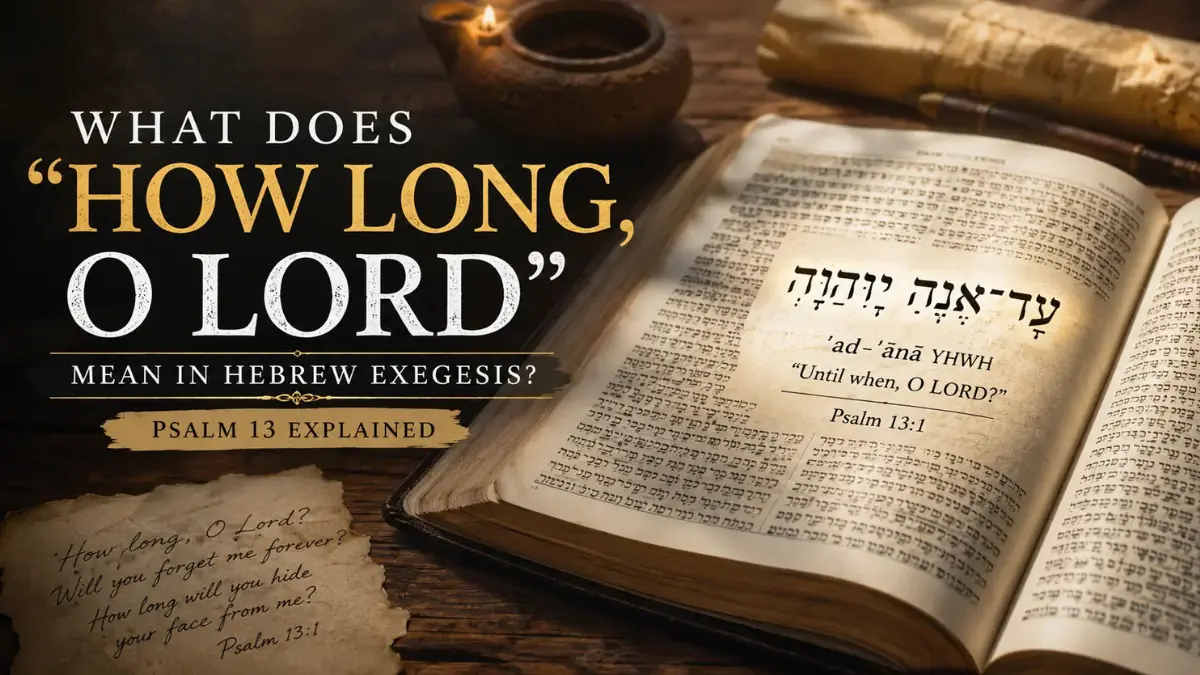

“How Long, O Lord” in Hebrew exegesis means more than a cry of impatience. In Psalm 13, it is a covenant lament where David asks how long God’s visible help, favour and answer will remain delayed. The phrase carries the weight of prolonged suffering, divine silence, inner sorrow and the painful appearance that the enemy is gaining ground while God has not yet acted.
The Hebrew phrase is:
עַד־אָנָה יְהוָה
ʿad-ʾānā YHWH
“Until when, LORD?” / “How long, O LORD?”
This phrase opens Psalm 13 with urgency. David is not asking a detached theological question. He is praying from inside a season where time itself has become part of the suffering.
עַד־אָנָה Means “Until When,” Not Simply “Why”
The Hebrew expression ʿad-ʾānā is a question about duration. David is not first asking, “Why did this happen?” He is asking, “Until when will this continue?”
That distinction matters because Psalm 13 is not mainly about a sudden wound. It is about suffering that has lasted long enough to feel spiritually heavy. The problem is not only pain. The problem is extended pain under the felt silence of God.
A “why” question looks for explanation. An “until when” question looks for an end. David’s cry assumes that the present condition should not be permanent. He is asking God to bring the period of silence, sorrow, and enemy advantage to its appointed limit.
This makes the phrase deeply important in Hebrew lament. It gives language to the burden of waiting when the sufferer still believes God can act but cannot see when God will act.
Also Read: Psalm 13 Explained: Why David Felt Forgotten by God
The Fourfold “How Long” Builds a Complete Portrait of Distress
Psalm 13 repeats the question “how long” four times. This repetition is not decorative. It is Hebrew poetic pressure.
David’s distress expands in four directions:
Toward God: “How long will You forget me?”
Before God’s face: “How long will You hide Your face from me?”
Inside the heart: “How long must I take counsel in my soul?”
Before the enemy: “How long shall my enemy be exalted over me?”
The structure shows that David is not dealing with only one problem. His crisis has spiritual, relational, internal, and external dimensions.
He feels forgotten by God. He feels deprived of God’s favorable presence. He is left to wrestle with his own thoughts. He also sees his enemy gaining visible advantage.
This layered movement gives Psalm 13 its exegetical force. David’s question is not shallow impatience. It is the prayer of someone whose whole life feels pressed by delay.
YHWH Makes the Cry a Covenant Appeal
David does not address God with vague religious language. He says YHWH, the covenant name of the Lord.
That means “How long, O Lord?” is not a cry into emptiness. It is addressed to the God who has revealed Himself as faithful, merciful, and bound to His people by covenant love.
This is why the phrase should not be read as unbelief. David is not walking away from God. He is bringing his complaint to God because he still knows God as the only true source of help.
The address YHWH gives the lament theological weight. David is effectively saying, “Lord, You are the covenant God. You are the God of loyal love and faithful action. How long will Your help remain unseen?”
His pain is real, but his prayer still has direction. He turns toward the Lord, not away from Him.
Also Read: How Lament Prayers Work in The Bible
“Will You Forget Me Forever?” Is Covenant Memory Language
David asks, “Will You forget me forever?” This does not mean he thinks God has lost mental awareness of him. In the Hebrew Bible, for God to “remember” often means to act faithfully toward someone. To feel “forgotten” by God means to feel left without visible intervention, rescue, or vindication.
So David is not accusing God of ordinary forgetfulness. He is describing the painful absence of saving action.
The word “forever” sharpens the distress. David knows God is faithful, but the delay feels endless from where he stands. His suffering has continued long enough that the future looks swallowed by the present.
This is one of the most honest parts of Psalm 13. Faith does not always experience delay as brief. Sometimes delay feels like abandonment, even when the believer still knows God has not truly abandoned him.
“Hide Your Face” Means Withheld Favor and Felt Distance
David’s second question is, “How long will You hide Your face from me?”
In Hebrew Scripture, God’s “face” often represents His favor, attention, blessing, and relational nearness. To have God’s face turned toward someone is to receive His gracious attention. To have God’s face hidden is to experience the painful sense that His favor is no longer visible.
This phrase explains why David’s suffering is so deep. His greatest pain is not only that enemies exist. His deeper pain is that God’s face feels hidden while the enemies remain active.
The language is relational, not physical. David is not saying God has a visible human face that has moved away. He is using covenant language to describe the felt withdrawal of divine favor.
In Psalm 13, the hidden face of God becomes more painful than the visible face of the enemy. The enemy is present, but God’s answer feels absent. That is the tension driving the lament.
Also Read: What David’s Words Reveal About Feeling Abandoned by God
“Counsel in My Soul” Shows the Mental Weight of Waiting
David then says, “How long must I take counsel in my soul and have sorrow in my heart?”
This line is easy to overlook, but it gives Psalm 13 psychological depth. David is not only suffering outwardly. He is carrying an inner conversation that does not resolve.
The phrase suggests repeated self-counsel, anxious reasoning, inward debate, and the mental labor of trying to survive without a clear answer from God. When prayer feels unanswered, the mind often becomes its own courtroom. The sufferer keeps reviewing the same fears, the same questions, and the same possibilities.
David’s sorrow is not described as a passing mood. It sits in the heart. It continues day after day. The delay outside him creates heaviness inside him.
This is one reason Psalm 13 remains so powerful. It understands that prolonged waiting does not only test belief. It also burdens thought, emotion, memory, and expectation.
The Enemy’s Exaltation Turns Personal Pain into a Justice Question
David’s fourth question is, “How long shall my enemy be exalted over me?”
The enemy’s position matters because it makes the crisis visible. David is not merely hurting in private. His opponent appears to be rising while he is sinking.
In biblical lament, the triumph of the enemy often raises a deeper question about justice. If the enemy continues to prevail and God remains silent, the sufferer is left asking whether evil will be allowed to define the outcome.
David’s concern is not only personal embarrassment. It is covenant seriousness. If God’s servant is crushed and the enemy is exalted, then the situation seems to contradict what David knows about God’s care, righteousness, and protection.
This is why the phrase “How long, O Lord?” carries moral urgency. David is asking God not only to comfort his heart, but also to act in a way that reveals His justice.
Also Read: How Christians Can Pray When Hope Feels Gone
“Look, Answer, Give Light” Moves the Psalm from Complaint to Petition
After the fourfold lament, David prays:
“Look.”
“Answer me.”
“Give light to my eyes.”
These three petitions are important because they show that biblical lament does not remain trapped in complaint. David names the pain, but then he asks for divine action.
To ask God to “look” is to ask for renewed attention. David has felt forgotten, so he asks God to turn toward him.
To ask God to “answer” is to ask God to break the silence. David does not only want emotional relief. He wants a real response from the Lord.
To ask God to “give light to my eyes” is to ask for restored life, strength, and clarity. In Hebrew expression, dimmed eyes can suggest weakness, fading vitality, or the nearness of death. David asks God to revive him before the darkness fully overtakes him.
This section of the psalm is crucial. David’s pain becomes prayer. His questions become requests. His lament becomes an appeal for God to intervene.
“Lest I Sleep the Sleep of Death” Shows the Stakes of the Prayer
David does not treat his condition as minor. He says, “Lest I sleep the sleep of death.”
This phrase shows that David believes the situation is dangerous. Whether the threat is physical death, spiritual collapse, or complete defeat, the language presents the matter as urgent.
He also says that if he falls, the enemy may say, “I have prevailed over him.” That means David is concerned not only with his survival, but also with what his downfall would communicate.
If the enemy rejoices over David’s collapse, the visible story would appear to favor the enemy. David asks God to act before that happens.
This gives the psalm a strong theological edge. David wants God’s help because his life, his witness, and the meaning of the conflict are all at stake.
“But I Have Trusted” Is the Main Turn in Psalm 13
The major shift in Psalm 13 comes with the word “But.”
David says:
“But I have trusted in Your steadfast love.”
This turn does not erase the earlier lament. It does not pretend the pain was unnecessary or exaggerated. It shows that David’s prayer has moved from the pressure of delay to the reliability of God’s character.
The circumstances may not have changed yet. The enemy may still be present. The answer may not yet be visible. But David’s focus changes. He moves from asking how long the suffering will continue to remembering what kind of God he is addressing.
This is not emotional denial. It is covenant reasoning. David anchors himself in what is more stable than his present experience: the steadfast love of the Lord.
חֶסֶד Explains Why the Psalm Can End in Song
The word behind “steadfast love” is ḥesed. It refers to God’s loyal love, covenant mercy, faithful kindness, and committed favor toward His people.
This word is the theological center of the ending. David can say he will rejoice and sing not because the psalm gives evidence that the situation has already changed, but because God’s ḥesed is more trustworthy than the silence David has been feeling.
That is why Psalm 13 can move from “How long?” to “I will sing.” The movement is not based on shallow optimism. It is based on covenant confidence.
David’s song comes from memory, not from denial. He remembers that the Lord has dealt bountifully with him. Past faithfulness becomes the ground for present trust.
The Hebrew Exegetical Meaning of “How Long, O Lord”
In Hebrew exegesis, “How Long, O Lord?” means: “Until when will Your saving action remain unseen, even though You are the covenant God whose steadfast love is my only secure hope?”
The phrase holds together several layers at once:
- David feels the burden of time.
- He feels the pain of God’s hidden face.
- He carries sorrow within his own heart.
- He sees the enemy gaining advantage.
- He still addresses YHWH as the faithful covenant Lord.
- He returns to ḥesed as the final ground of trust.
This is why Psalm 13 is not a prayer of unbelief. It is a disciplined lament. David speaks honestly about delay, but he speaks to God. He names sorrow without surrendering trust. He asks hard questions while still relying on the Lord’s covenant love.
The phrase “How Long, O Lord?” therefore belongs to the deepest language of biblical faith. It is the cry of a believer who does not understand the delay but still knows that God is the only one who can answer it.
Frequently Asked Questions
Why does David repeat “How Long” four times in Psalm 13?
The fourfold repetition emphasizes the full extent of David’s distress. Each question highlights a different aspect of his suffering: feeling forgotten by God, sensing God’s hidden favour, struggling with inner sorrow and watching his enemies gain the upper hand.
Is “How Long, O Lord” a sign of weak faith?
No. In biblical lament, this phrase reflects honest faith rather than unbelief. David brings his deepest questions directly to God because he continues to trust the Lord’s covenant faithfulness even while struggling with divine silence.
What does “You hide Your face” mean in Psalm 13?
In Hebrew Scripture, God’s face symbolizes His favour, presence and blessing. When David says God has hidden His face, he is describing the painful experience of feeling separated from God’s visible help, not claiming that God has literally abandoned him.
What is the main message of “How Long, O Lord” in Psalm 13?
The phrase teaches that believers can honestly express confusion and sorrow before God while continuing to trust His steadfast love. Psalm 13 moves from lament to confidence because David anchors his hope in God’s covenant faithfulness rather than in his present circumstances.

1 thought on “Hebrew Meaning of “How Long, O Lord” in Psalm 13 Explained”