
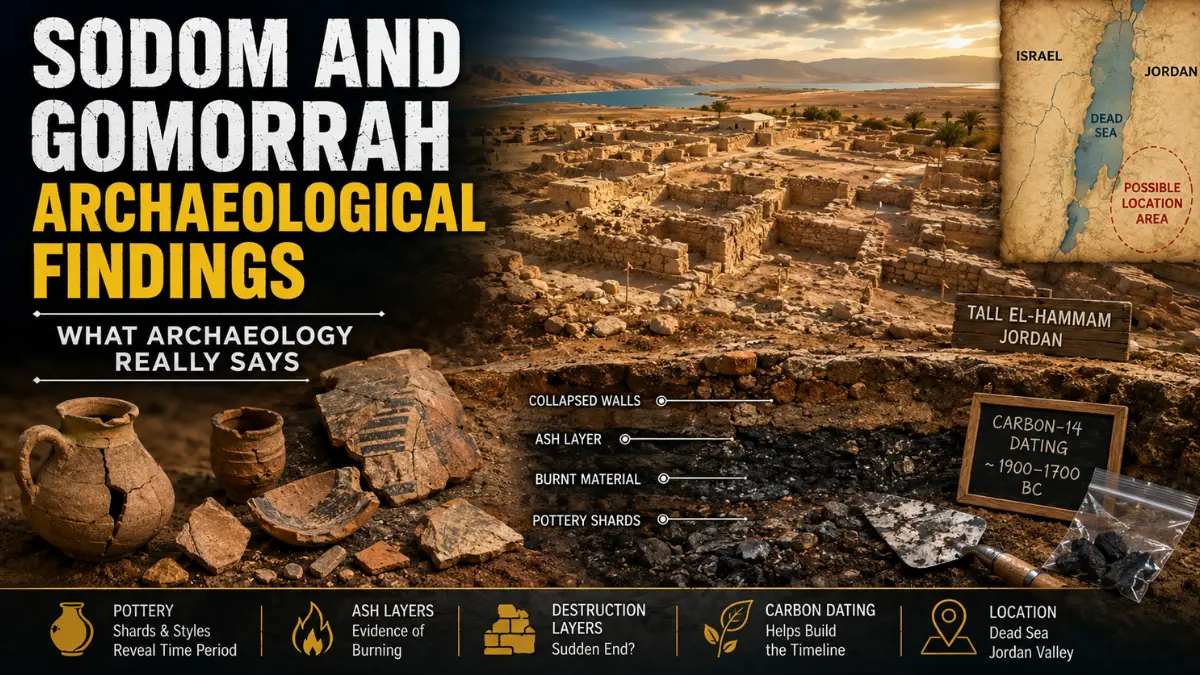

Sodom and Gomorrah archaeological findings do not give a final, universally accepted proof of where the cities stood. What archaeology gives is a set of physical clues from the Dead Sea and Jordan Valley region: pottery fragments, ash deposits, destruction layers, collapsed buildings, burial evidence, settlement patterns, and dating results that help researchers compare ancient sites with the biblical setting.
This article looks at the question from an archaeological and scientific angle. It does not try to prove a doctrine, defend a sermon point, or turn every discovery into a headline. The better question is more careful: what has been found in the ground, what can those findings actually show, and where do the limits of the evidence begin?
Archaeology Gives Clues
Archaeology has found ancient cities and settlements around the Dead Sea and Jordan Valley that are relevant to the search for Sodom and Gomorrah. Some of these sites show destruction, burning, abandonment, and evidence of life during the Bronze Age.
However, no excavation has produced a clear inscription naming a site as Sodom or Gomorrah. Without that kind of direct identification, archaeologists must work through comparison. They look at location, date, pottery, architecture, settlement size, destruction evidence, and the wider geography of the region.
That means the evidence can make a site possible, interesting, or even strong as a candidate. It cannot honestly be called final proof unless the evidence becomes much more direct.
Also Read: The Real Sin of Sodom and Gomorrah in Genesis 19
What Archaeologists Look for in the Search
The search for Sodom and Gomorrah is not based on one object or one dramatic discovery. Archaeology works by connecting many pieces of evidence from the same site and asking whether they fit together.
A serious candidate site would need to match several conditions. It would need to sit in a reasonable geographic area near the Dead Sea or Jordan Valley. It would need to show ancient settlement during the right broad period. It would need material remains that fit the kind of city or town being discussed. It would also need some explanation for destruction, abandonment, or major disruption.
Important evidence includes:
| Evidence Type | What It Can Show | What It Cannot Prove Alone |
|---|---|---|
| Pottery shards | A general time period and daily life pattern | The exact biblical name of the city |
| Ash layers | Burning or fire damage | The cause of the fire by itself |
| Collapsed walls | Structural destruction or later collapse | Whether the destruction was war, earthquake, fire, or another event |
| Carbon-14 dating | An approximate date range for organic material | An exact year or full historical identity |
| Human remains | Death, burial customs, or disruption | The full cause of a city’s end without context |
| City size | Whether the site was important or heavily settled | Whether it was Sodom or Gomorrah specifically |
| Location | Whether the site fits the Dead Sea/Jordan Valley setting | A final identification without supporting evidence |
This is why archaeology must be read carefully. A burnt city is evidence of a burnt city. It is not automatically evidence that the city was Sodom. A large ancient ruin near the Dead Sea is relevant, but relevance is not the same as certainty.
Why Pottery Shards Matter So Much
Pottery is one of the most useful tools in archaeology because it helps date human activity.
Ancient pottery was used in homes, storage areas, cooking spaces, trade, and religious or public settings. When pottery broke, the pieces often remained in the soil. Over time, pottery styles changed. Shapes, rims, handles, decorations, firing methods, and clay types can help archaeologists place a layer into a general period.
For the Sodom and Gomorrah discussion, pottery matters because any proposed site must fit the correct historical setting. If a site has strong destruction evidence but the pottery belongs to the wrong time, the identification becomes weaker. If a site fits the region but the pottery suggests a different cultural phase, the argument becomes more complicated.
Pottery does not identify Sodom by name, but it helps decide whether a site belongs in the conversation at all.
Also Read: Sodom and Gomorrah Story Summary for Beginners
Why Ash Layers Are Important but Limited
Ash layers are important because they show that fire affected a site. Archaeologists may find burnt mudbrick, blackened floors, charred beams, scorched pottery, or rooms sealed under destruction debris.
These details can suggest a sudden event, especially if objects are found where people left them. A room filled with storage jars under collapsed material may suggest that normal life ended quickly. A destruction layer across a large part of a site may suggest a major citywide crisis.
Still, ash must be interpreted with discipline. Ancient cities could burn for many reasons. Fire could come from attack, accident, earthquake damage followed by burning, domestic activity, or later disturbance. A burning layer is strong evidence that something destructive happened, but it does not automatically explain the cause.
For a scientific article, this distinction matters. Ash is evidence, but it is not a complete conclusion.
What Carbon-14 Dating Adds to the Debate
Carbon-14 dating can help estimate the age of organic material found in a layer, such as charcoal, seeds, bone, or wood.
This matters because destruction layers need to be dated. If a burnt layer is found, researchers need to know when it happened. Carbon-14 dating can place that event within a range and help compare it with pottery, architecture, and the wider settlement history.
But carbon-14 dating does not work like a label printed with an exact year. It gives a range of probability. The sample also matters. Charcoal from an old beam may be older than the fire that burned it. Seeds can be closer to the moment of use, but they still need context. Contamination, movement of soil, and later disturbance can also affect interpretation.
The strongest archaeological dating comes when several forms of evidence agree with each other. Pottery, carbon samples, architecture, and the order of layers need to support the same general conclusion.
Also Read: 5 Clues That Help Locate Sodom and Gomorrah
Tall el-Hammam and the Northern Location Theory
Tall el-Hammam is one of the most discussed sites in the modern Sodom debate. It is located in the lower Jordan Valley, northeast of the Dead Sea, in modern Jordan.
The site receives attention because it was a large ancient settlement with major architectural remains. Its location fits the northern theory, which places Sodom in or near the lower Jordan Valley rather than the southern Dead Sea region.
Supporters of this view focus on the idea that Lot chose a well-watered plain. From that angle, the lower Jordan Valley becomes important because it offers a geographic setting that could match a fertile plain near the Dead Sea region.
Archaeologically, Tall el-Hammam matters because it has evidence of urban occupation and major disruption. Discussions around the site often mention destruction debris, damaged architecture, burnt material, pottery, and dating arguments. These features make the site important, but they do not remove every question.
A large destroyed city can be a serious candidate. It is not automatically the biblical Sodom.
The Meteor or Airburst Theory
The most famous scientific claim connected with Tall el-Hammam is the airburst theory.
This theory suggested that the city was destroyed by an extreme atmospheric explosion from a cosmic object. The idea became popular because it seemed to offer a physical explanation for sudden destruction from above.
The proposed argument included high-temperature damage, unusual materials, destruction debris, and blast-like interpretation of the site. Because the claim sounded dramatic and visually close to the popular imagination of Sodom, it spread widely.
However, this theory should not be presented as proven. The main published version of the airburst argument has been withdrawn, and serious objections have been raised about the way some evidence was interpreted.
This does not make Tall el-Hammam irrelevant. It means the airburst explanation must be handled as disputed. The site can still be discussed as an archaeological candidate, but the meteor theory should not be treated as settled science.
Why the Airburst Claim Needs Careful Wording
The airburst theory is attractive because it gives readers a dramatic scientific explanation. A blast from the sky sounds like a simple bridge between archaeology and the biblical memory of destruction.
But scientific strength is not measured by how dramatic a theory sounds. It is measured by how well the evidence survives testing, criticism, comparison, and alternative explanations.
A site may show intense burning without proving an airburst. Materials may appear unusual without proving a cosmic event. A destruction layer may be severe without requiring a meteor. This is why the airburst claim should be discussed carefully and not used as the foundation of the article.
The responsible wording is that the airburst theory became well known, but it remains disputed and should not be treated as final archaeological evidence for Sodom.
Bab edh-Dhra and Numeira as Southern Candidates
Tall el-Hammam is not the only site connected with the Sodom and Gomorrah debate. The southern Dead Sea region also has important candidates, especially Bab edh-Dhra and Numeira.
These sites are in the southeastern Dead Sea region of modern Jordan. They are often discussed because they fit the southern location theory, which places the cities of the plain near the lower part of the Dead Sea basin.
Bab edh-Dhra has been proposed by some as a possible Sodom. Numeira has been proposed by some as a possible Gomorrah. The reason these sites matter is that they show ancient settlement activity in the region where many people have long searched for the cities.
Numeira is often discussed because of evidence of burning and destruction. Bab edh-Dhra is important because of its settlement remains and large burial area. Together, they give the southern theory real archaeological weight.
Still, the same caution applies. These are candidate sites, not final proof. Dating questions, settlement size, destruction timing, and the relationship between the sites all affect how strong the argument can be.
What the Southern Sites Contribute
The southern Dead Sea candidates show that the area was not empty or irrelevant. People lived there, built settlements, used pottery, buried their dead, and experienced major changes over time.
That matters because the Sodom and Gomorrah story is tied to a real geographic region. Archaeology can show that ancient communities existed in places that fit some parts of that setting.
The southern sites also help explain why the debate is not only about Tall el-Hammam. A serious article should not make the entire archaeological question depend on one site or one theory. The search involves a wider landscape, not a single excavation headline.
The southern evidence is meaningful because it supports the possibility of ancient urban life near the lower Dead Sea. It remains limited because it does not identify the cities by name.
Why One Site Cannot Carry the Whole Argument
The search for Sodom and Gomorrah becomes weak when one site is treated as if it must solve the entire question.
A responsible approach looks at several layers of evidence:
- The site must fit the geography.
- The site must fit the approximate period being argued.
- The material culture must make sense.
- The destruction evidence must be real and properly interpreted.
- The surrounding settlement pattern must fit the idea of cities in the plain.
- The proposed identification must explain both strengths and weaknesses.
This is why the strongest archaeological writing avoids overstatement. It is better to say that a site is a serious candidate than to claim that archaeology has solved the question when the debate remains open.
What Archaeology Can Say with Confidence
Archaeology can say that the Dead Sea and Jordan Valley region had ancient settlements.
- It can say that some sites show evidence of burning, destruction, abandonment, or major disruption.
- It can say that pottery and radiocarbon dating help place these remains into approximate historical periods.
- It can say that Tall el-Hammam, Bab edh-Dhra, and Numeira are among the important sites discussed in relation to Sodom and Gomorrah.
- It can also say that the airburst theory should be treated with caution rather than certainty.
What archaeology cannot honestly say at this stage is that one specific site has been proven beyond serious debate to be Sodom or Gomorrah.
How to Read Claims That Say “Sodom Has Been Found”
Readers should be cautious whenever a headline says that Sodom has been found.
A strong claim should be tested by basic archaeological questions. Does the site fit the geography? Does the pottery fit the proposed period? Is there a real destruction layer? Is the dating clear? Are alternative explanations considered? Is the claim accepted broadly, or is it mainly promoted through popular headlines?
These questions do not reject the evidence. They protect the evidence from being overstated.
Archaeology is most useful when it is allowed to remain careful. It can strengthen a location theory, weaken another theory, or show that ancient destruction really happened in the region. But it should not be forced to give certainty where the evidence does not yet provide it.
The Difference Between Evidence and Identification
Evidence and identification are not the same thing.
A destruction layer is evidence of destruction. Pottery is evidence of occupation and dating. Ash is evidence of burning. Carbon samples are evidence for an approximate time range. A large city site is evidence of urban life.
Identification is a higher-level conclusion. It asks whether all the evidence together is strong enough to name the site as Sodom or Gomorrah.
That is where the debate remains difficult. The physical evidence is real, but the final identification is not settled.
This distinction makes the article more authoritative because it does not deny the archaeology and does not exaggerate it.
The Most Balanced Scientific View
The most balanced view is that archaeology has produced serious clues but not final proof.
Tall el-Hammam is important because it is a major site in the lower Jordan Valley with evidence of destruction and because it fits the northern location theory. Bab edh-Dhra and Numeira are important because they belong to the southern Dead Sea discussion and show ancient settlement evidence in a region long connected with the cities of the plain.
The airburst theory should be discussed as a disputed proposal, not as settled evidence. Pottery, ash, destruction layers, and dating results all matter, but each one must be interpreted within the full archaeological context.
A careful article should avoid two extremes. It should not say there is no evidence at all, because there are real sites and real findings worth discussing. It should also not say the case is proven, because no candidate has removed all serious questions.
Simple Summary for Beginners
Archaeology has found ancient sites near the Dead Sea and Jordan Valley that are relevant to the search for Sodom and Gomorrah, but no site has been proven beyond debate.
Tall el-Hammam is a major northern candidate because it was a large ancient settlement in the lower Jordan Valley and has evidence of major destruction. The meteor or airburst theory connected with it became well known, but it should be treated as disputed rather than proven.
Bab edh-Dhra and Numeira are major southern candidates because they are located near the southeastern Dead Sea region and show ancient settlement evidence. They are important to the southern location theory, but they also remain debated.
Pottery shards help date ancient layers. Ash layers show burning but not always the cause. Carbon-14 dating helps build a timeline, but it usually gives ranges rather than exact dates. Destruction layers are important, but they do not automatically identify a city by name.
The best conclusion is that archaeology gives serious clues about possible locations and ancient destruction events, but it does not yet give final proof that one specific site is Sodom or Gomorrah.
