
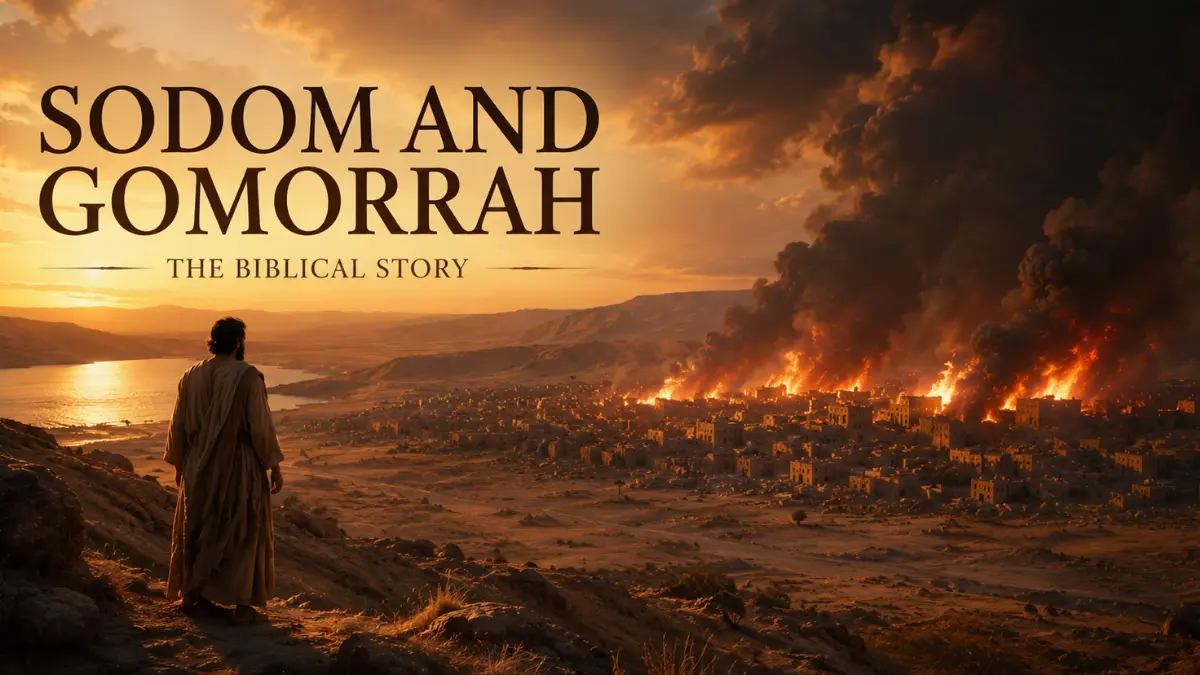

Sodom and Gomorrah story summary: Sodom and Gomorrah were two cities in Genesis that came under divine judgment because their wickedness had become severe. The story explains how Abraham pleaded for the cities, how two angels warned Lot to leave, how Lot hesitated before escaping, and how the cities were destroyed while Lot and part of his family were rescued.
The story is mainly found in Genesis 18 and Genesis 19. For beginners, the easiest way to understand it is to follow the events in order. Genesis does not present the destruction of Sodom and Gomorrah as a random disaster. The narrative moves through warning, investigation, intercession, moral exposure, rescue, and then judgment.
The Story Begins with Abraham and Lot
Before Sodom and Gomorrah were destroyed, the Bible introduces the background through Abraham and his nephew Lot.
Abraham and Lot had traveled together, but their households became too large to remain in the same area. They had many animals, servants, and possessions, and the land could not easily support both groups together. To avoid conflict, Abraham allowed Lot to choose where he wanted to settle.
Lot looked toward the plain of the Jordan and saw that it was well-watered and fertile. From a practical point of view, the land looked attractive. It seemed like a good place for prosperity, comfort and growth.
However, Lot’s choice placed him near Sodom, a city already described in Genesis as morally corrupt. Over time, Lot did not remain merely near the city. By the time the main story unfolds, he is living inside Sodom and has become connected to its public life.
This background is important because the story is not only about two cities being judged. It is also about Lot gradually settling in a place that looked beneficial on the outside but was spiritually and morally dangerous.
Also Read: The Real Sin of Sodom and Gomorrah in Genesis 19
God Revealed the Coming Judgment to Abraham
The next major scene happens when God reveals to Abraham that the outcry against Sodom and Gomorrah has become great.
In simple terms, the evil of the cities had become serious enough that judgment was approaching. The word “outcry” suggests that the wrongdoing in these cities was not small, hidden, or accidental. Genesis presents it as a condition that had reached a severe level.
Abraham responded by pleading for the cities. He asked whether God would destroy the righteous together with the wicked. This is one of the most important parts of the story because it shows that Abraham was concerned about justice and mercy.
Abraham began by asking if the city would be spared if fifty righteous people were found there. Then he continued asking about smaller numbers: forty-five, forty, thirty, twenty, and finally ten.
The point of this conversation is not that Abraham cared more about mercy than God did. The point is that the story carefully shows that judgment was not treated casually. The possibility of righteous people living inside the city was considered seriously.
By the end of the conversation, the issue becomes clear: the city did not even contain ten righteous people who could stand as a reason for it to be spared.
Two Angels Arrived in Sodom
After Abraham’s conversation with God, two angels arrived in Sodom in the evening.
Lot was sitting at the city gate when they came. In ancient cities, the gate was a public place where legal matters, business, and community discussions often happened. This detail shows that Lot was not simply a private resident living quietly outside the city’s influence. He had become part of Sodom’s daily life.
When Lot saw the two visitors, he urged them to stay at his house for the night. At first, they said they would stay in the open square, but Lot strongly insisted that they come into his home.
This detail shows that Lot understood the danger of the city. He knew that strangers were not safe in Sodom at night. His insistence suggests that he recognized the moral condition of the place where he was living, even though he had not separated himself from it.
The visitors entered Lot’s house, and he prepared a meal for them.
Also Read: 5 Clues That Help Locate Sodom and Gomorrah
The Evil of Sodom Was Exposed That Night
The story then reveals the condition of Sodom in a direct and disturbing way.
Before the visitors could sleep, men from the city surrounded Lot’s house. Genesis describes them as men from every part of Sodom, both young and old. This detail matters because the narrative presents the city’s corruption as widespread, not limited to one isolated group.
They demanded that Lot bring out the visitors. Their behavior showed violence, public wickedness, and open hostility toward vulnerable outsiders.
Lot went outside and tried to stop them. His response is also troubling because he offered his daughters instead. This part of the story should not be softened or ignored. Lot was trying to protect his guests, but his own moral judgment appears deeply damaged by the environment in which he had chosen to live.
The crowd rejected Lot’s appeal and became even more aggressive. They pressed against him and tried to break down the door.
At that moment, the angels pulled Lot back into the house and struck the men outside with blindness, so they could not find the door.
This scene explains why Sodom was under judgment. The city’s evil was not presented as a private weakness or a small moral failure. The narrative shows a public culture of violence, corruption, and resistance to righteousness.
The Angels Warned Lot to Leave
After the violence at Lot’s house, the angels told him that the city was about to be destroyed.
They asked Lot whether he had anyone else in the city, such as sons-in-law, sons, daughters, or other family members. He was told to bring them out because judgment was near.
Lot went to speak with his sons-in-law, who were pledged to marry his daughters. He warned them that the Lord was about to destroy the city.
But they did not take his warning seriously.
This moment shows how deeply Lot’s family had become tied to Sodom. His sons-in-law heard the warning, but they treated it as if it were a joke. The story suggests that Lot’s voice did not carry enough spiritual seriousness to convince them in the moment of danger.
That detail adds weight to the story. Lot had enough knowledge to recognize danger, but his long connection to Sodom had weakened his influence over those closest to him.
Also Read: Archaeology of Sodom and Gomorrah Explained Simply
Lot Hesitated Before Escaping
When morning came, the angels urged Lot to hurry.
They told him to take his wife and his two daughters and leave so they would not be destroyed along with the city. Even after the warning, Lot hesitated.
This hesitation is one of the most human parts of the story. Lot had seen enough to know that Sodom was dangerous, but he still struggled to leave. His home, possessions, relationships, and settled life were all connected to the city.
Genesis does not present Lot as a confident hero who immediately obeyed. It presents him as a man who had to be physically led away from destruction.
The angels took Lot, his wife, and his two daughters by the hand and brought them out of the city. The story explains this as an act of mercy. Lot’s rescue was not based on his quick decision-making or spiritual strength. He was rescued because God showed mercy and removed him from the place of judgment.
Lot Was Told Not to Look Back
Once Lot and his family were outside the city, they were given clear instructions. They were told to escape for their lives, not to look back, and not to stop anywhere in the plain.
The command not to look back was not a small detail. It showed that leaving Sodom required more than physical movement. Lot’s family had to separate themselves from a place that was under judgment.
Lot feared that he would not reach the mountains in time, so he asked to flee to a small nearby town called Zoar. His request was granted, and he was told to hurry there.
This part of the story shows the urgency of the escape. The destruction would not begin until Lot reached safety, which again shows the mercy built into the narrative before judgment fell.
Sodom and Gomorrah Were Destroyed
After Lot reached Zoar, Sodom and Gomorrah were destroyed.
Genesis says that burning sulfur came down on the cities. The destruction affected the cities, the plain, the people, and the vegetation of the land.
For many readers, this is the part of the story they remember most. However, in the biblical narrative, the destruction is not the only focus. Genesis first shows the seriousness of the cities’ evil, Abraham’s plea for mercy, the angels’ warning, Lot’s hesitation, and the effort to bring him out safely.
That order matters. The story is structured to show that the judgment of Sodom and Gomorrah came after the cities’ wickedness was exposed and after Lot was given a clear path of escape.
The destruction of the cities therefore functions as a serious judgment scene, but it is surrounded by details that show warning, patience, and rescue.
Lot’s Wife Looked Back
As Lot and his family escaped, Lot’s wife looked back and became a pillar of salt.
The Bible does not give a long explanation of everything happening inside her heart. Still, her action is meaningful within the story. She had been told not to look back, but she turned toward the city that God was judging.
For a beginner, the simplest way to understand this moment is that Lot’s wife physically left Sodom, but her backward look showed a dangerous attachment to what she had been commanded to leave.
Her part in the story warns readers that escape from judgment is not only about moving away from a place. It also involves letting go of what that place represents.
Abraham Saw the Smoke Rising
The next morning, Abraham went to the place where he had stood before the Lord.
He looked toward Sodom and Gomorrah and saw smoke rising from the land like smoke from a furnace. This scene connects Abraham back to the event. He had pleaded for the cities, and now he saw the result of the judgment.
The narrative also says that God remembered Abraham and brought Lot out of the destruction. This detail does not present Lot as perfect. Genesis has already shown his hesitation and weakness. But it does show that Lot’s rescue was connected to mercy and to Abraham’s place in the larger story.
By this point, the main event is complete. Sodom and Gomorrah had been judged, and Lot had been removed from the destruction before it fell.
What Happened After Sodom and Gomorrah Were Destroyed?
After escaping to Zoar, Lot became afraid to stay there. He left with his two daughters and lived in a cave in the mountains.
The events after this are dark and uncomfortable. Lot’s daughters believed there were no men left for them to marry, so they formed a sinful plan to preserve their family line through their father.
This part of the story shows that Lot’s escape from Sodom did not immediately restore everything in his life. He survived the destruction, but his later life was marked by fear, isolation, and family brokenness.
That aftermath is important because Genesis does not turn Lot’s rescue into a simple happy ending. The story shows that living close to corruption can leave deep damage, even when a person is rescued from the final disaster.
Simple Timeline of the Sodom and Gomorrah Story
Here is the story in chronological order:
- Abraham and Lot separate because their households become too large.
- Lot chooses the fertile plain near Sodom.
- Lot eventually lives inside Sodom.
- God reveals to Abraham that Sodom and Gomorrah are under judgment.
- Abraham pleads for the cities to be spared if righteous people can be found.
- Two angels arrive in Sodom and stay at Lot’s house.
- The men of Sodom surround Lot’s house and reveal the city’s corruption.
- The angels warn Lot that the city will be destroyed.
- Lot warns his sons-in-law, but they do not believe him.
- Lot hesitates, and the angels lead him and his family out.
- Lot is told not to look back.
- Lot escapes to Zoar.
- Sodom and Gomorrah are destroyed.
- Lot’s wife looks back and becomes a pillar of salt.
- Abraham sees smoke rising from the destroyed land.
- Lot later lives in a cave with his daughters.
Why Were Sodom and Gomorrah Destroyed?
Sodom and Gomorrah were destroyed because their wickedness had reached a severe level.
Genesis presents the cities as places marked by public corruption, violence, moral disorder, and resistance to righteousness. The scene at Lot’s house gives the clearest picture of that condition. The men of the city did not merely behave badly in private; they acted together in a way that exposed the deep moral condition of the community.
The story should not be reduced to the idea that the cities were judged for one isolated act. Genesis presents a broader picture of entrenched wickedness. The judgment comes after the cities’ condition is revealed, after Abraham pleads for mercy, and after Lot is warned to escape.
This is why the story carries so much weight in the Bible. It is a judgment narrative, but it is also a warning narrative. It shows what happens when evil becomes deeply established and when a society no longer responds to righteousness, restraint, or warning.
What Is the Main Lesson of the Story?
The main lesson of the Sodom and Gomorrah story is that God sees severe wickedness, warns before judgment, and shows mercy by rescuing Lot.
The story is not only about destruction. It is also about the process that happens before destruction. Abraham intercedes. The angels arrive. The city’s condition is exposed. Lot is warned. His family is urged to leave. Even when Lot hesitates, he is taken by the hand and brought out.
This gives the story a serious but balanced message. Genesis does not present judgment as careless or uncontrolled. It presents judgment as the result of deeply rooted wickedness, while also showing that mercy is extended before the final destruction arrives.
For beginners, this is one of the clearest ways to read the story: Sodom and Gomorrah show the seriousness of evil, while Lot’s rescue shows the mercy of God toward those He removes from judgment.

3 thoughts on “Sodom and Gomorrah Story Summary for Beginners”