
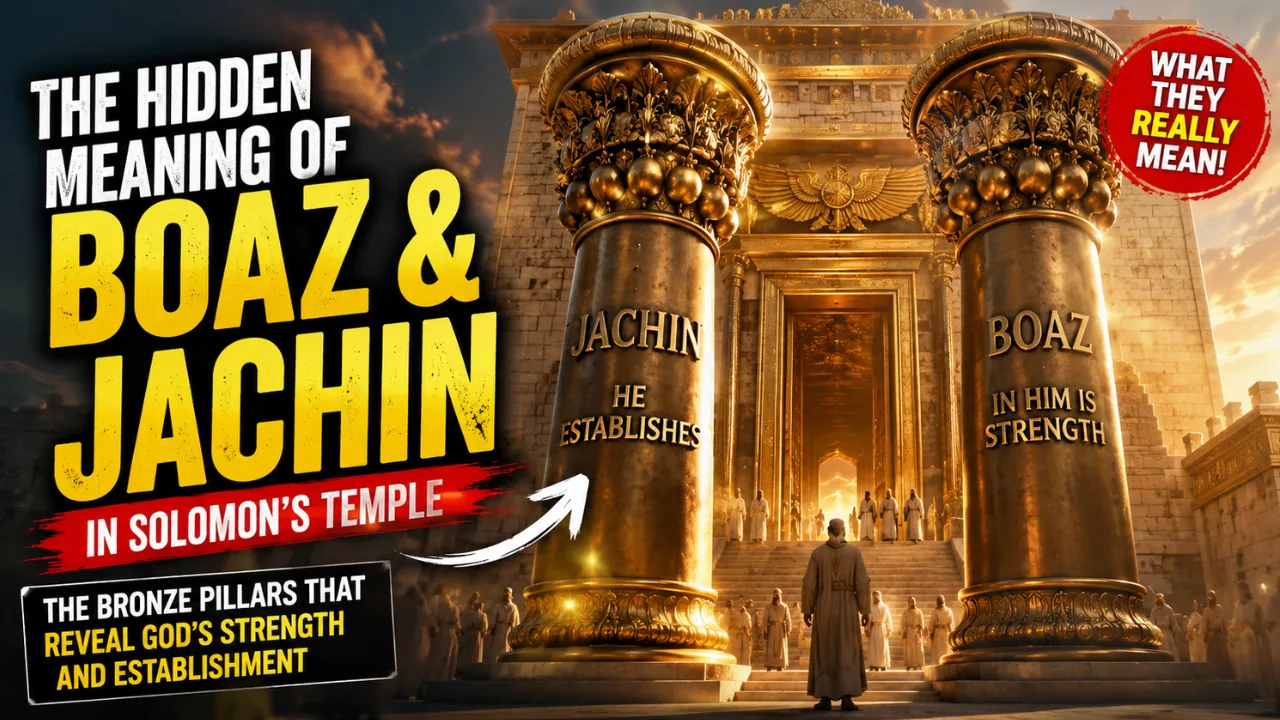

Before worshipers entered Solomon’s Temple, they saw two towering bronze pillars standing by the porch. Scripture names them Boaz and Jachin, which immediately shows that they were more than impressive architectural features. In the Bible, named objects often carry meaning and these pillars stood at the threshold of sacred space like bronze witnesses, declaring spiritual truth before worshipers moved deeper into the house of God.
Their exact architectural function has been discussed because the biblical text presents them with symbolic prominence rather than explaining them as ordinary load-bearing supports. They appear to have been monumental and ceremonial, placed before the temple entrance to proclaim covenant meaning. Jachin is commonly understood as “He establishes,” while Boaz is often understood as “in Him is strength.” Together, they formed one powerful message: God establishes what He strengthens.
Biblical Details Behind Boaz and Jachin
The descriptions in 1 Kings 7 and 2 Chronicles 3 give unusual attention to the pillars’ placement, material, height, capitals and ornamentation. They stood by the porch of the temple, visible at the front of the sacred house. Their capitals were richly decorated with lily-work, chains and rows of pomegranates, making them both imposing and beautiful.
This matters because Scripture does not waste such details. The bronze gave the pillars visual strength. The height gave them grandeur. The capitals lifted the eye upward. The pomegranates and lilies filled their strength with imagery of fruitfulness and beauty. The text presents Boaz and Jachin as theological architecture, not mere background decoration, reflecting [how symbolic imagery in the temple pointed beyond physical beauty toward covenant and spiritual meaning — Why Temple Ornamentation Carried Spiritual Significance in Scripture].
Why the Pillars Stood at the Temple Entrance
The placement of Boaz and Jachin was essential to their meaning. They stood before the temple porch, where worshipers would encounter them before moving toward sacrifice, prayer, priestly service and the inner sanctuary. Their position made them threshold symbols, marking the movement from ordinary space toward the sacred dwelling place associated with God’s covenant presence.
A Threshold Into Sacred Space
The temple was not ordinary public architecture. It was the visible centre of Israel’s worship, kingship, covenant identity and national devotion to the Lord. By placing Boaz and Jachin at the entrance, the temple proclaimed that approach to God rested on divine establishment rather than human achievement. The worshiper did not first encounter royal decoration alone but a theological announcement cast in bronze.
A Public Witness Before Worship
Unlike the hidden objects inside the temple, these pillars were publicly visible. Their message was not reserved only for priests. Every worshiper approaching the temple could see them and their presence silently taught that Israel’s worship stood upon the Lord’s faithfulness, not merely upon Solomon’s wealth, royal power or architectural beauty, much like [how the temple itself functioned as a visible witness to God’s covenant relationship with Israel — The Spiritual Purpose of Solomon’s Temple in Israel’s Worship].
Jachin: “He Establishes”
The pillar named Jachin carried the idea of establishment, firmness and divine confirmation. Its meaning reached beyond architecture into covenant theology itself. At the entrance of the temple, Jachin declared that God was the One who established His people, His promises, His worship and His covenant purposes.
Covenant Permanence
Solomon’s Temple stood within God’s covenant promises to Israel and David’s royal line. It was not merely a national building project or a monument to royal success. It represented God’s continuing faithfulness to dwell among His people. Jachin reminded Israel that the temple’s deepest foundation was not cedar, stone, bronze or gold but the establishing word of the Lord.
Stability From God
Jachin also spoke to the instability of human strength. Kings rise and fall, wealth shifts, armies weaken and even sacred buildings can be destroyed. The pillar’s message was that what truly lasts must be established by God. The temple looked solid but its real security depended upon the Lord who gave meaning to the structure.
Boaz: “In Him Is Strength”
The pillar named Boaz complemented Jachin by declaring the source of strength. If Jachin said that God establishes, Boaz said that God upholds. The two names belonged together because establishment without strength would be fragile, while strength without divine establishment could become pride.
Strength Beyond Temple Glory
Solomon’s Temple was visually magnificent but Boaz warned against trusting in visible glory alone. Bronze pillars, golden furnishings, costly stones and royal craftsmanship could not preserve the nation if the people abandoned God. Strength was not finally in the building, the monarchy or the religious system. Strength was in the Lord Himself.
Strength That Sustains Worship
Boaz also reminded worshipers that true worship depends upon divine strength. Human devotion can become weak, distracted, proud or hollow. The strength needed to remain faithful before God does not come from religious appearance alone. It comes from the Lord who sustains covenant life.
Bronze, Beauty and Fruitfulness
The pillars were made of bronze and decorated with capitals, lily-work, chains and pomegranates. These details are important because Scripture does not describe them casually. Their material and ornamentation created a layered message of strength, sacred beauty and covenant abundance.
Bronze and Enduring Strength
Bronze often carries associations of endurance, strength and judgment in biblical symbolism. At the temple entrance, bronze visually reinforced the meaning of the names. These pillars were meant to look strong because they pointed to a God whose covenant purposes do not collapse under human uncertainty.
Lilies and Sacred Beauty
The lily-work introduced beauty into the symbolism. The pillars were not harsh monuments of power. They were adorned with sacred artistry, showing that God’s strength is not cold domination. His established presence brings order, beauty, worship and holy flourishing.
Pomegranates and Covenant Fruitfulness
The pomegranates suggested abundance, fruitfulness and covenant blessing. This detail softened the bronze strength with the imagery of life. The message was not only that God establishes and strengthens but that life under His covenant is meant to become fruitful before Him, reflecting [why pomegranates became recurring symbols of abundance, holiness, and covenant blessing in temple imagery — The Spiritual Meaning of Pomegranates in the Bible].
Warning Hidden in Their Later History
The later destruction of the temple gives Boaz and Jachin a sobering edge. The very pillars that once proclaimed establishment and strength were eventually broken and carried away by Babylon. Their message did not fail; Israel failed to live faithfully before the God to whom the pillars pointed.
Sacred Symbols Cannot Replace Obedience
Boaz and Jachin were never meant to function like magical guarantees. They pointed to God’s strength but they were not substitutes for covenant faithfulness. This is a serious warning because people can stand near sacred things while drifting from sacred truth. A temple can be beautiful while the heart of the nation becomes spiritually hollow.
Visible Strength Can Become False Security
The pillars looked permanent but visible permanence cannot protect rebellion. Israel’s later history teaches that religious structures, sacred objects and outward identity cannot preserve a people who reject the Lord. The true strength behind the pillars was God Himself, not bronze detached from obedience.
Christ and the True Temple
For Christian readers, the meaning of Boaz and Jachin reaches its fullest depth in Jesus Christ. The temple pointed to God dwelling among His people, but Christ is the true and living meeting place between God and humanity. What the temple symbolized in structure, Christ fullfills in person.
Christ as the True Foundation
In Christ, the themes of establishment and strength become living realities. He is the foundation that cannot be moved, the cornerstone God has chosen and the One through whom an unshakable kingdom is established. Earthly temples can fall but Christ’s kingdom endures beyond every human structure.
Christ as the Strength of God’s People
Boaz declared that strength is found in God, and the Gospel reveals that strength through Christ’s death, resurrection and reign. Divine strength is not merely displayed in visible grandeur. It is revealed in sacrificial love, victory over sin and the power of resurrection life.
From Bronze Pillars to the Living Cornerstone
Boaz and Jachin stood outside the temple as symbolic witnesses, but Christ stands at the centre of God’s redemptive work as the living Cornerstone. The pillars could point toward establishment and strength but they could not create eternal access to God. Christ does what temple architecture could only announce. He establishes the people of God, strengthens them by His life and builds an unshakable kingdom that no exile, ruin or earthly collapse can overthrow, fulfilling [how the New Testament presents Jesus Christ as the true cornerstone and foundation of God’s spiritual temple — Why Christ Is Called the Chief Cornerstone].
Why Boaz and Jachin Still Matter
Boaz and Jachin still matter because modern life is filled with unstable foundations. People seek security in wealth, success, politics, institutions, relationships, reputation and personal control. Yet all of these can shift. The pillars remind readers that true establishment and true strength come from God alone.
Their message also challenges religious confidence that rests in appearance. Churches can look strong, ministries can appear successful and individuals can seem spiritually stable while lacking real dependence on God. Boaz and Jachin call worshipers back to the Lord who alone establishes what truly lasts and strengthens what truly endures.
Bronze Pillars Before the Holy House
The Boaz and Jachin pillars in Solomon’s Temple were monumental declarations of divine establishment and divine strength. Their bronze construction, towering presence, named identity, sacred decorations and temple placement all combined to proclaim that Israel’s worship and kingdom stood only by the faithfulness of God.
Before anyone entered deeper into the temple, these pillars preached without words. Jachin declared that God establishes. Boaz declared that strength is found in Him. Together they stood at the threshold of sacred space as bronze witnesses to a truth still needed today: what is built on human glory eventually trembles but what God establishes in His strength will endure beyond the fall of every earthly temple.
