
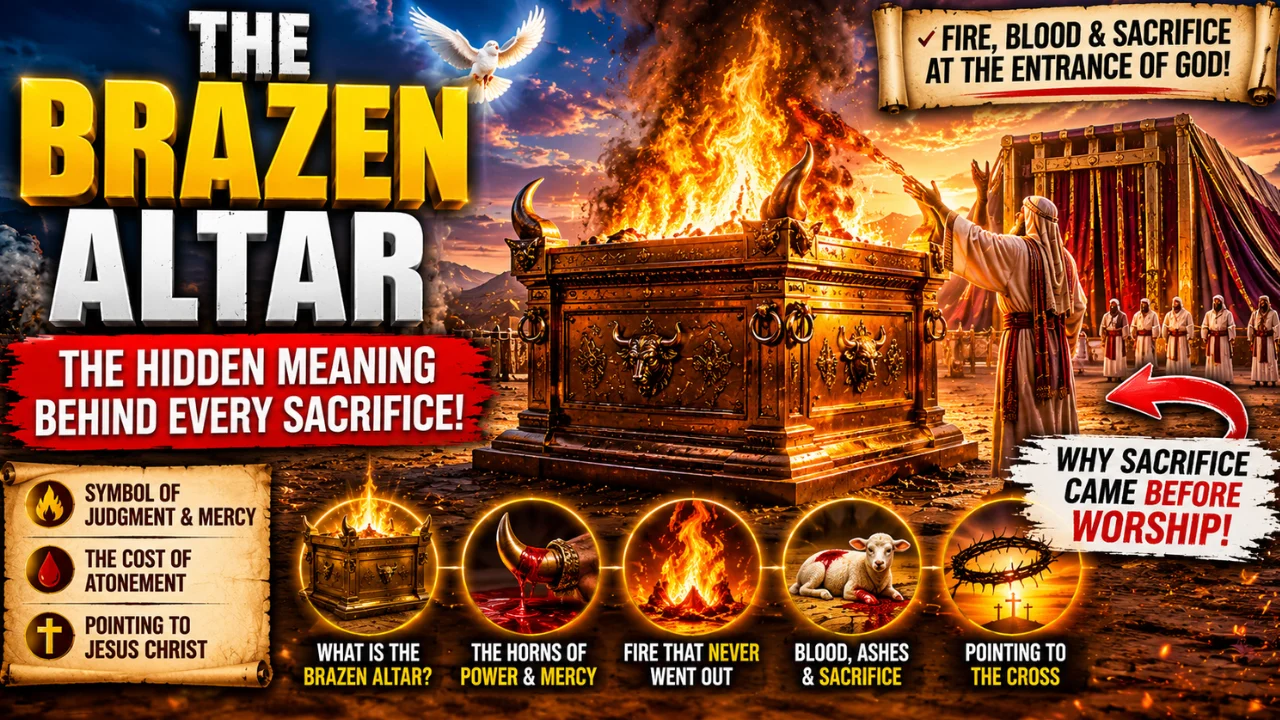

When an Israelite entered the courtyard of the tabernacle, the first major object before him was the brazen altar. He did not first see the golden lampstand, the table of showbread, the altar of incense, or the ark of the covenant hidden behind the veil. He first encountered bronze, fire, blood, ashes and sacrifice. The placement was not accidental. God arranged the tabernacle so that the journey toward His presence began at the place where sin was judged through sacrifice.
The brazen altar taught Israel that sinful humanity cannot move toward a holy God by sincerity, emotion or religious desire alone. Access began with atonement. Before there could be washing at the laver, priestly service in the Holy Place or worship before the veil, there had to be blood on the altar. The altar stood at the entrance because reconciliation had to come before fellowship and sacrifice had to come before deeper communion.
Why the Altar Was Called Brazen
The altar was made of acacia wood overlaid with bronze. This combination carries rich symbolic weight. Acacia wood was durable and resistant, often used in tabernacle furniture because it could endure the wilderness journey. Bronze, however, formed the visible surface of the altar and that mattered because bronze could withstand the heat of continual fire. The altar was built for burning, judgment and sacrifice.
In biblical imagery, bronze often carries associations of strength, endurance and judgment. The brazen altar stood in the open court under the sky, exposed to the sight of Israel, constantly bearing offerings consumed by fire. It was not golden like the furniture inside the Holy Place. Gold belonged to the inner sanctuary, where beauty, glory and priestly fellowship were emphasized. Bronze belonged to the place where sin was confronted. The altar’s material itself preached that judgment had to be endured before access could move inward, reflecting [why the outer court of the tabernacle focused on sacrifice before worship moved toward God’s presence — Understanding the Spiritual Journey Through the Tabernacle Layout].
Shape and Structure of the Altar
The brazen altar was square, with horns on its four corners, a bronze grating, rings, poles and utensils used for ashes, fire and sacrifice. These details were practical but they were also spiritually meaningful. The square shape suggested order and completeness. The horns projected strength and mercy. The grating allowed the sacrifice to be consumed by fire. The poles made the altar portable, reminding Israel that atonement travelled with them through the wilderness.
The altar was not a fixed monument of human religion. It moved with the people because God had chosen to dwell among them during their pilgrimage. Wherever Israel camped, the altar stood again at the entrance of approach. This portability gave the altar a living theological message: God’s people were not left without provision for sin while they journeyed. The need for sacrifice followed them, but so did the mercy of God, much like [how God continually provided spiritual provision for Israel throughout the wilderness journey — Lessons From God’s Presence and Provision in the Wilderness].
The Horns of the Altar
The horns of the altar are among its most powerful features. In Scripture, horns often represent strength, power and authority. On the altar, they became connected with atonement because blood from certain sacrifices was applied to them. This means the altar’s strength was not merely destructive power. It was power marked by sacrificial blood.
This detail gives the brazen altar deep spiritual balance. The altar was a place of judgment, but it was also a place where mercy could be sought. In some Old Testament narratives, people grasped the horns of the altar when seeking protection. That image shows how strongly the horns became associated with refuge under God’s appointed provision. The same altar that displayed the seriousness of sin also testified that mercy was available through sacrifice, reflecting [why blood and atonement were central to the Old Testament understanding of mercy and forgiveness — The Biblical Meaning of Blood on the Altar].
Fire That Could Not Go Out
The fire on the brazen altar was commanded to burn continually. It was not to be extinguished. This unending flame revealed the ongoing need for atonement under the old covenant. Morning and evening, day after day, sacrifice continued because sin continued. The fire became a constant witness that the people needed cleansing, forgiveness and restored covenant fellowship.
The continual fire also symbolized divine holiness consuming the offering. Sin was not ignored. Guilt was not treated as a minor inconvenience. The offering placed upon the altar passed through fire because the altar represented the meeting place of judgment and mercy. The fire did not burn randomly. It burned where God had provided sacrifice. That is the theological heart of the altar: judgment fell but it fell upon the substitute.
Sacrifice Before Cleansing at the Laver
After the brazen altar came the bronze laver, where priests washed before entering the Holy Place. This order is important. Sacrifice came before washing. Blood came before cleansing. The altar addressed guilt through atonement and the laver addressed priestly cleansing for service. Together, they formed the first movements of approach toward God.
This order helps explain the spiritual logic of the tabernacle. Humanity does not cleanse itself first and then earn atonement. God provides sacrifice and from that place cleansing follows. The altar dealt with the barrier of guilt, while the laver prepared the priest for holy service. In Christian understanding, this pattern finds fullfillment in Christ, whose sacrifice opens the way for cleansing, sanctification and worship, much like [how the bronze laver symbolized spiritual cleansing after sacrifice in the tabernacle worship system — Why Priests Washed at the Laver Before Entering the Holy Place].
Altar and the Journey Inward
The tabernacle was arranged as a movement from the outside toward the presence of God. The outer court contained bronze: the altar and laver. The Holy Place contained gold: the lampstand, table of showbread and altar of incense. Beyond the veil was the Holy of Holies, where the ark of the covenant represented the throne-like presence of God among His people.
The brazen altar stood at the beginning of that sacred journey. No priest could bypass it and move straight to the golden furniture. No worshiper could treat sacrifice as optional and still approach God on covenant terms. The altar announced that the way inward was not built on human confidence. It was opened through blood, substitution and God’s mercy.
Meaning of Blood at the Altar
Blood was central to the altar because life was in the blood. The shedding and application of blood declared that sin brought death and that reconciliation required life given in the place of the guilty. The worshiper laid hands upon the sacrificial animal, identifying with it before it was offered. The innocent victim then died as a substitute.
This act was not empty ritual. It formed Israel’s understanding of atonement. The altar taught that guilt could not be removed by denial, regret or religious performance. Sin required a life. The animal’s blood testified that forgiveness before God was costly. Every sacrifice upon the brazen altar declared that life had been given so the worshiper could remain in covenant relationship with the Lord, connecting closely with [why covenant relationship with God in the Old Testament depended upon sacrifice and atoning blood — Understanding the Role of Sacrifice in Maintaining Covenant Fellowship].
Ashes and the Memory of Judgment
The altar produced ashes because sacrifice was completely consumed by fire. Ashes were the remains of judgment carried out. They showed that the offering had passed through the flame and that the act of sacrifice was not symbolic only. Something real had been given, burned and reduced.
The handling of ashes added another layer to the altar’s meaning. The priests removed them carefully because even what remained from sacrifice belonged to holy service. The ashes reminded Israel that atonement was not sentimental. It involved death, consumption and the visible aftermath of judgment. The altar was not merely a place where worship happened. It was a place where the cost of sin could be seen.
Altar and the Different Offerings
The brazen altar received different kinds of offerings and each revealed a different dimension of Israel’s relationship with God. Burnt offerings emphasized total surrender and consecration. Sin offerings addressed guilt and purification. Peace offerings expressed fellowship and covenant communion. Grain offerings, though bloodless, were often connected to dedication and thanksgiving within the broader sacrificial system.
These offerings show that the altar was not only about guilt in a narrow sense. It was also about worship, dedication, fellowship, gratitude and restored relationship. Yet even the fellowship offerings depended upon the altar. Communion with God did not float above sacrifice. It rested upon the foundation of atonement and divine provision.
The Innocent Substitute
At the centre of the altar’s meaning is substitution. The guilty worshiper did not die. The offering died in his place. This does not mean the animal had moral guilt of its own. Rather, it became the appointed substitute under God’s covenant system. Through sacrifice, God taught Israel that sin deserves judgment and that mercy comes through a life given on behalf of another.
This substitutionary pattern prepares the reader for the cross. The brazen altar did not fully solve the deepest problem of sin forever, but it pointed toward the One who would. Every animal offered on that bronze altar was temporary, repeated and limited. Christ’s sacrifice is final, complete, and sufficient. The altar taught the language of substitution so that the cross could be understood as fullfillment rather than surprise, much like [how Old Testament sacrifices prepared the biblical foundation for understanding Christ as the final substitute for sin — Why Jesus Is Called the Lamb of God].
Brazen Altar and Christ’s Sacrifice
The brazen altar points directly toward the sacrifice of Jesus Christ. At the altar, innocent victims died so the guilty could approach God. At the cross, Christ gave Himself as the perfect and final sacrifice for sinners. At the altar, blood was shed repeatedly. At the cross, the blood of Christ was offered once for all. At the altar, fire consumed the sacrifice. At the cross, Christ bore the judgment that sin deserved.
This connection does not erase the original meaning of the tabernacle. It completes it. The altar was a shadow and Christ is the substance. The altar was the entrance point of approach, and Christ is the living way into the presence of God. The altar revealed that forgiveness costs blood and the cross revealed whose blood would finally accomplish redemption.
Why Worship Begins With Sacrifice
The brazen altar challenges shallow ideas of worship. In the tabernacle, worship did not begin with music, beauty, incense or golden light. It began with surrender, blood and fire. That order teaches that true worship is not merely emotional expression. It requires yielded life before God.
For believers today, the sacrifices of animals are no longer offered because Christ has fulfilled the sacrificial system. Yet the principle of surrendered worship remains. The New Testament calls believers to present themselves as living sacrifices. This means worship involves the whole life: the body, will, desires, obedience, repentance and devotion. The altar’s message continues in transformed form. A redeemed life is no longer placed on a bronze altar but it is still offered to God.
Altar as Judgment and Mercy Together
The brazen altar held two truths in one place. It showed that God is holy and does not ignore sin. It also showed that God is merciful and provides a way for sinners to draw near. Without holiness, the altar would not be necessary. Without mercy, the altar would not be provided.
This balance is essential to biblical faith. The altar prevents a casual view of sin because blood and fire stand at the entrance. It also prevents despair because the sacrifice is there by God’s command. The worshiper approaching the tabernacle saw judgment but he also saw provision. He saw the cost of guilt but he also saw the mercy of God making a way.
Smoke at the Door of Approach
The brazen altar meaning in the tabernacle is that access to God begins with sacrifice. Its bronze surface, acacia frame, horns, fire, blood, ashes, grating, poles and position in the outer court all declare that sin must be judged and that God Himself provides the way of atonement. The altar was not an obstacle to worship. It was the God-given doorway through which worship could proceed.
Before Israel saw the golden beauty of the sanctuary, they saw smoke rising from the altar. Before the priest moved toward the lampstand, the bread, the incense or the veil, sacrifice had already spoken. The bronze altar stood in the courtyard as a continual witness that fellowship with God is costly, mercy is holy, and the way into His presence is opened only through the blood of the substitute.
Frequently Asked Questions
What was the brazen altar in the tabernacle?
The brazen altar, also called the bronze altar, was the large altar located in the outer court of the tabernacle where sacrifices and burnt offerings were presented before God.
Why was the altar called brazen?
The word “brazen” refers to bronze. The altar was made of acacia wood overlaid with bronze, which symbolized strength, judgment and endurance under fire.
Why was the brazen altar placed at the entrance of the tabernacle?
The altar stood at the entrance because sacrifice came before deeper fellowship with God. Worshipers first encountered atonement before moving toward the Holy Place.
What sacrifices were offered on the brazen altar?
Burnt offerings, sin offerings, peace offerings, grain offerings and other sacrifices were presented on the altar as part of Israel’s covenant worship system.
Why did the altar have horns?
The horns symbolized strength, power and mercy. Blood was applied to the horns during certain sacrifices, connecting them with atonement and refuge.
