
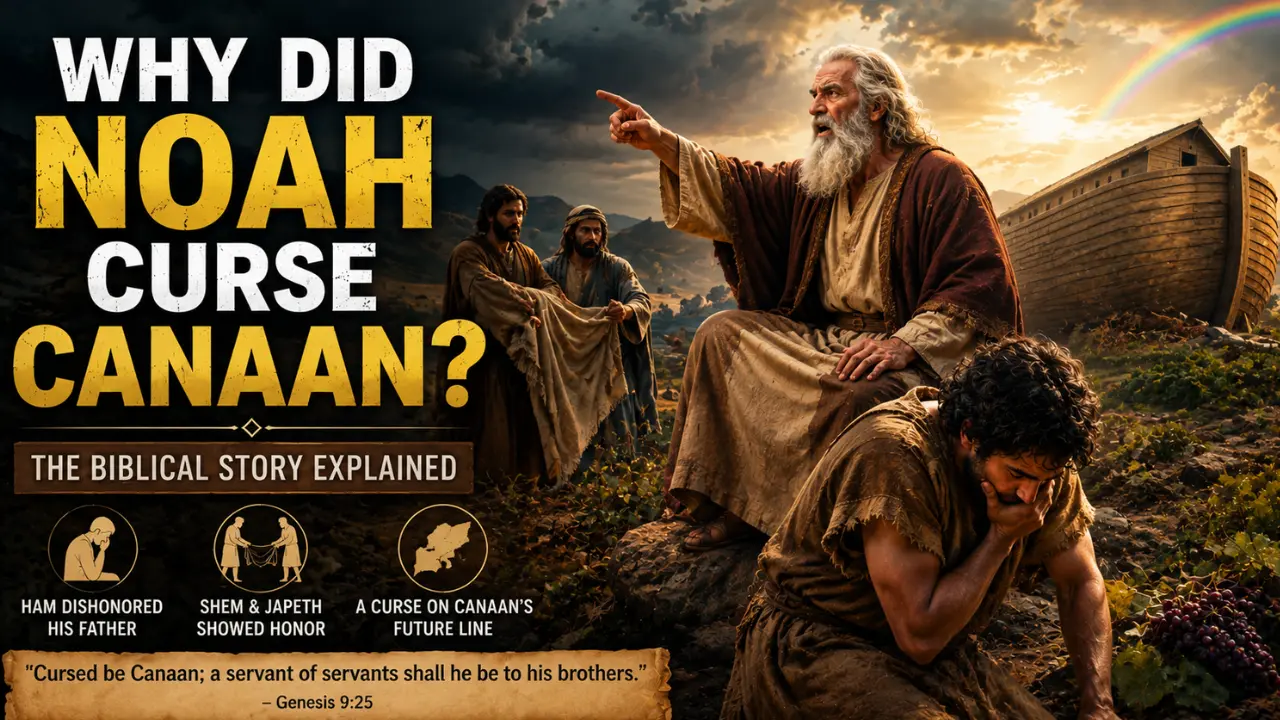

Noah cursed Canaan because Ham dishonoured his father and Canaan became the named line through which that dishonour would later appear in Israel’s history. Genesis 9 does not say Canaan personally committed the act but Noah’s curse falls on Canaan’s line, not on all of Ham’s descendants. The passage shows a serious breakdown of honour, family order and future judgment, not a racial curse.
The story appears in Genesis 9:20–27, after the flood.
Noah planted a vineyard, drank wine, became drunk, and lay uncovered inside his tent. Ham, the father of Canaan, saw his father’s nakedness and told his two brothers outside. Shem and Japheth then took a garment, walked backward, and covered Noah without looking at him.
When Noah woke and learned what happened, he said:
“Cursed be Canaan; a servant of servants shall he be to his brothers.”
— Genesis 9:25
This raises the difficult question: Why did Noah curse Canaan when Ham appears to be the one who acted wrongly?
Ham Dishonoured Noah Instead of Covering His Father’s Shame
The clearest problem in the passage is Ham’s response.
Genesis does not present Ham as a son who accidentally noticed something and quietly protected his father. Instead, Ham saw Noah’s shame and went outside to tell his brothers.
That detail matters.
In the ancient world, exposing a parent’s nakedness or shame showed deep dishonour. Ham should have covered Noah privately. Instead, he treated Noah’s humiliation as something to report.
Shem and Japheth did the opposite. They refused to look at their father’s nakedness and covered him carefully. Their action showed respect, restraint, and family honor.
So the first reason behind the curse is this:
Ham dishonoured his father, while Shem and Japheth honoured him.
Also Read: If God Is Good Why Do Bad Things Happen?
Why Was Canaan Cursed Instead of Ham?
Genesis does not give a full explanation, so we should avoid pretending the Bible says more than it says. But the text gives several clues.
1. Canaan receives focus because his descendants matter later in Genesis
Genesis often looks forward through family lines.
Canaan was Ham’s son, and the Canaanites later became one of the main peoples living in the land God promised to Abraham’s descendants. The curse on Canaan points forward to the future conflict between Israel and the Canaanites.
This does not mean every Canaanite acted exactly like Ham. It means the story introduces a family line that later becomes morally corrupt and judged in the biblical narrative.
2. Noah may have cursed the line that would carry Ham’s dishonor forward
In the Bible, blessings and curses often affect family lines, not only individuals.
Ham acted dishonorably, but Noah’s words fall on Canaan’s line. This may show that the same spirit of dishonor, rebellion, and moral corruption would become visible in Canaan’s descendants.
Later, the Canaanites become associated with idolatry, sexual immorality, child sacrifice, and deep moral corruption. The curse in Genesis 9 prepares the reader for that later history.
3. Canaan may have had some unstated involvement, but the text does not clearly say so
Some readers believe Canaan may have been involved in the offense because Noah says, “what his youngest son had done to him” in Genesis 9:24. However, the text mainly names Ham as the one who saw Noah and told his brothers.
Because Genesis does not clearly describe Canaan’s direct action, we should be careful.
The safest explanation is this: Ham committed the dishonoring act, and Noah’s curse prophetically marked Canaan’s line because that line would later become central in Israel’s story.
Curse Was Not on All of Ham’s Descendants
This point matters.
Noah did not curse all of Ham’s children. Ham had four sons: Cush, Egypt, Put, and Canaan. The curse specifically names Canaan.
That means the passage does not place a curse on every nation connected to Ham. It does not curse all African peoples. It does not teach racial inferiority. It does not justify slavery.
The so-called “curse of Ham” is not what Genesis says. Genesis says:
“Cursed be Canaan.”
That difference matters because people have misused this passage for centuries to defend racism and slavery. The Bible text does not support that misuse.
Noah’s Curse Was About Canaan
Genesis 9 says nothing about skin color.
The passage focuses on family dishonor, moral consequences, and the future role of Canaan’s descendants in biblical history. It does not connect the curse to race, ethnicity in the modern sense, or physical appearance.
Any teaching that turns this passage into a racial curse adds ideas that the text itself does not say.
A responsible reading must keep the curse where Genesis places it: on Canaan, not on Ham’s entire family and not on any modern racial group.
Did God Tell Noah to Curse Canaan?
Genesis records Noah’s curse, but it does not directly say God commanded Noah to speak it.
That distinction matters.
The Bible records many human words and actions without saying that every word came as a direct command from God. In this story, Noah speaks after waking and learning what happened. His words become significant in the biblical narrative, especially because Canaan’s descendants later appear in Israel’s history.
So we can say the curse has prophetic importance in Genesis, but we should not add a detail the text does not state.
What Did the Curse Mean?
Noah said Canaan would be “a servant of servants” to his brothers.
This points to humiliation, subjection, and loss of honor. In the larger biblical storyline, Canaan’s descendants later lose their land as Israel enters Canaan under Joshua.
However, this does not mean every Canaanite had no hope. The Bible includes examples of Canaanite or Canaan-connected people who receive mercy when they turn toward Israel’s God.
Rahab is one major example. She lived in Jericho, helped Israel’s spies, and became part of Israel’s story of faith. This shows that biblical judgment on a people group does not erase individual mercy for those who turn to God.
Why Did Shem and Japheth Receive Blessing?
Noah blessed Shem and Japheth because they acted with honor.
They did not exploit their father’s shame. They covered it. They showed reverence when Ham showed disrespect.
Noah said:
“Blessed be the Lord, the God of Shem…”
— Genesis 9:26
And:
“May God enlarge Japheth…”
— Genesis 9:27
The contrast is clear. Ham exposed shame. Shem and Japheth covered shame.
The passage teaches that honor matters, especially inside the family. It also shows that disrespect can carry consequences beyond one moment.
Lesson of Noah’s Curse on Canaan
The main lesson is not that Noah was perfect. Noah’s drunkenness also appears as a shameful moment. The story does not hide his failure.
But Ham’s sin came through how he responded to his father’s shame.
He saw weakness and exposed it. Shem and Japheth saw shame and covered it with honor.
Noah cursed Canaan because Ham’s dishonor revealed a serious moral failure, and Canaan’s line later became the family line where that corruption would appear in Israel’s history. The curse does not apply to all Ham’s descendants, and it does not support any racial interpretation.
Genesis 9 warns readers that dishonor, pride, and exposure of another person’s shame can become spiritually serious. It also reminds us to read difficult Bible passages carefully, without adding meanings the text never gives.

1 thought on “Why Did Noah Curse Canaan? Genesis 9 Explained”