
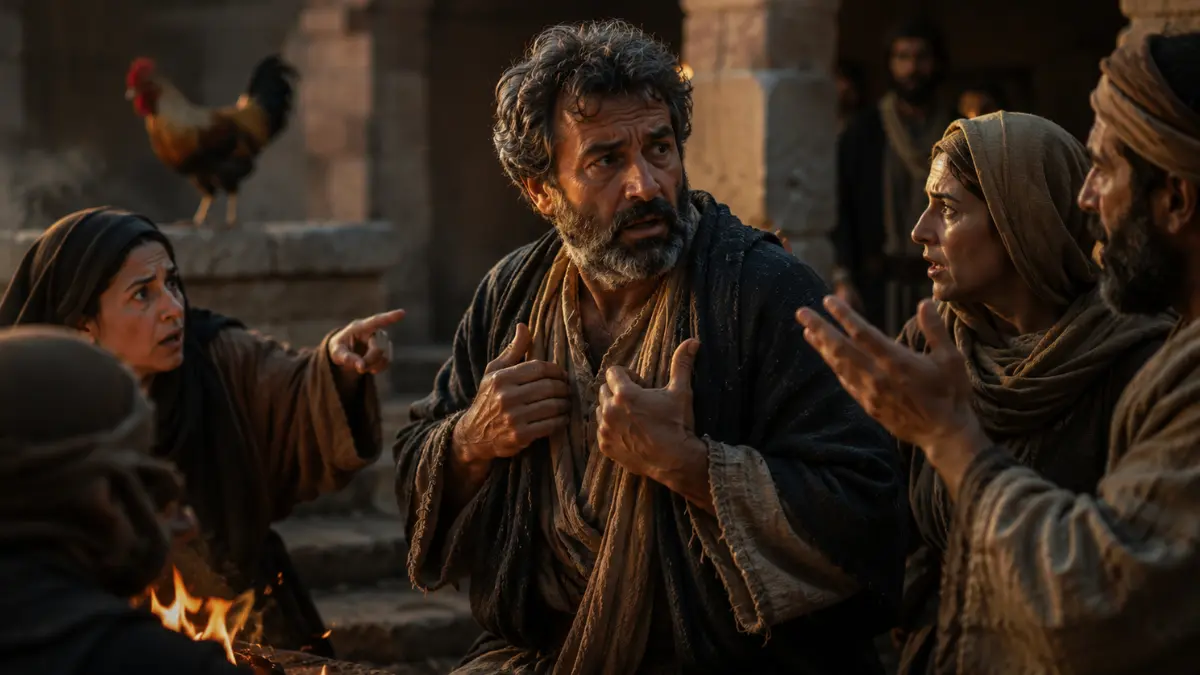

Peter denied Jesus three times during the night of Jesus’ arrest. Matthew, Mark, Luke and John all record the event, but each Gospel preserves different details about the accusations, the rooster’s crow, Peter’s response and what was happening nearby.
All four Gospels agree that Peter followed after Jesus’ arrest, denied his association with Him three times and heard a rooster crow as Jesus had predicted. Matthew emphasizes Peter’s increasingly forceful denials, Mark records two rooster crows in most modern translations, Luke describes Jesus looking at Peter and John connects the final accusation with the arrest in Gethsemane.
Where Is Peter’s Denial Recorded in the Bible?
Peter’s denial appears in four Gospel passages:
- Matthew 26:69–75
- Mark 14:66–72
- Luke 22:54–62
- John 18:15–18 and 18:25–27
The accounts agree on the central event but do not repeat every conversation with identical wording. They emphasize different people, locations within the courtyard area and details surrounding the three denials.
Reading the four accounts together gives a fuller picture of the night. Peter had confidently promised loyalty, followed Jesus after the arrest, attempted to avoid being identified as a disciple and then recognized that Jesus’ prediction had come true.
What Did Jesus Predict About Peter?
Before the arrest, Peter declared that he would remain loyal even if the other disciples abandoned Jesus. He also said that he was prepared to go to prison or die with Him.
Jesus answered that Peter would deny Him three times before the rooster crowed. Mark records the prediction more specifically as happening before the rooster crowed twice.
Luke adds that Jesus had prayed for Peter’s faith. Jesus also spoke of Peter turning back and strengthening the other disciples.
The warning therefore included both failure and a future beyond failure. Jesus knew Peter would fall but He also knew that the denial would not permanently end Peter’s discipleship.
John places the prediction during Jesus’ final evening with the disciples. Readers can explore that wider setting in the meaning of Jesus’ Farewell Discourse in John 13–17.
Peter’s promise sounded courageous, but the events that followed exposed how little he understood his own weakness.
What Happened Before Peter Denied Jesus?
After Jesus was arrested in Gethsemane, the disciples scattered. Peter did not completely leave the area. He followed from a distance and entered the courtyard connected with the high priest’s residence.
John says that another disciple, who was known to the high priest, helped Peter gain entrance. The Gospel does not identify that disciple by name.
The night was cold, so servants and officials gathered around a fire. Peter stood or sat among them while Jesus faced questioning nearby.
Peter’s position placed him between visibility and concealment. He had followed closely enough to observe what happened but he did not openly identify himself as one of Jesus’ disciples.
People in the courtyard soon began questioning him.
What Were Peter’s Three Denials?
The Gospels describe servant girls, bystanders, and other people joining the questioning. Their exact wording differs, but each account organizes the event around three denials.
Peter’s First Denial
A servant girl noticed Peter and connected him with Jesus.
Matthew says that she accused Peter of being with Jesus of Galilee. Mark refers to Jesus of Nazareth. Luke says that the servant girl looked closely at Peter and declared that he had been with Jesus.
John presents the accusation as a question from the woman guarding the entrance. She asked whether Peter was one of Jesus’ disciples.
Peter denied the association.
His answers differ slightly across the accounts. He says that he does not know what the speaker means, denies knowing Jesus or simply answers, “I am not.”
Peter’s Second Denial
Another accusation followed.
Matthew mentions another servant girl near the gateway. Mark says that the first servant girl spoke about Peter again to the people nearby. Luke refers to another person accusing him of belonging to Jesus’ followers.
John describes the people standing around the fire asking whether Peter was one of Jesus’ disciples.
Peter denied the connection again. Matthew records that this denial included an oath.
The questioning had now spread beyond one person. More people had begun to notice him and discuss whether he belonged with Jesus.
Peter’s Third Denial
The final accusation became more specific.
Matthew and Mark say that the bystanders identified Peter as a Galilean. Matthew adds that his manner of speaking revealed his regional background.
Luke says that about an hour passed before another man confidently insisted that Peter had been with Jesus because he was a Galilean.
John identifies the final questioner as a relative of Malchus, the man whose ear Peter had cut off during the arrest. He asked whether he had seen Peter in the garden with Jesus.
Peter denied Jesus for the third time. Matthew and Mark describe him using increasingly forceful language as he insisted that he did not know Jesus.
Then the rooster crowed.
What Does Matthew Record About Peter’s Denial?
Matthew emphasizes the increasing strength of Peter’s responses.
During the first accusation, Peter says that he does not know what the servant girl means. During the second, he denies knowing Jesus with an oath.
The third accusation causes an even stronger reaction. Peter begins calling down curses and swearing that he does not know the man.
Matthew’s account shows how the denials escalated. Peter did not merely repeat the same quiet answer three times. His words became more forceful as the accusations continued.
The bystanders also point to Peter’s speech. His Galilean accent or manner of speaking made his denial less convincing because it connected him with Jesus and the other disciples.
After the rooster crowed, Peter remembered Jesus’ prediction. He then went outside and wept bitterly.
Why Does Mark Mention Two Rooster Crows?
Most modern translations of Mark record two rooster crows, although some ancient manuscripts omit the first crow or the word “twice.”
In the commonly printed text, the first rooster crow follows Peter’s initial denial. Peter then faces further accusations and denies Jesus two more times.
After the third denial, the rooster crows a second time. Peter remembers that Jesus had said he would deny Him three times before the rooster crowed twice.
Mark does not say that Peter recognized the significance of the first crow. He remembers Jesus’ prediction after the second.
Matthew, Luke, and John focus on the decisive rooster crow connected with the completed threefold denial. Mark preserves a more detailed sequence in most modern editions.
The central agreement remains unchanged: Jesus predicted three denials, Peter denied Him three times, and the rooster’s crow confirmed that the prediction had been fulfilled.
What Does Luke Add to Peter’s Denial?
Luke records that Jesus turned and looked directly at Peter immediately after the third denial and the rooster’s crow.
The passage does not describe Jesus’ expression. It does not say whether the look communicated sorrow, warning, compassion, or several emotions together.
Luke focuses on what the moment caused Peter to remember.
Only hours earlier, Peter had promised that he would remain with Jesus through prison and death. Now Jesus stood under accusation while Peter denied knowing Him.
Peter remembered Jesus’ words, left the courtyard, and wept bitterly.
Luke’s account places Peter’s failure and Jesus’ awareness of it in the same moment. The rooster’s crow fulfilled the prediction, while Jesus’ look made Peter confront what had happened.
What Does John Add to Peter’s Denial?
John places Peter near a charcoal fire while Jesus faces questioning.
The first accusation comes from the servant girl guarding the entrance. Peter then stands with servants and officials who are warming themselves.
John briefly shifts the narrative to Jesus’ questioning before returning to Peter. The people around the fire ask whether he is one of Jesus’ disciples, and he denies it.
The final question comes from a relative of Malchus. This person asks whether he had seen Peter in the garden with Jesus.
That detail directly connects the courtyard scene with the arrest in Gethsemane. Peter was not merely suspected because of his accent. Someone connected with the injured man may have recognized him from the garden.
John creates a striking contrast between Peter’s forceful action during the arrest and his repeated denials while standing among servants and officials in the courtyard.
John also mentions another charcoal fire in chapter 21, where the risen Jesus later speaks with Peter beside the Sea of Galilee. Many readers see a meaningful connection between the two scenes, but John does not directly explain the repeated detail as a symbol.
Do the Four Gospel Accounts Contradict One Another?
The four accounts agree on the central event: Peter followed after Jesus’ arrest, denied his association with Jesus three times, and heard the rooster crow as Jesus had predicted.
They differ in the wording of the accusations, the people emphasized, Peter’s movements and Mark’s additional rooster-crow detail.
Several people may have joined each round of questioning. A servant girl could identify Peter and then repeat the accusation to a group. One Gospel may focus on the person who began the challenge, while another describes others who joined it.
However, the Gospels do not provide enough information to reconstruct every sentence and movement with complete certainty.
The safest conclusion is that the accounts preserve the same central event from different narrative perspectives while selecting different details.
All four record Peter’s three denials and the rooster’s crow. Matthew, Mark and Luke also describe Peter remembering Jesus’ warning and grieving. John ends the denial scene with the rooster crowing.
Why Did Peter Deny Jesus?
The Gospels do not directly explain every thought behind Peter’s denials.
Fear is the most natural inference from the setting. Jesus had been arrested, Peter stood among people connected with the authorities, and John records that the final questioner was related to Malchus, whose ear Peter had cut off.
Peter’s earlier confidence collapsed under pressure. His failure did not prove that he had never loved Jesus, but it revealed that sincere loyalty and courageous promises could fail when tested.
The focused explanation of his motives belongs in why Peter denied Jesus despite promising to remain loyal.
Why Does Peter’s Denial Matter?
Peter’s denial matters because it warns Christians against confidence based only on strong feelings or promises.
Peter genuinely believed that he would remain loyal. He underestimated the pressure ahead and overestimated his own ability to endure it.
The account also shows how one compromise can lead to another. Peter’s words became increasingly forceful as he attempted to maintain the denial he had already made.
Yet the event does not end in permanent rejection.
Jesus had already spoken about Peter turning back. After the resurrection, He met Peter personally, questioned him about his love and entrusted him with caring for His followers.
Grace did not make the denial unimportant. Peter recognized the seriousness of his failure. However, the failure did not become the final definition of his life.
The broader lesson about repentance and renewed service is explored in what Peter’s failure teaches about starting again.
The four Gospel accounts therefore preserve both a warning and a source of hope. Human confidence can collapse quickly but Jesus understands weakness and can restore a disciple who returns to Him.
Frequently Asked Questions
Did Jesus forgive Peter?
After the resurrection, Jesus personally restored and recommissioned Peter in John 21. This shows that Peter’s denial did not permanently end his relationship or calling.
Why did Peter deny Jesus?
The Gospels do not state every thought behind his actions. Fear is the most natural explanation because Jesus had been arrested and Peter was being connected with Him in a dangerous setting.
Did all four Gospels say Peter wept?
No. Matthew, Mark, and Luke describe Peter grieving or weeping. John ends the scene with the rooster crowing and does not describe Peter’s immediate response.
Why are the four Gospel accounts different?
Each Gospel writer selected different details, speakers and moments from the courtyard. They agree on the central event but do not provide an identical sentence-by-sentence account.
Why does Mark mention two rooster crows?
Most modern translations of Mark record one crow after Peter’s first denial and another after his third. Some ancient manuscripts preserve a shorter reading.

2 thoughts on “How the Four Gospels Describe Peter Denying Jesus”