
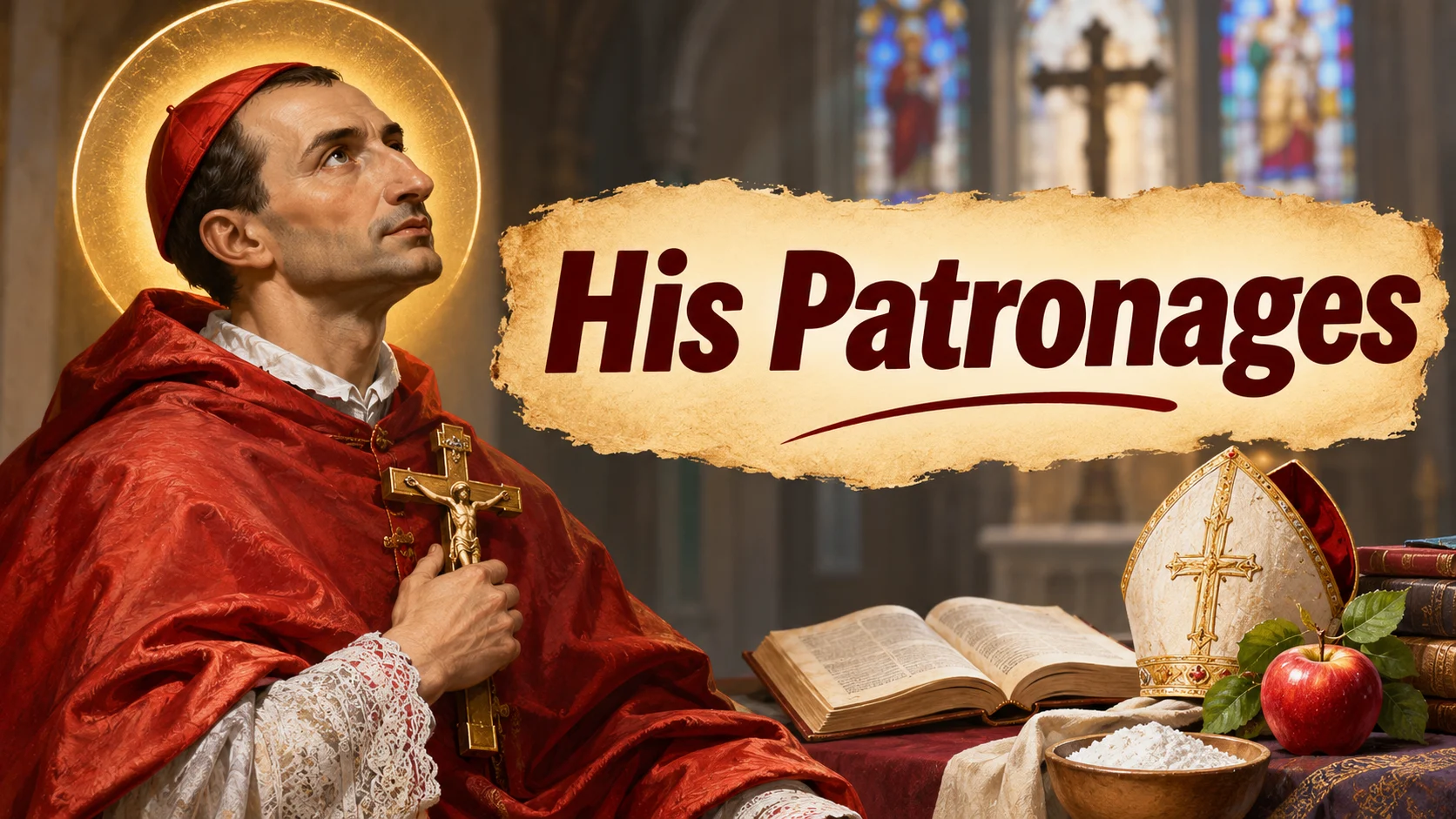

St. Charles Borromeo is the patron saint of bishops, seminarians, catechists, catechumens, cardinals and spiritual directors. He is also traditionally associated with protection against stomach diseases, ulcers, colic and intestinal disorders, as well as the patronage of apple orchards and starch makers.
His most recognized patronages reflect his work as Archbishop of Milan during the sixteenth century. He helped establish seminaries, strengthened religious instruction, promoted reforms within the Catholic Church and cared for people suffering during the devastating plague of 1576.
While his patronage of religious leaders and educators has a clear historical foundation, some lesser-known associations come from longstanding Catholic devotional traditions. Understanding these distinctions helps explain why so many different people and occupations are connected with the same saint.
St. Charles Borromeo’s Patronages
St. Charles Borromeo is associated with several groups, particularly those involved in Catholic religious education and spiritual leadership. His traditional patronages also include certain illnesses, occupations and geographical locations.
| Patronage | Reason or association |
|---|---|
| Bishops | His pastoral leadership and reforms as Archbishop of Milan |
| Seminarians | His establishment of seminaries and improvements in priestly education |
| Catechists | His efforts to organize and strengthen religious instruction |
| Catechumens | His commitment to preparing people in the Catholic faith |
| Cardinals | His service as a cardinal and involvement in Church reform |
| Spiritual directors | His emphasis on prayer, discipline and spiritual guidance |
| Spiritual leaders | His example of responsible religious leadership |
| Stomach diseases | Traditional patronage against digestive illnesses |
| Ulcers and colic | Specific conditions included in Catholic patronage lists |
| Intestinal disorders | Traditional association with illnesses affecting the intestines |
| Apple orchards | A lesser-known traditional patronage |
| Starch makers | An occupational patronage preserved in Catholic tradition |
Catholic patronage lists also associate him with Lombardy in Italy, the Diocese of Monterey in California, and São Carlos in Brazil. These connections reflect both the places directly associated with his ministry and the wider development of devotion to him.
Patron Saint of Seminarians
St. Charles Borromeo is particularly remembered as the patron saint of seminarians because he helped establish a stronger system for preparing men for the Catholic priesthood. His work addressed serious concerns about the education and spiritual formation of clergy during the sixteenth century.
Before the reforms associated with the Council of Trent, the preparation of future priests varied considerably between regions and institutions. Some men entered religious ministry without receiving the systematic theological education and pastoral training considered necessary for their responsibilities.
The Council of Trent addressed this problem in 1563 by establishing provisions for diocesan seminaries. Charles Borromeo became one of the earliest and most influential bishops to implement these reforms, establishing a seminary in Milan in 1564.
His approach emphasized several responsibilities that future priests needed to understand:
- Theological education: Developing a sound understanding of Catholic doctrine and Scripture.
- Spiritual formation: Establishing habits of prayer, discipline and personal reflection.
- Pastoral preparation: Learning to guide and care for the people entrusted to their ministry.
- Moral responsibility: Demonstrating personal conduct consistent with the teachings they would communicate.
Charles believed that religious knowledge alone could not adequately prepare someone for priestly ministry. Future priests also needed the character, judgment, and practical understanding required to fulfill their responsibilities faithfully.
His contribution was significant enough that Pope Paul VI specifically recognized his pioneering role in seminary education during an address on November 4, 1963. The pope identified Charles among the earliest promoters of the seminary system established following the Council of Trent.
This historical connection explains why Catholic seminaries are frequently dedicated to St. Charles Borromeo. His patronage represents his lasting contribution to the education and preparation of future priests.
Is He Also a Patron of Priests?
St. Charles Borromeo is closely associated with Catholic priests because of his reforms in priestly education. However, his patronage is particularly identified with seminarians, while St. John Vianney is recognized as the patron saint of parish priests.
The distinction concerns their respective contributions to Catholic religious life. Charles Borromeo is especially remembered for improving priestly formation, whereas John Vianney became widely recognized for his example of parish ministry.
Patron Saint of Bishops
St. Charles Borromeo’s patronage of bishops reflects his leadership as Archbishop of Milan and his efforts to reform pastoral administration. He believed that bishops should remain personally responsible for the spiritual welfare of their communities rather than treating their positions primarily as sources of authority or prestige.
During his ministry, Charles visited parishes, supervised clergy, encouraged religious education, and worked to improve discipline within the Church. He also supported the principle that bishops should reside in their dioceses, allowing them to understand and respond to the needs of the people under their care.
His commitment to these responsibilities became particularly evident during the plague that struck Milan in 1576. While many people sought safety away from the affected areas, Charles remained involved in organizing assistance for those experiencing illness, hunger, and poverty.
He helped arrange relief efforts, supported the distribution of essential supplies and used considerable personal resources to assist vulnerable communities. His conduct demonstrated that he regarded pastoral responsibility as a commitment requiring practical service, even during dangerous circumstances.
Charles also believed that religious leaders needed to demonstrate the principles they expected others to practice. His personal emblem featured the Latin word Humilitas, meaning humility, which reflected an important aspect of his understanding of Christian leadership.
This emphasis on humility connects with the biblical understanding of humility and serving others, where genuine spiritual maturity is expressed through compassionate actions rather than personal recognition.
His patronage of bishops therefore recognizes both his institutional reforms and the example he established through personal service. Catholic tradition remembers him as a bishop who sought to combine religious authority with direct responsibility for the people entrusted to him.
Patron Saint of Cardinals
St. Charles Borromeo was appointed a cardinal on January 31, 1560, when he was 21 years old. His uncle, Pope Pius IV, entrusted him with considerable responsibilities within the Catholic Church, including important administrative duties.
Charles became involved in the concluding period of the Council of Trent and subsequently helped promote the implementation of its reforms. His position provided opportunities to influence religious education, clerical discipline and the organization of Church institutions.
Although family connections contributed to his early appointment, his subsequent work established a reputation for serious religious commitment and administrative reform. His patronage of cardinals reflects his prominent role within the Catholic hierarchy and the responsibilities he exercised during a significant period of Church history.
Patron Saint of Catechists
St. Charles Borromeo is recognized as a patron saint of catechists because he devoted considerable attention to improving religious instruction. He believed that Catholics needed opportunities to understand their faith clearly rather than depending entirely on occasional sermons or informal teaching.
A catechist is someone who teaches Catholic beliefs, prayers, moral principles and religious practices. Charles supported organized catechetical education to help children and adults develop a stronger understanding of Christian doctrine.
He encouraged the work of the Confraternity of Christian Doctrine, which promoted structured religious instruction within Catholic communities. His support helped strengthen the involvement of teachers and parish organizations responsible for communicating the faith.
Charles also recognized that effective religious education depended on the preparation and personal conduct of those providing it. Catechists needed sufficient knowledge to explain Catholic teachings accurately, but they also had a responsibility to demonstrate sincerity in their own religious lives.
His patronage of catechists therefore has a direct connection with his historical achievements. Rather than simply encouraging religious education, he supported practical arrangements that made organized instruction more accessible to ordinary Catholic families.
Patron Saint of Catechumens
Catechumens are people preparing to enter the Catholic Church through Christian initiation. Their preparation involves learning about Catholic beliefs, understanding the responsibilities of Christian life and preparing to receive the appropriate sacraments.
Charles Borromeo’s commitment to systematic religious instruction explains his association with catechumens. His educational reforms emphasized the importance of helping people understand the faith before undertaking significant religious commitments.
The patronages of catechists and catechumens are therefore closely related, although they concern different roles. Catechists provide religious instruction, while catechumens receive preparation for entering the Church.
Patron Saint of Spiritual Directors
St. Charles Borromeo is also recognized as a patron saint of spiritual directors and spiritual leaders. His association with spiritual direction reflects his belief that guiding others in religious matters requires personal discipline, prayer and a sincere commitment to spiritual growth.
A spiritual director accompanies another person in examining their spiritual life, developing habits of prayer and discerning how to respond faithfully to God. Charles emphasized that those responsible for providing religious guidance needed to remain attentive to their own spiritual responsibilities.
In a sermon delivered during his final diocesan synod, he warned clergy against becoming so occupied with external duties that they neglected their own spiritual well-being. His concern was that constant religious activity could become spiritually unproductive when separated from personal prayer and reflection.
This teaching helps explain his patronage of spiritual directors. He understood that someone guiding another person’s spiritual development should also recognize personal weaknesses, maintain spiritual discipline and remain open to continuing growth.
His example remains particularly relevant within Catholic spiritual direction because it connects outward responsibilities with inward devotion. The Archdiocese of Baltimore specifically identifies spiritual directors among the groups associated with his patronage.
Patron Saint Against Stomach Illnesses
One of the lesser-known patronages of St. Charles Borromeo concerns digestive illnesses. Traditional Catholic references associate him with protection against stomach diseases, ulcers, colic and intestinal disorders.
These medical patronages differ from his associations with bishops, seminarians and religious educators. While his educational and pastoral achievements are extensively documented, the precise historical origins of his connection with these particular illnesses are less certain.
His charitable service during the Milan plague demonstrates his concern for people experiencing serious health difficulties. However, that work does not establish why specific digestive conditions eventually became associated with his patronage.
The association is nevertheless preserved in Catholic devotional references, including established patron saint directories. Catholics experiencing digestive illnesses may seek his intercession through prayer, although such devotion does not guarantee recovery or replace appropriate medical care.
Apple Orchards and Starch Makers
St. Charles Borromeo is also traditionally recognized as a patron of apple orchards and starch makers. These associations are considerably less familiar than his patronage of religious leaders and do not have equally well-documented historical explanations.
Apple Orchards
Catholic patronage lists include apple orchards among the traditional associations of St. Charles Borromeo. However, the principal historical accounts of his life do not clearly identify a particular event or miracle explaining why this patronage developed.
His connection with apple orchards is therefore best understood as part of Catholic devotional tradition. It should not be attributed to a specific incident involving apple cultivation without reliable historical evidence.
Starch Makers
Starch makers are another occupational group traditionally associated with St. Charles Borromeo. The historical origin of this patronage is not clearly established, and his documented ministry does not indicate that he personally worked in starch production.
Both associations appear in Catholic patronage directories, despite receiving relatively little attention in detailed biographies. They demonstrate how traditional patronages can extend beyond the activities for which a saint became historically famous.
Places Under His Patronage
St. Charles Borromeo is associated with several geographical locations, although the nature of these connections differs. Some reflect places where he personally exercised religious leadership, while others developed through later Catholic devotion.
Lombardy, Italy: Charles’s connection with Lombardy is especially significant because Milan, where he served as archbishop, is located within this northern Italian region. His pastoral reforms, educational initiatives and charitable activities directly influenced the religious life of communities throughout the area.
Diocese of Monterey, California: St. Charles Borromeo is a principal patron of the Catholic Diocese of Monterey. His connection is also reflected in the Cathedral of San Carlos Borromeo in Monterey and the historic Carmel Mission Basilica, both dedicated to him. This patronage concerns the Catholic diocese rather than establishing that he personally visited California.
São Carlos, Brazil: São Carlos is another location traditionally associated with St. Charles Borromeo. Its connection reflects the spread of Catholic devotion to him beyond Italy, where he spent his life and carried out his religious ministry.
His patronage of the Diocese of Monterey has a particularly clear ecclesiastical foundation. Pope Paul VI formally designated him a principal patron of the diocese in an apostolic letter issued on August 28, 1968.
What His Patronage Means
In Catholic tradition, a patron saint is a recognized heavenly intercessor associated with particular people, occupations, places or needs. Catholics may ask St. Charles Borromeo to pray for them when facing responsibilities or difficulties connected with his patronages.
A seminarian preparing for priesthood may seek his intercession for wisdom and perseverance, while a catechist may ask for guidance in teaching the Catholic faith. Bishops and spiritual directors may similarly look to his example when considering their responsibilities toward others.
Catholic teaching distinguishes asking a saint for intercession from worship, which is directed to God alone. His patronage therefore represents both the historical example of his life and the continuing devotional practice of Catholics who seek his prayers.
Feast Day of St. Charles Borromeo
The Catholic Church celebrates the feast day of St. Charles Borromeo on November 4 each year. He was born on October 2, 1538, died in Milan on November 3, 1584 and was canonized by Pope Paul V on November 1, 1610.
His feast day is particularly meaningful for seminaries, catechists, bishops and Catholic communities dedicated to him. These groups remember his efforts to improve religious education, strengthen pastoral leadership and support people experiencing hardship.
Although St. Charles Borromeo has numerous traditional patronages, his associations with bishops, seminarians and catechists remain especially significant because they directly reflect his documented work. His leadership in Milan, contributions to priestly formation and commitment to religious instruction provide the clearest historical explanation for why he continues to be recognized as their patron saint.
Frequently Asked Questions
Why Is St. Charles Borromeo the Patron Saint of Seminarians?
St. Charles Borromeo became associated with seminarians because he helped establish a more organized system of priestly education following the Council of Trent. His reforms emphasized theological knowledge, spiritual discipline and practical preparation for Catholic ministry.
Is St. Charles Borromeo the Patron Saint of Stomach Problems?
Yes, Catholic tradition recognizes St. Charles Borromeo as a patron against stomach diseases, ulcers, colic and intestinal disorders. Although these associations appear in traditional patronage lists, their precise historical origins are not clearly documented.
Why Is St. Charles Borromeo Associated With Apple Orchards?
Apple orchards are included among the lesser-known traditional patronages of St. Charles Borromeo. However, historical accounts do not clearly establish why this association developed and there is no widely documented event or miracle explaining the connection.
