
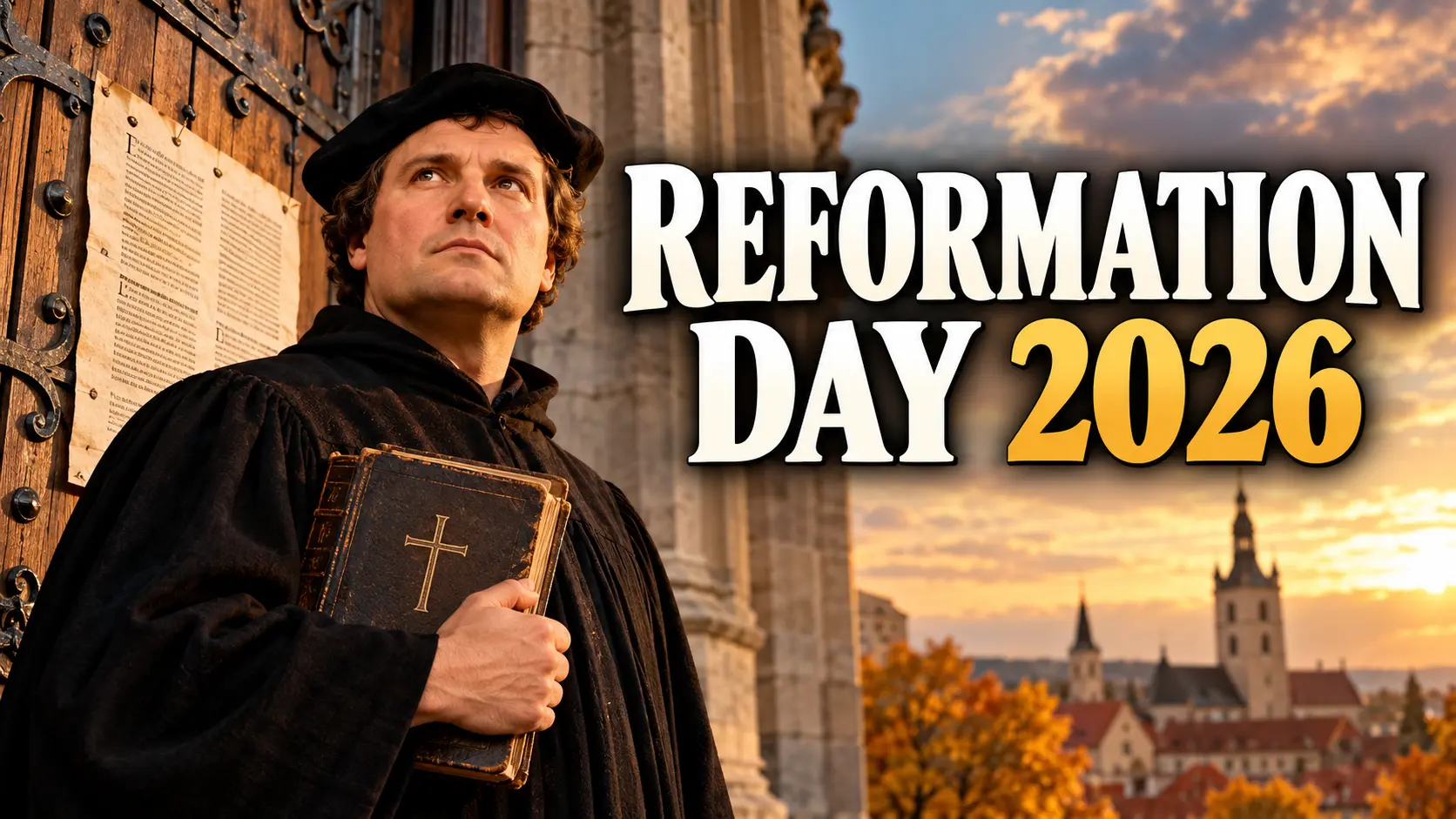

Reformation Day in 2026 falls on Saturday, October 31, 2026. The Christian observance remembers events associated with the beginning of the Protestant Reformation and invites believers to reflect on Scripture, grace, faith, Christ, repentance and spiritual renewal.
For many Lutheran and other Protestant Christians, the day is about more than Martin Luther or the famous 95 Theses. Its deeper emphasis is the Gospel and the conviction that salvation is God’s gift through Jesus Christ.
Reformation Day 2026 Quick Facts
Date: Saturday, October 31, 2026
Historical Date: October 31, 1517
Associated Event: Martin Luther and the 95 Theses
Main Traditions Observing: Lutheran, Reformed and some other Protestant churches
Liturgical Colour: Red in many Lutheran churches
Core Themes: Grace, faith, Scripture, Christ, repentance and renewal
Common Reformation Readings: Psalm 46, Romans 3:19–28 and John 8:31–36
What Is Reformation Day?
Reformation Day is a Christian observance commemorating the events that helped begin the Protestant Reformation, a major religious movement that reshaped Western Christianity during the 16th century.
The date is especially important within Lutheran tradition because of its association with Martin Luther’s objections to abuses surrounding indulgences in 1517. What began as a theological dispute eventually developed into broader disagreements concerning salvation, church authority, Scripture, worship and Christian doctrine.
For Protestants who observe Reformation Day, however, its purpose is not simply to celebrate one historical personality.
The day commonly emphasizes themes that became central to Reformation theology: God’s grace, justification through faith, the authority of Scripture, the centrality of Jesus Christ and the need for the church continually to examine its beliefs and practices.
This is why many Reformation Day services focus on biblical passages dealing with grace, righteousness, truth, freedom, repentance and God’s Word.
Why Is Reformation Day Celebrated on October 31?
Reformation Day is observed on October 31 because of events associated with Martin Luther in Wittenberg, Germany, on October 31, 1517.
Unlike Easter, which moves each year according to the church calendar, Reformation Day remains connected to this fixed historical date.
Martin Luther and the 95 Theses
Martin Luther was a German theologian, university professor and Augustinian friar. By 1517, he had become increasingly concerned about the way indulgences were being preached and understood.
On October 31, 1517, Luther sent a document formally titled the Disputation on the Power and Efficacy of Indulgences, now commonly called the 95 Theses, to church authorities. The document raised theological questions and was intended to encourage debate.
A famous tradition says Luther also nailed the theses to the door of the Castle Church in Wittenberg. That scene became one of the most recognizable images of the Reformation, although historians continue to debate whether the physical door-posting happened exactly as later accounts describe it.
What is much more firmly connected with October 31 is Luther’s circulation of the theses and his correspondence with church authorities.
The controversy centred on indulgences, which concerned the remission of temporal punishment associated with sin. Luther was especially critical of abuses in how indulgences were preached and promoted, arguing that such practices could confuse genuine repentance and dependence on God’s mercy.
Significantly, the first of the 95 Theses focuses on repentance, declaring that Christ intended the entire life of believers to be characterized by repentance.
What began as a dispute over indulgences eventually expanded into much larger theological and institutional conflicts.
What Did the Protestant Reformation Change?
The Reformation was not a single event and its leaders did not agree on every theological question. It developed differently across Europe and contributed to the emergence of Lutheran, Reformed, Anglican, Anabaptist and other Protestant traditions.
Several major themes nevertheless became closely associated with the movement.
- Authority of Scripture: Protestant Reformers emphasized Scripture as the final authoritative standard for Christian doctrine and teaching. This challenged understandings of authority that gave greater weight to papal rulings or established traditions.
- Salvation and Grace: Reformers placed renewed emphasis on justification as God’s gift, received through faith rather than earned through human merit.
- Bible Translation and Vernacular Worship: The movement encouraged wider access to Scripture and worship in languages ordinary people could understand. Bible translation, preaching and teaching became increasingly important.
- The Priesthood of All Believers: Reformation theology emphasized the spiritual calling of ordinary Christians. Work, family life, service and everyday responsibilities could be understood as meaningful Christian vocations rather than spirituality belonging mainly to clergy or monastic communities.
The Reformation also led to serious conflict, political upheaval, institutional division and long-lasting disagreement among Christians. Its history is therefore more complex than a simple story of one side correcting another.
Core Theology of the Reformation
Historical Nuance
Martin Luther did not publish a standardized list called the “Five Solas” on October 31, 1517. The familiar five-part framework developed later as a concise way of summarizing important themes within Protestant Reformation theology.
1. Sola Scriptura — Scripture Alone
Sola Scriptura expresses the Protestant conviction that Scripture is the final authoritative norm for Christian doctrine and faith.
This does not necessarily reject creeds, teachers, church history or theological tradition. Instead, these authorities are understood to remain accountable to Scripture.
2. Sola Fide — Faith Alone
Sola Fide refers to justification through faith rather than human works functioning as the basis for earning acceptance before God.
The idea became closely connected with Protestant readings of Paul’s letters, especially Romans and Galatians.
3. Sola Gratia — Grace Alone
Sola Gratia teaches that salvation is rooted entirely in God’s grace.
It is not something people earn through religious performance, moral achievement or personal merit. Salvation is understood as an undeserved divine gift.
4. Solus Christus — Christ Alone
Solus Christus places Jesus Christ at the centre of salvation.
Christ is understood as the unique mediator between God and humanity, with his life, death and resurrection forming the foundation of Christian hope.
5. Soli Deo Gloria — Glory to God Alone
Soli Deo Gloria means that the ultimate glory for salvation belongs to God.
Together, the Five Solas summarize a major Reformation conviction: Scripture points believers toward Christ, salvation comes by grace, it is received through faith and the glory belongs to God.
Bible Verses Connected With Reformation Day
Reformation Day worship often returns to passages about grace, righteousness, faith, truth and God’s Word.
Romans 1:16–17
“The just shall live by faith.”
Romans 1 became important in Protestant theology because of its emphasis on God’s righteousness and faith. The passage points away from confidence in human achievement and toward the Gospel as God’s saving power.
Romans 3:19–28
Romans 3 is among the most important traditional Reformation Day readings.
Paul describes humanity’s inability to boast before God and speaks of justification as something given by grace and received through faith.
The passage therefore connects directly with one of the Reformation’s central theological questions: how sinners are made right with God.
Ephesians 2:8–9
“For by grace are ye saved through faith.”
Few passages express the grace-centred emphasis of Protestant Reformation theology more clearly.
Ephesians teaches that salvation is God’s gift rather than an achievement that gives people grounds for spiritual boasting. Good works remain important in Christian life but they are not presented as the price paid for God’s grace.
John 8:31–32
“Ye shall know the truth and the truth shall make you free.”
Jesus connects discipleship with continuing in his word and describes truth as bringing freedom.
John 8:31–36 is also frequently used within Lutheran Reformation Day worship.
Psalm 46
“God is our refuge and strength.”
Psalm 46 has a particularly strong place in Reformation tradition.
Its confidence in God during turmoil fits themes long associated with Luther’s hymn A Mighty Fortress Is Our God. The psalm remains a common choice for Reformation worship.
Liturgy, Customs and Observances Today
Reformation Day does not have one universal form of celebration. Practices differ according to denomination, congregation and country.
For many Lutheran communities, worship remains at the centre of the observance.
Why Is Red Used on Reformation Day?
Red is traditionally used as the liturgical colour for Reformation Day in many Lutheran churches.
Within Christian liturgical symbolism, red can be associated with the Holy Spirit, witness, sacrifice and the church’s active proclamation of the Gospel. Exact explanations may differ among churches.
How Do Christians Observe the Day?
Many congregations hold a special Reformation Day or Reformation Sunday service.
Worship may include historic hymns such as A Mighty Fortress Is Our God, readings from Psalm 46, Romans 3 and John 8, and sermons centred on grace, faith, Scripture, repentance and the Gospel.
Churches may also organize Bible studies, lectures, children’s lessons or educational programs examining Reformation history.
Some congregations worship specifically on October 31, while others observe Reformation Sunday on a nearby Sunday for practical or liturgical reasons.
Do All Christians Celebrate Reformation Day?
No. Reformation Day is most strongly associated with Lutheran and Reformed Christianity, though some Christians from other Protestant traditions also recognize it.
Roman Catholic and Eastern Orthodox Christians approach the Reformation from different historical and theological perspectives. Many of the questions raised during that era remain points of disagreement among Christian traditions today.
A balanced understanding of Reformation Day therefore recognizes both its profound importance within Protestant Christianity and the different ways other Christian traditions interpret the same historical period.
Reformation Day, Halloween and All Saints’ Day
Several important observances occur at almost the same point in the calendar, which can easily cause confusion.
Reformation Day — October 31
Reformation Day remembers events associated with Martin Luther and the Protestant Reformation beginning in 1517.
Its focus is Christian history and theological themes such as Scripture, grace, faith, repentance and church reform.
Halloween or All Hallows’ Eve
Halloween also falls on October 31, but its history developed through a different mixture of Christian, cultural and folk traditions surrounding the evening before All Saints’ Day.
Reformation Day should therefore not simply be described as a Protestant replacement for Halloween.
Readers interested in the separate history of the date can explore PsalmWisdom’s guide to Halloween and All Hallows’ Eve.
All Saints’ Day — November 1
All Saints’ Day is observed on November 1, the day immediately following Reformation Day.
October 31 was therefore All Hallows’ Eve, and the following day’s observance formed part of Wittenberg’s religious calendar.
That setting is relevant to understanding the historical world surrounding the events of 1517. However, it is better not to claim with certainty that Luther chose October 31 solely because he expected large All Saints’ Day crowds.
For more on the next day’s observance, readers can continue with PsalmWisdom’s guide to All Saints’ Day.
What Reformation Day Means for Christians Today
More than five centuries have passed since 1517, yet the themes remembered on Reformation Day still raise practical questions about Christian belief and life.
1. A Continual Return to Scripture
The Reformation encourages Christians to examine what they believe rather than accepting religious claims only because those claims are familiar or traditional.
For Protestants, this means continually returning to Scripture and asking whether beliefs, teaching and practice remain faithful to God’s Word.
2. Resting in Unearned Grace
Reformation theology challenges the instinct to treat faith as a system in which God’s acceptance must be earned through sufficient religious achievement.
The emphasis on grace directs attention away from spiritual pride and toward dependence on Christ.
Good works remain an important part of Christian discipleship, but they flow from grace rather than purchasing it.
3. Pursuing Ongoing Spiritual Renewal
Reformation Day can also remind Christians that spiritual reform is not only an event belonging to the 1500s.
The later Reformation expression Ecclesia reformata, semper reformanda is commonly rendered as “the church reformed, always being reformed.”
The expression should not be presented as a quotation from Luther or from 1517. Its broader point is that churches and individual Christians should remain willing to examine themselves, repent when necessary, return to Scripture and keep Christ at the centre.
Keeping Christ at the Centre
Reformation Day 2026 falls on Saturday, October 31. More than 500 years after the events associated with Martin Luther and the 95 Theses, the observance continues to raise important questions about Scripture, grace, faith, repentance, truth and Christian renewal.
For those who observe it, Reformation Day ultimately points beyond a historical reformer or anniversary toward the Gospel and the person of Jesus Christ.
Reformation Day 2026 Takeaway
- Date: Saturday, October 31, 2026
- Core Theme: God’s grace received through faith in Christ
- Spiritual Emphasis: Returning to Scripture and keeping Christ at the centre
