
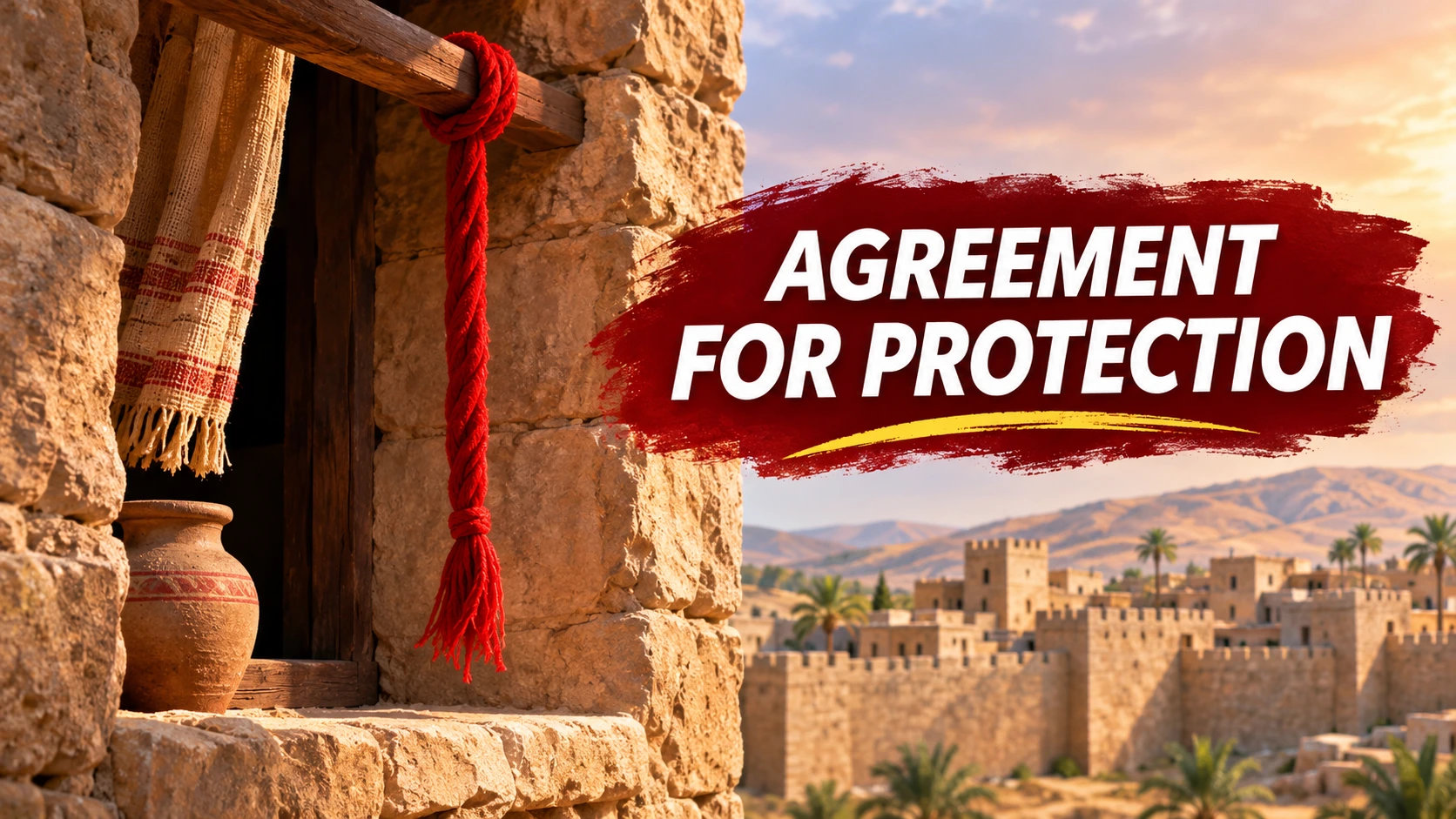

A scarlet cord hanging from a window seems like a small detail in the story of Rahab. Yet that ordinary piece of thread marked the house where she and her family had been promised protection when the Israelites came to Jericho.
Rahab placed the scarlet cord in her window because two Israelite spies instructed her to display it as part of their agreement. According to Joshua 2:17–21, the cord identified her house but the promise also depended on gathering her family inside, keeping them there and protecting the spies’ secret.
The Bible gives a surprisingly detailed account of these conditions. Understanding them reveals why the cord mattered, what Rahab was expected to do and where later interpretations go beyond the actual words of Scripture.
Why the Scarlet Cord Mattered
Before Israel entered Jericho, Joshua sent two spies to examine the city. Rahab sheltered the men, concealed them from the king’s messengers and eventually helped them escape through a window in her house.
In return, she asked the spies to protect her family when Israel came against Jericho. The men agreed but they needed a way to identify the household covered by their promise.
Joshua 2:18 (KJV) records their instruction:
“thou shalt bind this line of scarlet thread in the window”
The instruction gave the scarlet cord a practical purpose. It marked the house associated with the agreement, distinguishing Rahab’s household from the other homes in the city.
The Bible does not describe exactly how the Israelites later recognized the sign. Nevertheless, the connection between the cord, the window and the promised protection makes its identifying purpose clear.
The event belongs to the opening stage of Israel’s entry into Canaan under Joshua. Readers who want the larger historical setting can explore Joshua’s journey to the Promised Land without confusing that broader story with the specific purpose of Rahab’s cord.
The Promise Came First
Rahab did not begin by asking the spies for a scarlet cord. Her first concern was whether the men would spare her parents, siblings and other family members when Israel took the city.
In Joshua 2:12–13, she asked them to show kindness to her father’s household because she had shown kindness to them. She also requested a reliable assurance that her family would be kept alive.
The spies answered with a solemn commitment. Joshua 2:14 records their promise to deal kindly and faithfully with Rahab, provided she did not reveal their business.
Only after this exchange did they explain the conditions involving the scarlet cord. The sequence matters because the cord was not the source of their promise; it became an agreed sign associated with that promise.
Rahab’s situation therefore involved more than displaying a coloured object. She had received an assurance from two men whose lives she had protected and those men were placing serious obligations upon themselves.
The distinction helps readers understand the passage without assigning supernatural power to the cord. Its importance came from the instructions and the oath connected with it.
The Four Conditions
Joshua 2:17–20 explains what Rahab needed to do for the spies’ promise to remain binding. These instructions concerned the location of her house, the people included in the agreement and the trust established between her and the two men.
1. Mark the Window
The spies told Rahab to bind the scarlet line in the window through which she had helped them escape. They did not tell her to place it above the main entrance, carry it outside or display it anywhere she preferred.
The chosen window had already played an important role in their escape. Joshua 2:15 explains that Rahab’s house was situated on Jericho’s town wall, allowing her to lower the men through the opening.
The window connected the earlier act of assistance with the later promise of protection. By using that particular location, the spies established an identifiable sign associated with Rahab’s house.
2. Gather Her Family
The agreement required Rahab to bring her father, mother, brothers and her father’s household into her home. This condition was essential because she had asked the spies to protect her relatives as well as herself.
The promise did not automatically extend to family members wherever they might be in Jericho. Those included in the agreement needed to gather at the designated house.
This detail shows that the scarlet cord was not intended to identify Rahab alone. It marked the location where the people covered by the agreement were expected to be together.
3. Remain Inside
Joshua 2:19 established a clear boundary for the promised protection. Anyone who left Rahab’s house and went into the street would no longer be under the spies’ responsibility if that person was killed.
The men accepted responsibility for anyone who remained inside and was harmed. Their words created a distinction between those who followed the agreement and those who moved outside its stated conditions.
Remaining in the house was therefore as important as gathering there. The cord identified the location but the family’s responsibility was to stay within it when danger came.
4. Keep the Secret
The spies also warned Rahab not to disclose their business. Joshua 2:20 states that they would be released from their oath if she revealed what they were doing.
This condition protected the secrecy of their mission and the trust involved in their agreement. Rahab had already helped them avoid capture and revealing their activities could have undermined their escape.
The passage does not explain precisely what Rahab told her family when she gathered them. It establishes only that she was not permitted to betray the spies’ business.
Together, these four conditions show why the cord cannot be understood in isolation. It belonged to an agreement that required identification, cooperation, secrecy, and clearly defined responsibility.
When Rahab Tied the Cord
One revealing detail appears in Joshua 2:21. After agreeing to the spies’ terms and sending them away, Rahab bound the scarlet line in her window.
The narrative places this action before the spies returned to Joshua. Rahab therefore displayed the cord before the Israelites arrived to take Jericho, rather than waiting until the danger was directly outside her house.
Scripture does not explain her private reasoning or specify how long the cord remained hanging. It simply records that she accepted the instructions and carried them out.
There is something meaningful about that sequence. Rahab had no control over the Israelites’ arrival, but she could fulfill the requirement that had been placed upon her.
Her action also helps clarify the nature of the agreement. The spies had given her instructions concerning a future event, and she responded by preparing the designated sign in advance.
Was It the Escape Rope?
A common question concerns whether the scarlet cord was the same rope Rahab used to lower the spies from her window. Many illustrations and retellings treat the two as identical, although the Hebrew wording deserves closer examination.
Joshua 2:15 describes Rahab lowering the men with a cord, while Joshua 2:18 refers to the scarlet line that she was instructed to display. Both objects are associated with the same window but the passages use different Hebrew terms.
The word used for the escape rope is commonly transliterated as chebel. The word translated as “line” in Joshua 2:18 is tiqvah, which elsewhere in Hebrew can also carry the meaning of hope or expectation.
Readers can compare the wording in Joshua 2:18’s Hebrew lexicon, which identifies the terms used in the passage. The difference is worth noticing because it prevents us from assuming that the English words alone settle the question.
However, different Hebrew terms do not conclusively prove that two separate physical objects were involved. The passage does not provide enough information to establish that detail with certainty.
For understanding Rahab’s agreement, the distinction is not essential. Whether the scarlet line was the original escape rope or another cord, its assigned purpose was to identify her house.
Why Was the Cord Scarlet?
Scripture identifies the cord’s colour but does not explicitly explain why scarlet was chosen. The colour may have made the sign easier to distinguish, although Joshua does not state that visibility was the reason.
Scarlet also appears elsewhere in the Old Testament, including descriptions of the tabernacle’s materials. Its presence in those passages has encouraged later readers to explore whether Rahab’s cord carried additional religious significance.
One familiar Christian interpretation connects the scarlet cord with the blood placed on Israelite doorposts during the first Passover. In Exodus 12, households were instructed to display the prescribed sign and remain inside during the night of judgment.
The two accounts share certain features involving marked houses, danger and the protection of households. These similarities offer a meaningful basis for comparison but the accounts should not be treated as identical.
Exodus 12 directly explains the significance of the Passover blood. Joshua 2, however, does not explicitly identify the scarlet cord as a prophecy of Christ’s blood or explain its colour in that way.
Some Christians understand Rahab’s cord as a picture of redemption through Jesus Christ. That interpretation belongs to a broader theological reading of Scripture rather than the explicit explanation supplied in Joshua.
For readers interested in that wider theme, our study of the scarlet thread from Genesis to Revelation examines the connection between scarlet imagery, redemption and Christian teaching.
The immediate meaning in Rahab’s story remains more specific. The cord was a visible sign connected with the protection promised to her household.
Did the Cord Have Power?
The Bible never says Rahab’s scarlet cord possessed supernatural power. It does not describe the material as holy, attribute miraculous properties to its colour or suggest that a red thread could protect anyone who displayed it.
The cord mattered because of the agreement attached to it. Rahab was instructed to display the sign, while the spies had pledged to protect the people who remained within the conditions they established.
This distinction is important because it separates the physical object from the commitment it represented. Hanging a scarlet cord without the agreement would not have carried the same meaning in the biblical narrative.
Joshua 6:22 later confirms that Joshua remembered the oath. He directed the two men who had investigated Jericho to bring Rahab and those belonging to her out of the city, just as they had promised.
The passage records the fulfillment of the agreement without assigning independent protective power to the cord. The object was significant because it belonged to a promise that was honoured.
This also means the account should not be turned into a universal instruction for Christians to hang red cords in their windows. Joshua describes a particular agreement made during Israel’s entry into Canaan, not a continuing ritual for obtaining divine protection.
What the Scarlet Cord Teaches
The scarlet cord offers a useful lesson about the difference between making a promise and acting upon it. Rahab requested protection, the spies accepted responsibility and both sides understood that their agreement involved specific obligations.
Rahab could not determine when Israel would arrive or control everything that would happen to Jericho. She could, however, prepare her house according to the instructions she had received.
The spies also had responsibilities beyond expressing gratitude for her help. Their oath required them to remember the agreement and act upon it when the time came.
This makes the scarlet cord a practical reminder that trustworthy commitments involve more than reassuring words. They require clarity about what has been promised and faithfulness in carrying out the responsibilities involved.
There is also a lesson in paying attention to the details of Scripture. The cord is often remembered for its colour, yet Joshua devotes considerable attention to the household, the oath and the conditions surrounding it.
Reading those details together provides a more complete understanding than treating the cord as an isolated symbol. It also prevents later traditions from overshadowing what the biblical account actually says.
Meaning of the Window Sign
Rahab’s scarlet cord was important because it identified the household covered by a solemn promise. The spies required her to display it, gather her relatives, keep them inside and protect the secrecy of their mission.
The passage becomes clearer when these instructions are read together. They explain why the cord appeared in the window and why its significance extended beyond the material or colour itself.
Rather than presenting the scarlet cord as a mysterious object with hidden power, Joshua shows how an ordinary sign became associated with an extraordinary responsibility. Its place in the story reminds readers that promises have meaning when they are clearly understood, faithfully followed and ultimately honoured.
