
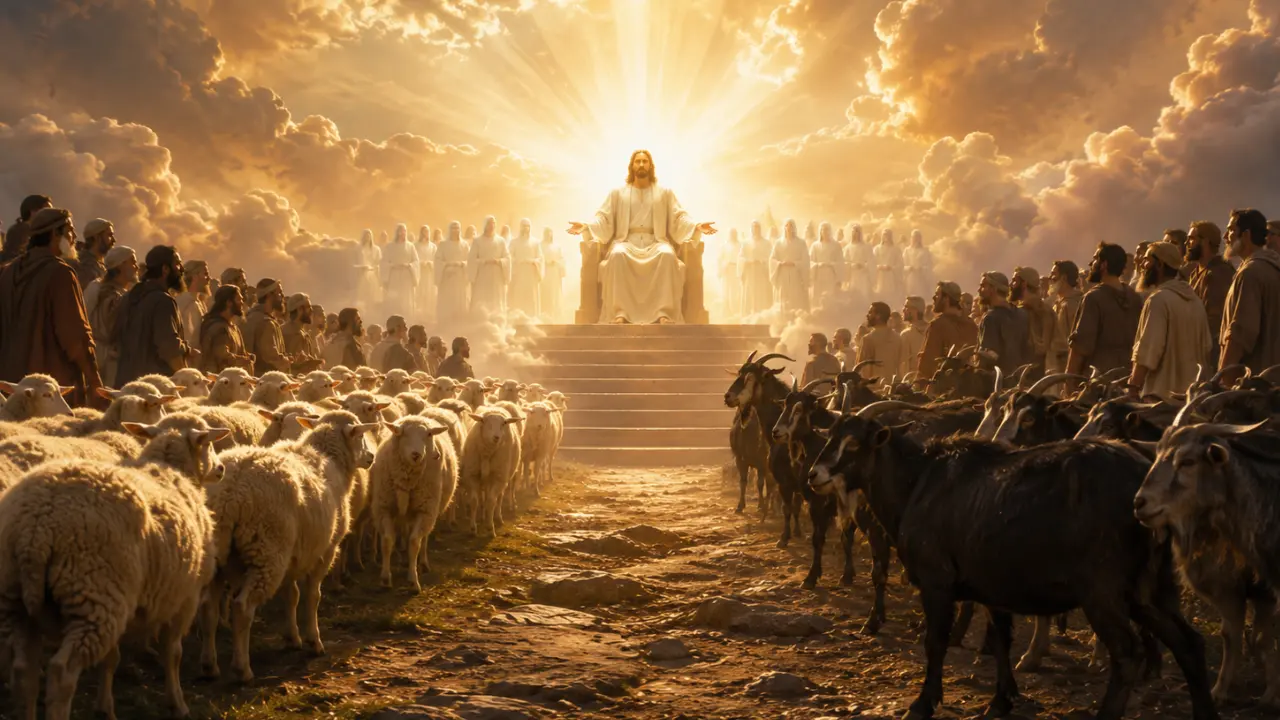

Matthew 25:31–46 describes Jesus returning as King and separating people according to what their lives reveal about their response to Him. Their acts of mercy do not function as isolated charitable achievements. They show whether allegiance to Christ has produced practical love or remained an empty profession.
Jesus presents people from all nations gathered before Him. He separates them as a shepherd separates sheep from goats, placing one group on His right and the other on His left.
The King then explains that their treatment of “the least of these” revealed how they had treated Him.
What Does Matthew 25:31–46 Mean?
Matthew 25:31–46 describes the return of the Son of Man, the gathering of people from all nations and a final separation before Christ’s throne.
Jesus compares the scene to a shepherd separating sheep from goats. The sheep receive the kingdom, while the goats face punishment.
The King identifies six acts of mercy:
- Feeding the hungry
- Giving drink to the thirsty
- Welcoming the stranger
- Clothing the needy
- Caring for the sick
- Visiting the imprisoned
The sheep performed these acts, while the goats neglected them.
Both groups ask when they saw the King in such conditions. Jesus answers that what they did, or failed to do, for “the least of these” reached Him personally.
The passage teaches that a person’s response to Christ becomes visible through practical conduct. Mercy does not replace faith, but a profession of faith that never produces love deserves serious examination.
What Is the Context of the Sheep and Goats?
Matthew 25 forms part of Jesus’ teaching about His return, spiritual readiness, faithful service and judgment.
Matthew 24 warns that the Son of Man will return unexpectedly. Jesus therefore tells His followers to remain watchful and faithful.
Matthew 25 develops this warning through three connected scenes.
The parable of the ten virgins teaches the need for lasting readiness. The parable of the talents teaches faithful stewardship during the master’s absence. The sheep and goats reveal what happens when the King returns.
The chapter moves from preparation to responsibility and then to judgment.
Matthew 25 first warns believers to remain prepared through the meaning of the midnight cry and the Bridegroom’s arrival. The final scene then shows that readiness must become visible through faithful living.
Jesus does not describe readiness as merely knowing that He will return. True readiness affects how people use opportunities, treat others, and respond to those connected with Christ.
Why Is Jesus Presented as the Son of Man and King?
Jesus begins the passage by describing the Son of Man coming in glory with His angels.
He then sits upon a glorious throne.
The title “Son of Man” appears throughout the Gospels. Jesus uses it when speaking about His earthly ministry, suffering, authority, and future return.
In Matthew 25, the Son of Man appears as the reigning King and Judge.
This creates a powerful contrast. Jesus will soon be betrayed, rejected, and condemned by human authorities. However, their verdict will not be final.
The rejected Jesus will return in glory. People from all nations will stand before Him, and He will pronounce the decisive judgment.
This passage therefore presents Jesus as more than a teacher encouraging kindness. He possesses authority to judge, welcome, exclude, and determine the final outcome.
What Do the Sheep and Goats Represent?
The sheep represent those whom the King receives, while the goats represent those whom He rejects.
Jesus draws the image from ordinary shepherding. Sheep and goats could remain together during the day, but the shepherd could separate them when needed.
The meaning does not depend on speculative claims about the personalities of the animals.
Jesus does not explain that sheep are saved because they are naturally gentle or that goats are condemned because they are naturally stubborn. The important action is the shepherd’s separation.
Before judgment, people may appear similar. Religious words, public reputation, and outward association cannot always reveal the condition of the heart.
The King sees what human observers cannot. His judgment exposes the true direction of each life.
The sheep stand at His right, a place associated with acceptance and honor. The goats stand at His left and hear the sentence of rejection.
Who Are “The Least of These My Brothers”?
“The least of these my brothers” is one of the most discussed phrases in Matthew 25:31–46.
Some Christians understand the phrase as referring broadly to every hungry, poor, sick, displaced, or imprisoned person. Under this interpretation, Jesus identifies Himself with suffering humanity.
Other interpreters understand “my brothers” more specifically as Jesus’ vulnerable followers and representatives.
In Matthew’s immediate context, “my brothers” most naturally points to people identified with Jesus, especially His vulnerable disciples and messengers.
Jesus elsewhere describes His faithful followers as His family. He also teaches that receiving His representatives amounts to receiving Him.
Early Christian disciples could experience hunger, homelessness, rejection, illness, persecution, and imprisonment because of their witness. Helping them could require courage and personal sacrifice.
Many Christians also understand the passage as expressing Christ’s concern for every suffering person. The wider teaching of Scripture clearly commands compassion toward poor people, strangers, widows, oppressed people, and neighbors in need.
Whichever scope receives emphasis, the passage does not permit indifference toward suffering.
Its central warning is that a person’s response to Christ becomes visible through practical mercy, especially toward people the world may consider unimportant.
What Does “You Did It Unto Me” Mean?
Jesus identifies closely with those He calls His brothers.
An act of care shown to them reaches Him personally. Their suffering does not escape His attention, and their apparent insignificance does not reduce their value.
The King says:
“Inasmuch as ye have done it unto one of the least of these my brethren, ye have done it unto me.”
The sheep express surprise. They do not remember seeing the King hungry, thirsty, sick or imprisoned.
Their surprise suggests that they did not perform these acts merely to gain recognition from Him. Mercy had become part of their ordinary response to need, and only at judgment did they understand how personally Christ received it.
The goats also express surprise. Their answer suggests that they would have served the King had they recognized Him in a visible and honored form.
However, they overlooked people who appeared weak or insignificant.
Jesus therefore challenges selective service. A person can not sincerely honour Christ while treating those He values as invisible.
Does Matthew 25 Teach Salvation by Good Works?
Matthew 25 places acts of mercy directly within the judgment scene but it does not present charity as a price paid for salvation.
The King invites the sheep to inherit a kingdom already prepared for them.
The language points to gracious reception rather than wages earned through charitable activity. At the same time, Jesus gives their deeds real evidential weight. Their lives reveal that the King’s rule has taken root in them.
Good works do not stand apart from faith as an alternative way of salvation. They grow from a living relationship with Christ.
This agrees with the wider biblical teaching that grace saves and genuine faith produces fruit.
The sheep do not receive the kingdom because they completed a required number of generous acts. Their mercy shows the direction and character of their lives.
Living faith produces visible action rather than empty religious profession, as explained in what “faith without works is dead” means.
Matthew 25 therefore rejects two errors.
People cannot purchase salvation through good works. However, they also should not assume that saving faith can remain permanently empty of mercy, obedience, and love.
Why Were the Goats Condemned for Neglect?
The goats are condemned because they failed to respond to vulnerable people identified with the King.
They did not feed, welcome, clothe, care for or visit.
Their failure shows the seriousness of sins of omission. Sin includes not only actively committing evil but also refusing the good that love and obedience require.
The goats are not condemned for failing to solve every human problem. No individual possesses unlimited time, knowledge, or resources.
Their neglect represents a life consistently closed to mercy. Christ’s priorities never shaped their response to vulnerable people.
Jesus therefore treats neglected love as morally serious rather than spiritually neutral.
One missed opportunity does not provide a complete picture of a person’s life. The passage addresses an established direction revealed through repeated conduct.
What Do Eternal Punishment and Eternal Life Mean?
Matthew 25:46 presents two solemn and contrasting outcomes:
“And these shall go away into everlasting punishment: but the righteous into life eternal.”
The same verse describes both punishment and life as eternal. This gives the closing judgment lasting weight.
Eternal life means life within God’s kingdom, under His blessing and in fellowship with the King.
Eternal punishment describes exclusion from that kingdom and accountability before Christ.
The passage does not explain every detail of the afterlife. Jesus’ purpose is to warn that present allegiance carries eternal consequences.
He gives the warning before the judgment so that people can respond now through repentance, faith, readiness, and transformed living.
How Should Christians Apply Matthew 25:31–46?
Christians should examine whether their profession of faith produces practical mercy.
Jesus calls His followers to notice vulnerable people rather than treating them as invisible. Compassion should move beyond sympathetic words when real help is possible.
Believers can provide practical help according to their genuine ability. The exact response will vary, but love should not remain permanently inactive.
Christians should especially remember believers facing poverty, persecution, displacement, sickness, isolation, or imprisonment because of their faith.
Service should remain sincere. The sheep did not appear to act for public admiration or spiritual status.
Their example encourages Christians to practise serving others without seeking recognition.
The passage also calls for honest self-examination. Religious language alone can not prove allegiance to Christ.
A life shaped by the King should gradually reflect His mercy, priorities and concern for people who appear powerless or forgotten.
Frequently Asked Questions
What do eternal punishment and eternal life mean?
They describe the two solemn outcomes announced by Christ. One group enters life in His kingdom, while the other faces punishment and exclusion from His favour.
Does “all nations” refer to modern governments?
The passage describes people from all nations gathered before Christ. It should not be reduced to a prediction that modern countries receive collective salvation or condemnation based on one political policy.
Why were the goats condemned?
The goats showed a settled pattern of neglect. They did not respond with mercy when vulnerable people needed food, welcome, clothing, care or companionship.
Does Matthew 25 teach salvation by good works?
No. Charitable deeds do not purchase salvation. However, Jesus gives those deeds evidential importance because living faith should produce practical mercy, love and obedience.
