
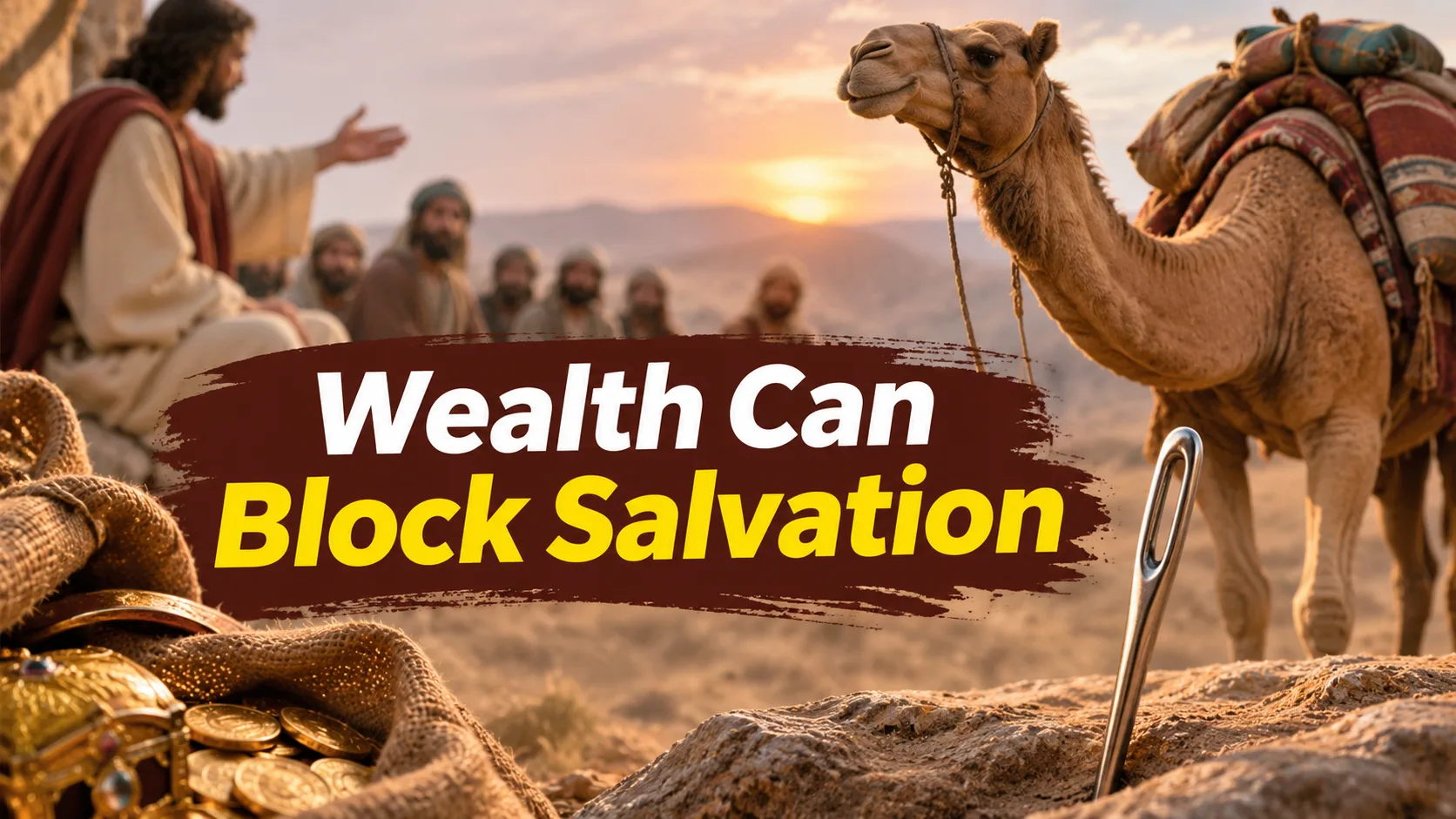

Matthew 19:24 means that wealth can become a serious obstacle to entering God’s kingdom when someone values possessions more than following Jesus. Christ used the impossible image of a camel passing through the eye of a needle to show that money, personal achievements, and human effort cannot secure salvation.
Jesus was not declaring that every wealthy person would be excluded from heaven. His warning came after a rich young man walked away rather than surrender his possessions, and His explanation in Matthew 19:26 reveals that what is impossible for human beings remains possible with God.
Matthew 19:24 (KJV) says:
“And again I say unto you, It is easier for a camel to go through the eye of a needle, than for a rich man to enter into the kingdom of God.”
A Camel Could Never Fit Through a Needle’s Eye
Jesus deliberately compared a large animal with an opening far too small for it to enter. Camels were familiar to His listeners, while the eye of a sewing needle was an ordinary opening designed to accommodate thread.
The difference in size made the illustration impossible rather than merely difficult. No amount of preparation or determination could enable a camel to pass through such a tiny opening, which explains why Jesus chose this striking comparison.
The word “easier” makes His statement particularly powerful. Jesus was emphasizing the overwhelming difficulty a wealthy person faces in entering God’s kingdom, using a familiar physical impossibility to communicate the seriousness of that spiritual obstacle.
Wealth could provide security, influence and considerable advantages in ordinary life. However, the comparison challenged the assumption that those advantages could help someone obtain eternal life.
The Jerusalem Gate Misinterpretation
A popular interpretation claims that the eye of a needle was a narrow gate in Jerusalem. According to this explanation, a camel could pass through only after its belongings were removed and it knelt down.
However, there is no reliable historical evidence that such a gate existed in Jerusalem during Jesus’ lifetime. A 2022 study published in New Testament Studies traced the gate explanation to later interpretive traditions rather than documented evidence of a Jerusalem gateway.
The gate theory changes the meaning of the illustration by turning an impossible situation into something achievable through preparation. An ordinary sewing needle better preserves the force of Jesus’ comparison, especially when considered alongside His statement about human impossibility in Matthew 19:26.
The Rich Young Man Behind Jesus’ Warning
Jesus spoke about the camel and the needle immediately after meeting a wealthy young man who wanted to obtain eternal life.
In Matthew 19:16, the man approached Jesus and asked what good thing he needed to do to receive eternal life. Jesus directed him toward God’s commandments, and the young man responded that he had kept them, yet he still wanted to know what he lacked.
Jesus then instructed him in Matthew 19:21 to sell his possessions, give to the poor and follow Him. The instruction offered the promise of treasure in heaven but required the man to surrender something that had become deeply important to him.
Matthew 19:22 records that the young man went away sorrowful because he possessed great wealth. He desired eternal life, but when following Jesus required him to part with his possessions, he was unwilling to accept the invitation.
His sorrow reveals the particular danger Jesus was addressing. The man did not simply own valuable possessions; his attachment to them had become powerful enough to determine his response to Christ.
Although he expressed confidence in keeping God’s commandments, the instruction to surrender his wealth exposed a conflict in his priorities. He wanted to follow the path toward eternal life without losing the financial security that mattered so much to him.
After the man departed, Jesus told His disciples in Matthew 19:23 that a rich person would enter the kingdom of heaven with difficulty. His statement in the following verse made that warning even more striking through the comparison of the camel and the needle.
The young man’s departure therefore explains why Jesus connected wealth with such an extreme illustration. Riches can become spiritually dangerous when someone is unwilling to surrender them, even when retaining them conflicts with following Christ.
This does not mean that possessing wealth is itself the same as rejecting God. The young man’s response revealed the problem because his possessions had become an obstacle to accepting Jesus’ invitation.
The Disciples’ Astonishment and Jesus’ Answer
The disciples’ reaction in Matthew 19:25 provides an important clue to understanding the full meaning of the comparison.
After hearing Jesus’ words, they were exceedingly amazed and asked, “Who then can be saved?” Their question shows that they understood the illustration as something more serious than an ordinary warning about financial attachments.
Jesus had described an obstacle that human ability could not overcome. The disciples therefore wondered how anyone could be saved if entering God’s kingdom presented such an overwhelming difficulty.
Rather than giving them another requirement to fulfill, Jesus answered in Matthew 19:26:
“With men this is impossible; but with God all things are possible.” (KJV)
His response completes the meaning of Matthew 19:24. Just as the camel could not pass through a needle’s eye through its own ability, human beings cannot obtain salvation through their own resources, achievements or efforts.
The wealthy young man’s experience demonstrated how material attachments could prevent someone from responding to Jesus. Nevertheless, Christ’s answer showed that human limitations do not place salvation beyond God’s power.
This distinction also explains why Matthew 19:24 should not be interpreted as an automatic condemnation of everyone who possesses wealth. Jesus warned about the spiritual danger riches can create, but His words in Matthew 19:26 leave no doubt that salvation remains possible through God.
The encounter with Zacchaeus in Luke 19 offers a relevant contrast. Although Zacchaeus was wealthy, he responded to Jesus by promising generosity toward the poor and fourfold repayment for anyone he had cheated, demonstrating a willingness to accept financial loss rather than protect dishonest gains.
Unlike the rich young man who departed sorrowfully, Zacchaeus showed a changed attitude toward his possessions. His actions did not purchase salvation but they reflected a response to Jesus in which retaining wealth no longer took priority over doing what was right.
Jesus’ instruction to sell everything was specifically directed toward the young man in Matthew 19. The passage does not establish an identical requirement for every Christian but it demonstrates how attachment to possessions can interfere with a person’s willingness to follow Christ.
The meaning of Matthew 19:24 is that wealth can become a powerful obstacle to entering God’s kingdom, while no amount of money or human effort can secure salvation. Jesus illustrated that danger through the impossible image of a camel passing through a needle’s eye, immediately after a wealthy young man refused to surrender his possessions.
The disciples’ astonishment revealed the seriousness of His warning, but Matthew 19:26 provided the essential answer. What human beings can not accomplish through their own ability remains possible through God’s saving power.
Frequently Asked Questions
Does Matthew 19:24 Mean Rich People Can not Enter Heaven?
No. Matthew 19:24 warns that wealth can become a serious obstacle when possessions hold greater importance than following Jesus. In Matthew 19:26, Jesus explains that salvation remains possible through God’s power, so the passage does not automatically exclude everyone who possesses wealth.
What Does the Eye of a Needle Represent in Matthew 19:24?
The eye of a needle represents an impossibly small opening through which a camel could never physically pass. Jesus used this extreme comparison to emphasize the difficulty faced by those whose attachment to riches prevents them from following God, while showing that salvation cannot be accomplished through human ability alone.
Does Matthew 19:24 Mean Christians Must Give Away All Their Money?
Matthew 19:24 does not establish a universal command requiring every Christian to give away all possessions. Jesus specifically instructed the wealthy young man to sell what he owned because his response exposed an attachment that prevented him from following Christ.
