
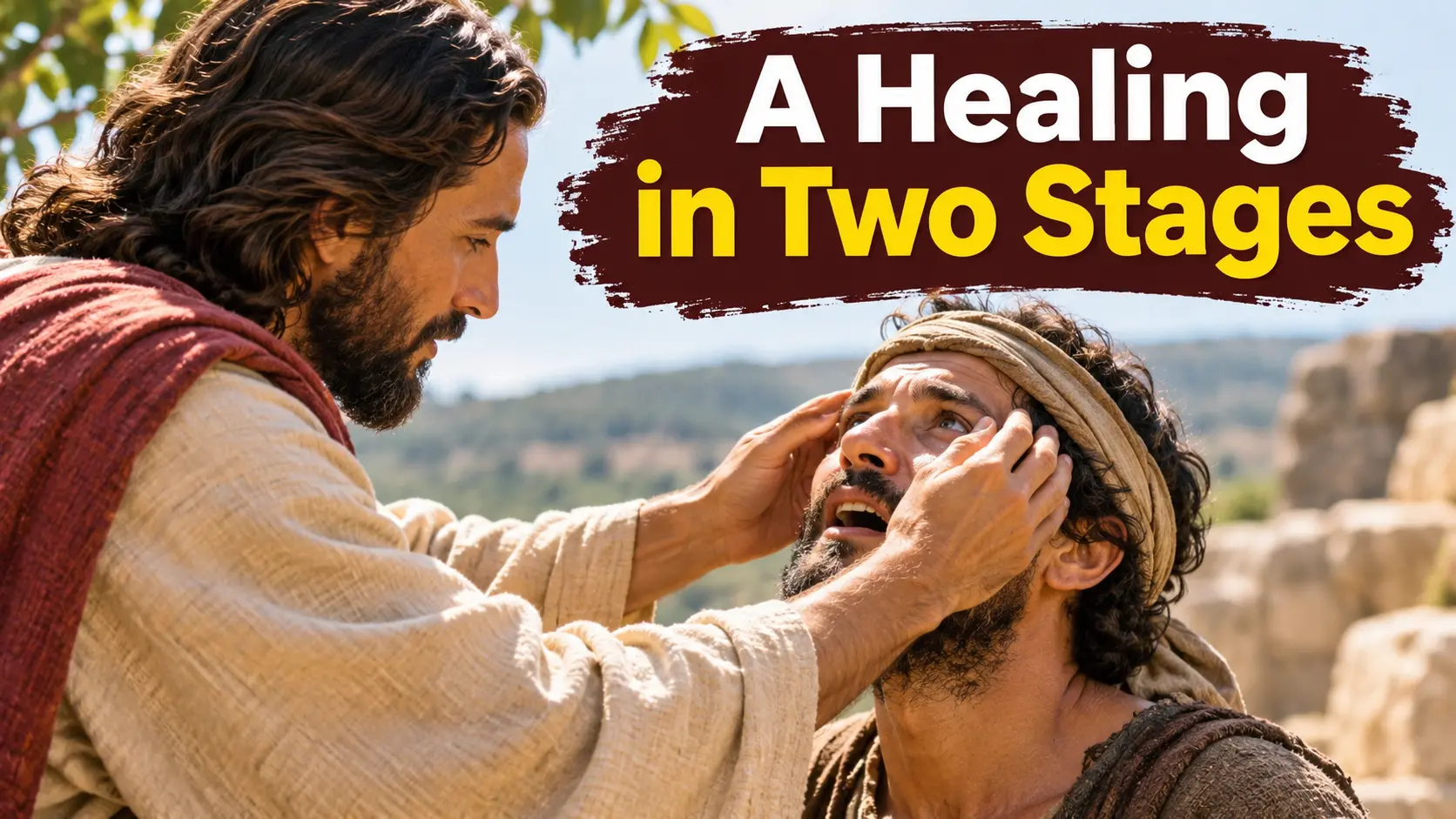

Why did Jesus heal a blind man in two stages when He could restore sight immediately? In Mark 8:22–26, Jesus touches a man’s eyes but his vision remains unclear until a second touch. Unlike other healing accounts, this miracle includes a moment when the man can see people moving without recognizing them clearly.
The Bible does not directly explain why Jesus chose this unusual method. However, the surrounding passages offer an important clue because the miracle occurs between two conversations about the disciples’ incomplete understanding of Jesus. Its placement suggests a connection between the man’s developing physical sight and the disciples’ struggle to understand who Jesus truly was.
The Healing at Bethsaida
Mark 8:22 begins with Jesus arriving at Bethsaida, where several people bring a blind man to Him. They ask Jesus to touch him, but instead of healing him before the gathering, Jesus takes the man by the hand and leads him outside the town.
According to Mark 8:23, Jesus spits on the man’s eyes and places His hands upon him. He then asks whether the man can see anything, allowing him to describe what has happened.
The man’s response in Mark 8:24 is one of the most unusual statements in the healing accounts. In the King James Version (KJV), he says, “I see men as trees, walking.” His words reveal that he can now perceive moving figures, although their appearance remains indistinct.
Jesus places His hands upon the man’s eyes again and Mark 8:25 reports that “he was restored, and saw every man clearly.” The second touch brings the healing to completion, leaving no suggestion that the man continues to experience impaired vision.
Afterward, Jesus sends him home with instructions not to enter the town or tell anyone there about the miracle. Mark does not record the man’s name, his previous experiences or any further conversation after his sight is restored.
Why Two Touches?
The passage never suggests that Jesus lacked sufficient power to heal the man immediately. Throughout the Gospels, Jesus restores people through different actions and nothing in Mark 8 describes the first touch as an unsuccessful attempt.
There is also no indication that the man’s faith was too weak. The people who brought him requested Jesus’ help but Mark does not describe the man’s beliefs or make his healing dependent on a particular expression of faith.
One important detail is Jesus’ question after the first touch. Mark could have reported the restoration without describing this exchange, yet he preserves both the question and the man’s unusual response. These details make the intermediate stage an essential part of the account.
The description of people resembling walking trees also deserves careful attention. It shows that the man can recognize movement and general shapes but it does not tell us whether he had previously possessed normal vision. Any claim about his childhood, the cause of his blindness or the duration of his condition would go beyond the passage.
What the narrative establishes is a deliberate distinction between partial and complete sight. To understand why that distinction may matter, readers need to examine the conversations Mark records immediately before and after the miracle.
The Disciples’ Blindness
In Mark 8:14–21, Jesus and His disciples are traveling by boat when a misunderstanding develops. Jesus warns them about the leaven of the Pharisees and Herod but the disciples begin discussing their shortage of bread.
Their reaction reveals that they have misunderstood the subject of His warning. Instead of considering what Jesus is teaching, they become concerned about having only one loaf of bread with them.
Jesus responds by reminding them of two earlier miracles in which He fed thousands of people. He asks how many baskets of food remained after feeding the five thousand and the four thousand, drawing attention to events they had personally witnessed.
In Mark 8:18, Jesus asks, “Having eyes, see ye not? and having ears, hear ye not? and do ye not remember?” His question challenges their understanding rather than their physical ability to see or hear.
The disciples have witnessed extraordinary demonstrations of Jesus’ authority, yet they continue struggling to understand their significance. Their concern about bread exposes how easily they overlook what His earlier miracles should have taught them.
Jesus ends the conversation in Mark 8:21 by asking, “How is it that ye do not understand?” The next event Mark records is the healing at Bethsaida, where a man begins to see but does not immediately see clearly.
This sequence connects two different kinds of perception. The disciples possess functioning eyesight but lack understanding, while the blind man receives physical sight through a process that Mark describes in unusual detail.
The Gospel does not explicitly identify the healing as a symbolic lesson for the disciples. Nevertheless, the connection is supported by the arrangement of the passages and becomes more meaningful when the following conversation is considered.
Peter’s Incomplete Understanding
Immediately after the healing, Jesus travels with His disciples toward Caesarea Philippi. During their journey, He asks who people believe Him to be before directing the same question to His closest followers.
Peter responds in Mark 8:29, “Thou art the Christ.” His answer recognizes Jesus as the promised Messiah rather than merely another prophet or religious teacher.
This confession marks an important moment in Mark’s Gospel, but the following verses reveal a serious misunderstanding. Jesus begins explaining that He must suffer, be rejected by the religious authorities, be killed and rise again after three days.
Peter finds this teaching difficult to accept and takes Jesus aside to rebuke Him. Although he recognizes Jesus as the Christ, he resists the suffering and death that Jesus describes as necessary parts of His mission.
Jesus corrects Peter in Mark 8:33, explaining that his thinking reflects human concerns rather than the things of God. Peter’s problem is not that he has failed to identify Jesus but that his expectations about the Messiah conflict with what Jesus has revealed.
This provides the strongest contextual support for understanding the significance of the two-stage healing. The blind man’s initial sight is genuine but imperfect, while Peter’s confession is correct despite his mistaken expectations about Jesus’ mission.
Mark places these events close together, allowing readers to recognize a distinction between identifying Jesus and understanding what His identity means. Peter’s confession is therefore an important beginning, but the teaching that follows challenges him to reconsider his assumptions about the Messiah.
The Healing of Bartimaeus
Another account of restored sight appears in Mark 10:46–52, where Jesus encounters Bartimaeus near Jericho. Bartimaeus calls upon Jesus for mercy, asks to receive his sight and is healed immediately.
Mark 10:52 records that Bartimaeus “followed Jesus in the way” after receiving his sight. This final detail distinguishes his account from the healing at Bethsaida, where Jesus sends the unnamed man home.
The two miracles appear on opposite sides of an extended section about Jesus’ suffering and the responsibilities of discipleship. Between them, Jesus repeatedly teaches His followers that greatness in God’s kingdom differs from ordinary human expectations.
In Mark 9:33–35, the disciples argue about who should be greatest, prompting Jesus to teach them about humility and service. Their disagreement shows that they continue thinking about status even while following someone who has been teaching them about sacrifice.
A similar misunderstanding appears in Mark 10:35–45 when James and John seek positions of honour. Jesus responds by explaining that greatness among His followers must be expressed through service rather than power over others.
These conversations make the placement of the two blindness miracles particularly meaningful. The Bethsaida account introduces a section in which the disciples struggle to understand Jesus’ mission, while the Bartimaeus account ends with a man receiving sight and following Him.
Both miracles remain accounts of actual physical healing. Their narrative positions also help frame Mark’s teaching about discipleship, without requiring readers to treat every action or detail as a hidden spiritual symbol.
Why Leave Bethsaida?
Jesus’ decision to lead the blind man outside Bethsaida is another detail that invites attention. Mark specifically records Jesus taking him by the hand, showing the personal care involved in guiding someone who can not see.
The passage does not explain why Jesus chooses a location outside the town. One possible reason is that He wishes to avoid drawing public attention to the healing, although the text does not confirm this as His precise motive.
That possibility agrees with the instructions given after the miracle. In Mark 8:26, Jesus sends the man home and tells him not to enter the town or tell anyone there what happened.
A somewhat similar encounter appears in Mark 7:31–37, where Jesus takes a man with impaired hearing and speech away from the crowd before healing him. That account also includes the use of saliva, showing that Jesus sometimes employs physical actions while attending personally to individuals.
John 9:6–7 describes another method when Jesus makes clay with saliva and places it on a blind man’s eyes. He then instructs the man to wash in the Pool of Siloam, after which the man returns with his sight restored.
Our related article, What Does the Pool of Siloam Mean in John 9:7?, examines why John identifies that location and explains its meaning. Although the circumstances differ from Bethsaida, both accounts demonstrate that Jesus did not use an identical method whenever He restored someone’s sight.
These differences are important because the Gospels do not present saliva, repeated touching or any particular physical action as a required healing formula. Each narrative describes what Jesus did in that encounter, while the emphasis remains on His authority and the restoration accomplished.
What Christians Can Learn
The account encourages readers to distinguish between knowing something about Jesus and understanding His teaching accurately. Peter’s confession demonstrates genuine recognition but his reaction to Jesus’ prediction of suffering reveals how personal expectations can interfere with accepting what Scripture teaches.
It also illustrates the importance of reading biblical events within their surrounding context. Without Mark 8:14–21 and 8:27–33, the healing might appear to be an isolated miracle with an unexplained second touch. Those adjoining passages provide a meaningful setting for understanding why the account receives such careful attention.
For Christians studying Scripture, this means allowing the biblical text to challenge familiar assumptions rather than forcing a passage to support an expected conclusion. The disciples’ misunderstandings show that witnessing extraordinary events and hearing Jesus’ words did not automatically prevent them from reaching mistaken conclusions.
The miracle also reveals Jesus’ personal care for the unnamed man. He responds to the request for healing, takes the man by the hand and remains with him until his sight is fully restored.
Nothing in the account portrays the man as responsible for the gradual nature of his healing. His condition should not be used to suggest that someone who remains ill or experiences delayed improvement must lack sufficient faith.
Similarly, the passage does not promise that every unanswered prayer will receive a particular outcome after repeated requests. Its purpose should not be reduced to a formula for obtaining miracles when Mark gives no such instruction.
The most useful lesson is found in the relationship between Jesus’ actions and His teaching. The disciples needed to understand Him according to what He revealed about His mission, not simply according to what they expected the Messiah to accomplish.
The Meaning of the Miracle
Mark 8:22–26 leaves Jesus’ exact reason for healing the man in two stages unstated. The surrounding narrative, however, supports an interpretation in which the movement from partial sight to clear vision reflects the disciples’ incomplete understanding of Jesus.
This interpretation does not diminish the reality of the man’s healing or suggest that Jesus needed two attempts to succeed. Instead, it recognizes how Mark places an unusual miracle within a larger account of people learning what it means to recognize and follow the Messiah.
The passage ultimately invites readers to consider whether their understanding of Jesus is shaped by His own words or by expectations they have brought to Scripture. That question gives the healing at Bethsaida lasting significance beyond the unusual manner in which the man’s sight was restored.
Frequently Asked Questions
Did Jesus fail to heal the blind man the first time?
The passage does not describe Jesus’ first touch as a failed attempt. The man’s vision improves after the first touch and becomes completely clear after the second, with no indication that Jesus lacked the power to heal him immediately.
Why did the blind man see people like walking trees?
In Mark 8:24, the man describes people as resembling walking trees because his vision has not yet been completely restored. His statement shows that he can recognize movement and shapes, although he can not distinguish people clearly until Jesus touches his eyes again.
Was this the only miracle Jesus performed in two stages?
The healing at Bethsaida is the only Gospel account that explicitly describes a blind person’s sight returning through two distinct stages. Other miracles involve different actions or instructions, but Mark 8:22–26 is unusual because it records partial vision followed by complete restoration.
