
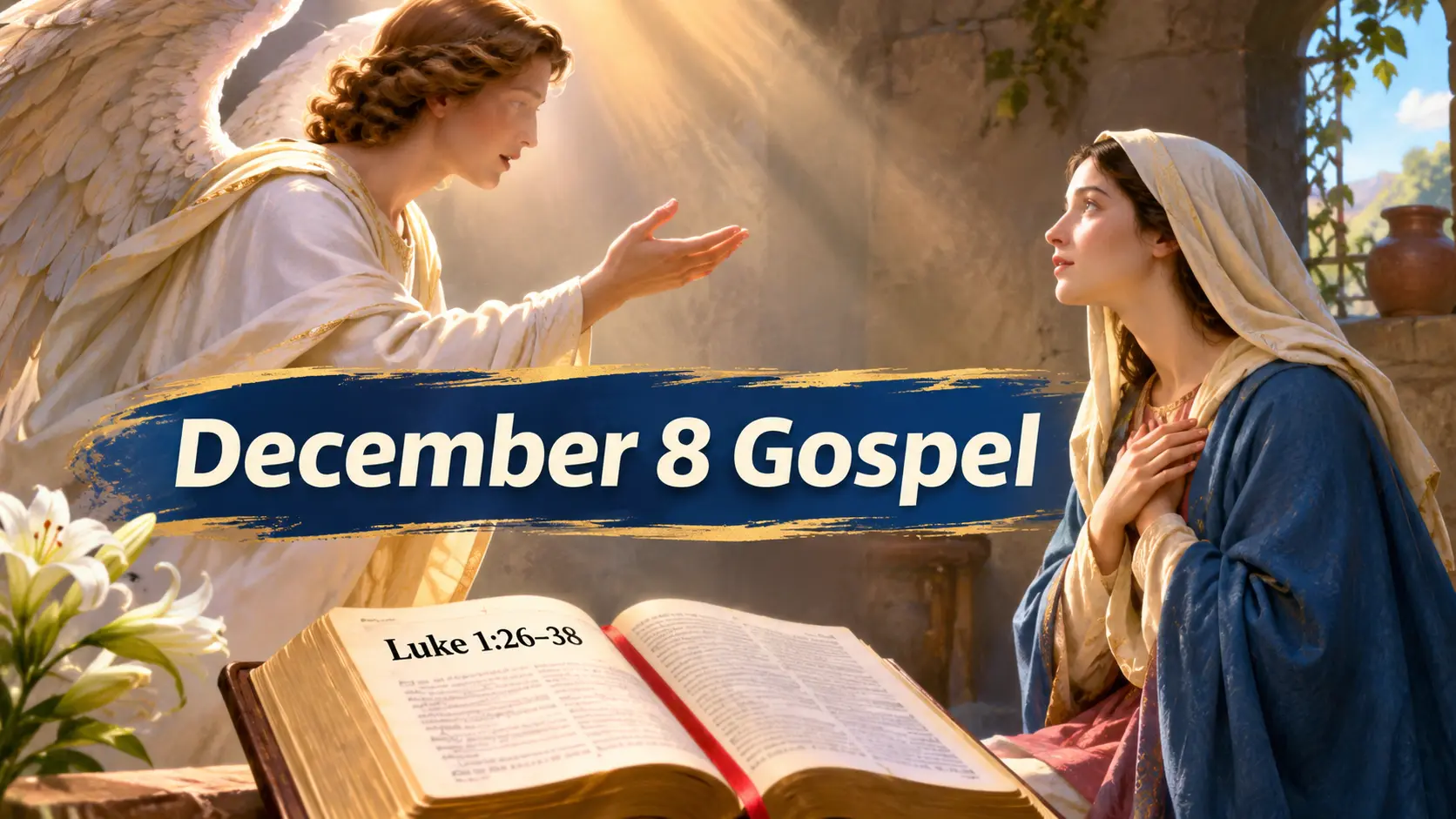

At Catholic Masses in the United States on December 8, 2026, the Gospel reading is Luke 1:26–38, which describes Gabriel announcing the birth of Jesus. This may seem unusual because the Immaculate Conception celebrates Mary’s conception, not the conception of Jesus.
The Church reads this Gospel because Gabriel’s greeting reveals the extraordinary grace Catholics associate with Mary’s Immaculate Conception. Although Luke does not describe Mary’s conception, the angel’s words help explain why the Church understands her place in God’s saving plan as unique.
What December 8 Celebrates
The Immaculate Conception refers to the Catholic belief that Mary was preserved from original sin from the first moment of her conception. According to this doctrine, she received that grace through the saving merits of Jesus Christ.
This is different from the Annunciation, when Gabriel told Mary that she would conceive Jesus through the Holy Spirit. The Annunciation is celebrated on March 25, while December 8 commemorates Mary’s own conception.
The canonical Gospels contain no account of Mary’s conception, but they do record Gabriel’s extraordinary greeting to her. Paragraphs 490–493 of the Catechism of the Catholic Church explain why Catholics understand those words in connection with the Immaculate Conception.
Why Luke Is Read
Luke 1:26–38 begins with Gabriel visiting Mary in Nazareth, where she was betrothed to Joseph. The angel announces that she will conceive Jesus, who will be called the Son of the Most High.
Before announcing the coming birth, Gabriel greets Mary with words emphasizing God’s favour toward her. This greeting provides the main connection between the Annunciation Gospel and the December 8 celebration.
Pope Benedict XVI explained this connection during his December 8, 2010 Angelus reflection. He described Gabriel’s greeting as revealing Mary’s special relationship with divine grace, which Catholic doctrine associates with her preservation from original sin.
The Gospel therefore reveals something the Church considers important about Mary rather than describing the event commemorated by the solemnity. Its central announcement still concerns Jesus, whose saving work is the foundation of the Catholic teaching about Mary’s Immaculate Conception.
Gabriel’s Greeting
Luke 1:28 KJV records Gabriel addressing Mary with the words “Hail, thou that art highly favoured”. The English Catholic Mass reading uses full of grace, a different translation of the same underlying Greek expression.
The Greek word kecharitōmenē comes from a verb associated with bestowing grace or favour. Its grammatical form presents Mary as someone who has received divine favour, emphasizing God’s action toward her.
Catholics understand this greeting within their broader teaching about Mary’s exceptional holiness. However, the Greek wording alone does not explicitly state that she was preserved from original sin at her conception.
This distinction helps explain why Christians interpret the passage differently. Many Protestant readers recognize Mary’s extraordinary favour without accepting that Luke 1:28 establishes the Catholic doctrine of the Immaculate Conception.
Gabriel’s words in Luke 1:30 provide further context by reassuring Mary that she has found favour with God. The angel then explains that she will become the mother of Jesus, connecting the greeting with the remarkable responsibility awaiting her.
The difference between highly favoured and full of grace is worth understanding when comparing Bible translations. The KJV is useful for studying the passage, although the English lectionary used at Catholic Masses in the United States is based on the New American Bible.
Mary’s Response
Gabriel’s announcement also shows how Mary responds when she learns that she will conceive Jesus through the Holy Spirit. After asking how this will happen, she accepts the message and the responsibility it brings.
In Luke 1:38 KJV, Mary responds, “be it unto me according to thy word.” Her answer expresses faith and willingness to follow God’s message despite the extraordinary circumstances.
Catholic teaching considers this response an important expression of Mary’s obedience to God. However, her acceptance did not cause the Immaculate Conception, which Catholic doctrine places at the beginning of her life.
Mary’s response also helps explain the connection between Luke and the first reading from Genesis. The Church traditionally contrasts her willing acceptance with the disobedience described in the account of Adam and Eve.
Families exploring Gabriel’s announcement during Advent can also use PsalmWisdom’s first-week Advent Bible reading plan. Its fifth-day reading covers Luke 1:26–38 and provides a simpler explanation of Mary’s encounter with the angel.
How the Readings Connect
The first reading for December 8 is Genesis 3:9–15, 20, which describes Adam and Eve after their disobedience. Catholic tradition connects this passage with Mary through the New Eve interpretation, contrasting Eve’s disobedience with Mary’s acceptance of God’s message.
This comparison appears in paragraph 494 of the Catechism, drawing on an interpretation found among early Christian writers. Genesis does not explicitly identify Mary but Catholic theology understands the comparison through the larger story of salvation.
Ephesians 1:3–6, 11–12 provides another connection by describing God’s grace and saving purpose through Jesus Christ. Although Paul addresses believers generally, Catholic teaching sees these themes as relevant to the special grace associated with Mary’s Immaculate Conception.
Psalm 98 adds a response of praise for God’s saving works rather than directly describing Mary’s conception. Its place in the liturgy directs attention toward the salvation revealed through Christ.
The official USCCB readings for December 8, 2026 bring these passages together. Genesis introduces humanity’s need for redemption, Ephesians emphasizes God’s gracious purpose and Luke announces the coming of Jesus through Mary.
This explains why the Church reads the Annunciation Gospel during the Solemnity of the Immaculate Conception. Gabriel’s greeting provides the central biblical connection, while the other readings place Mary’s role within the wider Christian understanding of salvation through Christ.
