
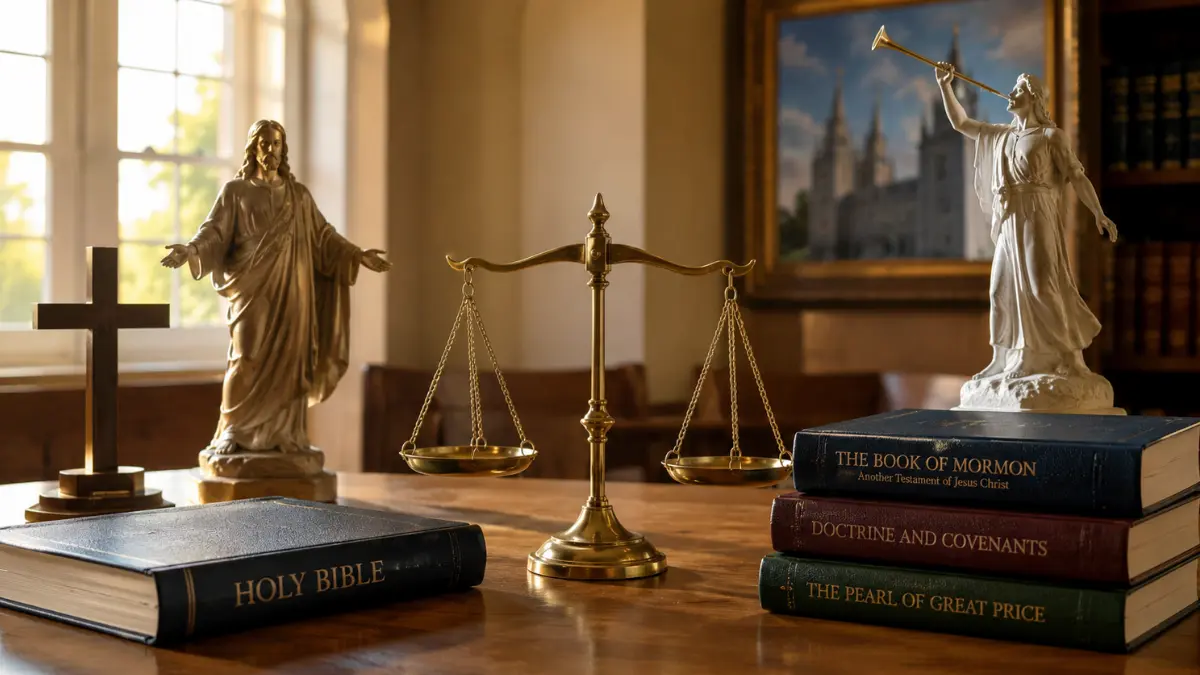

Latter-day Saints and historic Christians share belief in Jesus Christ, prayer, resurrection, moral responsibility and life after death. However, they understand several foundational doctrines differently, including the nature of God, the identity of Jesus, Scripture, salvation, human existence, church authority, temple ordinances and eternal destiny.
The Church of Jesus Christ of Latter-day Saints identifies itself as a Christian church centred on Jesus Christ. However, it describes itself as a restored church rather than a Catholic, Orthodox or Protestant denomination and does not accept the historic Christian creeds. Historic Nicene Christianity defines God as one divine being in three distinct Persons and confesses Jesus Christ as eternally divine and of one being with the Father.
This article uses historic Christianity to refer to the broad Nicene faith shared by Catholic, Eastern Orthodox, Anglican and many Protestant churches. These traditions disagree on several secondary questions but they share important beliefs about the Trinity, Christ’s divine identity, creation and the apostolic foundation of the Christian faith.
Also Read: John 3:16 Explained in Its Full Biblical Context
Latter-day Saints and Historic Christianity Compared
| Belief | Latter-day Saint teaching | Historic Christian teaching |
|---|---|---|
| God | The Father, Son, and Holy Ghost are three separate beings united in purpose | One God exists eternally as Father, Son and Holy Spirit |
| Jesus Christ | The divine Son of God, Savior and separate being from the Father | God the Son, eternally one in divine being with the Father |
| Scripture | The Bible, Book of Mormon, Doctrine and Covenants and Pearl of Great Price | The Old and New Testaments form the biblical canon |
| Revelation | God continues to reveal doctrine through living prophets | God guides the church but no later prophet replaces the apostolic gospel |
| Humanity | People lived with God as spirit children before birth | God creates human beings; they do not normally have a premortal personal existence |
| Salvation | Christ’s grace, faith, repentance, authorized ordinances, covenants and endurance | Salvation comes through Christ’s grace; traditions differ on faith, works and sacraments |
| Eternal destiny | Three kingdoms of glory, with exaltation in the highest celestial glory | Resurrection, judgment and eternal life with God or separation from Him |
| Religious authority | Restored priesthood authority through Joseph Smith | Authority continues through Scripture, apostolic faith, church ministry and tradition |
The table gives a general overview. Each difference requires further explanation because both groups sometimes use the same words while giving those words different theological meanings.
Do Latter-day Saints Believe in Jesus Christ?
Latter-day Saints believe that Jesus Christ is the Son of God, the Messiah, the Savior and Redeemer of humanity, and the central figure in God’s plan of salvation. They believe He lived a sinless life, died to overcome sin and death, rose bodily from the dead, and will return. Their official teachings state that salvation and eternal life become possible through His Atonement and Resurrection.
Therefore, it would misrepresent Latter-day Saint belief to claim that its members do not believe in Jesus or do not take Him seriously.
The deeper disagreement concerns who Jesus is within the nature of God.
Historic Christianity confesses Jesus as the eternal Son of God, “begotten, not made,” and fully sharing the one divine being of the Father. He became human without ceasing to be eternal God. The Father and Son remain distinct Persons but they do not exist as separate divine beings.
Latter-day Saint theology describes the Father and Jesus Christ as separate, glorified beings who remain perfectly united in purpose, doctrine, love and saving work. This understanding places Jesus within a different doctrine of God from the one expressed in the Nicene Creed.
Also Read: God Is Love — 1 John 4:8 Meaning Explained
The LDS Godhead and the Christian Trinity
The doctrine of God creates the clearest difference between Latter-day Saint beliefs and historic Christian beliefs.
The LDS Church teaches that God the Father, Jesus Christ and the Holy Ghost make up the Godhead. They are three separate beings who work in complete unity. The Father and Son possess glorified bodies of flesh and bones, while the Holy Ghost remains a personage of spirit.
Historic Christianity teaches the Trinity: one God who exists eternally as three distinct Persons—Father, Son and Holy Spirit. Christians do not believe that the three Persons are one Person wearing different forms. They also do not believe in three Gods. They believe the Father, Son and Holy Spirit fully share one indivisible divine nature.
This difference does not concern terminology alone. It changes how each tradition understands:
- The unity of God
- The eternal relationship between the Father and Son
- Christ’s divine identity
- The Holy Spirit
- Creation
- Worship
- Humanity’s possible destiny
Latter-day Saints sometimes use the word “Trinity,” but they do not mean one divine substance shared by three Persons. They mean three separate personages united in will and purpose.
The Holy Ghost
Both traditions describe the Holy Spirit or Holy Ghost as personal rather than an impersonal force. Both connect Him with revelation, spiritual guidance, sanctification, comfort and testimony.
Latter-day Saint doctrine identifies the Holy Ghost as a separate member of the Godhead and a personage of spirit. He does not possess the tangible body attributed to the Father and Son.
Historic Christianity identifies the Holy Spirit as fully divine and eternally one in being with the Father and Son. The Nicene Creed calls Him “the Lord, the giver of life” and declares that Christians worship and glorify Him with the Father and Son.
The difference therefore concerns more than the Holy Spirit’s work. It concerns whether He shares the one divine nature or belongs to a Godhead made up of separate beings.
Bible and Additional LDS Scriptures
Latter-day Saints accept the Bible as the word of God “as far as it is translated correctly.” They also accept the Book of Mormon as Scripture. Their broader canon includes four collections known as the standard works:
- The Bible
- The Book of Mormon
- Doctrine and Covenants
- The Pearl of Great Price
The LDS Articles of Faith also affirm past, present, and future revelation from God.
Historic Christian traditions receive the Old and New Testaments as canonical Scripture. Catholic, Orthodox and Protestant Christians disagree about some Old Testament books and about the relationship between Scripture and church tradition. However, none accepts the Book of Mormon, Doctrine and Covenants or Pearl of Great Price as apostolic Scripture.
The central difference involves the source of final doctrinal authority. Latter-day Saints understand the canon as open and accept continuing revelation through modern prophets. Historic Christianity believes that later teachers must remain accountable to the apostolic faith preserved in Scripture and cannot introduce a new canonical gospel.
Also Read: Hidden Meaning of Isaiah 60:22 Is Not Instant Success
Joseph Smith, Restoration and Church Authority
Latter-day Saint teaching says that Christ established His church through the apostles, but essential truths, ordinances and priesthood authority later disappeared during a Great Apostasy.
According to LDS belief, God began restoring the complete gospel through Joseph Smith in 1820. This restoration included additional Scripture, priesthood authority, prophets and apostles, church organization, temple ordinances and continuing revelation.
Historic Christianity rejects the claim that Christ’s church and priesthood authority entirely disappeared for centuries. Catholic and Orthodox churches emphasize apostolic succession. Protestant churches generally emphasize the continued authority of the biblical gospel and the community of believers, even when institutional churches become corrupt.
This disagreement explains many of the later differences. A person who accepts Joseph Smith as a restoring prophet will also consider the Book of Mormon, Doctrine and Covenants, restored priesthood, and temple ordinances authoritative. A person who rejects the restoration claim will not accept those doctrines as part of the original apostolic faith.
Salvation, Grace and Obedience
Both traditions teach that Jesus Christ makes salvation possible. Both reject the idea that people can overcome sin and death without Him.
However, they organize the relationship between grace, faith, ordinances, obedience, and eternal destiny differently.
Official LDS teaching distinguishes several meanings of salvation. Christ’s Resurrection guarantees resurrection from physical death for everyone. Salvation from sin requires faith in Christ, repentance, baptism by proper authority, receiving the Holy Ghost, and continued faithfulness. LDS teaching also distinguishes general immortality from eternal life or exaltation, which includes living in God’s presence and continuing in eternal family relationships.
Historic Christianity teaches that Christ’s death and Resurrection accomplish salvation and that grace, rather than human merit, provides its foundation. Christian traditions disagree about how faith, baptism, sacraments, obedience, perseverance, and good works relate to receiving and living within that grace.
Many Protestants emphasize justification through faith apart from works. Catholic and Orthodox churches give a larger role to baptism, sacraments, obedience, and participation in the life of the church. However, historic Christian traditions do not accept LDS priesthood ordinances, temple endowments, or restored covenants as necessary steps toward exaltation.
The difference should therefore not be reduced to “Christians believe in grace, while Latter-day Saints believe in works.” Latter-day Saints also speak strongly about Christ’s grace. The more accurate difference concerns the LDS covenant system, authorized ordinances, restored priesthood and the goal of exaltation.
Premortal Life and Human Identity
Latter-day Saints believe that human beings lived with God before birth as His spirit sons and daughters. They believe people received preparation in premortal life, accepted God’s plan, came to earth to receive physical bodies and now exercise moral agency without remembering that earlier existence.
Historic Christianity generally does not teach that every human person lived consciously with God before conception or birth. It teaches that God creates human beings in His image and gives them dignity, purpose and an eternal future.
This difference affects each tradition’s understanding of human identity. LDS teaching places mortal life within a longer journey that begins as a spirit child, continues through physical life and the spirit world and may culminate in exaltation.
Historic Christianity maintains a firm distinction between the uncreated God and created human beings. Some Christian traditions speak of glorification, sanctification or participation in God’s life, but they do not normally describe that hope through the LDS doctrine of premortal spirit children progressing toward the kind of life God lives.
Exaltation and Becoming Like God
Latter-day Saint teaching uses exaltation to describe the highest form of salvation. Exalted people live eternally in the presence of God, continue in family relationships, and become like their Heavenly Father. LDS teaching connects the highest degree of celestial glory with temple marriage and continued faithfulness to sacred covenants.
Historic Christianity also teaches that believers will become holy, glorified, immortal, and deeply united with God. Eastern Christianity often uses the term theosis for participation in divine life.
However, historic Christian teaching preserves the distinction between God by nature and human beings by creation. Christians may share in God’s life through grace, but they do not become separate gods equal to the one eternal Creator.
The two traditions therefore use similar language about becoming like God while placing that language within different understandings of God and humanity.
Temple Sealings and Eternal Families
Latter-day Saints distinguish ordinary meetinghouses from temples. They use temples for sacred ordinances that include the endowment, proxy work for the dead, and family sealings.
A temple sealing joins a husband and wife for time and eternity when they remain faithful to their covenants. Children may also become part of an eternally sealed family. LDS teaching connects eternal marriage with exaltation and the highest degree of celestial glory.
Historic Christian churches honour marriage as sacred, although they differ over whether they call it a sacrament or ordinance. They do not perform LDS sealing ceremonies or teach that a particular temple marriage forms a requirement for the highest eternal kingdom.
Historic Christianity also generally interprets Jesus’ teaching that people “neither marry, nor are given in marriage” after the resurrection differently from LDS teaching about eternal family sealings.
Baptism for the Dead
Latter-day Saints perform proxy baptisms for deceased people who did not receive baptism through proper priesthood authority during mortal life.
A living member receives baptism on behalf of the deceased person inside a temple. LDS teaching says that the deceased person retains freedom to accept or reject the ordinance in the spirit world.
Historic Christianity does not practice proxy baptism for the dead. Christian interpretations of 1 Corinthians 15:29 vary, but Catholic, Orthodox, and Protestant churches have not treated that verse as a command to baptize living people on behalf of deceased ancestors.
This practice reflects the wider LDS belief that authorized ordinances remain necessary and that God provides a way for people who died without receiving them.
The Three Kingdoms of Glory
Latter-day Saint theology teaches that resurrected people will inherit one of three kingdoms of glory:
- The celestial kingdom
- The terrestrial kingdom
- The telestial kingdom
The celestial kingdom represents the highest glory and includes life in the presence of the Father and Son. LDS teaching connects a person’s final kingdom with conversion, desires, conduct, ordinances, covenants and reception of Christ’s testimony.
Historic Christianity usually describes final destiny through resurrection, judgment, eternal communion with God and final separation from Him. Catholic, Orthodox, and Protestant traditions differ over several details, but they do not generally accept the LDS system of three eternal kingdoms.
The difference also involves the meaning of eternal life. In LDS teaching, nearly everyone receives resurrection, while exaltation belongs to those who inherit the highest celestial glory. Historic Christianity usually uses eternal life more broadly for final salvation and communion with God.
Beliefs They Share
The doctrinal differences remain substantial, but the traditions also share meaningful beliefs and values.
Both affirm:
- Jesus Christ’s historical life, crucifixion and Resurrection
- The importance of prayer and repentance
- Moral accountability
- The value of family life
- Service to neighbours
- Missionary activity
- Bodily resurrection
- Final judgment
- Life after death
- The need to follow Jesus
Latter-day Saints also use the Bible extensively and seek to organize their lives around faith, worship, family responsibility, charity and personal holiness.
Acknowledging these shared beliefs does not erase the theological differences. It helps readers compare the traditions accurately rather than relying on stereotypes.
Are Latter-day Saints Christians?
Latter-day Saints answer yes because they worship Jesus Christ as Savior, pray in His name, accept His Atonement and Resurrection, and seek to follow His teachings. They understand their church as the restored Church of Jesus Christ rather than a new religion disconnected from Him.
Historic Nicene churches often answer the question differently because the LDS Church rejects the traditional doctrine of the Trinity, accepts additional Scripture, teaches a nineteenth-century restoration, and defines God, humanity and exaltation outside the boundaries of the Nicene Creed.
The disagreement therefore depends partly on how someone defines “Christian.” A broad sociological definition may include any movement centred on Jesus Christ. A historic doctrinal definition usually requires agreement with the Trinity and the ancient Christian creeds.
Readers can recognize that Latter-day Saints sincerely identify as Christians while also acknowledging that LDS theology differs significantly from Catholic, Orthodox, Anglican and mainstream Protestant Christianity.
Understand the Differences Clearly
Latter-day Saints and historic Christians use many of the same religious terms, but they do not always give those terms the same meaning.
Their most important differences concern:
- Whether God consists of one divine being or three separate divine beings united in purpose
- Whether Jesus shares the one eternal essence of the Father
- Whether Scripture includes later LDS revelations
- Whether priesthood authority disappeared and required restoration
- Whether people lived with God before birth
- How grace, ordinances, and obedience relate to salvation
- Whether eternal life includes exaltation and eternal temple marriage
- Whether the afterlife contains three kingdoms of glory
A respectful comparison should neither claim that the two traditions believe the same doctrines nor misrepresent Latter-day Saint devotion to Jesus Christ.
Understanding the beliefs in their own terms allows readers to see where genuine agreement exists and where the two theological systems follow substantially different paths.
Frequently Asked Questions
Are Latter-day Saints Christians?
Latter-day Saints identify themselves as Christians because they worship Jesus Christ as the Son of God, accept His death and Resurrection, and seek to follow His teachings. Historic Nicene churches often classify LDS theology separately because it rejects the traditional Trinity and accepts additional scriptures, restored priesthood authority, and modern prophets.
Do Latter-day Saints believe in Jesus Christ?
Yes. Latter-day Saints believe Jesus Christ is the Son of God, Savior, Messiah, and Redeemer. The main disagreement with historic Christianity concerns His relationship with God the Father and the nature of the Godhead, not whether He holds an important place in LDS faith.
Do Latter-day Saints believe in the Trinity?
Latter-day Saints believe in the Father, Son, and Holy Ghost, but they do not accept the historic doctrine of the Trinity. They teach that the three members of the Godhead are separate beings who remain completely united in purpose, love, and saving work.
How do LDS and Christian beliefs about salvation differ?
Both teach that salvation depends on Jesus Christ and His grace. LDS teaching also connects eternal life and exaltation with faith, repentance, authorized ordinances, temple covenants, and continued faithfulness. Historic Christian traditions differ among themselves on faith, works, and sacraments, but they do not accept the LDS system of restored priesthood ordinances.

1 thought on “LDS Beliefs Compared With Historic Christianity”