
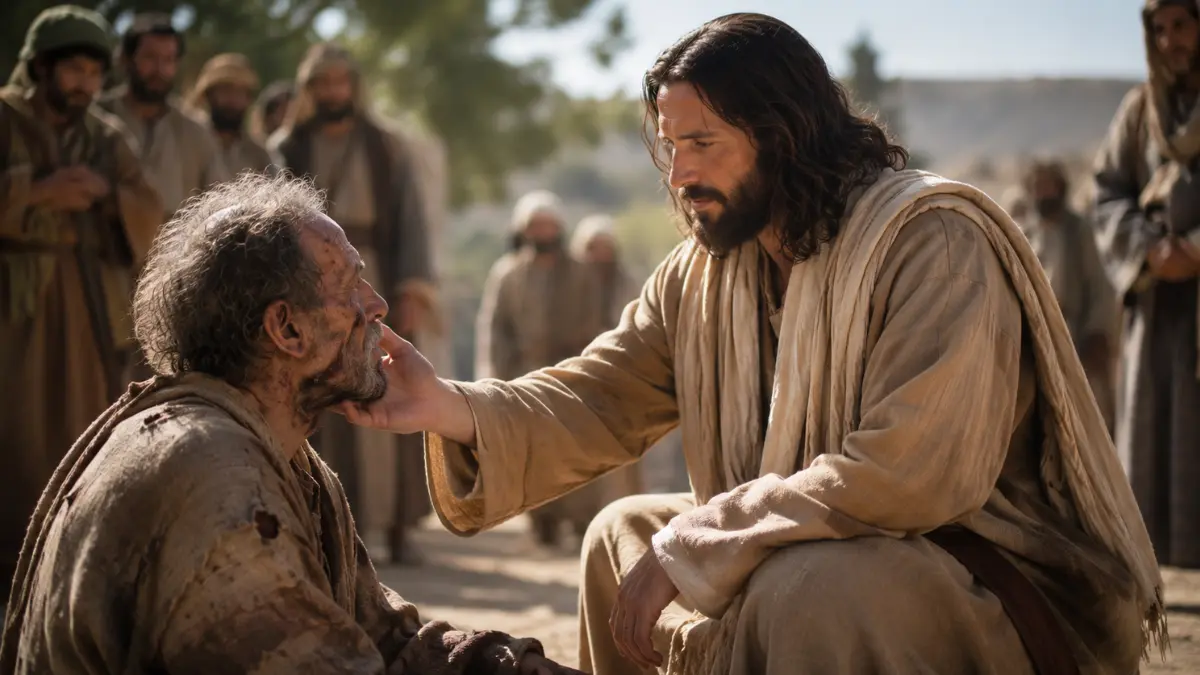

Why did Jesus touch the leper in Matthew 8:1–4? Jesus touched the man to reveal His compassion, willingness and authority to cleanse. The touch was not necessary for the miracle, but it showed that Jesus did not withdraw from someone suffering under disease, uncleanness and social separation.
Matthew places this healing immediately after the Sermon on the Mount. Jesus had taught with authority, and He now demonstrated that authority through action. A man with leprosy approached Him, knelt before Him, and said, “Lord, if You are willing, You can make me clean.”
Jesus reached out His hand, touched him and answered, “I am willing. Be clean.” The man became clean immediately. Jesus then instructed him to show himself to the priest and offer the gift Moses commanded.
This brief encounter reveals the compassion of Jesus, the humility of genuine faith and Christ’s authority to bring cleansing and restoration.
What Happens in Matthew 8:1–4?
Matthew 8 begins as Jesus comes down from the mountain with large crowds following Him. A man with leprosy approaches, kneels before Him, and asks to be made clean.
The word traditionally translated as “leprosy” could refer to several serious skin conditions in the biblical world. It should not automatically be understood as an exact reference to modern Hansen’s disease.
Whatever the precise condition was, the man had been declared ceremonially unclean under the regulations described in Leviticus. His condition affected more than his physical health. It also limited his participation in ordinary community and religious life.
The man approached Jesus and said:
“Lord, if You are willing, You can make me clean.”
Jesus touched him, declared His willingness and commanded him to be clean. The cleansing happened immediately.
Jesus then told the man to show himself to the priest and present the offering required by Moses. This step allowed the cleansing to be officially examined and confirmed.
Why Did the Leper Say, “If You Are Willing”?
The man’s words express confidence in Jesus’ power while placing the outcome under Jesus’ will. He does not ask whether Jesus is able to cleanse him. He asks whether Jesus is willing.
His request contains both faith and humility.
Faith says, “You can make me clean.”
Humility says, “The decision belongs to You.”
The man did not demand healing or speak as though Jesus owed him a miracle. He approached respectfully, acknowledged Christ’s authority and submitted his request to Christ’s will.
His example shows that biblical faith is not the same as demanding a particular outcome. Faith trusts God’s power, while humility accepts that His wisdom and will are greater than human expectations.
Matthew 8 does not promise that every request for physical healing will receive the same immediate answer. It does show that suffering people may approach Jesus honestly and confidently.
The man did not allow shame, isolation, or his condition to keep him from coming to Christ.
Why Did Jesus Touch the Leper Before Healing Him?
Jesus did not need physical contact to heal. In other Gospel accounts, He healed people from a distance and restored others simply by speaking.
His decision to touch this man was therefore intentional.
The touch visibly communicated compassion. Jesus did not treat the man merely as a condition to be corrected from a safe distance. He reached toward him personally.
The man’s condition had placed him under rules of separation and examination. Other people would normally have been cautious about approaching him. Jesus did not respond with fear or disgust.
He extended His hand.
The touch also answered the concern expressed in the man’s request. The man had asked whether Jesus was willing. Jesus responded with both an action and a declaration:
“I am willing.”
The touch visibly affirmed the man’s dignity as Jesus restored his health. The miracle displayed divine power, while the touch revealed the compassion behind that power.
This pattern appears throughout the miracles of Jesus recorded in Matthew. His miracles were not empty demonstrations. They revealed His authority, mercy, and identity.
Did Touching the Leper Make Jesus Unclean?
Matthew does not say that Jesus became ceremonially unclean. Instead, the narrative emphasizes what happened to the man. After Jesus touched him and commanded him to be clean, his condition ended immediately.
The safest conclusion is not that Jesus ignored the Law, but that His authority brought cleansing where uncleanness had ruled.
Jesus then instructed the man to complete the process Moses commanded by presenting himself to the priest. This instruction shows that Jesus did not treat the Law as meaningless.
The passage should therefore not be reduced to the claim that Jesus simply broke purity regulations. Matthew presents Him as the One who had authority to cleanse while still directing the healed man to follow the process established in Scripture.
The central result is clear: contact with the suffering man did not prevent Jesus from cleansing him.
Christ’s holiness and authority were not overcome by the man’s condition.
Why Did Jesus Say, “I Am Willing”?
Jesus’ answer directly addressed the question contained in the man’s request.
The man had said, “If You are willing.”
Jesus answered, “I am willing.”
He did not hesitate, shame the man or send him away. His response revealed personal compassion as well as divine authority.
The passage does not teach that Jesus will remove every illness immediately whenever someone asks. The Gospels record a specific miracle that reveals who Jesus is and what kind of authority He possesses.
The main truth is not that faithful people will never remain sick. The main truth is that Jesus is neither powerless nor indifferent toward human suffering.
His compassion does not weaken His authority and His authority does not make Him cold or distant.
Both are displayed together in this encounter.
Why Was the Healing Immediate?
Matthew says the man became clean immediately.
The speed of the cleansing emphasizes the complete authority of Jesus. He did not begin a treatment, perform a long ceremony, or wait to see whether the condition improved.
He spoke, and the condition ended.
The immediate result also distinguished the authority of Jesus from the role of the priest.
A priest could examine a person and determine whether cleansing had occurred. The priest could confirm the person’s condition and oversee the required rituals, but the priest did not create the healing.
Jesus did what the priest could only later verify.
The miracle therefore reveals more than compassion. It shows that Jesus possessed direct authority over the condition that had controlled the man’s life.
Why Did Jesus Send the Man to the Priest?
Jesus told the man to show himself to the priest because the priest had an official role in confirming that cleansing had occurred.
Leviticus 14 describes the process followed when a person appeared to have recovered from a serious skin condition. A priest examined the person and oversaw the required sacrifices, washing, and purification procedures.
The instructions included a cleansing process involving sacrifice, washing, and hyssop.
The priestly examination mattered because the man needed more than private confidence that he had been healed. He needed official confirmation that he could return to ordinary religious and community life.
Jesus therefore cared about complete restoration.
The man’s body had been cleansed, but the priestly process would publicly recognize that change.
Jesus’ command also demonstrated respect for the Law of Moses. He did not tell the man to ignore the established procedure. He sent him directly into it.
What Did Jesus Mean by “As a Testimony to Them”?
Jesus said that the man’s offering would serve as a testimony to the priests.
- The healed man’s appearance would provide visible evidence that something extraordinary had happened. The priest could examine the man and confirm that the condition was gone.
- The testimony was not merely the man’s spoken story. His restored condition and obedience to the required process would stand as evidence.
- The phrase may also carry a challenging element. The priests would be required to confront the reality that a man with a serious condition had been cleansed through the authority of Jesus.
Matthew does not explain precisely how every priest responded. The article should therefore avoid claiming more than the passage states.
What is clear is that Jesus wanted the healing to be properly examined and witnessed.
Why Did Jesus Tell the Man Not to Tell Anyone?
Jesus warned the man not to spread the news and told him to go directly to the priest.
Matthew does not fully explain every reason behind this instruction, so the passage should not be forced into one narrow interpretation.
At minimum, Jesus wanted the man to obey the priestly process without delay. The man’s first responsibility was not to attract attention but to follow Christ’s command.
Jesus also did not build His ministry around uncontrolled publicity. Crowds often gathered because they wanted miracles, while failing to understand His teaching, identity, or mission.
Mark 1:45 adds that the man spread the news widely, after which Jesus could no longer enter towns openly. Matthew does not include that result, but Mark helps explain how uncontrolled publicity could interfere with Jesus’ movements and ministry.
The healing was real, but the proper response began with obedience rather than self-directed publicity.
What Does This Miracle Reveal About Jesus?
The cleansing of the leper reveals several important truths about Christ.
Jesus Has Authority to Cleanse
The condition that controlled the man’s life ended at Jesus’ command. The healing was immediate and complete.
Jesus Responds With Compassion
Jesus saw more than a medical or ceremonial problem. He saw a suffering person and reached toward him.
Jesus Welcomes Those Who Approach Him
The man came in humility and faith. Jesus did not reject him because of his condition or uncleanness.
Jesus Restores More Than Physical Health
The healing opened the way for the man to return to community and religious life after priestly confirmation.
Jesus Respected the Law of Moses
He commanded the man to follow the process Scripture required. His compassion did not lead Him to dismiss God’s revealed instructions.
Jesus’ Holiness Is Not Fragile
The man’s condition did not overpower or prevent Christ from acting. Jesus brought cleansing into a situation defined by uncleanness.
What Can Christians Learn From the Leper’s Faith?
The leper provides a helpful model for approaching Christ.
- He came honestly. He did not hide his need or pretend that nothing was wrong.
- He came confidently. His words showed that he believed Jesus had the power to cleanse him.
- He came humbly. He placed the request under Christ’s will instead of making a demand.
- He came directly. Shame, separation, and suffering did not destroy his hope that Jesus might receive him.
Christians can follow that pattern in prayer. Faith does not require pretending that pain is easy. Humility does not require doubting God’s power.
A believer may name a need clearly, trust Christ’s authority, and place the result in His hands.
The passage also challenges Christians to consider how they respond to people whom society avoids. Jesus did not respond to the man with contempt or disgust.
Christian compassion should recognize human dignity while acting with wisdom, truth, and faithfulness.
Is Leprosy a Symbol of Sin in This Passage?
Leprosy is sometimes used in Christian teaching as an illustration of sin because both involve uncleanness, separation, and the need for cleansing.
However, Matthew does not explicitly identify the man’s condition as a symbol of sin or say that personal wrongdoing caused his illness.
The miracle should first be understood as the real cleansing of a suffering man.
A spiritual comparison may be made carefully, but it must not replace the passage’s historical meaning or imply that sickness proves personal guilt.
Jesus elsewhere rejected the assumption that every physical condition could be directly traced to a particular personal sin.
The safest interpretation begins with what Matthew clearly records: a suffering man approached Jesus in faith, and Jesus willingly cleansed him.
What Is the Main Meaning of Matthew 8:1–4?
The main meaning of Matthew 8:1–4 is that Jesus possesses compassionate authority to cleanse and restore.
His touch shows that He did not recoil from the person who came to Him in need. His command shows that the man’s condition could not resist His authority.
The man’s request reveals faith that trusted Jesus’ ability while submitting to His will.
Jesus’ response reveals a Savior whose power is personal, willing, and complete.
The priest could confirm that cleansing had occurred. Jesus caused it to occur.
The crowd could keep its distance. Jesus reached out His hand.
The man asked whether Christ was willing. Jesus answered clearly.
Matthew begins the encounter with a man living under disease, uncleanness, and separation. It ends with that man cleansed and sent toward full public restoration.
Frequently Asked Questions
Why did Jesus heal the leper in Matthew 8?
Jesus healed the leper to restore both physical health and social dignity. The act revealed God’s mercy toward those excluded and showed that compassion is central to Jesus’ mission.
Was Jesus breaking the law by touching the leper?
Jesus did not abolish the law. He honoured its purpose while revealing its deeper intent. His touch showed that holiness restores rather than avoids those who suffer.
Why was leprosy such a serious issue in biblical times?
Leprosy caused social, religious, and emotional isolation. Those affected were excluded from community life, worship, and relationships, making the condition deeply dehumanizing.
Why did Jesus tell the healed man to see the priest?
This instruction ensured full social and religious restoration. It showed that compassion and obedience to the law work together.
What is the main message of Jesus’ healing?
The central message is that compassion fullfills God’s law by restoring life, dignity, and community.

2 thoughts on “Why Did Jesus Touch the Leper? Matthew 8:1–4 Explained”