
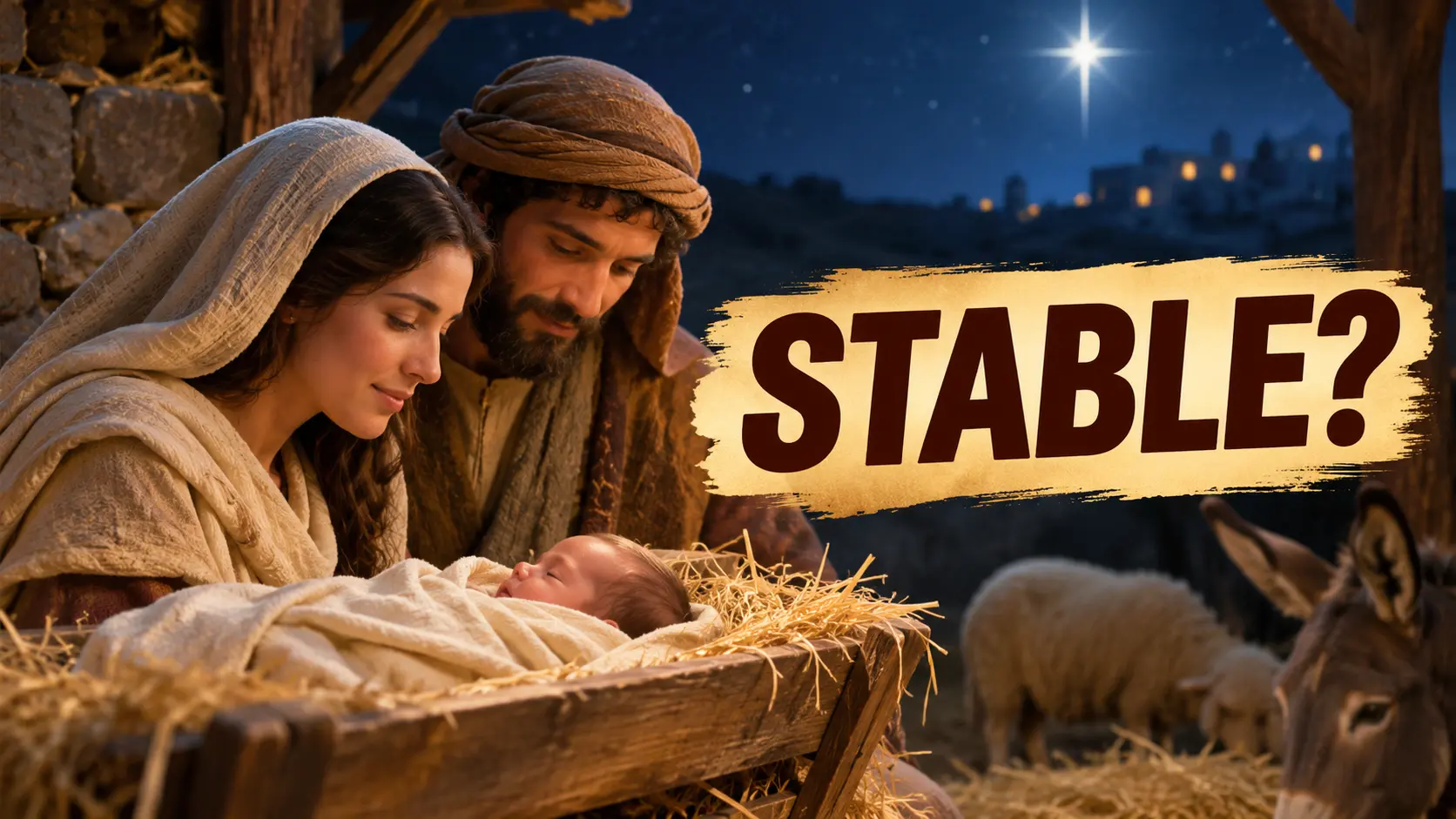

The Bible never explicitly says Jesus was born in a stable. Luke 2:7 tells us that Mary gave birth to Jesus in Bethlehem, wrapped Him in swaddling clothes and laid Him in a manger because there was no room available for them in their lodging.
The manger is the main reason people associate Jesus’ birth with a stable. However, a feeding trough does not necessarily mean the birth happened inside a separate shelter for animals. The original Greek wording of Luke 2:7 also raises an important question about whether Mary and Joseph were staying at a public inn or somewhere else.
What Luke 2:7 Actually Says
Luke describes the birth of Jesus in a single verse, without identifying the building where Mary gave birth. The King James Version records:
“And she brought forth her firstborn son and wrapped him in swaddling clothes, and laid him in a manger; because there was no room for them in the inn.” — Luke 2:7 (KJV)
The verse gives us three details that help explain the circumstances of Jesus’ birth:
- Mary gave birth to her firstborn son. Luke identifies the birth but does not describe the room or building where it occurred.
- Jesus was laid in a manger. Mary used a feeding trough as a resting place for her newborn child.
- There was no room available in their lodging. The lack of suitable space explains why the manger was used.
An important distinction is that Luke says Jesus was laid in a manger, not that He was born inside one. The manger was where Mary placed Him after His birth, and the passage does not identify exactly where she delivered the child.
Luke 2:6 also says that the time came for Mary to give birth while she and Joseph were in Bethlehem. It does not describe them reaching the town at the last moment or searching desperately for accommodation while Mary was already in labor.
This leaves the precise circumstances of their arrival uncertain. The familiar picture of a hurried search for shelter may be possible but it is not something Luke actually records.
Does a Manger Mean a Stable?
A manger was a feeding trough used to hold food for animals. The Greek word phatnē, used in Luke 2:7, refers here to this kind of feeding place.
Because mangers were associated with livestock, a stable seems like a natural setting for Jesus’ birth. However, the presence of a manger does not tell us whether it stood inside a separate stable, a cave used for animals or part of a larger household.
Where Were Mangers Kept?
In some ancient homes, animals were accommodated within or alongside the main dwelling. A household might have a lower section or an adjoining area where animals could be sheltered, with feeding troughs nearby.
This arrangement means that a manger could have been available without Mary and Joseph needing to stay in a separate barn. If they were inside a house with an area used for animals, Mary could have placed Jesus in a feeding trough within the same building.
Such household arrangements are historically plausible, although Luke does not describe the construction of the building where Jesus was born. The possibility of a domestic setting should therefore be considered without treating it as an established biblical fact.
Did Luke Really Mean an Inn?
The word “inn” in Luke 2:7 has shaped the traditional understanding of Jesus’ birth for centuries. Many readers imagine Mary and Joseph approaching a crowded public inn, being refused accommodation and eventually finding shelter among animals.
However, the original Greek word translated as “inn” is kataluma. It can describe a guest room or a more general place of lodging and its meaning depends on the context.
Inn or Guest Room?
Different English Bible translations reflect the uncertainty surrounding the word.
| Bible Translation | Term Used in Luke 2:7 |
|---|---|
| King James Version (KJV) | Inn |
| English Standard Version (ESV) | Inn, with a footnote allowing “guest room” |
| New International Version (NIV) | Guest room |
| Christian Standard Bible (CSB) | Guest room |
The difference matters because a guest room suggests a potentially different situation from a commercial inn. Mary and Joseph might have been staying in a household where the designated guest space was unavailable or unsuitable.
Luke uses kataluma again in Luke 22:11 when referring to the guest room where Jesus would eat the Passover with His disciples. In that passage, the word clearly refers to a room associated with a house.
Interestingly, Luke uses another Greek word, pandocheion, in Luke 10:34 when describing the inn where the Good Samaritan took an injured traveller. That term refers more specifically to a public lodging establishment.
This comparison supports the possibility that kataluma in Luke 2:7 refers to a guest room rather than a commercial inn. Nevertheless, biblical scholars have proposed different interpretations, including the broader meaning of a place to stay.
The original Greek makes the traditional public-inn interpretation uncertain but it does not prove that Mary and Joseph were staying in a private family home. Both the meaning of the word and the surrounding circumstances must be considered before drawing conclusions.
Where Could Jesus Have Been Born?
If Luke does not explicitly identify a stable, several possible settings remain consistent with the presence of a manger. None can be established with certainty from the birth narrative alone.
Inside a House
One interpretation is that Mary and Joseph were staying in a house where the guest room was unavailable or lacked sufficient space. An area ordinarily used for animals could have provided access to a manger.
Under this explanation, Jesus might have been born within a household rather than inside a separate stable. Mary could then have placed Him in a feeding trough located in the animal area of the building.
This interpretation connects the possible meaning of kataluma with the presence of a manger. However, Luke never identifies the house, its owner or the arrangement of its rooms, so these details remain possibilities rather than confirmed facts.
Inside a Stable
A separate stable remains a reasonable possibility because such a shelter could have contained a feeding trough. Nothing in Luke 2:7 rules out this setting.
The difficulty is that Luke does not actually name a stable or describe Mary and Joseph entering one. He records the manger without explaining whether it was located inside a separate animal shelter or somewhere connected to a dwelling.
Therefore, the traditional stable scene is not necessarily incorrect. It simply represents a possible reconstruction rather than a setting explicitly identified in Scripture.
Inside a Cave
Another possibility comes from early Christian traditions that associated Jesus’ birth with a cave. Caves could be used as shelters for animals, making the presence of a feeding trough understandable.
However, Luke 2:7 contains no reference to a cave and the tradition does not establish the exact location of Jesus’ birth. Like the stable interpretation, it remains a possibility that goes beyond the details recorded in the Gospel.
What the Shepherds Found
The manger appears again when the angel announces Jesus’ birth to the shepherds. In Luke 2:12, the angel explains that they will recognize the child because He will be wrapped in swaddling clothes and lying in a manger.
This is significant because the manger serves as an identifying sign. The angel does not tell the shepherds to search for a stable, cave or particular type of house.
Luke 2:16 then records that the shepherds hurried to Bethlehem and found Mary, Joseph and the baby lying in the manger. Their discovery confirms the detail previously described in Luke 2:7.
Yet Luke still does not identify the surrounding building. Even when describing the shepherds’ arrival, he focuses on the people and the manger rather than the structure in which they were staying.
The shepherds’ account therefore strengthens the biblical evidence for the manger without resolving the question of whether Jesus was born in a stable.
What About the Innkeeper and Animals?
Traditional Nativity scenes often include an innkeeper, a crowded lodging house and animals gathered around the newborn Jesus. These details make the story easy to visualize but they are not all stated in Luke’s account.
Three familiar elements deserve particular attention:
- The innkeeper: Luke never mentions an innkeeper refusing Mary and Joseph accommodation or directing them toward a stable.
- The rejection: The passage explains that suitable space was unavailable but it does not say anyone deliberately rejected the couple.
- The animals: Although a manger was associated with livestock, Luke does not identify any animals present when Jesus was born.
These additions are understandable because people naturally imagine the surroundings of a feeding trough. Over generations, Christmas artwork, Nativity displays and storytelling have helped establish the stable as the familiar setting.
However, a traditional illustration and a biblical description are not necessarily the same thing. A stable filled with animals may represent one possible interpretation but the details should not be presented as though Luke explicitly recorded them.
The broader account is explained in the Christmas story in the Bible, where the events surrounding Jesus’ birth are considered together. Luke 2:7 itself provides a much narrower description of the circumstances.
