
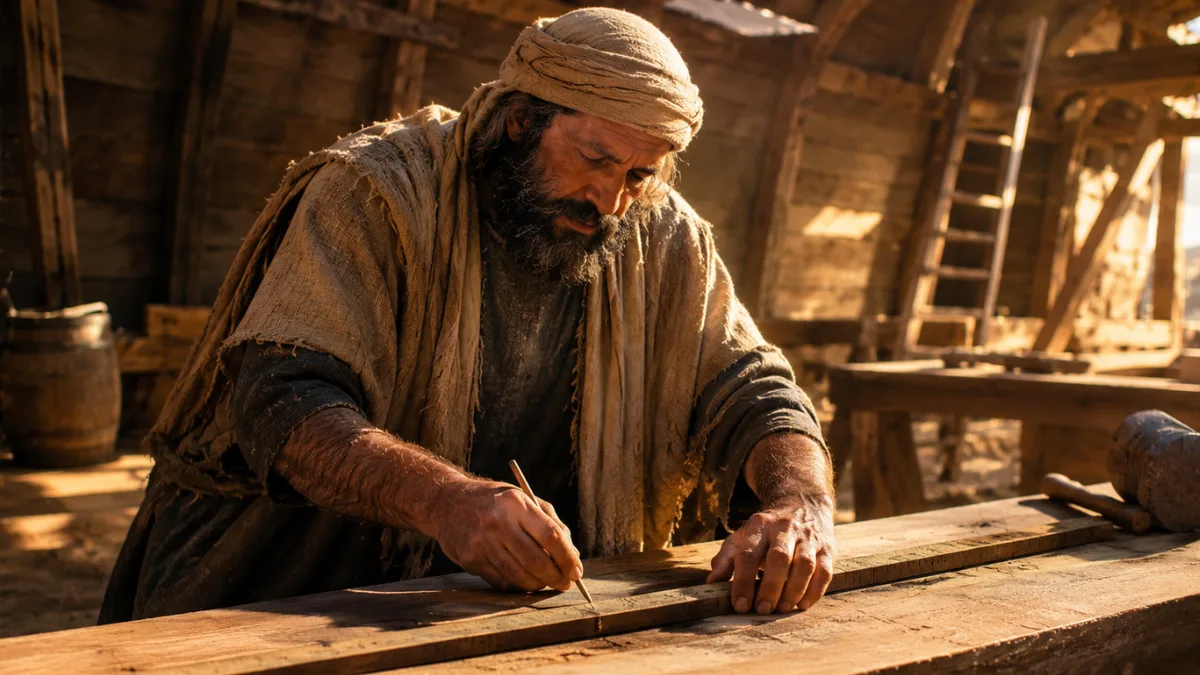

How long is a cubit in the Bible? A cubit was an ancient unit of length based roughly on the distance from the elbow to the fingertips. Ancient cubit standards could vary, while 18 inches is a common modern approximation used when converting biblical measurements into feet.
Using that familiar 18-inch estimate, Noah’s Ark would have been approximately 450 feet long, 75 feet wide, and 45 feet high. Genesis itself gives the dimensions as 300 cubits long, 50 cubits wide and 30 cubits high, so any conversion into modern feet or meters remains approximate.
This distinction matters because the Bible gives a clear measurement in cubits without telling modern readers exactly how many inches were intended by the cubit used in Genesis 6.
How Long Was a Cubit in Biblical Times?
The cubit was a common ancient unit whose basic idea came from the human forearm. It represented roughly the distance from the elbow to the end of the middle finger.
That made it a practical basis for measuring length in societies that did not use modern inches, feet, or meters.
The Bible Odyssey explanation of the cubit notes that ancient Near Eastern cubits could fall roughly within the range of 17.5 to 20 inches. This helps show why modern readers should not assume that every ancient cubit everywhere represented one perfectly identical length.
That range describes ancient cubit standards generally. It does not tell us exactly which length was intended for Noah’s Ark.
For simple Bible conversions, an 18-inch cubit is commonly used. Since 18 inches equals 1.5 feet, it provides an easy way to visualize dimensions that the biblical text gives only in cubits.
The important point is to distinguish between the ancient biblical measurement and the modern estimate. Genesis says 300 cubits. Saying 450 feet requires the additional assumption that one cubit is approximately 18 inches.
What Measurements Does Genesis Give for Noah’s Ark?
Genesis 6:15 gives Noah three basic dimensions for the Ark:
- Length: 300 cubits
- Width: 50 cubits
- Height: 30 cubits
These are the measurements actually stated in the biblical text.
Using an 18-inch cubit gives the familiar modern estimate:
- Length: approximately 450 feet
- Width: approximately 75 feet
- Height: approximately 45 feet
In metric units, that is approximately:
- 137 meters long
- 23 meters wide
- 14 meters high
These modern figures help readers picture the scale of the structure described in Genesis, but they should not replace the original biblical measurements.
The biblical measurement is 300 × 50 × 30 cubits. The 450 × 75 × 45-foot version is a conversion based on an assumed cubit length.
Why Is 450 Feet Only an Approximate Conversion?
The arithmetic itself is simple.
If one cubit is assumed to equal 18 inches, then:
300 cubits × 18 inches = 5,400 inches.
Dividing by 12 inches per foot gives:
450 feet.
The same calculation produces 75 feet for the width and 45 feet for the height.
The uncertainty is not in the multiplication. It is in the first assumption: Was the cubit intended in Genesis 6 exactly 18 modern inches?
Genesis does not say.
Ancient societies used cubit standards of somewhat different lengths, and Scripture itself provides evidence that a longer cubit could sometimes be distinguished from another standard.
For this reason, 450 feet is best described as a reasonable conventional estimate, not an exact reconstruction of Noah’s Ark to the modern inch.
This wording also prevents two opposite errors. There is no reason to pretend that the dimensions in Genesis are meaningless because cubits varied, but there is also no basis for claiming greater modern precision than the text provides.
Genesis gives the size very clearly in its own measurement system.
Did the Bible Use More Than One Cubit Standard?
There is strong biblical evidence that at least a longer cubit standard could be recognized.
Ezekiel 40:5 describes the measuring rod used in the prophet’s Temple vision and explains the cubit involved as a cubit plus a handbreadth. Several English translations therefore refer to it as a “long cubit.”
A handbreadth was itself another ancient body-based unit, roughly connected with the width of the hand.
The significance of Ezekiel’s wording is not that it tells us the length of Noah’s cubit. It shows that the biblical world could distinguish between cubit standards.
If every cubit were automatically identical, there would be little reason for Ezekiel to specify that the unit contained an additional handbreadth.
However, that information should not be transferred directly into Genesis 6. Ezekiel identifies a longer measurement for his particular context, while Genesis simply states Noah’s Ark dimensions in cubits without a comparable qualification.
Ezekiel therefore confirms that different cubit standards could be recognized, but it does not identify which exact standard Genesis intends for Noah’s Ark.
That is another reason modern measurements should remain approximate.
What Were Noah’s Ark’s Proportions?
One useful feature of the Genesis measurements does not depend on knowing the exact length of a cubit at all: the Ark’s proportions.
Genesis gives:
300 cubits long × 50 cubits wide × 30 cubits high.
The length-to-width ratio is therefore:
300 ÷ 50 = 6
So the Ark was described as six times as long as it was wide.
The length-to-height ratio is:
300 ÷ 30 = 10
So it was ten times as long as it was high.
These proportions remain unchanged regardless of whether someone converts the cubit using 18 inches or another historically plausible standard.
That makes them more certain than the modern conversion.
If a reader pictures an Ark 450 feet long, the 75-foot width and 45-foot height preserve exactly the same 300:50:30 relationship stated in Genesis.
The proportions also make clear that the biblical description is not of the small, rounded boat frequently seen in children’s illustrations. Genesis describes an elongated structure with specifically stated dimensions.
Nothing more needs to be claimed from those proportions. They do not by themselves prove conclusions about engineering, seaworthiness, animal capacity, or the historical mechanics of the Flood. Those are separate questions from the measurement intent of this passage.
Was a Cubit Literally Measured With Someone’s Arm?
The forearm explains where the measurement concept came from, but that does not mean ancient builders necessarily measured every structure by repeatedly placing a person’s arm against it.
Body-based units could become standardized.
Ancient systems used measures based on familiar parts of the body, including cubits, spans, handbreadths, and fingers. Once recognized standards existed, measuring rods and other tools could reproduce those units more consistently than using a different person’s arm each time.
This explains how a cubit could originate from the human body while functioning as a practical building measurement.
It also helps explain why several standards could exist. One culture, period, or specific measuring system might define a cubit somewhat differently from another without making the unit useless.
When Genesis gives Noah’s Ark as 300 cubits long, it presents a meaningful ancient measurement. The uncertainty arises only when modern readers try to convert that ancient standard into an exact number of inches.
Where Else Does the Bible Use Cubits?
Noah’s Ark is far from the only biblical object measured in cubits.
One particularly familiar example is the Ark of the Covenant. Exodus describes that sacred chest as two and a half cubits long, one and a half cubits wide, and one and a half cubits high.
Readers interested in that separate object can explore PsalmWisdom’s detailed study of the Ark of the Covenant, its construction, meaning, and biblical history.
The shared word “ark” can cause confusion, but Noah’s Ark and the Ark of the Covenant were completely different objects. Their relevance here is simply that both demonstrate how naturally Scripture uses cubits for physical dimensions.
Cubits also appear in descriptions involving the tabernacle, Temple structures, altars, walls, and other objects or distances.
Understanding the cubit therefore helps with many biblical passages beyond Genesis 6.
Why Do Some Bibles Say 450 Feet Instead of 300 Cubits?
Bible translations sometimes handle ancient measurements differently.
One approach preserves the original unit and prints 300 cubits.
Another translates the measurement into an approximate modern equivalent such as 450 feet so readers can understand the scale immediately.
Both approaches are attempting to communicate Genesis 6:15.
The difference is that one keeps the ancient unit visible, while the other supplies a modern conversion based on an assumed cubit length.
A translation that says “300 cubits” leaves the conversion to the reader or a study note.
A translation that says “450 feet” has effectively made the 18-inch-cubit calculation for the reader.
This is useful, but it can also hide an important detail: the original Hebrew text does not contain a unit equivalent to modern feet.
Therefore, when two Bible translations appear to give “300 cubits” and “450 feet,” they are not necessarily describing different Arks. They are representing the same Genesis dimensions using different measurement systems.
The modern figure should still be understood as approximate.
Can We Know the Exact Size of Noah’s Ark in Feet?
We cannot establish its exact modern dimensions to the inch from Genesis alone.
What we can know directly from the text is:
300 cubits long 50 cubits wide 30 cubits high
If the familiar 18-inch conversion is used, that becomes approximately:
450 feet long 75 feet wide 45 feet high
or roughly:
137 meters long 23 meters wide 14 meters high
Those figures are useful for visualization and comparison.
What Genesis does not provide is a statement defining Noah’s cubit as exactly 18 modern inches. Because ancient cubit standards were not universally identical, the conversion should remain qualified.
The clearest way to state Noah’s Ark dimensions is therefore:
Genesis gives an exact ancient measurement of 300 × 50 × 30 cubits. Using the common 18-inch approximation gives about 450 × 75 × 45 feet.
That preserves both the biblical text and the limits of modern conversion.
