
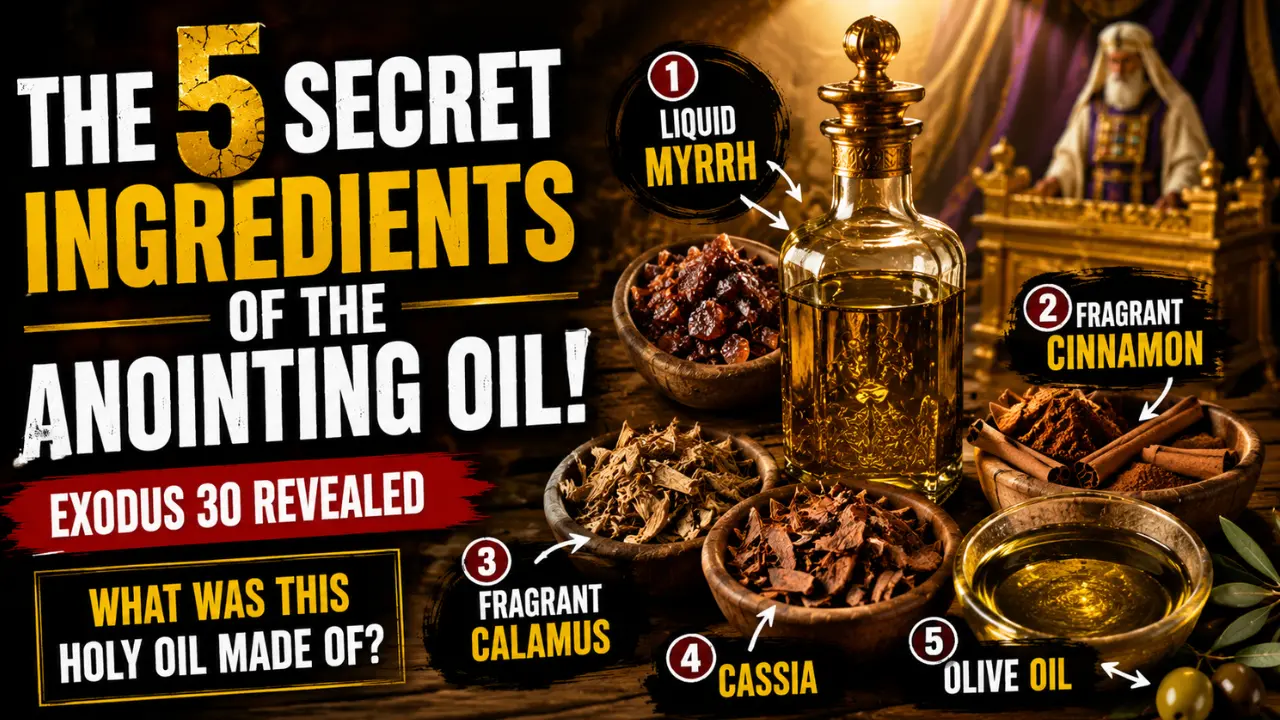

The five ingredients of the holy anointing oil are listed in Exodus 30:22–25. God commanded Moses to prepare this sacred oil for the tabernacle, its furnishings and the priests who served before Him.
The five ingredients were:
- liquid myrrh
- fragrant cinnamon
- fragrant calamus
- cassia
- olive oil
This was not ordinary oil for personal use. It was a holy mixture set apart for worship, consecration and priestly service.
Where the Oil Recipe Appears in the Bible
The recipe appears in Exodus 30, where the Lord gives Moses detailed instructions for sacred worship. The anointing oil was prepared from costly spices and olive oil, blended by the skill of a perfumer.
The passage gives specific measurements:
- 500 shekels of liquid myrrh
- 250 shekels of fragrant cinnamon
- 250 shekels of fragrant calamus
- 500 shekels of cassia
- 1 hin of olive oil
These details show that the oil was carefully prepared according to God’s command. Israel was not free to invent its own sacred mixture. The oil belonged to the worship order God gave for the tabernacle.
1. Liquid Myrrh
Liquid myrrh was a fragrant resin valued in the ancient world for its strong aroma. It was costly, rich and often associated with perfume, burial preparation and precious offerings.
In the holy anointing oil, myrrh formed one of the largest portions of the spice mixture. Its presence gave the oil a deep fragrance and helped mark it as something distinct from common use.
Myrrh’s value also reflected the seriousness of what the oil was used for. The oil was not casual or cheap. It was prepared for holy service before the Lord.
Also Read: Did Jesus Ever Use Oil in the Bible?
2. Fragrant Cinnamon
Fragrant cinnamon added warmth and sweetness to the sacred oil. In the biblical world, cinnamon was a valuable spice used in aromatic mixtures and perfumes.
Its inclusion shows that the holy anointing oil was meant to be carefully and beautifully prepared. The fragrance itself helped distinguish sacred use from ordinary use.
The oil was not simply functional. It carried a sense of honour, beauty and reverence because it was connected to the worship of God.
3. Fragrant Calamus
Fragrant calamus, also called aromatic cane, was another sweet-smelling ingredient in the oil. It came from a plant valued for its fragrance and was used in perfumes and sacred mixtures.
Calamus helped complete the distinctive aroma of the holy oil. Like the other spices, it was included because God commanded a mixture that was set apart from everyday use.
The ingredient reminds readers that the anointing oil was not a random blend. Each part belonged to a sacred recipe given for consecration.
4. Cassia
Cassia was a fragrant spice similar to cinnamon but stronger in character. It was used in perfumes and rich aromatic blends.
In Exodus 30, cassia appears in the same amount as myrrh, making it one of the major spice ingredients in the mixture. Its strength and fragrance added depth to the holy oil.
Cassia helped form an oil that was rich, weighty and distinct. The mixture was meant to be recognized as sacred, not confused with ordinary household oil.
5. Olive Oil
Olive oil was the base that carried all the spices together. It blended the myrrh, cinnamon, calamus and cassia into one holy anointing oil.
Olive oil was common in daily life but in Exodus 30 it was set apart for sacred use. When combined with the appointed spices according to God’s command, it became part of a holy mixture used for consecration.
The olive oil made the fragrance usable for anointing the tabernacle, sacred objects and priests.
What the Anointing Oil Was Used For
The holy anointing oil was used to consecrate what belonged to God’s worship.
It was applied to:
- the tabernacle
- the ark of the covenant
- the table and its utensils
- the lampstand and its utensils
- the altar of incense
- the altar of burnt offering
- the basin
- Aaron and his sons
The purpose was to mark these people and objects as holy, set apart for service before the Lord.
Also Read: How Oil Was Used in Biblical Worship and What It Meant
Why the Oil Was Holy
Exodus 30 repeatedly emphasizes that the oil was holy. It was not to be copied, imitated or used like ordinary perfume. God warned Israel not to pour it on an ordinary person or make another mixture like it for common use.
This matters because the holiness of the oil came from God’s command and sacred purpose. The ingredients were valuable but the oil was holy because God appointed it for worship.
The oil pointed to consecration. What was anointed with it was no longer treated as common.
Was the Anointing Oil Magical?
The Bible does not present the anointing oil as magical. Its importance did not come from secret power inside the ingredients.
The oil mattered because God commanded it and assigned it a sacred role in worship. It was a visible sign that something or someone had been set apart for the Lord.
The focus is not superstition. The focus is holiness, obedience and consecration.
What Are the 5 Ingredients of the Anointing Oil?
The five ingredients of the holy anointing oil in Exodus 30 were liquid myrrh, fragrant cinnamon, fragrant calamus, cassia and olive oil.
God gave this recipe to Moses for a sacred oil used in tabernacle worship. It was prepared carefully, used reverently and reserved for consecrating the holy things and priests connected to service before the Lord.
