
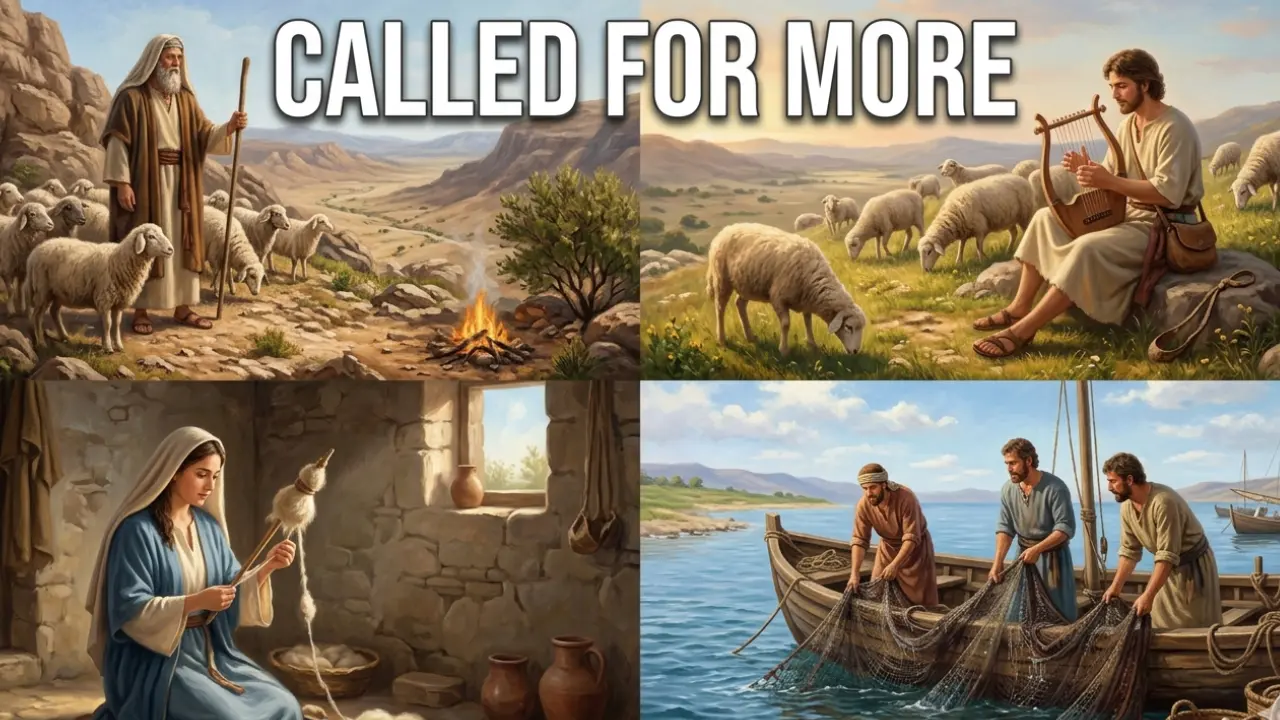

People often assume God works primarily through the powerful, educated, influential or spiritually extraordinary. Scripture tells a remarkably different story.
Again and again, the Bible reveals God calling shepherds, fishermen, fearful individuals, unknown young people, tax collectors, farmers and even former enemies to accomplish purposes far greater than themselves. These stories are not random historical details scattered throughout Scripture. Together, they reveal a consistent pattern in how God works throughout history.
The remarkable truth woven throughout the Bible is that God rarely begins with outward greatness. Instead, He shapes ordinary people through obedience, dependence, faith, humility and willingness. Scripture repeatedly shows that divine calling is not built upon status, talent, wealth, influence or public recognition [how God develops faith through obedience — How Obedience Strengthens Your Relationship With God].
QUICK OVERVIEW
| Biblical Person | Ordinary Beginning | Spiritual Lesson |
|---|---|---|
| Moses | Shepherd | God prepares quietly |
| David | Shepherd boy | God sees the heart |
| Gideon | Fearful man hiding | God sees potential |
| Mary | Young unknown woman | Humble surrender matters |
| Fishermen disciples | Workers beside the sea | Availability matters |
| Matthew | Tax collector | Grace changes lives |
| Esther | Ordinary young woman | Purpose emerges unexpectedly |
| Samaritan woman | Socially rejected | Brokenness can become testimony |
| Paul | Former persecutor | God redeems completely |
Moses Felt Unqualified
When people think of Moses, they usually remember the great leader who confronted Pharaoh and led Israel out of Egypt. Yet the man God called in Exodus 3 was not standing confidently before crowds. He was living quietly as a shepherd in Midian after fleeing Egypt decades earlier. Moses viewed himself as unqualified, forgotten and incapable of the assignment God placed before him.
His story demonstrates one of the clearest biblical examples of God using ordinary people who feel deeply inadequate [why God chooses weak people for His purpose — Why God Uses Weakness to Display His Strength].
God Called Moses in Ordinary Life
Before the burning bush encounter, Moses was not leading a nation or holding influence in Egypt. He was tending sheep in the wilderness. From a human perspective, his greatest opportunities appeared long gone.
In Exodus 3, God called Moses from an ordinary workday in the desert. The setting itself is important. Scripture often shows God initiating extraordinary purposes in ordinary moments. Moses was not searching for prominence. He was simply living faithfully in obscurity when God interrupted his routine [how God works through ordinary daily life — Seeing God in Everyday Life].
This pattern appears throughout the Bible. God frequently calls people during common responsibilities rather than dramatic spiritual settings. Moses encountered God while shepherding, David while tending sheep and several disciples while fishing. The Bible consistently dismantles the idea that God only works through visibly important people.
Moses Doubted Himself
One of the most relatable aspects of Moses’ story is his repeated resistance to God’s calling. In Exodus 4, Moses questioned his own ability several times:
- “Who am I that I should go to Pharaoh?”
- “What if they do not believe me?”
- “I am slow of speech and tongue.”
Moses believed his limitations disqualified him. God responded by redirecting Moses away from self-focus and toward divine sufficiency [trusting God when you feel inadequate — Trusting God Despite Fear and Self-Doubt].
God’s answer was not based on Moses becoming naturally confident. Instead, God promised His presence:
“I will be with you.” — Exodus 3:12
That statement becomes central to understanding biblical calling. God does not call people because they already possess everything necessary. He calls them while knowing their weaknesses fully. The power behind the mission comes from God Himself.
This truth appears repeatedly throughout Scripture. Human inadequacy becomes the stage upon which divine strength is displayed.
God Met Gideon in Hiding
The story of Gideon in Judges 6 presents another striking example of God choosing someone unlikely by human standards. Israel was suffering under Midianite oppression and Gideon was not emerging as a courageous national leader when God approached him. He was hiding.
This account powerfully reveals how God often sees potential and purpose where people see only weakness.
Gideon Doubted His Worth
Judges 6 describes Gideon threshing wheat in a winepress to hide from the Midianites. Rather than working openly in confidence, he was operating quietly in fear because of the danger surrounding Israel.
Then the angel of the Lord appeared and addressed him with surprising words:
“The Lord is with you, mighty warrior.” — Judges 6:12
The contrast is remarkable. Gideon did not see himself as a warrior at all. His immediate response focused on weakness, insignificance and limitation.
He explained that:
- his clan was the weakest in Manasseh
- his family lacked prominence
- he considered himself the least in his household
Gideon evaluated himself according to social standing and personal capability. God evaluated him according to divine purpose [what the Bible says about identity and purpose — Finding Your Identity in God].
Courage Grew Over Time
Gideon did not become fearless overnight. Even after receiving God’s calling, he asked for signs and reassurance multiple times. Some readers criticize Gideon for this but his story actually reflects the gradual process through which many believers learn trust.
God patiently strengthened Gideon step by step.
This does not mean fear is ideal. Rather, it shows that God can work through imperfect faith that continues moving toward obedience growing faith during seasons of fear.
Many biblical figures were not naturally bold at the beginning:
- Moses hesitated
- Jeremiah felt too young
- Peter struggled with instability
- Jonah resisted entirely
Yet God continued working through them.
Gideon’s life reminds readers that God’s calling is not reserved for naturally fearless people [how God builds spiritual courage over time — Developing Courage Through Faith].
God Saw David Differently
David’s rise to prominence is one of the clearest examples in Scripture of God choosing someone society overlooked. Before becoming king, David was not treated as the obvious future leader of Israel. Even within his own family, he was largely unnoticed.
His story reveals how God often works through hidden faithfulness long before public recognition appears [why faithfulness in small things matters to God — Faithful in the Small Things].
David Was the Forgotten Son
In 1 Samuel 16, the prophet Samuel visited Jesse’s family to anoint the future king of Israel. Jesse presented several sons before Samuel, each appearing strong and impressive outwardly.
David was not even initially invited to the gathering.
While his brothers stood before the prophet, David remained in the fields tending sheep. His assignment seemed ordinary and insignificant compared to the expectations surrounding kingship.
Yet God rejected the outward assumptions people naturally make and declared:
“People look at the outward appearance, but the Lord looks at the heart.” — 1 Samuel 16:7
This verse forms one of the central theological truths behind why God uses ordinary people. Human beings often evaluate worth according to visibility, achievement, status, appearance or influence. God evaluates the heart [what it means to have a heart after God — Developing a Heart That Pleases God].
David’s hidden life mattered deeply to God long before anyone else recognized him.
Mary Accepted God’s Calling
When people think about individuals God used in extraordinary ways, Mary is often remembered with deep reverence. Yet before the announcement recorded in Luke 1, Mary was living an ordinary life in an unremarkable town. She was not politically influential, publicly powerful or socially elevated. From a human perspective, nothing about her background suggested global historical significance.
Still, God chose her to carry one of the most important responsibilities in biblical history.
Mary’s story demonstrates that God often works through people whose greatest strength is humble willingness to trust Him [what the Bible teaches about humble obedience — The Importance of Humility in the Christian Life].
Mary Was Ordinary but Chosen
Nazareth itself carried little prestige in Jewish society. Later in the Gospel accounts, Nathanael famously asked:
“Can anything good come out of Nazareth?” — John 1:46
Mary came from a place people dismissed. She also lived within a culture where young women possessed limited public influence. Yet God intentionally entered history through someone who appeared ordinary by every social measurement.
This pattern reflects a consistent biblical theme. God frequently bypasses the centres of human prestige and chooses individuals the world underestimates [why God values humility over worldly status — What God Looks for in a Faithful Heart].
The angel Gabriel greeted Mary not with praise for worldly achievement but with assurance of God’s favour. Her significance did not originate from earthly status. It originated from God’s purpose.
That distinction matters deeply when understanding biblical calling. Scripture repeatedly teaches that divine usefulness is not built upon human prominence.
Mary Chose Surrender
Mary’s response to Gabriel remains one of the clearest examples of humble obedience in Scripture:
“I am the Lord’s servant. May your word to me be fulfilled.” — Luke 1:38
This response becomes even more remarkable when considering the uncertainty surrounding her future. Accepting God’s calling exposed Mary to misunderstanding, potential shame and enormous personal cost.
She did not possess full knowledge of how events would unfold. She simply trusted God enough to obey.
Biblical calling often functions this way. God rarely reveals every detail at the beginning. Instead, He calls people into faithful obedience one step at a time.
Mary’s humility also protected her from turning divine calling into personal self-exaltation. In Luke 1:46–55, her song of praise consistently magnifies God rather than herself.
True biblical calling always directs glory toward God.
Mary Lived With Quiet Obedience
Modern culture often celebrates visibility, influence and public recognition. Mary’s life points toward a different spiritual reality. God accomplished world-changing purposes through someone marked by humility, faith and surrender.
Much of Mary’s obedience unfolded quietly:
- she raised Jesus in ordinary family life
- she endured seasons of uncertainty
- she remained faithful through suffering
- she stood near the cross during Christ’s crucifixion
Her story reminds believers that faithfulness in hidden places still matters profoundly to God.
Many people assume significance requires public visibility. Scripture repeatedly teaches otherwise. God frequently accomplishes eternal purposes through quiet obedience that the world barely notices.
Failure Did Not Disqualify Peter
Peter eventually became one of the most influential leaders in the early church, boldly preaching after Christ’s resurrection and helping establish the spread of the gospel. Yet the Gospels portray Peter as deeply imperfect, impulsive and inconsistent.
His story offers enormous encouragement because it demonstrates that God does not abandon people because of weakness, emotional instability or past failure [how God restores people after failure — What the Bible Says About Restoration and Grace].
Jesus Met Peter in Everyday Life
Before becoming a disciple, Peter worked as a fisherman alongside his brother Andrew. Fishing required hard labour, long hours and ordinary daily routines. There was nothing outwardly prestigious about Peter’s occupation.
In Matthew 4:19, Jesus approached these ordinary workers with a life-changing invitation:
“Follow me, and I will make you fishers of men.”
The simplicity of this moment is important. Jesus did not primarily recruit religious elites, political leaders or cultural intellectuals. Many of His disciples came from common labour backgrounds.
This reflects a broader truth throughout the New Testament. The kingdom of God expands not through worldly status but through transformed lives surrendered to Christ.
Peter’s calling also illustrates that God often meets people directly within their everyday responsibilities. Divine calling is not confined to dramatic religious settings.
Peter Grew Into Bold Faith
The same Peter who denied Jesus later preached publicly before crowds in Acts 2. The fearful disciple became a courageous witness willing to suffer persecution for Christ.
What changed?
The answer was not natural personality improvement alone. Peter was transformed through:
- the resurrection of Christ
- the power of the Holy Spirit
- ongoing spiritual growth
- restored relationship with Jesus
This transformation demonstrates that God’s calling includes both purpose and process. God does not merely assign tasks. He reshapes people over time.
Peter’s life also challenges the misconception that God only uses naturally polished individuals. The Bible consistently shows God refining imperfect people into faithful servants.
That reality continues offering hope to believers who feel disqualified because of weakness [can God still use broken people — How God Uses Imperfect People for His Purpose].
God Called Amos From Ordinary Life
Among the prophets of the Old Testament, Amos stands out because of his ordinary vocational background. Unlike prophets connected to formal religious structures or elite educational systems, Amos came from agricultural labour.
His story strongly reinforces the biblical truth that God’s calling is not restricted to socially recognized positions.
Amos Had No Religious Status
In Amos 7:14–15, Amos described himself plainly:
“I was neither a prophet nor the son of a prophet but I was a shepherd, and I also took care of sycamore-fig trees.”
This statement carries enormous significance.
Amos was essentially saying:
- he lacked prophetic lineage
- he did not belong to elite religious circles
- he worked ordinary agricultural jobs
- he possessed no obvious institutional authority
Yet God called him anyway.
Throughout Scripture, God repeatedly demonstrates freedom from human systems of status and qualification. While God certainly uses trained leaders at times, He is never limited by institutional expectations [what qualifies someone for God’s calling — Biblical Qualifications for Spiritual Leadership].
Amos reminds readers that divine authority originates from God’s calling rather than human prestige.
Amos Spoke Against Injustice
The message Amos carried was not small or comfortable. God used this ordinary shepherd to confront corruption, injustice, exploitation and spiritual hypocrisy within Israel.
His prophecies addressed:
- oppression of the poor
- dishonest leadership
- empty religious rituals
- moral compromise
This reveals another important biblical principle: God often entrusts significant assignments to unexpected people.
Amos possessed neither political influence nor elite social standing. Yet his obedience allowed him to speak truth with spiritual authority.
The effectiveness of biblical ministry has never depended solely on public status. Again and again, Scripture shows God empowering ordinary individuals who remain faithful to His word.
God Uses Willing Hearts
One of the strongest lessons from Amos’ life is that availability matters more than worldly credentials when responding to God’s calling.
Modern culture often prioritizes:
- image
- platform size
- recognition
- social influence
The Bible repeatedly shifts focus toward faithfulness, obedience, humility and willingness to serve.
Amos did not appear powerful according to societal standards. Yet God used his life to deliver enduring prophetic truth preserved within Scripture itself.
His example challenges believers not to underestimate what God can accomplish through ordinary people willing to obey Him fully.
It also reminds readers that spiritual impact is not reserved for celebrities, public figures, or influential institutions. Throughout biblical history, God continually worked through people whose backgrounds appeared ordinary to everyone around them.
Esther Was Chosen for Her Time
The story of Esther reveals how God can position ordinary individuals within extraordinary circumstances for purposes far greater than they initially understand. Unlike prophets who received dramatic public callings, Esther’s journey unfolded within political tension, personal risk and hidden providence.
At the beginning of her story, Esther was simply a young Jewish woman living in exile. Yet God used her courage and obedience to preserve an entire people during a moment of national crisis.
Her life demonstrates that divine calling sometimes emerges through the circumstances God sovereignly places around a person.
Esther’s Influence Began Quietly
Esther did not begin her journey with visible authority or spiritual prominence. She was an orphan raised by her cousin Mordecai during Israel’s exile under Persian rule. Humanly speaking, she belonged to a vulnerable and politically powerless group.
Even after becoming queen, Esther initially concealed her Jewish identity. Her position may have appeared glamorous outwardly but it carried uncertainty and danger beneath the surface.
The Bible often highlights this tension between appearance and reality. God may place people in ordinary or difficult situations long before the larger purpose becomes visible [what the Bible says about waiting on God’s timing — Learning to Trust God’s Timing].
Esther likely never imagined that her life would influence the survival of an entire nation. Yet God was already orchestrating events beyond what she could see.
This reflects one of the most comforting truths in Scripture: God frequently works through hidden providence before people fully understand His plan.
Mordecai Guided Esther Wisely
One of the defining moments in Esther’s story occurs when Mordecai challenges her during the crisis created by Haman’s decree against the Jews.
He tells her:
“And who knows but that you have come to your royal position for such a time as this?” — Esther 4:14
This statement captures a major biblical theme regarding calling and purpose. Sometimes God places people within specific situations not for personal comfort but for kingdom responsibility.
Esther initially feared approaching the king because doing so without invitation could result in death. Her hesitation was understandable. Obedience often involves risk, uncertainty and sacrifice.
Yet Esther ultimately chose courage over self-preservation.
Her response demonstrates that biblical faith is not the absence of fear. Rather, it is willingness to obey God despite fear.
Grace Changed Paul’s Life
Among all biblical examples of transformation, few are as dramatic as the calling of Paul. Before becoming one of Christianity’s most influential apostles, Paul actively persecuted believers and opposed the early church.
His story powerfully demonstrates that no past places someone beyond the reach of God’s grace and purpose [can God redeem a broken past — How God Brings Redemption Through Grace].
God Redirected Paul’s Path
Before his conversion, Paul — then known as Saul — viewed Christianity as dangerous and heretical. Acts 8 and Acts 9 describe his active participation in persecuting believers.
He approved of violence against Christians, pursued arrests and sought to suppress the spread of the gospel.
From a human perspective, Saul appeared to be the least likely candidate for apostolic ministry.
Yet Scripture repeatedly shows God calling unexpected individuals whose lives display the depth of divine mercy. God does not merely improve people morally. He transforms hearts entirely.
Paul later acknowledged this reality openly in his writings, recognizing himself as someone profoundly dependent upon grace.
Paul’s Life Changed on the Road
Acts 9 records the pivotal moment when Jesus confronted Saul on the road to Damascus. This encounter radically altered the direction of his life.
The transformation was immediate in significance but gradual in development. Paul did not instantly become spiritually mature overnight. He spent years growing, learning and preparing for ministry.
This distinction matters because many believers misunderstand calling as an instant arrival point rather than an ongoing process [why spiritual growth takes time — Understanding the Journey of Spiritual Growth].
God often begins with transformation before expanding responsibility.
Paul’s life after conversion included:
- suffering
- imprisonment
- rejection
- hardship
- spiritual perseverance
His calling did not eliminate difficulty. Instead, it redirected his entire life toward God’s purpose.
Paul’s Life Shows God’s Mercy
Paul eventually became one of the primary voices shaping early Christian theology and mission. Through his letters and ministry, countless churches were strengthened throughout the ancient world.
Yet Paul never presented himself as self-made or spiritually superior. Instead, he repeatedly emphasized grace.
In 1 Corinthians 15:10, he wrote:
“But by the grace of God I am what I am.”
This perspective is essential when understanding how God uses ordinary people. Divine calling is not ultimately about human worthiness. It is about God’s mercy, power and transforming work.
Paul’s story especially encourages those burdened by regret, failure or painful history. Scripture shows that God can redeem even deeply broken pasts for meaningful kingdom purpose.
Ordinary Workers Became Disciples
The ministry of Jesus consistently overturned cultural expectations regarding influence and importance. Instead of building His inner circle from political leaders, philosophers or religious elites, Jesus called ordinary working people.
The disciples represent one of the clearest collective examples of God using ordinary individuals to accomplish extraordinary spiritual impact [why Jesus chose ordinary disciples — Lessons From the Calling of the Disciples].
Jesus Chose Ordinary Workers
Several of the disciples worked as fishermen before following Christ. Others came from similarly ordinary backgrounds connected to daily labour and common society.
In the ancient world, religious influence was often associated with formal education and elite status. Yet Jesus intentionally called men who appeared unimpressive according to conventional standards.
This choice was not accidental.
The New Testament repeatedly emphasizes that God’s kingdom operates according to values different from worldly systems of prestige and power [how God’s kingdom differs from worldly success — Biblical Success vs Worldly Success].
In 1 Corinthians 1:27–29, Paul later explained:
“But God chose the foolish things of the world to shame the wise; God chose the weak things of the world to shame the strong.”
The disciples embodied this principle. Their effectiveness would ultimately reveal God’s power rather than human greatness.
Jesus Taught Through Relationship
When Jesus called the disciples, they were not already spiritually mature leaders. Much like modern believers, they struggled with misunderstanding, fear, pride, doubt and inconsistency.
Throughout the Gospels:
- they misunderstood Jesus’ teachings
- argued about greatness
- reacted fearfully during storms
- struggled to grasp Christ’s mission
- abandoned Jesus during His arrest
Yet Jesus continued teaching, correcting and shaping them patiently.
This process reveals that God often develops ordinary people gradually rather than instantly perfecting them.
Spiritual growth happens through ongoing relationship, correction, obedience and dependence upon God [how discipleship leads to spiritual maturity — Growing Spiritually Through Daily Discipleship].
Ordinary People Spread the Gospel
After Christ’s resurrection and the coming of the Holy Spirit in Acts 2, these ordinary disciples became foundational leaders in the expansion of Christianity across nations.
Their influence eventually reshaped history.
Importantly, even opponents recognized something unusual about them. Acts 4:13 notes that the religious leaders observed the disciples were “unschooled, ordinary men.” Yet they also recognized that these men had been with Jesus.
That final detail explains everything.
The power of their lives did not originate from worldly prestige, elite status or personal brilliance. It came through relationship with Christ and empowerment by God.
The Bible consistently returns to this central truth: God delights in working through ordinary people so that His wisdom, strength and glory become unmistakable.
Why These Stories Still Matter
The stories of Moses, Gideon, David, Mary, Peter, Amos, Esther, Paul and the disciples all point toward the same spiritual reality. God does not reserve His purposes for the naturally impressive, socially powerful, or personally flawless.
Instead, Scripture repeatedly reveals God calling:
- fearful people
- overlooked people
- broken people
- humble people
- ordinary workers
- individuals with painful pasts
- people who feel inadequate
This does not mean human weakness itself is virtuous. Rather, the Bible teaches that dependence upon God creates space for His power to become visible [why dependence on God matters in the Christian life — Learning to Depend Fully on God].
These biblical examples continue encouraging believers because they redirect attention away from human qualification and toward divine faithfulness. God equips those He calls, shapes them through obedience and works through their lives in ways far beyond what they could accomplish alone.
Paths Worth Exploring After Reflecting on God’s Calling
- How God Strengthens Weak Faith Throughout Scripture
- What the Bible Teaches About Purpose, Obedience, and Spiritual Growth
- Hidden Faithfulness in the Bible: Ordinary Lives That Honored God

1 thought on “How God Uses Ordinary People”