
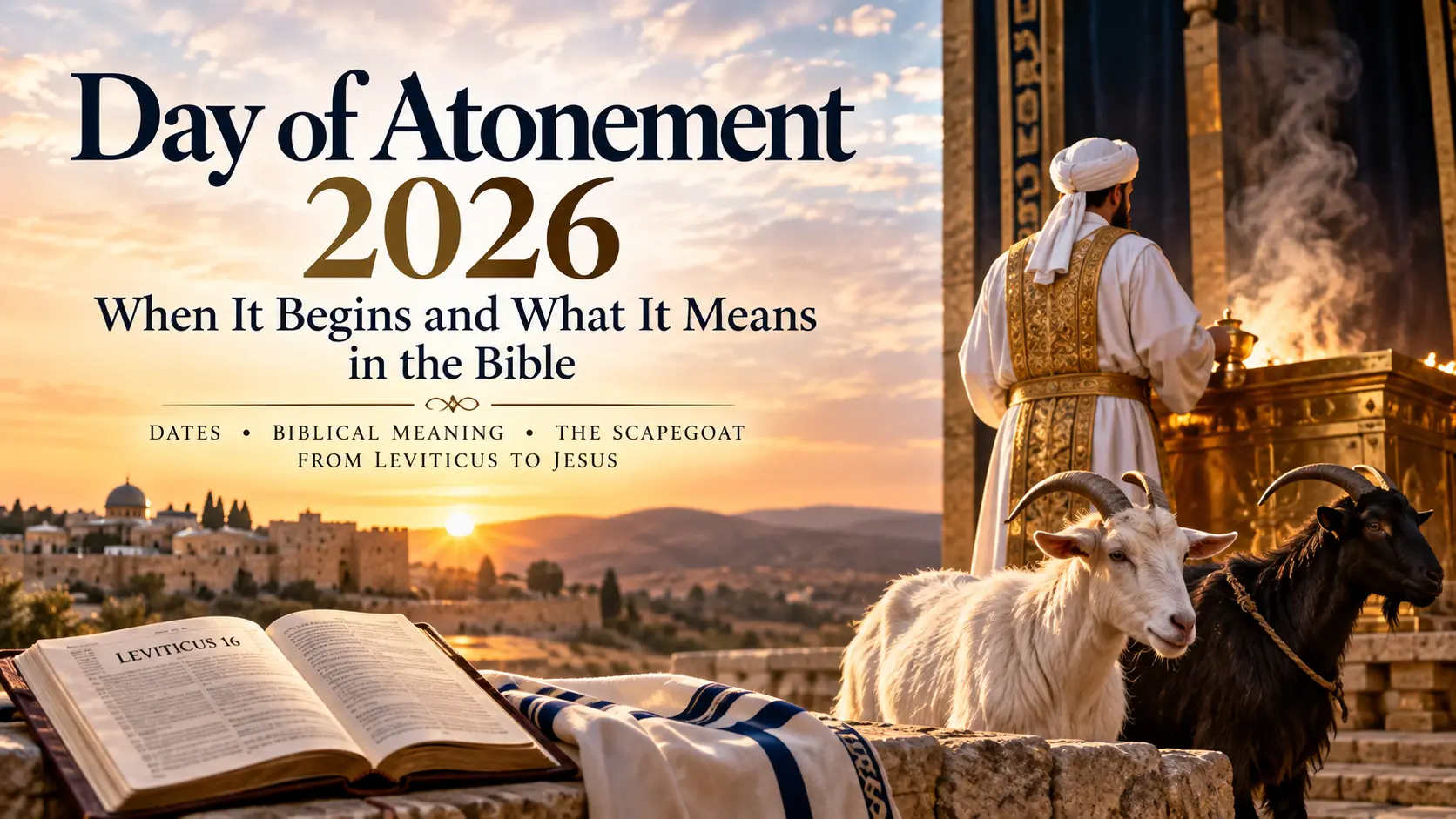

When reading through the Old Testament, few calendar events carry the solemn weight and deep spiritual gravity of the Day of Atonement. Known traditionally as Yom Kippur, this sacred day centred on atonement, cleansing and the carefully restricted approach of Israel’s high priest into the Most Holy Place.
For readers following the upcoming biblical calendar, this guide gives the dates for Day of Atonement 2026, explains the powerful rituals recorded in Leviticus 16, and looks at why this ancient day is so important for understanding the New Testament themes of sacrifice, priesthood, forgiveness, and access to God.
The month begins with the Feast of Trumpets 2026 on its first day. In Judaism, this day is observed as Rosh Hashanah, while Leviticus describes the corresponding biblical festival as the first day of the seventh month, marked by sacred rest and trumpet blasts.
When Is the Day of Atonement in 2026?
On the Hebrew calendar, the Day of Atonement falls on the 10th day of Tishrei, the seventh month in the biblical festival calendar. Leviticus 23:32 specifically directs Israel to observe this solemn rest from evening to evening.
For 2026, the dates are:
- Begins: Sunday evening, September 20, 2026, at sundown.
- Ends: Monday evening, September 21, 2026, at nightfall.
- Hebrew Calendar Date: 10 Tishrei 5787.
Exact sunset, fast-start, and nightfall times depend on location, but September 20–21 are the calendar dates for Yom Kippur in 2026.
What Is the Day of Atonement in the Bible?
The Day of Atonement was Israel’s great annual day of atonement and cleansing. Sacrifices and purification rites took place throughout the year, but Leviticus 16 describes a unique ceremony dealing comprehensively with the sins and uncleanness associated with the people, priesthood, altar, Tabernacle, and Most Holy Place.
The purpose was therefore larger than giving individuals a yearly emotional fresh start. Leviticus presents a holy God dwelling among a people affected by sin and impurity, together with an appointed means by which atonement and cleansing could be made.
Leviticus 16:30 summarizes the meaning of the day: atonement would be made for the people so that they could be cleansed from their sins before the Lord.
What Happened in Leviticus 16?
Leviticus 16 outlines a highly specific sequence of events that the High Priest had to follow carefully. The complex ritual can be broken down into five distinct phases:
- The Priest’s Personal Preparations: Before representing the community, the High Priest had to bathe and put on sacred linen garments. He presented a bull as a sin offering to make atonement for himself and his household. This becomes important later in Hebrews, where Jesus is contrasted with earthly priests who themselves needed atonement.
- Entering the Most Holy Place: The High Priest was permitted to pass through the inner veil and enter the Most Holy Place or Holy of Holies, as part of this annual rite. He took burning coals and incense inside so that the cloud of incense covered the atonement cover above the Ark. Leviticus gives a stark warning that he had to approach God in the prescribed way so that he would not die.
- The Blood Sacrifice: The priest first brought blood from his own bull offering into the Most Holy Place. Two male goats were also presented for the community, and lots were cast over them. One goat was designated for the Lord and killed as a sin offering. Its blood was then brought behind the veil and sprinkled on and before the atonement cover. The ceremony continued as atonement was made for the sanctuary, Tent of Meeting and altar because they stood among a people marked by uncleanness and sin.
- The Sending of the Scapegoat: The priest then turned to the second living goat, commonly called the scapegoat. Placing both hands on its head, he confessed over it the wickedness, rebellion and sins of Israel. The goat was entrusted to an appointed person and taken into the wilderness, symbolically bearing the people’s sins away to a remote place. The image is striking: the guilt of the community was pictured as being carried away from them.
- Concluding Procedures: After completing these rites, the High Priest removed the special linen garments, bathed again, put on his regular priestly garments and offered burnt offerings for himself and the people. The detailed sequence reinforced the seriousness of approaching the presence of a holy God.
Why Was the Day of Atonement So Serious?
Unlike biblical festivals strongly associated with communal rejoicing and feasting, the Day of Atonement was marked by solemnity, self-denial, repentance, and complete rest.
Leviticus commands the people to “deny themselves,” or, in older translations, to “afflict” themselves. Fasting became the traditional Jewish expression of this command, and Yom Kippur today is commonly observed with a fast lasting approximately 25 hours.
It is useful, however, to distinguish the wording of Scripture from later religious practice. Leviticus commands self-denial and forbids work; the detailed customs surrounding the approximately 25-hour fast developed within Jewish interpretation and observance.
The biblical warning itself was severe. Those who refused to deny themselves were to be cut off from their people, while anyone who worked on the day faced an even stronger judgment. Leviticus describes it as a Sabbath of solemn rest, observed from evening to evening. Its seriousness reflected the themes at the heart of the day: sin, holiness, judgment, atonement, cleansing, and restored fellowship with God.
What Does the Scapegoat Mean?
The two goats used during the ritual together create a powerful picture of how Israel’s sin was addressed on the Day of Atonement:
- The First Goat — Sacrifice and Atonement: The goat designated for the Lord was killed as a sin offering, and its blood was used in the purification and atonement rites. Within the larger biblical sacrificial system, it demonstrates the seriousness with which sin and uncleanness were dealt with before God.
- The Second Goat — Removal of Sin: The living goat had Israel’s sins confessed over it and then carried them into the wilderness. It gave the community a visible picture of those sins being removed from their midst. The imagery naturally recalls other biblical descriptions of God removing transgression, including Psalm 103:12, which speaks of sins being removed as far as east is from west.
The two goats should therefore be understood together within the single Day of Atonement ceremony. One was sacrificed and its blood used in the atonement rites; the other dramatically pictured the removal of Israel’s confessed sins.
How Does Hebrews Connect the Day of Atonement to Jesus?
For New Testament readers, the Book of Hebrews deliberately draws on imagery closely connected with the Day of Atonement when explaining the priesthood and sacrifice of Jesus Christ.
Hebrews contrasts the repeated work of Israel’s high priests with what Christians believe Christ accomplished finally and completely:
- A Superior Priest: Earthly high priests had to deal with their own sins as well as represent the people. Hebrews presents Jesus as the sinless High Priest who did not need to offer a sacrifice for His own guilt before acting on behalf of others.
- A Superior Sanctuary: The ancient high priest entered an earthly sanctuary. Hebrews describes Christ entering a greater and more perfect sanctuary “not made with human hands” and later says that He entered heaven itself to appear in God’s presence on behalf of His people.
- A Superior Sacrifice: The Day of Atonement returned every year, demonstrating the repeated nature of the Old Covenant ritual. Hebrews contrasts this repetition with Christ offering Himself once for all. His sacrifice is presented as accomplishing eternal redemption and cleansing the conscience in a way animal sacrifices could not accomplish.
- Open Access: Under the Tabernacle system, entrance into the Most Holy Place was intensely restricted. Hebrews later tells believers that because of Christ they may draw near to God with confidence. The tearing of the temple veil at Jesus’ death provides another powerful New Testament image of the barrier associated with the sanctuary being opened.
The point of Hebrews is not simply that Jesus reenacted every detail of Leviticus 16. Its argument is that the earlier priesthood, sanctuary, sacrifices, and repeated rituals prepared readers to understand something greater and final in Christ.
Do Christians Need to Observe the Day of Atonement Today?
Christian traditions approach this question differently, although most historic Protestant and Catholic traditions do not regard observance of Yom Kippur as a requirement for Christians.
- Mainstream Protestant & Catholic Theology: Most Protestant and Catholic Christians do not observe the Day of Atonement as a required religious holiday. Hebrews emphasizes that Christ offered Himself once and contrasts His completed sacrifice with sacrifices that had to be repeated. For these Christians, Yom Kippur remains deeply valuable for understanding atonement and the biblical background of Christ’s priestly work, but keeping the Old Testament calendar day is not considered necessary for receiving forgiveness.
- Messianic & Some Torah-Observant Traditions: Some Messianic Jewish believers and certain Christian groups that intentionally follow the biblical festival calendar continue to mark Yom Kippur with fasting, prayer, repentance, or Scripture reading. Their reasons and theology vary considerably. Many who believe in Jesus do not regard the observance as another sacrifice for sin, but as a time of remembrance, repentance, worship, and reflection on the biblical meaning of atonement.
This distinction matters because Christians who observe the date and Christians who do not may both regard Leviticus 16 and Hebrews as spiritually important while reaching different conclusions about whether the calendar observance itself should continue.
What Comes After the Day of Atonement?
The Day of Atonement does not stand alone; it belongs to a tightly connected group of sacred days in Israel’s seventh month.
The month begins with the Feast of Trumpets on its first day. In Judaism, this day is observed as Rosh Hashanah, the Jewish New Year, while Leviticus describes it as the first day of the seventh month, marked by solemn rest, sacred assembly, and trumpet blasts. Jewish tradition later came to describe the period from Rosh Hashanah through Yom Kippur as the Ten Days of Repentance.
The biblical calendar then produces a striking change of atmosphere. The Day of Atonement falls on the 10th day of the month, while the joyous Feast of Tabernacles begins on the 15th. After the solemn themes of self-denial, atonement, and cleansing come seven days associated with booths, worship, gathering, and rejoicing before God.
In 2026, Yom Kippur ends on the evening of September 21, while Sukkot begins at sundown on September 25.
Tabernacle vs. The Cross
| Feature | The Old Covenant Ritual (Leviticus 16) | The New Covenant Fulfillment (Hebrews) |
|---|---|---|
| The Priest | Human high priest who also needed atonement | Sinless High Priest — Jesus |
| Frequency | Repeated every year | Accomplished once for all |
| Sanctuary | Earthly Most Holy Place behind the veil | Greater heavenly sanctuary; heaven itself |
| The Blood | Blood of bulls and goats | Christ’s own self-offering and blood |
| The Result | Annual atonement and ritual cleansing within Israel’s covenant | Eternal redemption and cleansing of the conscience |
| Believer Access | Entrance into the inner sanctuary was severely restricted | Believers are invited to draw near to God with confidence |
What do you think? Whether you study the Day of Atonement for its biblical history, its place in Jewish tradition or its significance for understanding Christ’s work in Hebrews, which part of the imagery in Leviticus 16 most shapes the way you think about atonement and grace?
