
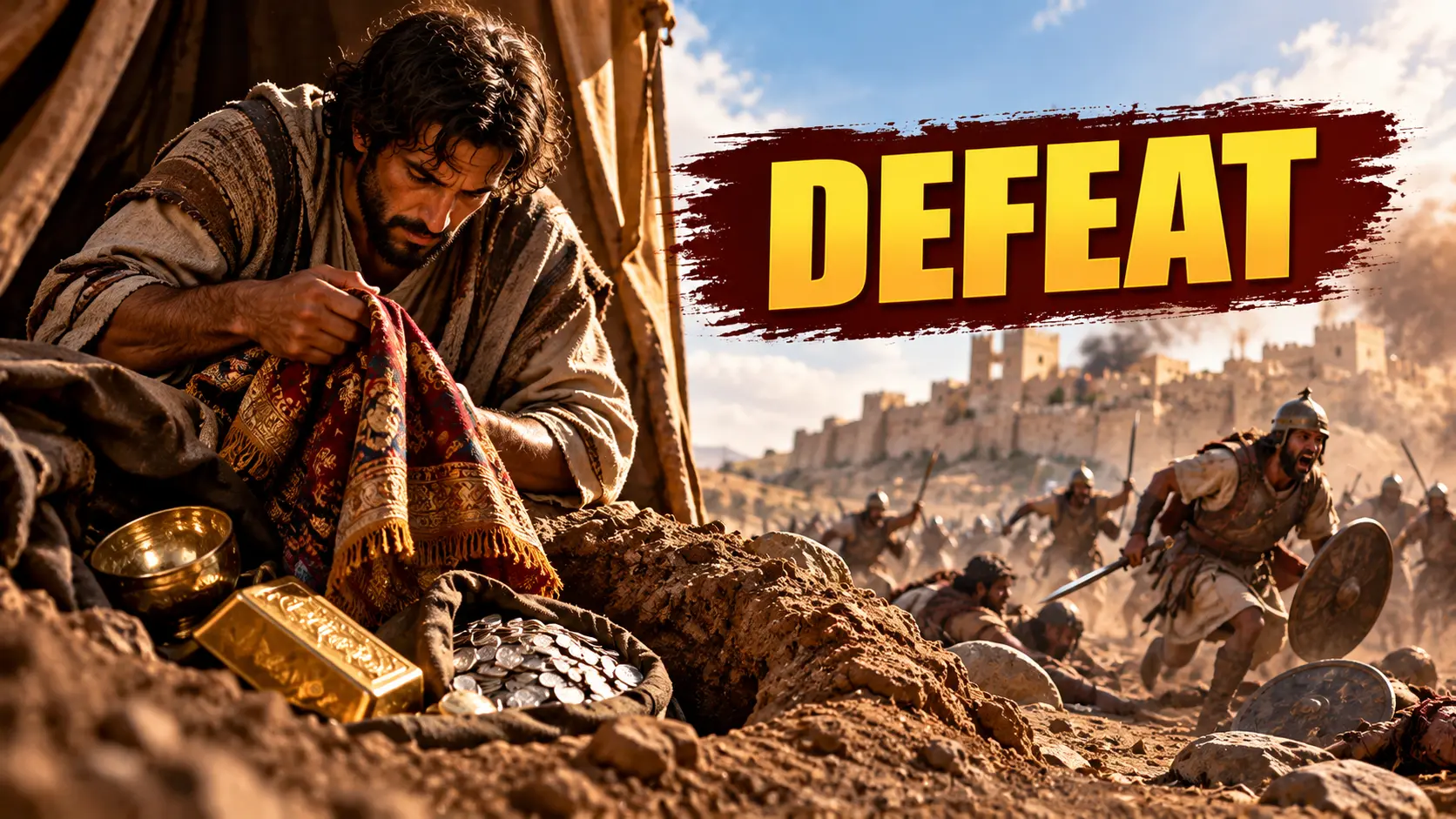

Achan’s sin in Joshua 7 explains why the Israelites suffered a devastating defeat at Ai shortly after their remarkable victory at Jericho. Although Joshua’s soldiers expected to conquer the smaller city without much difficulty, the battle ended with thirty-six Israelites dead and the surviving troops fleeing from their enemies.
Israel lost the Battle of Ai because Achan secretly took possessions that God had forbidden anyone to keep from Jericho. His actions violated a command given to the entire nation and Joshua 7 describes the resulting defeat as God’s judgment against Israel for breaking its covenant obligations.
What makes this account particularly difficult is that Joshua and his soldiers did not know about Achan’s theft before the battle. The forbidden possessions remained hidden beneath his tent, yet their presence affected the entire army and prevented Israel from continuing its conquest.
Achan Broke a Specific Command Given Before Jericho Fell
The explanation for Israel’s defeat begins in Joshua 6, when God gave instructions concerning the capture of Jericho. The Israelites were not permitted to treat the city’s possessions as ordinary military plunder because Jericho had been placed under a special ban.
Joshua 6:18 warned the people against taking anything devoted to destruction. The command also stated that doing so would bring trouble upon Israel’s camp, establishing a direct connection between forbidden possessions and consequences for the wider community.
However, not every valuable object was to be destroyed. Joshua 6:19 specifically reserved silver, gold, bronze and iron for the Lord’s treasury, meaning individual soldiers had no authority to keep those materials for themselves.
These instructions formed part of the same divine direction that governed Israel’s unusual victory at Jericho. The people had marched around the city while priests sounded trumpets, a sequence explained more fully in PsalmWisdom’s article about the meaning of the trumpets at Jericho.
The restrictions on Jericho’s possessions were equally explicit. Although Israel had conquered the city, its soldiers could not personally claim everything they discovered inside its walls.
Achan violated that command when he encountered valuable items among the city’s possessions. Instead of leaving them according to God’s instructions, he secretly removed them and carried them back to his tent.
The Forbidden Objects Achan Took
Joshua 7:21 identifies three possessions that Achan admitted stealing: a beautiful garment from Shinar, two hundred shekels of silver and a gold bar weighing fifty shekels.
The garment was associated with Shinar, a region connected with Babylonia. Although the biblical account does not explain its exact appearance or value, Achan considered it desirable enough to take despite the prohibition.
The silver and gold presented an even clearer violation because those materials had been specifically reserved for the Lord’s treasury. Achan had no permission to claim them, regardless of their value or whether anyone else noticed their disappearance.
He later confessed that he saw the objects, wanted them and took them. After bringing them into the camp, he buried them in the ground inside his tent, placing the silver beneath the other possessions.
His concealment matters because the objects were not accidentally brought into the camp or mistakenly stored for later delivery. Achan’s confession describes an intentional act of taking forbidden property and hiding it from others.
Joshua 7:1 introduces the consequences before the military defeat is even described. The verse identifies Achan as the offender and states that God’s anger was directed against Israel because of the violation.
Why Did Israel Lose the First Battle at Ai?
After Jericho fell, Joshua sent men to examine Ai, a city near Bethel. The scouts returned with a favourable report, believing that the city had relatively few defenders and would not require Israel’s entire fighting force.
According to Joshua 7:3, they advised Joshua to send approximately two or three thousand soldiers. Joshua accepted their recommendation and dispatched about three thousand men to capture the city.
The attack failed almost immediately. Ai’s defenders drove the Israelites back, pursued them and killed approximately thirty-six soldiers, leaving the surviving troops terrified.
This outcome was difficult for Joshua to understand because Israel had just experienced an extraordinary victory against Jericho. The army now appeared unable to defeat a smaller city that its own scouts had considered manageable.
Some commentators interpret the scouts’ confidence as evidence that Israel underestimated Ai. However, the chapter does not explicitly state that overconfidence or insufficient military preparation caused the defeat.
Instead, Joshua 7 identifies a specific covenant violation that had already occurred before the army approached Ai. Achan’s stolen possessions remained concealed within the camp and God had not authorized Israel to continue as though His earlier command had been obeyed.
God’s Explanation to Joshua in Verses 11–12
Joshua responded to the defeat by falling before the ark of the Lord with Israel’s elders. He questioned why God had brought the nation across the Jordan if its enemies were now going to defeat it.
His concern extended beyond the thirty-six men who had died. Joshua feared that the surrounding nations would hear about Israel’s weakness and unite against the people before they could establish themselves in Canaan.
God’s response revealed that Joshua had misunderstood the immediate cause of the disaster. In Joshua 7:11, God declared that Israel had sinned by violating the covenant, taking forbidden possessions, stealing and concealing what had been taken.
The following verse directly connects that offense with the failed military campaign. God explained that Israel could not stand against its enemies because the nation had become subject to the ban associated with the forbidden possessions.
This was the explanation Joshua had been missing. The army’s defeat was not presented merely as a tactical mistake or proof that Ai possessed superior military strength.
God stated that He would not continue with Israel unless the forbidden things were removed from the camp. The unresolved violation therefore stood at the center of the nation’s inability to defeat Ai.
The instructions that followed were not simply to assemble a larger force or develop a different strategy. Joshua first had to identify the offense and remove the objects that had brought Israel under judgment.
Achan’s Confession Revealed the Cause of the Defeat
After God explained the problem, Joshua was instructed to prepare Israel for a process that would identify the guilty person. Joshua 7:14–18 describes the people being brought forward by tribes, clans, households and individuals until Achan was identified.
The process began with the tribe of Judah and eventually narrowed to Achan’s family. When Joshua confronted him, he asked Achan to acknowledge what he had done rather than conceal the offense any longer.
Achan confessed that he had taken the garment, silver and gold from Jericho. He also revealed their location, explaining that the objects were buried inside his tent.
Joshua sent messengers to investigate and they discovered the possessions exactly where Achan said they would be. The stolen objects were then brought before Joshua and the assembled Israelites, confirming the details of his confession.
This discovery established what had happened before the failed attack. The forbidden possessions had remained within Israel’s camp while Joshua’s soldiers were preparing to fight Ai, although the army had no knowledge of their presence.
The confession also distinguished Achan’s personal responsibility from the broader consequences experienced by Israel. God had accused the nation of violating the covenant but the investigation identified one individual who had deliberately taken the forbidden possessions.
The Difference Between Achan’s Guilt and Israel’s Judgment
Joshua 7 does not describe the entire Israelite army participating in the theft. Achan acknowledged taking the objects himself and the messengers found them hidden in his own tent.
Nevertheless, God addressed the violation as an offense affecting Israel. The command concerning Jericho had been given to the people collectively and Joshua 6:18 had already warned that taking forbidden possessions would bring trouble upon the camp.
The discovery therefore revealed both the individual offender and the reason his actions had consequences beyond himself. Achan committed the theft but Israel suffered the defeat that followed the violation of the covenant.
This distinction becomes essential when examining the deaths of the soldiers at Ai.
Why Did Thirty-Six Israelites Die Because of Achan’s Sin?
Joshua 7:5 records that approximately thirty-six Israelite soldiers were killed during the failed attack. The chapter does not identify those men as participants in Achan’s theft or suggest that they knew forbidden possessions had been hidden within the camp.
Their deaths raise a difficult question about the relationship between individual wrongdoing and collective consequences. If Achan alone took the objects, why did soldiers who apparently had no involvement in the offense suffer during the battle?
The biblical account presents Israel as a covenant community rather than a collection of unrelated individuals. God’s command concerning Jericho applied to the nation and the warning against forbidden plunder specifically mentioned consequences for the entire camp.
Joshua 7:1 reflects this collective responsibility by describing Israel as having acted unfaithfully before identifying Achan as the offender. In verses 11–12, God again addresses the nation while explaining why its soldiers could no longer stand against their enemies.
This does not mean every Israelite personally committed the same offense. The narrative identifies Achan as the thief but the consequences of violating the command extended beyond the person who took the objects.
What Joshua 7 Does Not Explain About the Soldiers’ Deaths
Although the chapter identifies the covenant violation as the reason Israel suffered defeat, it does not explain why those particular thirty-six soldiers died. Their individual actions during the battle are not described in enough detail to establish personal guilt.
It would therefore be inaccurate to claim that the soldiers secretly participated in Achan’s theft or were individually punished for offenses the passage never identifies. Their deaths belong to the wider military disaster that Joshua 7 connects with Israel’s broken covenant obligations.
The distinction does not remove the difficulty of the account. It establishes the limits of what the biblical text actually explains: Achan’s actions brought consequences upon Israel but the chapter does not provide a separate moral explanation for every person who suffered.
Joshua had initially understood the defeat as a threat from Ai’s military forces. God’s response revealed that the nation faced a problem within its own camp, one that had remained hidden until the disaster exposed the need for an investigation.
Joshua Removed the Forbidden Possessions and Judged Achan
After discovering the stolen objects, Joshua and the Israelites brought Achan to the Valley of Achor. Joshua 7:24 records that his sons, daughters, livestock, tent and possessions were also brought to the location.
The account describes a severe judgment involving stoning and burning. Joshua confronted Achan for bringing trouble upon Israel, connecting his punishment directly with the consequences of his actions.
The wording of Joshua 7:25 has produced disagreement about whether Achan’s children were also executed. The verse initially refers to stoning him, while subsequent language refers to them, leaving interpreters divided over whether the later expression includes his family or refers to his possessions and livestock.
The chapter does not explicitly identify his children as participants in the theft. Any claim that they knowingly helped conceal the stolen property goes beyond what the narrative directly establishes.
For understanding the defeat at Ai, the decisive detail appears at the end of the chapter. Joshua 7:26 states that God’s anger against Israel turned away after the judgment had been carried out.
Earlier, God had told Joshua that Israel could not stand against its enemies while the forbidden possessions remained within the camp. The identification of Achan, recovery of the objects and resulting judgment addressed the violation that God had identified.
The location became known as the Valley of Achor, a name associated with trouble or disaster. Its connection with Achan’s punishment reflects Joshua’s accusation that his actions had brought trouble upon Israel.
The chapter ends with the obstacle to Israel’s advance removed, preparing the narrative for a second attempt against Ai.
Israel’s Second Battle Shows What Had Changed
Joshua 8 begins with God instructing Joshua not to be afraid or discouraged. He told Joshua to take the fighting men and attack Ai again, this time promising that the city would be delivered into Israel’s hands.
The second campaign differed considerably from the first. Instead of relying on a relatively small force sent after the scouts’ recommendation, Joshua organized a larger operation involving an ambush behind the city.
When Ai’s defenders moved out to attack, Joshua’s forces drew them away from their position. Israelite soldiers waiting behind the city then moved in and captured it, while the main force turned against the pursuing defenders.
The revised strategy contributed to the military outcome, but Joshua 7–8 presents another important difference between the two campaigns. The forbidden possessions had been discovered and removed before God renewed His promise of victory.
God Permitted Plunder at Ai but Had Forbidden It at Jericho
Joshua 8:2 contains a detail that helps explain the precise nature of Achan’s offense. God explicitly permitted the Israelites to keep the livestock and other possessions taken from Ai.
This permission differed from the instructions given before Jericho’s destruction. At Jericho, certain possessions were subject to the ban, while precious metals were reserved for God’s treasury.
The comparison demonstrates that taking valuable objects after a battle was not automatically forbidden in every situation. Achan’s wrongdoing consisted of taking possessions from a city where God had specifically prohibited the Israelites from keeping them.
Israel’s second victory therefore followed two significant changes recorded in the narrative. The covenant violation associated with Jericho had been addressed, and Joshua now carried out a new military campaign under God’s instructions.
Joshua 8 records that Israel successfully captured Ai after the earlier defeat. The same city that had driven approximately three thousand soldiers into retreat was conquered once the problem identified in Joshua 7 had been resolved.
Frequently Asked Questions
What exactly did Achan steal from Jericho?
Achan stole a beautiful garment from Shinar, two hundred shekels of silver, and a gold bar weighing fifty shekels. Joshua 7:21 records his confession and explains that he hid the possessions beneath his tent. The objects violated God’s instructions concerning Jericho’s devoted possessions and valuables reserved for His treasury.
How many Israelites died during the first Battle of Ai?
According to Joshua 7:5, approximately thirty-six Israelite soldiers died when the defenders of Ai drove Joshua’s forces back. The defeat occurred after Israel’s successful conquest of Jericho and before Joshua discovered Achan’s theft.
Why did God allow Israel to take possessions from Ai but not Jericho?
God gave different instructions for the two cities. At Jericho, the Israelites were forbidden to keep the devoted possessions and certain valuables were reserved for the Lord’s treasury. In Joshua 8:2, God explicitly permitted the Israelites to take livestock and other possessions from Ai. Achan’s offense was taking objects that were specifically forbidden at Jericho.
