
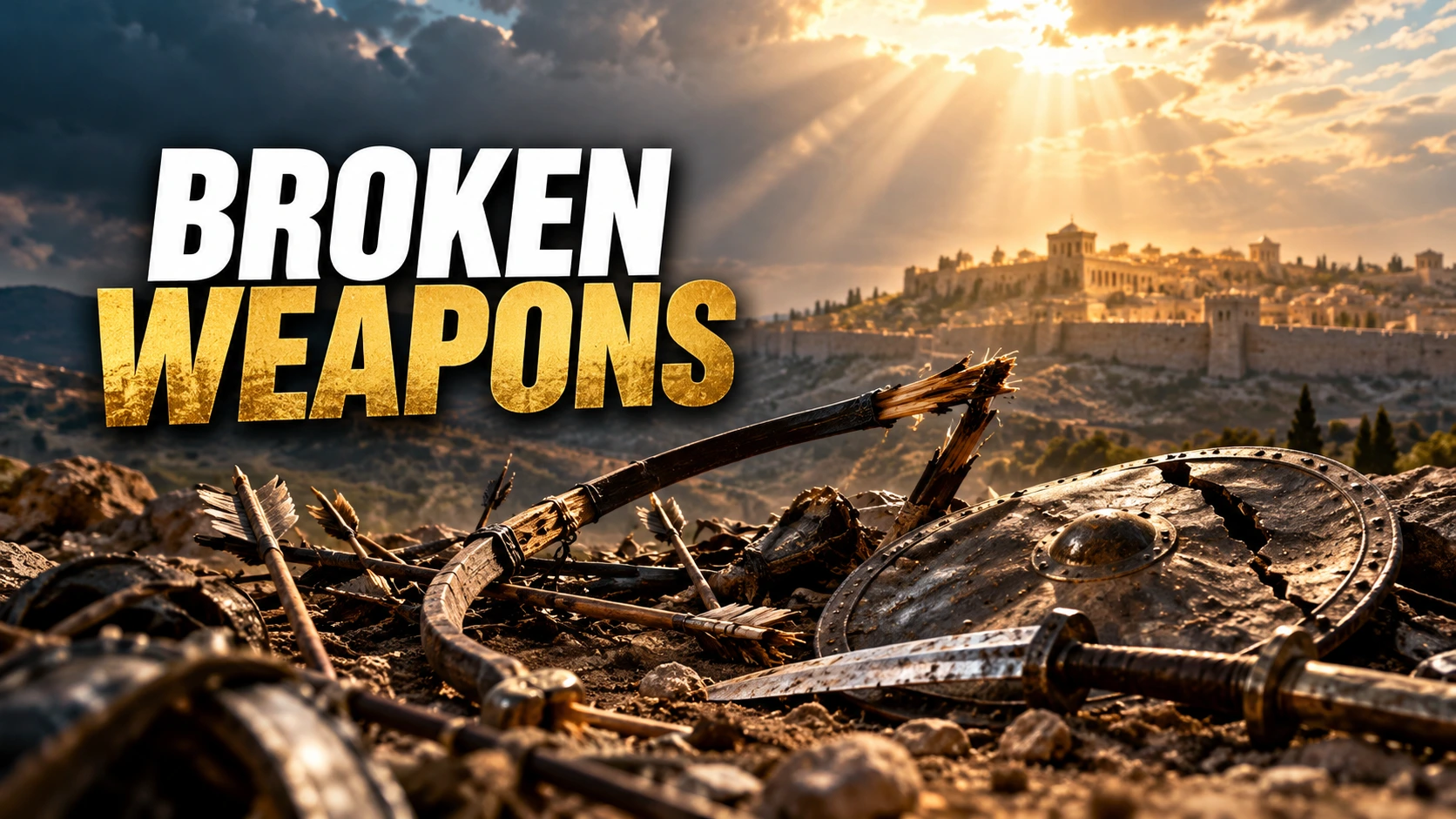

Psalm 76 describes God’s victory over powerful enemies and reveals why human weapons can not stand against His judgment. The psalm celebrates a military defeat in which bows, shields, swords and even the strongest warriors become powerless. Through these images, the writer shows that no army possesses enough strength to overcome God’s authority.
The breaking of weapons has a deeper significance than military victory alone. Psalm 76 connects the defeat of hostile forces with God’s judgment and His deliverance of the afflicted. The destruction of military power becomes evidence that those who threaten others cannot act beyond His authority.
Traditionally associated with Asaph, the psalm begins in Jerusalem, describes the collapse of an enemy army and ends by declaring that even earthly rulers must acknowledge God. Each part develops the same message through a different aspect of the victory.
Why God Breaks the Weapons of War in Psalm 76:1–3
Psalm 76 begins by declaring that God is known in Judah and that His name is great in Israel. Verse 2 identifies Salem and Zion as His dwelling place, connecting the coming military victory with Jerusalem.
The opening establishes where the psalmist sees God’s power being revealed. Before describing the enemy’s defeat, the writer directs attention to the God who dwells among His people.
Psalm 76:3 then introduces the central image:
“There brake he the arrows of the bow, the shield and the sword and the battle. Selah.” — Psalm 76:3 (KJV)
The verse describes God destroying the instruments used in warfare. Arrows and bows enabled soldiers to attack from a distance, shields protected them and swords allowed them to fight at close range.
These weapons represented different aspects of an army’s ability to wage war. By describing their destruction together, the psalmist presents a military force that has lost both its offensive and defensive strength.
The word there connects this victory with the location mentioned in the preceding verse. The battle imagery is therefore not an unrelated statement about God’s strength but a description of His protection of Zion.
What Does Breaking the Weapons Symbolize?
The broken weapons represent the defeat of human military power before God. The image goes beyond the physical destruction of bows and swords because it also communicates that the army can no longer accomplish what it intended.
A shield is valuable because it protects a soldier, while a sword is valuable because it allows an attack. When both become useless, the army loses its ability to control the battle.
This distinction helps explain why the psalm focuses on weapons rather than celebrating the strength of Israelite soldiers. The victory is attributed to God’s intervention instead of superior military equipment or strategy.
Psalm 46:9 uses a related image of God bringing wars to an end and breaking instruments of battle. Both passages present Him as greater than the violence that threatens His people, although neither should be read as a promise that believers will never face danger.
The same distinction matters when understanding other Psalms about God’s protection. Biblical protection is presented through God’s power and care, not as a guarantee that suffering or opposition will never occur.
Was Psalm 76 Written About a Real Battle?
Psalm 76 describes what appears to be a decisive military victory but it does not identify the defeated army or name its commander. Its heading associates the song with Asaph without establishing a specific date.
Some commentators connect the psalm with the Assyrian army’s defeat during Sennacherib’s campaign against Jerusalem. Second Kings 19:35–36 records a devastating loss among the Assyrians, followed by Sennacherib’s withdrawal.
That account shares important features with Psalm 76, particularly the sudden defeat of a powerful army and the protection of Jerusalem. Nevertheless, the psalm does not explicitly identify this event, so the connection remains a possible historical interpretation.
The meaning of the broken weapons does not depend on proving that identification. The psalm’s emphasis is that military strength becomes ineffective when God rises against those threatening His people.
How God Defeats the Strongest Warriors in Psalm 76:4–6
After describing the broken weapons, the psalmist turns to the soldiers who depended on them. Psalm 76:4 praises God’s majesty, while verses 5–6 describe the complete helplessness of the enemy’s fighting force.
Psalm 76:5 says:
“The stouthearted are spoiled, they have slept their sleep: and none of the men of might have found their hands.” — Psalm 76:5 (KJV)
The stouthearted are courageous and powerful warriors. These were not people who lacked experience or the ability to fight, yet their strength could not prevent their defeat.
The expression about not finding their hands describes their helplessness. They are no longer capable of exercising the strength that ordinarily makes them dangerous in battle.
The reference to sleep also carries a serious meaning in this context. Many biblical interpreters understand it as describing death, although some translations express the image as a deep sleep or state of complete helplessness.
The following verse expands the defeat to the army’s horses and chariots. These were important military resources because they provided mobility and could give an army a considerable advantage during combat.
Yet Psalm 76:6 attributes their collapse to God’s rebuke. The writer does not describe an extended struggle in which God gradually overcomes an equally powerful opponent. Instead, the army’s ability to fight disappears before His command.
The progression from broken weapons to helpless warriors is central to Psalm 76. Verse 3 shows the destruction of the army’s equipment, while verses 5–6 show that the soldiers and their military resources are equally unable to resist.
The passage therefore presents a complete defeat. The enemy loses not only the weapons needed for battle but also the strength to continue fighting.
Why God’s Judgment Ends the Battle in Psalm 76:7–9
Psalm 76:7 shifts attention from the defeated army to the authority responsible for its defeat. The psalmist asks who can stand before God when His anger is aroused.
The question follows directly from the preceding verses. If courageous soldiers, powerful weapons and warhorses cannot withstand God’s intervention, the rulers commanding those forces can not assume they are beyond His judgment.
Psalm 76:8–9 describes the result:
“Thou didst cause judgment to be heard from heaven; the earth feared and was still, When God arose to judgment, to save all the meek of the earth.” — Psalm 76:8–9 (KJV)
The declaration that judgment comes from heaven places God’s authority above the earthly powers involved in the conflict. Human armies may exercise control over territory and populations but they do not possess ultimate authority over justice.
The earth becoming still continues the imagery of the defeated forces. The military power that previously threatened others has been silenced and the wider world is portrayed as responding with fear before God’s judgment.
However, verse 9 introduces a detail that explains the purpose of this intervention.
Why Does God Save the Meek Through Judgment?
Psalm 76:9 says that God rises to judgment to save the meek of the earth. Many modern translations use afflicted, oppressed or humble to communicate the meaning of the people being delivered.
This is important because it shows that the defeat of the army is not presented merely as a display of overwhelming strength. God’s judgment is connected with the rescue of people who are suffering under hostile power.
The distinction gives the broken weapons their significance within the psalm. They represent the removal of a threat that vulnerable people could not necessarily overcome through their own resources.
An army may possess swords, shields, horses and experienced soldiers, while those it threatens may have little ability to resist. Psalm 76 presents God’s intervention as the decisive answer to that imbalance.
The passage does not suggest that every military defeat throughout history is automatically an act of divine judgment. It describes a particular victory through which the psalmist celebrates God’s justice and deliverance.
The movement of the psalm is now clearer. The weapons are broken, the warriors are defeated and the purpose of God’s judgment is revealed through the rescue of the afflicted.
What Psalm 76:10 Means About Human Wrath
Psalm 76:10 presents one of the passage’s more difficult statements:
“Surely the wrath of man shall praise thee: the remainder of wrath shalt thou restrain.” — Psalm 76:10 (KJV)
In the King James Version, the first part suggests that human hostility can ultimately become an occasion for God’s praise. The enemy may intend destruction but the defeat of that aggression reveals God’s power instead.
This interpretation fits the earlier military imagery. The hostile army intended to exercise its strength, yet the outcome became a demonstration of the authority it could not overcome.
However, the Hebrew wording is difficult and translators disagree about the precise meaning. The NET Bible understands the first line as referring to God’s wrath against humanity, while the King James Version interprets it as human wrath.
The second line also has competing interpretations. Some translations understand God as restraining the remaining anger, while others describe Him as girding Himself with wrath.
These differences should not be overlooked when explaining the verse. Although the precise wording is debated, the surrounding passage consistently emphasizes that the power exercised by human enemies cannot overturn God’s judgment.
The military defeat described earlier provides the context for this statement. The army’s aggression did not produce the victory it expected and the outcome instead led the psalmist to praise God’s greatness.
Why Psalm 76 Ends With a Warning to Rulers
The closing verses explain the response to God’s victory. Psalm 76:11 calls people to fulfill their vows and bring gifts to the One whose power has been demonstrated.
This instruction follows naturally from the defeat of the enemy. Those who have witnessed deliverance are called to acknowledge God through sincere worship rather than treating the victory as an achievement of human strength.
Psalm 76:12 then returns to the subject of earthly power:
“He shall cut off the spirit of princes: he is terrible to the kings of the earth.” — Psalm 76:12 (KJV)
The expression about cutting off the spirit of princes describes God’s ability to humble powerful rulers. Even those who command armies and exercise authority over nations remain subject to a power greater than their own.
This final declaration completes the meaning of the broken weapons in verse 3. The psalm began by describing the destruction of military equipment and ends by reminding the rulers behind that equipment that their authority has limits.
The connection is important because weapons do not act independently. They are used by soldiers under the direction of people who possess the authority to wage war.
By addressing rulers at the end, the psalmist shows that God’s supremacy extends beyond the battlefield to those responsible for exercising military power.
Psalm 76 ultimately presents the breaking of weapons as evidence of God’s authority over human violence and His ability to deliver the afflicted. The defeat of powerful warriors demonstrates that military strength is not absolute, while the final warning to kings shows that earthly authority remains accountable before Him.
The psalm’s message is therefore not simply that God possesses greater strength than an army. It is that weapons, soldiers and rulers cannot prevent His judgment and the power used to threaten others can not place its possessors beyond His authority.
Frequently Asked Questions
Why does God break the weapons of war in Psalm 76?
Psalm 76:3 describes God breaking bows, shields and swords to demonstrate the defeat of an enemy’s military power. The destruction of these weapons shows that the army can no longer carry out its attack and emphasizes God’s authority over the forces threatening His people.
What does Psalm 76:5 mean when it says the warriors slept their sleep?
The expression describes the complete defeat of powerful warriors who can no longer use their strength in battle. In this context, many interpreters understand the reference to sleep as an image of death, emphasizing how thoroughly the opposing army has been overcome.
Why does Psalm 76 say God saves the meek of the earth?
Psalm 76:9 connects God’s judgment with the deliverance of the meek, often translated as the afflicted or oppressed. The passage shows that the defeat of hostile military power is not merely a demonstration of strength but also an act of rescue for people threatened by that power.
