
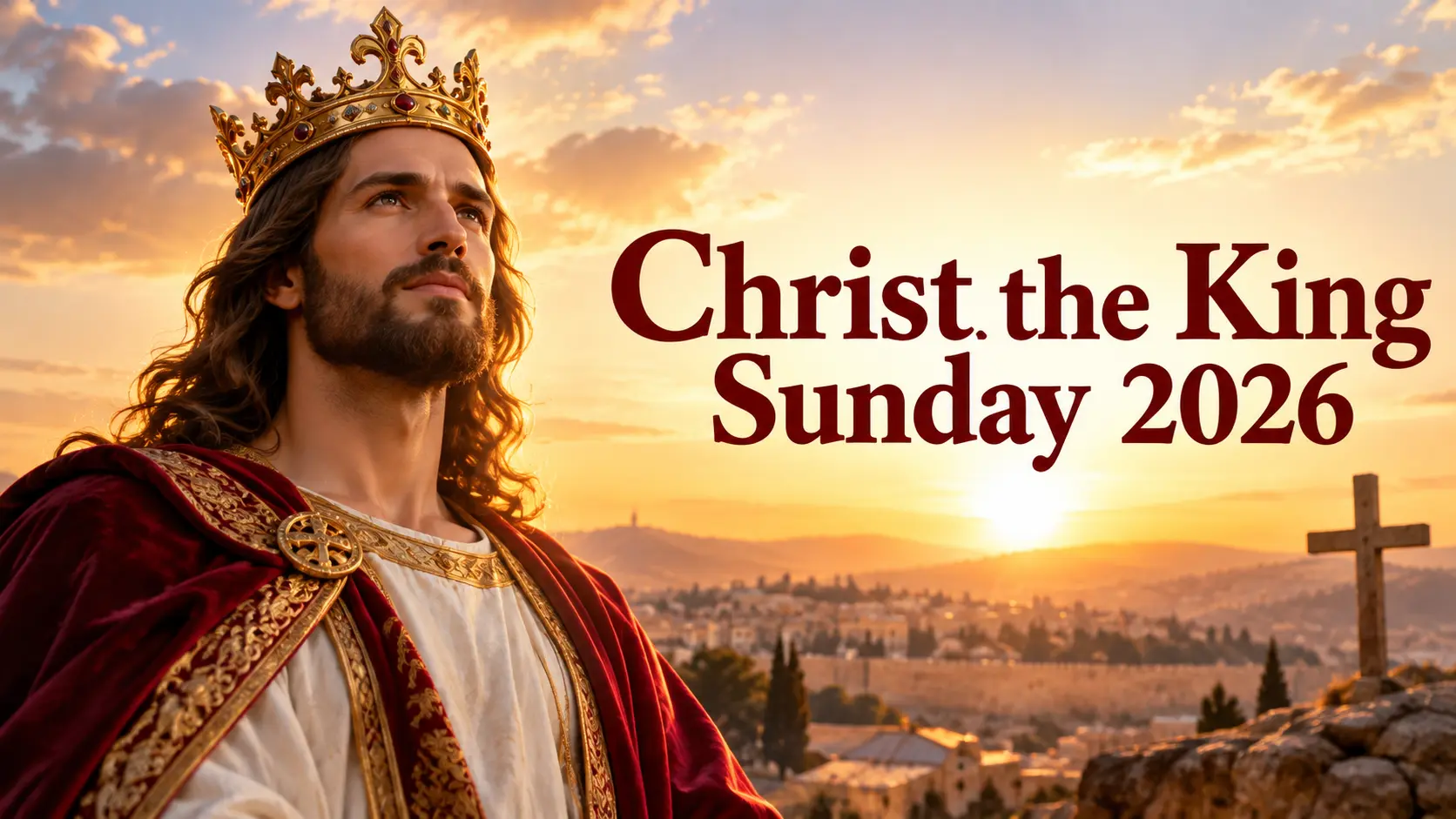

Christ the King Sunday 2026 falls on Sunday, November 22, 2026. It is observed at the close of the Christian liturgical year, exactly one week before the First Sunday of Advent on November 29 and directs attention to Jesus Christ as King, Shepherd, Judge, and Lord.
For Catholics, the day is formally known as the Solemnity of Our Lord Jesus Christ, King of the Universe. Many Anglican, Lutheran, Methodist, Presbyterian and other churches that follow the Revised Common Lectionary observe the same Sunday as Reign of Christ Sunday, although traditions vary in how the day is celebrated.
Its position at the end of the church year gives the observance special meaning. Before Christians begin Advent and once again prepare for the coming of Christ, the liturgical calendar concludes by asking believers to consider who the coming Christ truly is and what His reign means for daily life.
When Is Christ the King Sunday 2026?
Christ the King Sunday in 2026 is Sunday, November 22. It falls on the final Sunday before Advent, which begins the following week on Sunday, November 29, 2026.
Unlike Christmas, Christ the King Sunday does not have a permanently fixed numerical date. Its modern observance is tied to the final Sunday of the liturgical year, so its calendar date changes according to when Advent begins.
In the Roman Catholic calendar, November 22 is the Solemnity of Our Lord Jesus Christ, King of the Universe and concludes the final week of Ordinary Time. The Year A readings include Ezekiel 34:11–12, 15–17; 1 Corinthians 15:20–26, 28; and Matthew 25:31–46.
Churches using the Revised Common Lectionary also observe November 22, 2026 as Reign of Christ Sunday, Year A. The readings include Ezekiel 34:11–16, 20–24, Ephesians 1:15–23 and Matthew 25:31–46, so both traditions share several important themes even though the exact epistle reading differs.
This placement helps explain the purpose of the day. Before Advent turns attention toward expectation and Christ’s coming, the church year ends by proclaiming the identity of the One Christians are waiting for: the Shepherd-King whose kingdom ultimately stands above every temporary human power.
What Is Christ the King Sunday?
Christ the King Sunday celebrates the Christian belief that the authority of Jesus is not limited to one nation, historical period, denomination or private part of life. The New Testament presents His reign as universal, with all creation ultimately brought under God’s purposes through Christ.
Biblical kingship, however, does not simply imitate the usual patterns of worldly authority. Jesus joins power with service, truth with mercy and authority with self-giving love, making His kingship fundamentally different from domination for personal gain.
The observance therefore invites Christians to consider more than a theological title. Calling Jesus “King” raises practical questions about whether His teaching shapes personal priorities, relationships, choices, treatment of others and the way believers understand success and power.
Historical Origin of Christ the King Sunday
The modern feast was established by Pope Pius XI in 1925 through the encyclical Quas Primas. Europe was still living with the consequences of the First World War, while secular political movements and competing claims to human authority were transforming public life.
Pius XI emphasized the kingship of Christ as a reminder that no earthly institution or ruler can occupy the place that belongs to God. The purpose was not simply to create another church celebration but to direct Christian allegiance toward Christ above every temporary system of power.
The feast was originally celebrated on the last Sunday of October. Following Roman Catholic liturgical reforms in 1969, it was moved to the final Sunday of the liturgical year, strengthening its connection with Christ’s final victory and the fulfillment of God’s purposes in history.
Its present location is therefore significant. The church year concludes not with human accomplishment but with the confession that history ultimately belongs to Christ.
Biblical Foundation & Scripture Passages
Although Christ the King Sunday became an annual feast in the twentieth century, the belief it celebrates is rooted throughout Scripture. Images of divine kingship, shepherding, judgment, resurrection and an everlasting kingdom appear repeatedly across the Old and New Testaments.
Together, these passages present a vision of authority that differs sharply from simple earthly dominance. Christ reigns as Shepherd, risen Lord, righteous Judge, servant and the One through whom God’s kingdom reaches its promised fulfillment.
Ezekiel 34: Shepherd-King
Ezekiel 34 provides an important background for Christ the King Sunday in 2026. After condemning leaders who failed God’s people, the chapter portrays God Himself searching for scattered sheep, rescuing them, feeding them, caring for the injured and judging with justice.
The passage joins authority with compassion. The true Shepherd does not exploit the flock but uses His authority to restore, protect, guide and judge rightly.
This same pattern becomes central to Christian leadership. PsalmWisdom’s study of Jesus’ model of servant leadership explores how Christ combines genuine authority with humility, service, sacrifice and obedience to the Father.
Daniel 7: A Kingdom That Will Not Pass Away
Daniel 7 describes “one like a son of man” receiving dominion, glory and a kingdom that will not be destroyed. The vision later becomes important background for New Testament passages in which Jesus uses the title Son of Man, particularly when speaking about glory and judgment.
Although Daniel 7 is not one of the main Year A readings for November 22, 2026, it strengthens the larger biblical picture behind the feast. Earthly kingdoms rise and pass away, while the kingdom associated with the Son of Man is presented as lasting and universal.
Matthew 25:31–46 and the King Who Judges the Nations
The central Gospel reading for Christ the King Sunday in Year A is Matthew 25:31–46, often called the judgment of the sheep and the goats. Jesus describes the Son of Man coming in glory, sitting on His throne, gathering the nations and separating people as a shepherd separates sheep from goats.
The passage clearly presents Christ as King and Judge but it also reveals the moral character of His kingdom. Jesus draws attention to feeding the hungry, welcoming the stranger, clothing those in need, caring for the sick and visiting the imprisoned.
PsalmWisdom’s detailed explanation of Matthew 25:31–46 in its biblical context looks more closely at the sheep and goats, “the least of these,” mercy, allegiance to Christ and final judgment.
Matthew 25 therefore prevents Christ’s kingship from remaining an abstract doctrine. The way believers treat vulnerable people becomes part of the passage’s serious call to live faithfully under the authority of the King.
1 Corinthians 15: Christ’s Victory Over Every Enemy
In the Catholic Year A reading from 1 Corinthians 15:20–26, 28, Paul places Christ’s reign within the larger story of resurrection. The risen Christ reigns until every opposing power is brought beneath His authority, with death itself described as the final enemy to be destroyed.
This gives Christ the King Sunday a dimension greater than political or social authority. Christian hope rests on the resurrection of Christ and the promise that His victory ultimately reaches even humanity’s greatest enemy: death.
The King celebrated on this Sunday is therefore not merely a moral teacher or historical leader. He is the risen Christ whose reign is connected with resurrection, restoration and the completion of God’s purposes.
Revelation 19: King of Kings and Lord of Lords
Revelation 19 gives Jesus one of Scripture’s most recognizable royal titles: “King of kings and Lord of lords.” The language emphasizes that His authority surpasses every lesser claim to sovereignty.
Yet the same New Testament also presents Jesus washing His disciples’ feet, welcoming outsiders, serving others and giving His life sacrificially. Christian kingship therefore can not be separated from the character of Christ Himself.
Why Christians Celebrate Christ the King Sunday Today
For many Christians, Christ the King Sunday provides a natural opportunity to examine where their deepest allegiance actually lies. It is possible to confess Christ in worship while allowing status, ambition, fear, wealth, culture or personal preference to exercise greater influence over everyday decisions.
The observance can therefore serve as a spiritual reset before the new liturgical year begins. Instead of asking only whether Jesus is King in Christian doctrine, believers can consider whether His teaching actually shapes their relationships, priorities, habits and treatment of others.
Realigning Daily Priorities Before the New Liturgical Year
The final Sunday of the church year creates a useful moment for reflection. Christians can consider what has dominated their attention during the year and whether their lives increasingly reflect the character and teaching of Christ.
This reflection does not have to remain abstract. It might lead someone to repair a damaged relationship, return to consistent prayer, serve a person in need, become more faithful in ordinary responsibilities or give greater attention to Scripture.
Christ’s own example provides the pattern. His authority did not depend on self-promotion and His willingness to serve demonstrated that greatness in God’s kingdom can not simply be measured by worldly status.
Living Under an Unshakable Kingdom in a Divided World
Human governments, institutions, cultures and societies continually change. Christ the King Sunday reminds Christians that none of these temporary realities should be confused with the eternal kingdom of God.
That conviction does not require withdrawal from ordinary civic life. Christians can participate responsibly in their communities while remembering that no government, political party, national identity, ideology or leader deserves the absolute allegiance that Christian faith reserves for God.
Matthew 25 also prevents this hope from becoming passive. Allegiance to Christ should produce mercy, hospitality, generosity, faithful service and concern for people who are easily neglected.
Christians therefore celebrate the reign of Christ not only through hymns and royal titles but by allowing the values of His kingdom to reshape ordinary life.
How Christ the King Sunday Connects to and Prepares for Advent
Christ the King Sunday and Advent sit directly beside each other on the Christian calendar but they are distinct observances. Christ the King Sunday falls on November 22, 2026, while the First Sunday of Advent follows on November 29, 2026.
The transition creates a powerful contrast. The church year concludes with Christ presented as reigning King and Judge, while the new year begins with Christians waiting again for the coming of the Savior.
From Final Judgment to Joyful Expectation
Christ the King Sunday looks toward the fulfillment of Christ’s reign, while Advent holds together several forms of expectation. Christians remember the hope for the Messiah, prepare to celebrate the birth of Jesus at Christmas and reflect on the New Testament promise of His return.
The movement into Advent therefore does not leave Christ’s kingship behind. Instead, the perspective changes from the culmination of His reign to the mystery of how the King entered the world and how believers continue to wait faithfully for the fulfillment of His promises.
PsalmWisdom’s study of the midnight cry in Matthew 25 and Christ’s return develops this theme of spiritual readiness. The parable of the ten virgins presents Christian waiting not as speculation about dates but as a call to remain prepared and faithful.
The King Who Comes in Humility
Ending the liturgical year with Christ enthroned makes the beginning of Advent especially striking. Christian worship moves from the King who judges the nations to the promised Savior whose birth is remembered in Bethlehem, where divine kingship appears through humility rather than earthly spectacle.
This contrast reflects one of the central themes of Christian faith. Jesus is proclaimed as Lord while becoming a servant, described as King while accepting suffering and expected to return in glory even though His earthly life began in vulnerability.
For believers, Christ the King Sunday 2026 on November 22 can therefore become more than the final date on a church calendar. It offers an opportunity to examine allegiance to Christ, rediscover the biblical character of His kingdom and enter Advent one week later with a clearer understanding of the King Christians are waiting to welcome.
