
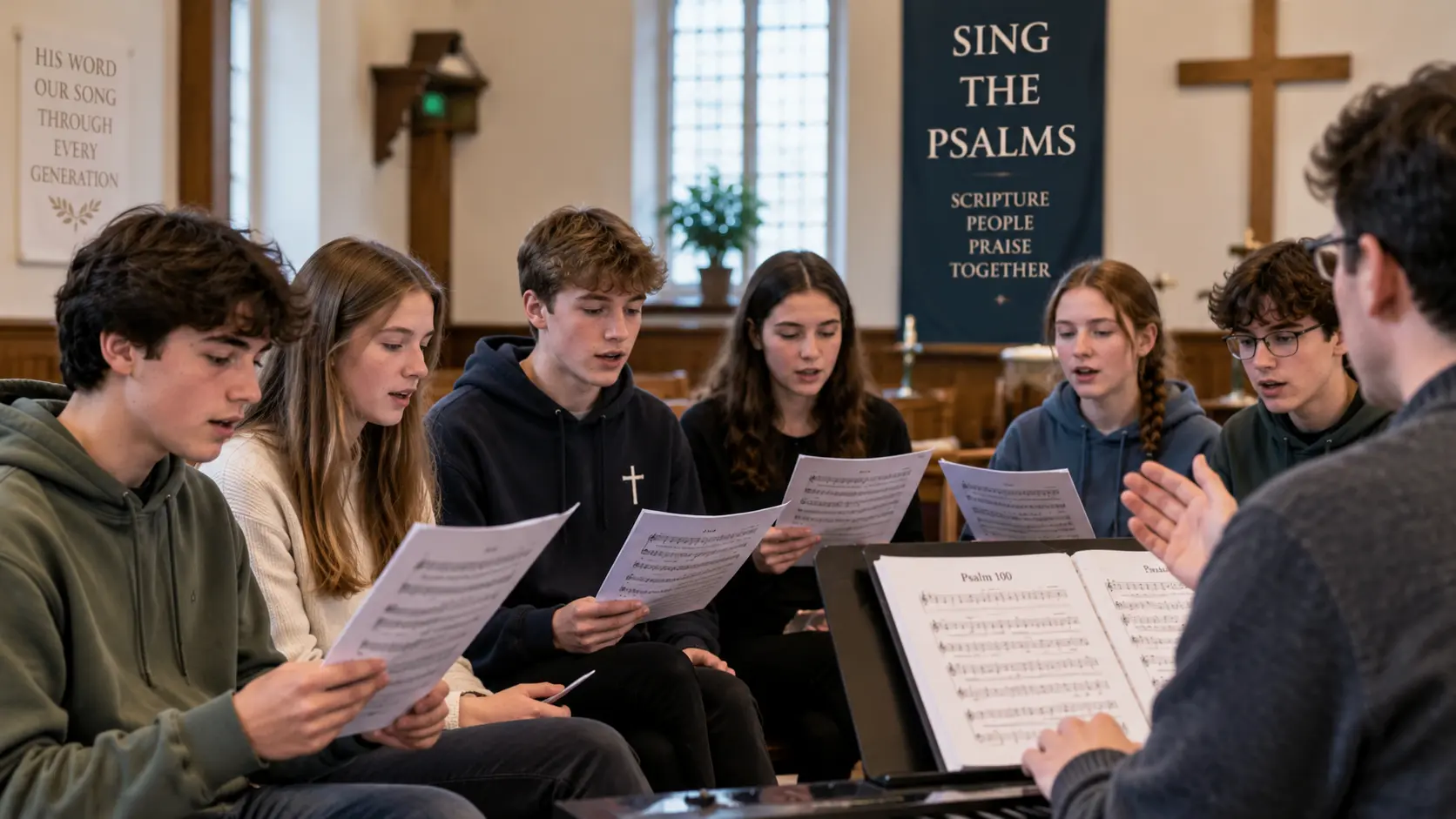

Teaching a youth group to sing the Psalms does not require teenagers to love old music or understand centuries of church history. A better starting point is simpler: choose one accessible Psalm, teach it in small pieces, repeat it over several meetings and help the group understand what they are actually singing.
Churches have faced this problem before.
In Reformation Geneva, congregational Psalm singing did not become established simply because people were handed a Psalter. New words and unfamiliar melodies had to be taught deliberately. Children became an important part of that process.
That history offers a practical lesson for youth groups today:
Psalm singing becomes familiar through participation, repetition, clear leadership and understanding—not through one enthusiastic introduction.
Why Were Children Taught to Sing the Psalms in Reformation Geneva?
Children were taught the Psalms because church leaders wanted congregations to become capable of singing Scripture together.
Historical records show that in June 1542, Guillaume Franc received payment for teaching children to sing the Psalms in church. The children were then able to help support congregational singing while the wider community was still learning unfamiliar melodies.
Psalm instruction continued as the practice developed. The Geneva Academy eventually included an hour of Psalm singing each day in the children’s curriculum.
The important point is not that young singers were naturally better at Psalm singing.
They had something adults did not yet have:
structured practice.
They heard the melodies repeatedly, learned them deliberately and became familiar enough to sing with confidence.
The process was not flawless.
Historical accounts even describe an evening service in which children under Guillaume Fabry faltered and stopped singing. Congregations elsewhere also struggled when unfamiliar Psalm tunes were introduced.
That failure makes the history more useful, not less.
It shows that Psalm singing was not effortless even in communities that considered it important.
People still had to learn.
A modern youth group should expect the same learning curve.
Why Can Psalm Singing Feel Difficult for a Youth Group?
Even teenagers who are interested in Scripture may hesitate when the words, melody and act of singing together are unfamiliar.
Several practical barriers can appear at once:
- the melody is unfamiliar;
- the wording may sound formal;
- some teenagers may worry about singing incorrectly;
- nobody wants to become the only clearly audible voice;
- the tune may demand too much concentration;
- the leader may spend too long explaining before anyone sings;
- or the group may attempt several Psalms instead of learning one properly.
The last mistake is especially easy to make.
A youth leader may want to expose the group to several historic settings immediately. But familiarity usually grows through repetition.
One Psalm remembered is more valuable than six Psalms barely attempted.
What Psalm Should a Youth Group Learn First?
The first Psalm should be short enough to learn, clear enough to understand and musically simple enough for the group to sing together.
Do not begin by asking which historic tune is most impressive.
Ask:
Which Psalm can this particular group realistically learn?
A useful first choice usually has:
- one clear emotional or spiritual theme;
- a short or easily divided text;
- a melody within a comfortable vocal range;
- repeated or predictable musical phrases;
- language that can be explained quickly;
- and a message that young people can understand.
Psalm 117 is an obvious possibility because it is extremely short and centered on praise.
Psalm 100 also has a strongly communal character.
Psalm 121 offers another interesting option. It belongs to the Songs of Ascents, a collection traditionally associated with pilgrims traveling toward Jerusalem. PsalmWisdom’s guide to Psalm 121 and the Songs of Ascents gives useful background for understanding how Psalms could function within shared worship and communal religious life.
The exact selection matters less than choosing something the group can successfully learn.
The first experience should build confidence.
Complexity can come later.
Where Should a Youth Group Start?
Not every group should begin at the same musical level.
A youth group with confident singers can handle more than a group that rarely sings without a worship band.
Use this progression to choose the right starting point.
| Level | Method | Best For |
|---|---|---|
| 1 | Leader sings one line, group repeats | A completely inexperienced or hesitant group |
| 2 | Short repeated refrain | Groups that need confidence before learning a full setting |
| 3 | Whole group sings in unison | Groups that already know the melody |
| 4 | Full metrical Psalm setting | Groups ready to learn an entire Psalm structure |
| 5 | Harmony or a more complex historic tune | Experienced singers who already have a Psalm repertoire |
There is no advantage in starting at Level 4 if the group is not ready for it.
The goal is participation, not difficulty.
A simple call-and-response Psalm sung confidently can be more successful than a sophisticated arrangement that leaves most of the room silent.
What Is a Metrical Psalm?
A metrical Psalm reshapes the biblical text into a regular poetic meter so that it can be sung to a consistent melody.
This approach became particularly important in Reformed and Presbyterian Psalm singing.
The reason was practical.
Biblical prose does not automatically fit the rhythm of a congregational hymn. A metrical version arranges the content into lines that can be sung more easily.
The Genevan Psalter became one of the most influential examples of this approach. Its melodies helped congregations sing biblical texts together and carry the Psalms into memory.
But youth leaders should understand an important distinction.
A metrical Psalm is usually not a word-for-word reproduction of a modern Bible translation. Its wording has been arranged to fit poetic meter.
A good teaching method therefore does two things:
- read the biblical Psalm itself;
- explain how the sung version expresses the same passage.
This keeps the activity rooted in Scripture rather than turning the Psalm into an isolated piece of church music.
A Simple 4-Week Plan for Teaching a Youth Group to Sing a Psalm
The easiest way to make Psalm singing feel normal is to spread the learning across several meetings.
Do not turn every week into a music class.
Use a small amount of repeated practice.
Week 1: Hear the Psalm Before Trying to Master It
Begin with the biblical text.
Read the selected portion aloud and ask one straightforward question:
What is this Psalm saying to God, about God, or from the experience of the person praying it?
Keep the discussion brief.
Then let the group hear the melody once.
A leader can sing it, a musician can demonstrate it, or a suitable reference recording can be used during practice.
Next, teach only the easiest section.
Stop before everyone becomes tired of it.
The purpose of Week 1 is not musical perfection.
It is recognition.
Week 2: Learn the Melody in Small Phrases
Begin by repeating what the group learned the previous week.
Then add one short phrase at a time.
The leader sings.
The group repeats.
When two phrases feel comfortable, join them together.
The lesson from Geneva is useful here. Unfamiliar Psalm tunes required leadership and repeated teaching before congregations could sing them confidently.
The modern principle is simple:
Do not bury an unfamiliar melody underneath unnecessary musical complexity.
Let people learn the tune first.
Week 3: Connect the Music to the Meaning
By Week 3, the melody should demand less concentration.
Now return attention to the words.
Ask what changes when the Psalm is sung instead of only read.
A Psalm of praise may feel more communal when everyone sings it together.
A lament may become more emotionally immediate.
A Psalm of trust may become easier to remember.
This is one of the strengths of learning the Psalms as songs.
The biblical Psalms contain praise, fear, repentance, grief, thanksgiving, confusion, anger, confidence, and hope.
A youth group that sings them gradually gains a larger vocabulary for prayer.
Week 4: Sing Without Depending on the Demonstration
Begin the fourth session without immediately playing the reference version.
Give the starting note if necessary.
Then let the group sing.
Some hesitation is normal.
The goal is not performance quality.
The question is whether the teenagers now recognize the melody and can carry the Psalm together.
If they can, the group has gained something more valuable than a one-week worship activity.
It has added part of Scripture to its shared memory.
What Should the First 15 Minutes Look Like?
A first Psalm-singing session should be short, predictable and weighted toward participation.
Fifteen focused minutes can accomplish more than a long explanation followed by rushed singing.
Try this structure:
Minutes 0–2: Explain why the group is trying Psalm singing.
Minutes 2–5: Read the selected Psalm or passage aloud.
Minutes 5–7: Let everyone hear the melody.
Minutes 7–10: Teach the first phrase and repeat it.
Minutes 10–13: Add the next phrase.
Minutes 13–15: Sing the section together without stopping.
Then continue with the normal youth-group meeting.
The restraint is intentional.
Psalm singing should become part of the group’s rhythm rather than an exhausting special project.
What If Your Youth Group Has No Skilled Musicians?
A youth group can begin singing Psalms without a band, choir, or accomplished pianist.
The method simply has to match the group’s resources.
Possible approaches include:
- singing together in unison;
- having a leader sing one line and the group repeat it;
- using a short repeated refrain;
- dividing the room into two responding groups;
- using a piano or guitar only to establish pitch;
- or beginning a cappella once the melody is familiar.
A repeated response is especially useful for a hesitant group because no one has to learn an entire Psalm immediately.
Musical simplicity is not a weakness.
If a simple structure gets fifteen teenagers singing Scripture instead of three confident musicians performing for them, it has achieved the more important purpose.
What Reformation Geneva Got Right
Modern churches can learn from historic Psalm-singing traditions without trying to recreate sixteenth-century worship.
There is no need to imitate every historic musical decision.
A youth group does not have to:
- sing every Psalm;
- use only unaccompanied music;
- preserve every original melody;
- learn complicated notation;
- or assume something is spiritually better simply because it is old.
History should provide wisdom, not become a costume.
The principles worth carrying forward are more practical:
Teach before expecting confidence.
Repeat before adding complexity.
Keep the words central.
Use melodies ordinary people can actually sing.
Give young people meaningful participation instead of making them spectators.
The essential question is not:
How historic can we make this sound?
It is:
How can this group learn to sing Scripture together?
Psalm Singing Is Older Than the Reformation
Reformation Geneva provides a useful teaching example, but Christians did not begin singing Psalms in the sixteenth century.
The Psalms themselves emerged from the worshipping life of God’s people, and the New Testament preserves an important scene of shared singing.
After the Last Supper, Matthew and Mark record Jesus and His disciples singing before going toward the Mount of Olives.
The Gospels do not identify the exact hymn.
Because the meal took place in a Passover setting, however, the Hallel Psalms—Psalms 113–118—have long been associated with that moment.
PsalmWisdom’s examination of the hymn Jesus and His disciples may have sung after the Last Supper explains why those Psalms are such a strong possibility while also distinguishing what Scripture explicitly says from later historical reconstruction.
That scene gives modern Christians an important reminder.
Psalm singing is not mainly about recovering unusual old music.
It is about returning biblical words of praise, prayer, trust, lament, and thanksgiving to the voices of God’s people.
How Do You Know Whether the Youth Group Has Really Learned the Psalm?
Success should not be measured by whether the group sounds like a choir.
After several weeks, ask whether the teenagers can:
- recognize the melody when it begins;
- join without waiting for the leader to sing every phrase;
- explain the central meaning of the Psalm;
- remember at least part of it away from the printed page;
- sing together with growing confidence;
- and connect the words with prayer or worship.
If those things are happening, the process is working.
Only then does it make sense to introduce another Psalm.
Over time, one learned Psalm can become two.
Two can become four.
A repertoire develops gradually.
That is more likely to create lasting congregational memory than introducing a completely unfamiliar Psalm every meeting.
