
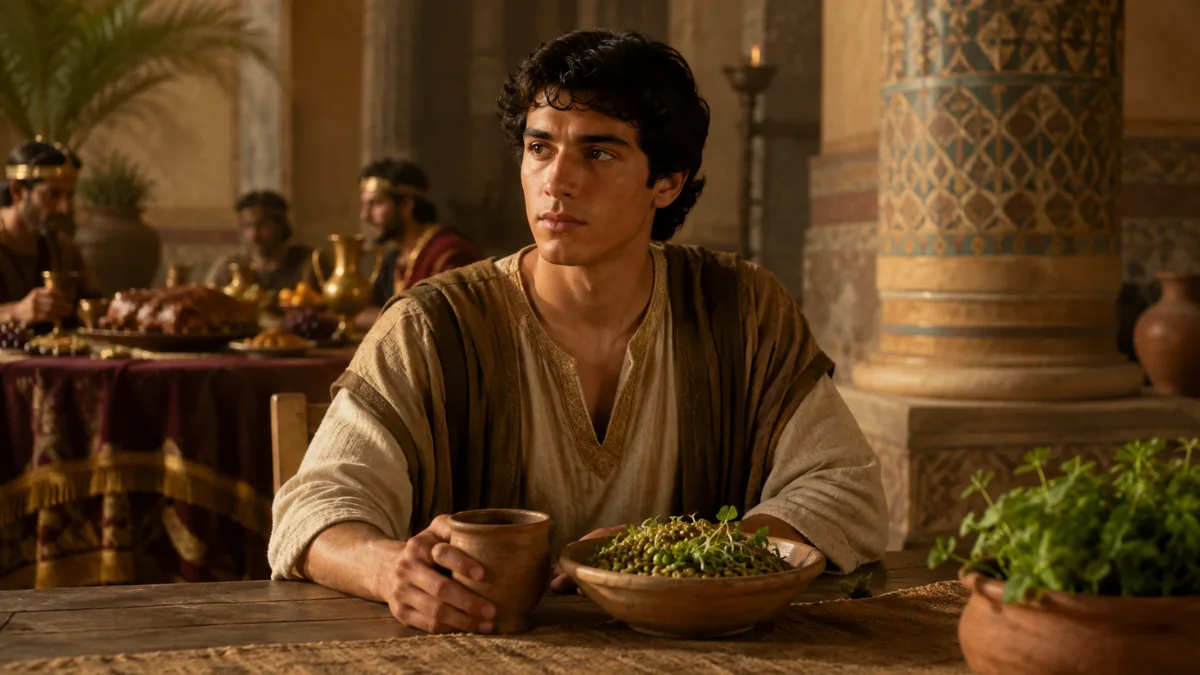

Why did Daniel choose vegetables and water in Babylon? He chose them because he believed the king’s assigned food and wine would defile him. Daniel 1 does not identify one exact ingredient or say that vegetables were healthier; it presents the diet as Daniel’s deliberate way to avoid royal provisions that conflicted with his loyalty to God.
Daniel did not stop eating altogether. He requested a different diet for ten days so that he and his three companions could avoid the king’s food and wine while remaining healthy. The complete passage can be read in Daniel 1:8–17.
What Was Daniel Trying to Avoid?
The king of Babylon had assigned Daniel and the other Judean youths food and wine from his own table. These young men were being trained for royal service, so the food was part of the program arranged for them.
Daniel’s objection appears in Daniel 1:8. He resolved not to “defile himself” with the king’s food and wine. This statement gives us Daniel’s spiritual reason, but the passage does not explain exactly which part of the food or drink caused the problem.
Several possibilities have been suggested.
The royal food may have included animals that violated Israelite dietary laws. Even food from an acceptable animal could have been prepared in a way that did not follow Israelite requirements.
The food and wine may also have been connected with Babylonian worship. Meat and wine served in a pagan royal court could have carried associations with offerings to false gods. However, Daniel 1 does not explicitly say that every item had been offered to an idol, so this should be treated as a possibility rather than a proven detail.
Another interpretation is that eating continually from the king’s table represented dependence on the king’s favour. Sharing a ruler’s provisions could symbolize acceptance of his patronage and way of life. Daniel was willing to live and serve in Babylon, but he would not allow the king’s provisions to control his allegiance to God.
The strongest conclusion is therefore broader than one disputed ingredient: Daniel believed accepting the royal food and wine would compromise his covenant faithfulness.
Why Did Daniel Choose Vegetables and Water?
Vegetables and water gave Daniel a clear alternative to the royal menu. He could continue eating and drinking without accepting the specific food and wine that troubled his conscience.
The word translated “vegetables” does not necessarily mean only leafy vegetables in the modern sense. It is connected with something sown or grown from seed. The diet may have included different types of plant food, such as grains, legumes, or other produce.
The American Bible Society’s translation commentary on Daniel 1:12 explains that the Hebrew term is related to sowing or something planted. The King James Version translates it as “pulse,” while many modern translations use “vegetables.”
Water was the natural alternative to the wine assigned by the king. Daniel did not need to make a general statement that all wine was sinful. He simply avoided the royal drink along with the royal food.
This choice made the boundary clear. Daniel was not asking for another luxurious meal from the palace. He was asking for basic plant food and water so that he could remain faithful to his convictions.
Why Did Daniel Ask for a Ten-Day Test?
The official responsible for the young men was afraid that Daniel and his friends would look weaker than those who ate the king’s food. If that happened, the official feared that the king would punish him.
Daniel responded respectfully. He asked the steward to give them vegetables and water for ten days and then compare their appearance with the other young men. He did not demand that the steward accept his claim without evidence. He proposed a limited test and allowed the official to judge the result.
The ten-day period also made the request practical. Daniel could demonstrate that refusing the royal menu would not make him unfit for service. His faithfulness involved courage, but it did not require unnecessary hostility toward the authorities.
After the test, Daniel and his companions looked healthier and better nourished than the young men who had eaten the royal food. The steward then removed the royal food and wine and continued giving them vegetables.
Did the Vegetables Make Daniel Wise?
The passage does not say that the vegetables gave Daniel supernatural wisdom.
Daniel 1:15 describes the visible result of the ten-day test: Daniel and his friends appeared healthier than the other youths. The expression “fatter in flesh” in older translations refers to a well-nourished or healthy appearance in this context, not necessarily modern obesity.
Daniel 1:17 then gives the source of their intellectual ability:
God gave the four young men knowledge and understanding in every kind of literature and wisdom.
Their wisdom came from God, not from a special nutritional formula. The narrative shows that Daniel’s obedience did not prevent him from becoming useful in Babylon, and that God sustained him after he rejected the king’s provisions.
The passage should therefore not be turned into a guarantee that a vegetable-and-water diet will produce unusual health, intelligence or spiritual power.
Was This the Daniel Fast?
Daniel 1 describes a restricted diet, but it is not a complete fast. Daniel and his companions continued eating plant food and drinking water.
It is also different from Daniel’s later experience in Daniel 10:2–3, when he mourned and avoided desirable food, meat, and wine for three weeks. That later episode is discussed separately in What Is Fasting in the Bible?.
Daniel 1 should not be used to establish a universal vegetarian command for Christians. Daniel did not refuse meat because the passage teaches that meat is always sinful. He refused the king’s assigned provisions because he believed accepting them would defile him.
The issue was the meaning and religious setting of the royal food, not a blanket condemnation of every form of meat or wine.
What Does Daniel’s Choice Mean?
Daniel chose vegetables and water because they were the simplest available alternative to food and wine that he believed would compromise his loyalty to God.
The central issue was not that vegetables were spiritually superior. The issue was that Daniel had already decided where his allegiance stood. He was living in Babylon, receiving Babylonian training, and preparing to serve within the government, but he refused to cross a line that violated his conscience.
The exact reason the royal food was considered defiling remains uncertain. It may have involved dietary laws, improper preparation, idolatrous associations, royal dependence, or a combination of these concerns. Scripture does not require readers to choose one explanation with absolute certainty.
What the passage makes clear is Daniel’s response. He did not abandon his faith when he entered Babylon. He remained respectful, acted wisely and trusted God while refusing provisions that he believed would compromise his obedience.
The vegetables and water were therefore not the main lesson. They were the visible expression of Daniel’s deeper decision to remain faithful to God in a foreign culture.
