

little edit needed
What does Psalm 82:1 mean by “gods”? The Hebrew verse uses elohim for the God who judges and again for the group standing before Him. Many modern scholars understand the second elohim as heavenly or divine beings, while an influential traditional interpretation identifies them as human judges or rulers. In either reading, Psalm 82:1 does not present these “gods” as equal to the God who judges them.
The wording sounds strange in English because readers often associate Elohim only with the God of Israel. Psalm 82:1 shows that the Hebrew term can be used more broadly, depending on context.
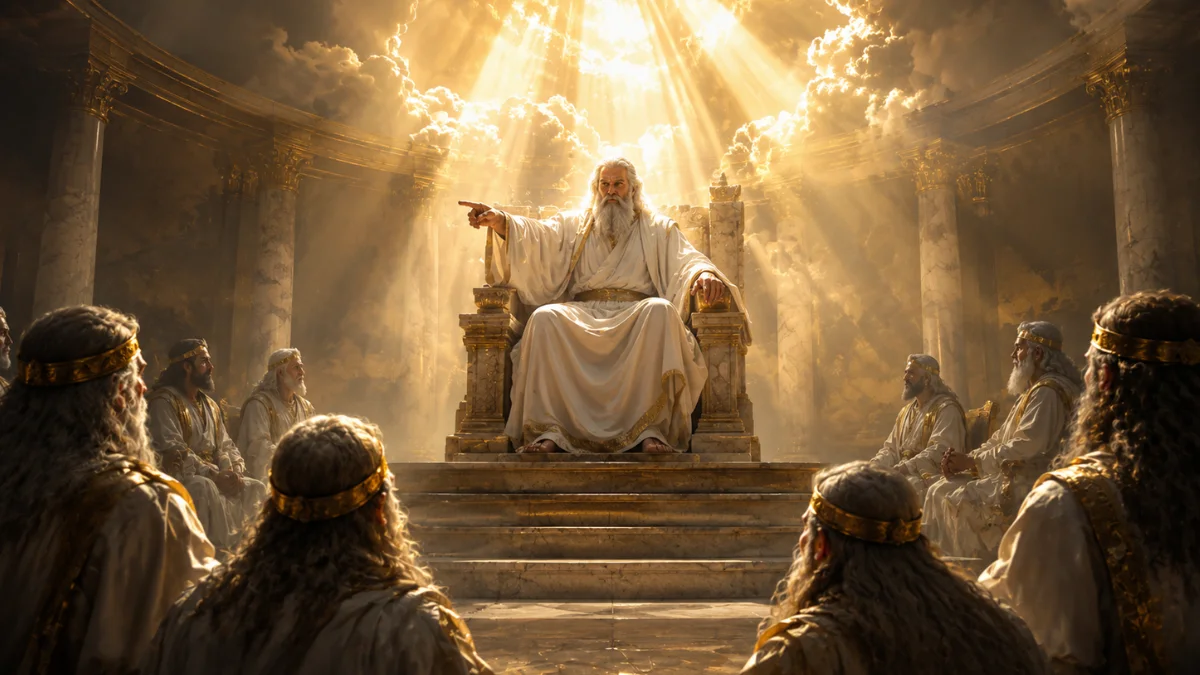
The verse presents a courtroom scene:
“God has taken his place in the divine council; in the midst of the gods he holds judgment.”
The central question is therefore not whether the Hebrew says elohim. It does. The question is who the second group of elohim represents.
How can elohim mean “God” and “gods” in Psalm 82:1?
Psalm 82:1 contains the word elohim twice, but the grammar and context distinguish the two uses.
At the beginning of the verse, Elohim functions as a singular subject. God stands or takes His place in the assembly.
Later, the verse says that He judges “in the midst of elohim.” Here the context points to a plurality of figures standing under judgment.
That distinction does not by itself settle who those figures are. Grammar helps show that the first occurrence refers to one divine judge and the second to a group, but it does not independently prove whether that group consists of human judges or heavenly beings.
The word elohim therefore has to be interpreted from the broader context of Psalm 82.
One point is already clear from verse 1: the figures are not portrayed as equals.
One Elohim stands in judgment over the others.
Who are the “gods” in Psalm 82:1?
Two major interpretations have shaped discussion of the verse.
One identifies the elohim as human judges or rulers.
The other understands them as heavenly or divine beings within a divine assembly.
The human-judges interpretation
The human-judges interpretation has a long history in Jewish and Christian interpretation.
It fits the judicial language of Psalm 82 particularly well. After verse 1, the figures are condemned for judging unjustly, showing partiality to the wicked, and failing to defend the weak, poor, fatherless, and oppressed.
Those are responsibilities associated with rulers and judges.
Under this interpretation, God stands above corrupt authorities and holds them accountable for abusing the authority entrusted to them.
Some interpreters have also connected this reading with other Old Testament passages where elohim has traditionally been understood in a judicial setting.
However, those passages are themselves debated, so they should not be treated as proof that elohim simply means “human judges.”
Psalm 82 must still be interpreted from its own wording.
The heavenly-beings interpretation
Many modern scholars understand Psalm 82 as depicting a heavenly or divine assembly.
Several details contribute to this reading.
Psalm 82:1 places God within an assembly and refers to the other figures as elohim. Verse 6 calls them “gods” again and also describes them as “sons of the Most High.”
Verse 7 then tells them:
“Nevertheless, like men you shall die.”
That statement is especially important.
If the figures are heavenly beings, the judgment that they will die “like humans” carries a strong contrast between their status and the punishment they are about to receive.
If they are already ordinary human rulers, the comparison is less striking, although not impossible.
For that reason, many contemporary interpreters consider the heavenly-being reading the stronger contextual explanation.
A scholarly treatment from Luther Seminary discusses the major interpretations of Psalm 82 and explains why the divine-assembly reading has significant support while still acknowledging alternative interpretations.
Does “divine council” mean many equal gods exist?
No.
Even if the plural elohim are understood as heavenly beings, Psalm 82 does not present them as equal to the God who judges them.
The structure of the psalm points in the opposite direction.
God stands over them as judge. He rebukes them. He pronounces judgment against them. Their status does not protect them from His authority.
The word elohim should therefore not automatically be read as though Psalm 82 teaches the existence of several equally supreme gods.
English can make this difficult because the word “god” often suggests a being comparable to the one supreme God.
Hebrew usage is more flexible.
In Psalm 82, the decisive point is not merely that several figures are called elohim. The decisive point is the relationship between them.
One stands as judge. The others stand under judgment.
That hierarchy is built directly into the scene.
Why do Psalm 82:6–7 matter for identifying the “gods”?
Although the article is about Psalm 82:1, verses 6–7 are necessary because they provide evidence about the identity of the figures introduced in verse 1.
Verse 6 says:
“I said, ‘You are gods, sons of the Most High, all of you.’”
The phrase “sons of the Most High” is one reason many scholars understand the figures as more than ordinary earthly judges.
Verse 7 then says:
“Nevertheless, like men you shall die.”
Together, these verses create a contrast between the status assigned to the figures and the judgment pronounced upon them.
That is one of the strongest arguments for the heavenly-being interpretation.
However, it should still be treated as an argument rather than unquestionable proof.
The human-judges interpretation remains historically important because the accusations in Psalm 82:2–4 are so closely connected with failures of justice.
Those verses condemn the figures for defending the wicked instead of protecting the weak and vulnerable.
That concern with justice also connects naturally with PsalmWisdom’s broader explanation of the biblical meaning of justice, while Psalm 82:1 itself remains focused on the identity of the elohim being judged.
Which interpretation best explains Psalm 82:1?
The heavenly-being interpretation explains several unusual details particularly well: the divine assembly, the plural elohim, the expression “sons of the Most High,” and the statement that these figures will die “like humans.”
For those reasons, it has strong support in modern scholarship.
The human-judges interpretation, however, should not be dismissed. It has a substantial interpretive history and fits the psalm’s repeated concern with corrupt judgment and neglected justice.
The most careful conclusion is therefore not that one side has no evidence.
It is this:
Psalm 82:1 clearly presents the God of Israel standing in judgment over figures called elohim. Many modern scholars identify those figures as subordinate heavenly beings, while an important traditional interpretation understands them as human judges or rulers. In neither reading are the “gods” presented as equal to the God who judges them.
That last point is the clearest part of the verse.
Psalm 82:1 does not weaken God’s authority by mentioning other elohim. It uses the courtroom scene to display that authority.
He is the one who stands among them as Judge.
