
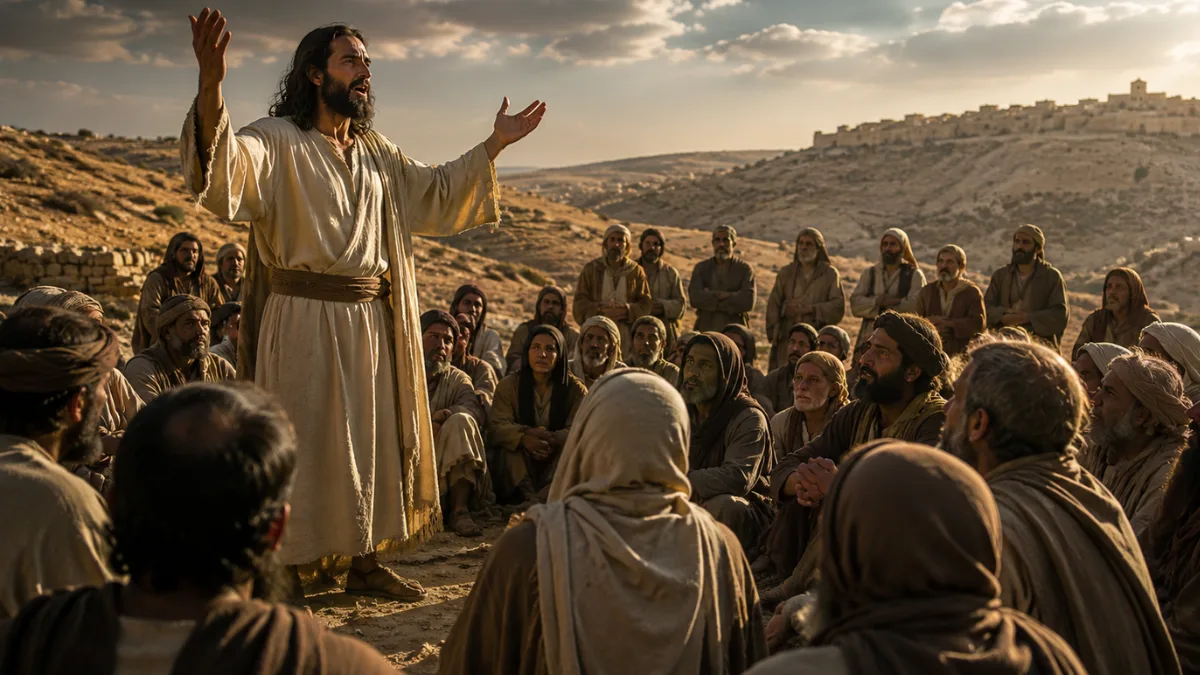

“The kingdom of heaven suffers violence” describes the unusually forceful and contested situation surrounding God’s kingdom from the ministry of John the Baptist onward. The Greek wording in Matthew 11:12 is difficult, which is why interpreters disagree over whether Jesus primarily describes violent opposition against the kingdom or forceful movement toward it.
Jesus is not commanding Christians to use physical violence, nor does the verse clearly teach that believers must become spiritually aggressive in order to force God to answer prayers or release blessings. The statement belongs to Jesus’ discussion of John the Baptist and the intense response surrounding the arrival of God’s kingdom.
Why Matthew 11:12 Is Difficult to Translate
The King James Version reads:
“And from the days of John the Baptist until now the kingdom of heaven suffereth violence, and the violent take it by force.”
The difficulty comes mainly from the Greek wording behind “suffereth violence.” The verb can be understood in a passive sense, giving the idea that the kingdom is being subjected to violence. It can also be understood in a sense suggesting forceful movement or advance.
That difference changes how the rest of the verse is understood.
If the first phrase means that the kingdom is being subjected to violence, then “the violent” can naturally refer to hostile people attacking or opposing what God is doing.
If the phrase describes the kingdom advancing forcefully, then the second half may describe forceful or determined people pressing toward it or laying hold of it.
This is why English Bible translations do not all sound the same. Readers can compare the wording of Matthew 11:12 across English Bible translations and see that the difference involves interpretation, not simply updated wording.
The ambiguity should therefore be acknowledged rather than hidden. It is one of the main reasons Matthew 11:12 has produced different interpretations.
Why Jesus Begins With John the Baptist
Jesus specifically says:
“From the days of John the Baptist until now…”
That starting point is essential to the meaning of the verse.
Earlier in Matthew 11, John is already in prison. He sends disciples to ask Jesus whether He is the expected One, and Jesus answers by pointing to what is happening through His ministry. Jesus then speaks to the crowd about John and his prophetic role.
Matthew 11:12 follows that discussion.
John therefore marks a decisive moment in the announcement of God’s kingdom. His preaching called people to repentance and prepared the way for the Messiah, but his ministry also produced strong reactions. Some received his message, others rejected it, and John himself was imprisoned.
Jesus’ words therefore arise from a setting in which the kingdom’s arrival was already producing intense response and opposition.
Here, “the kingdom of heaven” refers to God’s reign and saving rule rather than a physical territory that could literally be conquered. PsalmWisdom explains that kingdom idea separately in its guide to what “seek ye first the kingdom of God” means in Matthew 6:33.
That makes a literal military reading of Matthew 11:12 highly unlikely.
Does “The Kingdom of Heaven Suffers Violence” Mean the Kingdom Is Being Attacked?
This is one major interpretation, and the immediate context gives it significant support.
On this reading, Jesus means that since John began announcing the kingdom, God’s kingdom and its messengers have encountered violent opposition.
John’s imprisonment is an obvious example within the chapter itself.
The wording would therefore describe the hostile reaction produced by the arrival of God’s kingdom. The kingdom confronts established loyalties and exposes resistance to God’s authority, and that resistance can become aggressive.
The second half of the verse would then describe violent people attempting to seize, oppose, or suppress what God is doing.
This interpretation takes “violence” in a negative sense and fits naturally with the fact that John is already suffering because of his ministry.
However, the Greek wording does not make this interpretation the only possible reading.
Why Some Translations Suggest the Kingdom Is Forcefully Advancing
Another interpretation understands the first phrase more positively.
Instead of saying that the kingdom is suffering violence, the wording can be understood as saying that the kingdom is advancing forcefully or appearing with powerful movement.
The second half can then describe forceful or determined people laying hold of it.
Luke 16:16 contains a related saying. Jesus again connects a major transition with John and speaks about the kingdom being proclaimed, followed by language that some translations render in terms of people pressing into it.
That parallel helps explain why the forceful-response interpretation has remained important.
However, Luke 16:16 does not remove the grammatical ambiguity in Matthew 11:12. The two passages are related, but Matthew must still be interpreted on its own wording and immediate context.
John’s ministry did produce an urgent response. People came to hear him, confessed sins, received baptism, and responded strongly to the announcement that God’s kingdom was near. Jesus’ own ministry continued to provoke equally serious reactions.
On this reading, the violent imagery describes the intensity surrounding the kingdom’s arrival rather than literal aggression.
Even here, the language remains figurative.
Who Are “The Violent” Who Take It by Force?
This is the hardest part of Matthew 11:12 because the answer depends partly on how the first half of the verse is understood.
If “the kingdom suffers violence” means that it is being attacked, then “the violent” are naturally understood as hostile opponents who attempt to seize or assault what belongs to God’s kingdom.
If the kingdom is understood as forcefully advancing, “the violent” can instead describe people responding to it with unusual urgency or determination.
The Greek expression translated “take it by force” carries a strong idea of seizing or laying hold of something.
That strong wording shows that Jesus is describing something intense. The verse should not be softened into a vague statement that the kingdom was simply becoming popular.
The interpretive question is whether the force is primarily directed against the kingdom or describes the intensity of people’s response toward it.
The immediate context clearly contains conflict and powerful reaction, but Matthew 11:12 itself does not settle the question so easily that one reading can simply be declared obvious.
What Matthew 11:12 Does Not Mean
Whatever interpretation is preferred, Matthew 11:12 does not teach that Christians should use physical violence to advance God’s kingdom.
It also does not provide a clear command for believers to practice something called “spiritual violence,” nor does it teach that aggressive prayer can force God to release blessings, breakthroughs, or answers.
Those ideas go beyond what Jesus actually says.
The verse describes what has been happening from the days of John the Baptist until now. Its focus is the intense situation surrounding the announcement and arrival of God’s kingdom, not a method believers must imitate in order to obtain something from God.
Matthew 11:12 therefore should be read with interpretive humility. The immediate context clearly shows that the arrival of God’s kingdom beginning with John produced an intense and contested response. Whether the verse itself primarily emphasizes violent opposition against the kingdom or forceful movement toward it remains disputed because of the Greek wording.
What the passage does not support is turning Jesus’ language into a command for literal aggression or a formula for forcing spiritual results.
