
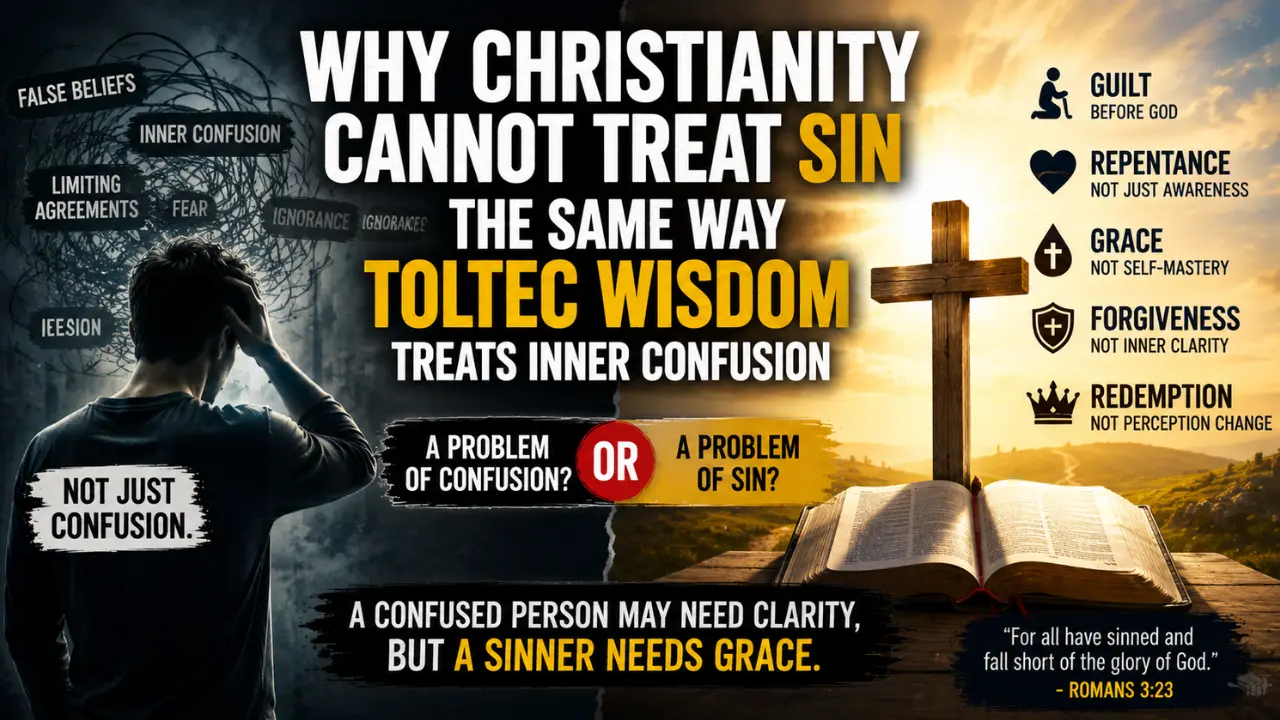

Christianity cannot treat sin the same way modern Toltec-style wisdom treats inner confusion because the Bible does not define the human problem as only illusion, ignorance, false belief or lack of awareness. Confusion may cloud the mind but sin involves guilt before God, rebellion against His will, corrupted desire and moral responsibility that requires repentance, forgiveness, grace and redemption.
Every spiritual system begins with a diagnosis. It names what is wrong with human beings before it explains how they can become free. Modern Toltec-style wisdom often speaks in the language of false agreements, mistaken perception, fear, inner bondage, and freedom from limiting beliefs. That language can feel attractive because it makes the human problem sound correctable through awareness, clarity, and self-mastery.
Christianity can agree that people are often confused, deceived, wounded, and shaped by false beliefs. But it cannot stop there. The Bible’s diagnosis is deeper. The human problem is not only that people misunderstand themselves. It is that they stand morally accountable before God.
That is why Christianity cannot simply rename sin as inner confusion.
Real Difference Is the Diagnosis of the Human Problem
The central difference is not only vocabulary. It is diagnosis.
If the human problem is mainly inner confusion, then the solution is clearer awareness. A person needs to wake up, question false beliefs, break inner agreements, and stop living under mistaken perception. The path becomes a movement from confusion to clarity.
Christianity does not deny that this can describe part of human experience. People do live under lies. They do believe false things about themselves, others, and God. They do act from fear, shame, pride, and wounded perception. The Bible itself recognizes deception, blindness, hardened thinking, and the danger of being led by falsehood.
But Christianity denies that confusion is the deepest name for the human condition.
In Christianity, the human problem is not only that people are mentally clouded. It is that they have sinned before God. They have loved what should not be loved, resisted what should be obeyed, excused what should be confessed, and chosen ways that violate God’s moral will.
This is why the Christian answer cannot be only awareness. If the problem is sin, then clarity must lead to repentance, grace, and reconciliation with God.
Christianity does not deny that people are confused. It denies that confusion is the deepest problem.
Inner Confusion Can Cloud the Mind
Inner confusion can explain many painful human experiences. It can explain why someone feels trapped in fear, reacts too quickly, believes the worst, repeats destructive patterns, or lives under emotional pressure. Confusion can cloud judgment and make a person less able to see what is true.
But Christianity says something more serious is also happening. Human beings are not only confused minds. They are responsible wills.
A person may be confused and still accountable. A person may be wounded and still guilty. A person may be shaped by false beliefs and still responsible for pride, cruelty, dishonesty, lust, envy, hatred, unbelief, or rebellion. Christianity does not flatten moral responsibility into emotional confusion.
This is where the distinction becomes important.
Confusion describes a clouded mind. Sin describes a guilty will before God.
That does not mean Christianity ignores pain, trauma, ignorance, or deception. It means Christianity refuses to explain every wrong action as merely a misunderstanding. Some things are not only unhealthy. They are evil. Some things are not only mistaken. They are disobedient. Some things are not only the result of inner wounds. They are violations of God’s will.
This is why Christianity uses moral language that modern spirituality often avoids. The Bible speaks of guilt, judgment, confession, repentance, forgiveness, and cleansing because it sees the human condition as more than mental disorder or emotional bondage.
If sin is only confusion, then people mainly need insight. If sin is guilt before God, then people need mercy.
False Belief Is Not the Same as Rebellion Against God
Modern Toltec-style wisdom often focuses on false agreements, mistaken stories, and wrong perceptions. In that framework, a person’s suffering may come from believing lies, accepting harmful assumptions, or allowing fear to define reality.
Christianity can acknowledge that false belief is powerful. People can believe lies about their worth, identity, purpose, pain, and future. False belief can shape behavior and keep people trapped in fear or shame.
But false belief is not the same as rebellion against God.
In Christianity, sin is not only believing wrongly about the self. It is living wrongly before God.
This means sin has a vertical dimension. It is not only about how a person feels inside. It is about how a person stands before the One who made them. Sin is tied to worship, desire, obedience, authority, and truth. It is not merely a broken inner story. It is a broken relationship with God.
A person may need to correct false beliefs, but Christianity says the deeper issue is not only mental correction. The will must turn. The heart must surrender. The person must come under God’s truth rather than simply feel clearer within the self.
This is why Christianity cannot reduce sin to a problem of perception. A thief does not only need to believe a better story. He must turn from theft. A proud person does not only need inner clarity. He must humble himself before God.
False belief matters, but it does not exhaust the meaning of sin. Sin includes wrong desire, wrong worship, wrong action, and resistance to God’s authority.
Awareness Can Expose Sin
Awareness has value, but Christianity does not treat awareness as salvation.
A person may become aware of anger, pride, fear, envy, lust, dishonesty, or selfishness. That awareness can be useful because hidden sin is harder to confront. A person who never notices a pattern may keep defending it. A person who becomes aware may finally begin to see what needs to change.
But awareness only reveals the problem. It does not remove guilt.
This distinction is essential:
- Awareness may reveal a sinful pattern.
- Repentance turns from that pattern before God.
- Awareness may explain why someone reacts wrongly.
- Grace forgives what awareness cannot erase.
- Awareness may bring clarity about the self.
- Redemption restores what self-understanding cannot repair.
This is where Christianity separates itself from any path that treats inner clarity as the main cure. A person can understand why they sinned and still need forgiveness. A person can identify a harmful pattern and still need grace. A person can become emotionally honest and still remain morally accountable before God.
Awareness can uncover sin, but it cannot atone for sin.
This is why Christianity does not stop at self-knowledge. The Bible calls people not only to see themselves accurately, but to confess, turn, receive mercy, and walk in obedience. Self-awareness may be part of the process, but it is not the foundation of salvation.
Repentance Is Deeper Than Self-Correction
Self-correction and repentance may look similar on the surface because both involve change. But they are not the same.
Self-correction says, “I need to adjust my thinking, habits, reactions, and inner patterns.” That can be helpful. People often do need better habits, wiser reactions, and healthier ways of thinking.
Repentance goes deeper. Repentance says, “I have sinned before God, and I must turn from what He calls evil.”
The difference is authority.
Self-correction can remain centered on personal peace. A person changes because a behavior no longer serves their happiness, stability, relationships, or self-image. Repentance is centered on God’s authority. A person turns because God is holy, His truth is right, and sin is not merely unhelpful but morally wrong.
Repentance is not merely becoming aware of unhealthy patterns. It is moral surrender before God.
That is why Christianity cannot treat repentance as just a stronger form of personal growth. Repentance involves confession, humility, sorrow over sin, and a willingness to come under God’s correction. It does not simply ask, “Is this behavior hurting me?” It asks, “Is this behavior evil before God?”
A person may correct habits without surrendering to God. But repentance requires surrender.
Grace Answers What Inner Clarity Cannot Reach
If the deepest problem is confusion, then inner clarity may seem like enough. But if the deepest problem is sin, then grace becomes necessary.
Christian grace does not merely help people feel lighter. It answers the moral problem that inner clarity cannot remove.
Modern spiritual language often speaks about healing, release, freedom, and peace. Those words can describe real human longings. People do want freedom from shame, fear, guilt, and inner heaviness. They want to feel whole. They want to stop being controlled by past pain or false beliefs.
Christianity values healing, but it does not reduce grace to emotional relief. Grace deals with guilt. Grace forgives sin. Grace reconciles sinners to God. Grace transforms people who cannot save themselves by awareness, discipline, effort, or self-mastery.
Inner clarity may help a person understand broken patterns, but grace addresses guilt before God. Awareness may bring insight, but grace brings forgiveness and new life. Self-understanding may explain what happened inside a person, but it cannot cleanse the conscience or restore a sinner to God.
This is why Christianity’s answer is deeper than self-understanding. It does not only say, “See more clearly.” It says, “Come to God for mercy.”
Grace matters because awareness cannot cleanse the conscience. Self-mastery cannot erase guilt. Emotional release cannot reconcile a sinner to God. Only grace can answer the moral weight of sin.
Why Christianity Cannot Reduce Sin to Inner Confusion
Christianity cannot reduce sin to inner confusion because doing so changes the whole spiritual path.
If sin is mainly confusion, then the goal becomes awareness. If sin is mainly false belief, then the goal becomes mental correction. If sin is mainly illusion, then the goal becomes perception change. If sin is mainly emotional bondage, then the goal becomes inner freedom.
Christianity includes truth, clarity, healing, and freedom, but it does not make them the whole answer. It teaches that people need truth, but also forgiveness. They need clarity, but also repentance. They need healing, but also grace. They need transformation, but also reconciliation with God.
This is why the Christian view of sin cannot be softened into a language of mere confusion. Sin is not only a fog in the mind. It is a moral condition before God. It touches desire, will, worship, action, guilt, and responsibility.
The difference is not small. If Christianity accepts confusion as the deepest problem, then repentance becomes unnecessary, grace becomes emotional comfort, and redemption becomes self-awareness. But Christianity cannot allow that reduction because its diagnosis is deeper.
For the broader belief-system comparison, see Toltec Wisdom vs Christianity: A Surprising Comparison Most Believers Never Explore.
A confused person may need clarity, but a sinner needs grace. Christianity’s answer is deeper because its diagnosis is deeper: the human problem is not only that people believe falsely about themselves, but that they stand morally accountable before God.

1 thought on “7 Ways Biblical Sin Differs from False Belief”