
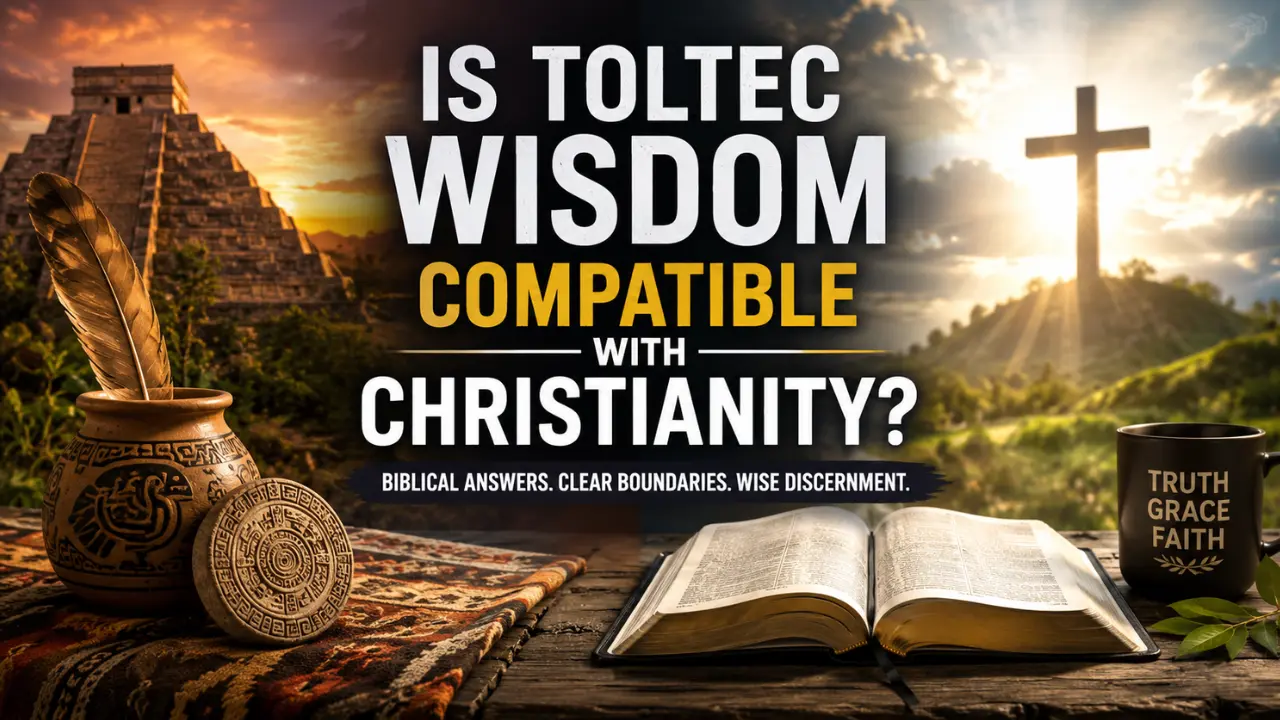

Toltec wisdom is not fully compatible with Christianity as a spiritual foundation. A Christian may recognize limited moral insight in it but only where those ideas agree with Scripture and do not replace the Bible, Christ, repentance, grace, prayer, or obedience to God.
That is the main boundary. Some Toltec-style teachings may sound practical because they speak about careful words, emotional discipline, fear, awareness, and personal freedom. A Christian can examine those ideas, but should not receive Toltec wisdom as spiritual authority or as a path equal to biblical faith.
The question is not only, “Does this sound wise?” The deeper question is, “What spiritual foundation is this teaching asking me to trust?”
Why This Question Matters for Christians
Christians ask this question because Toltec wisdom often uses moral language that can sound close to biblical wisdom. It may encourage careful speech, emotional restraint, freedom from fear, and awareness of personal reactions.
Those concerns are not automatically wrong. The Bible also speaks seriously about words, fear, self-control, pride, motives, and the condition of the heart.
The concern is not whether some advice sounds helpful. The concern is whether the spiritual framework behind that advice agrees with Scripture. Christianity is not only a system for better living. It is a revealed faith centered on God, sin, redemption, grace, Christ, and obedience.
A teaching may contain a useful observation and still carry a foundation that Christians should not follow.
For more context on the deeper similarities and differences, read Toltec Wisdom vs Christianity: A Surprising Comparison Most Believers Never Explore.
Is Toltec Wisdom Compatible with Christianity?
Toltec wisdom may be partly compatible with Christianity at the level of common moral observation, but it is not compatible as a spiritual foundation.
A Christian can agree that words matter. Scripture also teaches that speech can harm, heal, deceive, encourage, and reveal the heart. A Christian can agree that fear often controls people in unhealthy ways. Scripture also calls believers to trust God instead of being ruled by fear. A Christian can agree that people should examine their motives and reactions. Scripture also calls believers to wisdom, humility, and self-control.
But agreement in a few practical areas does not make the whole system spiritually compatible.
Christianity does not teach that human freedom comes mainly through self-mastery, personal awareness, or changing inner agreements. Christianity teaches that people need God’s truth, forgiveness of sin, new life in Christ, and transformation by grace.
That is why Christians should be careful. Toltec wisdom may contain some limited observations, but it should not become a Christian’s spiritual guide.
Why Similar Ideas Do Not Mean the Same Faith
Similar language can hide different meanings.
For example, both Christianity and Toltec wisdom may speak about the power of words. But in Christianity, words matter because people are accountable before God. Speech is connected to truth, love, holiness, deception, encouragement, and judgment. Words are not merely tools for shaping personal reality; they are moral actions before the Lord.
The same difference appears with fear. Christianity teaches believers not to be ruled by fear because God is sovereign, Christ is Lord, and God’s promises are trustworthy. Fear is not only a mental pattern to escape. It is often connected to faith, trust, suffering, obedience, and dependence on God.
Toltec wisdom may speak about freedom from fear in terms of awareness, perception, or personal liberation. That may sound similar at first, but it is not the same foundation as biblical faith.
Similarity in behavior does not always mean compatibility in belief.
Christians should not only ask whether an idea sounds helpful. They should ask whether it agrees with the Bible’s view of God, truth, sin, salvation, and spiritual transformation.
What Parts Can a Christian Accept with Discernment?
A Christian may accept limited practical observations from Toltec wisdom only when those ideas agree with Scripture and remain under biblical authority.
For example:
- Careful speech: A Christian can agree that words should be used with wisdom, honesty, and restraint.
- Emotional restraint: A Christian can recognize the value of not reacting to every insult, accusation, or offense.
- Personal responsibility: A Christian can accept the need to examine habits, motives, and repeated patterns.
- Freedom from fear: A Christian can affirm the desire to stop being controlled by fear, as long as freedom is rooted in trust in God.
- Awareness of the heart: A Christian can value self-examination when it leads to repentance, humility, and obedience.
The important point is that Christians do not need Toltec spirituality to build these convictions. Scripture already gives a stronger foundation for speech, humility, courage, forgiveness, self-control, and inner renewal.
A Christian should not treat Toltec wisdom as something that completes, corrects, or strengthens Christianity at the level of spiritual foundation. Some observations may overlap with biblical wisdom, but Scripture must decide what is true, safe, and spiritually useful.
Where Does Toltec Wisdom Cross a Biblical Boundary?
Toltec wisdom crosses a biblical boundary when it moves from practical advice into spiritual authority.
If a teaching says, “Be careful with your words,” a Christian can evaluate that as a moral observation. But if it begins to suggest that words create reality in a spiritual sense, or that personal perception is the highest truth, then it no longer fits within biblical Christianity.
The Bible does not teach that truth is created by human perception. Truth belongs to God. People may misunderstand truth, resist truth, or distort truth, but they do not create ultimate truth by changing the way they see themselves.
Toltec wisdom also crosses a boundary if self-awareness becomes a substitute for salvation. Awareness may help a person notice patterns, but it cannot forgive sin, reconcile a person to God, or give eternal life. Christianity teaches that people are not saved by deeper self-understanding. They are saved by the grace of God through Christ.
It also becomes dangerous when Christian words remain but their meanings slowly change. Grace can be reduced to self-acceptance. Repentance can become emotional release. Truth can become personal perception. Freedom can become detachment instead of redemption. Wisdom can become technique instead of obedience to God.
That kind of spiritual mixing is not compatible with Christianity.
A Simple Test for Christians
A Christian should test Toltec wisdom with clear biblical questions.
Ask:
- Does this idea agree with Scripture, or only sound peaceful?
- Does it keep Christ central, or does it make Him one wisdom teacher among many?
- Does it treat sin seriously, or reduce sin to ignorance, fear, or false thinking?
- Does it lead me toward prayer, repentance, humility, and obedience?
- Does it make self-awareness more important than God’s truth?
- Does it strengthen biblical faith, or slowly replace biblical categories with another spiritual framework?
These questions help separate common wisdom from spiritual compromise.
A Christian does not need to fear every outside idea, but a Christian should never be careless with spiritual foundations.
Can a Christian Read Toltec Wisdom?
A mature Christian may read Toltec wisdom with discernment, but should not receive it as spiritual guidance equal to Scripture.
Reading something is not automatically the same as accepting it. Christians may read philosophy, history, psychology, cultural wisdom, or non-Christian writings without making those sources their authority. The danger is not always in reading. The danger is in absorbing a spiritual framework without testing it.
A Christian should be especially careful if Toltec wisdom begins shaping their view of God, prayer, sin, truth, identity, freedom, or transformation. Once an outside system begins to disciple the heart, it is no longer just casual reading.
A simple rule is useful:
A Christian may read outside wisdom as something to test, but should not follow it as a spiritual path.
Final Answer for Christians
Toltec wisdom is not spiritually compatible with Christianity as a foundation for belief or practice. A Christian may recognize limited practical observations where they agree with Scripture, but should reject any teaching that changes the meaning of truth, sin, grace, salvation, or freedom in Christ.
Common wisdom can be tested, but Christian faith must remain rooted in Scripture, centered on Christ, and guided by God’s revealed truth.
Frequently Asked Questions
What parts of Toltec wisdom can Christians accept?
Christians may accept practical observations about careful speech, emotional restraint, personal responsibility, and self-examination when those ideas agree with the Bible. These ideas should remain under Scripture, not above it.
Where does Toltec wisdom become dangerous for Christians?
Toltec wisdom becomes dangerous when it becomes a spiritual authority, changes the meaning of truth, treats self-awareness like salvation, or replaces prayer, repentance, grace, and obedience to God.
Is Toltec wisdom the same as biblical wisdom?
No, Toltec wisdom and biblical wisdom are not the same. They may overlap in some practical areas, but biblical wisdom begins with God’s truth, while Toltec wisdom comes from a different spiritual foundation.
