
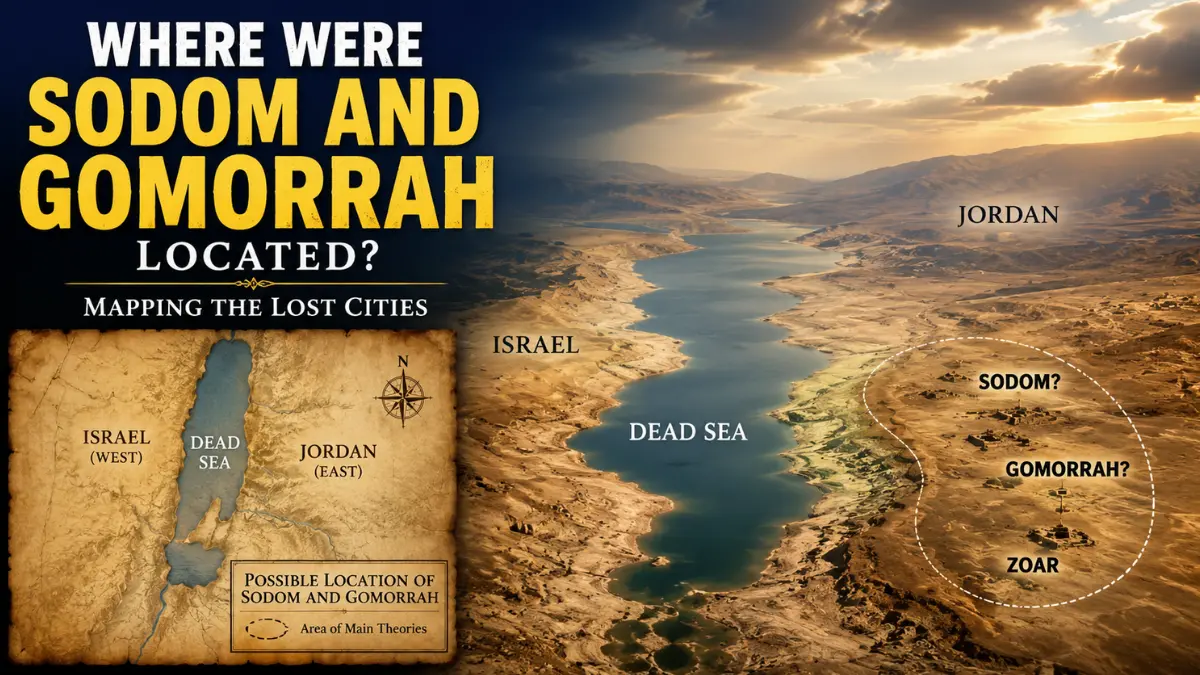

Sodom and Gomorrah location: The exact location of Sodom and Gomorrah has not been proven with complete certainty, but the strongest geographic discussions place the lost cities somewhere around the Dead Sea region. Most proposals focus either on the southern Dead Sea area or the northeastern Dead Sea/Jordan Valley area, with many suggested sites falling inside modern Jordan.
For a beginner, the important point is simple: the Bible does not give modern coordinates for Sodom and Gomorrah. It gives geographic clues. Those clues point readers toward the Jordan Valley, the Dead Sea, the cities of the plain, and nearby places such as Zoar. Because those clues can be interpreted in more than one way, the location remains debated.
This guide explains the likely region, the main location theories, and how modern borders like Jordan and Israel help readers picture the map without pretending the question is fully settled.
The Short Answer: Sodom and Gomorrah Were Likely Near the Dead Sea
The most reasonable starting point is the Dead Sea region.
Sodom and Gomorrah are connected in Genesis with the plain of the Jordan, the Salt Sea, and the wider group known as the cities of the plain. These details place the story in a real geographic setting rather than in an unknown symbolic place.
Today, the Dead Sea sits between modern Jordan on the east and Israel and the West Bank on the west. Because many proposed locations are on the eastern or southeastern side of the Dead Sea, modern Jordan is often central to the discussion.
This does not mean the Bible is using modern political borders. It is not. The story belongs to an ancient landscape long before the borders of Jordan and Israel existed in their present form. But for modern readers trying to understand the map, it is helpful to know that many serious location theories point toward areas that are now inside Jordan.
Also Read: The Real Sin of Sodom and Gomorrah in Genesis 19
Why the Dead Sea Region Matters
The Dead Sea is not just a background detail in the Sodom and Gomorrah story. It is the main geographic anchor for the location debate.
The region around the Dead Sea contains desert land, salt formations, dry valleys, ancient settlement areas, and places where water and fertility could exist near otherwise harsh surroundings. This combination fits the kind of landscape implied in Genesis, where Lot sees a region that appears attractive and useful before the story later turns toward judgment.
The Dead Sea region also helps explain why the location is difficult to prove. Ancient cities could be buried, destroyed, eroded, covered by later changes in the land, or confused with other ruins from the same broad period. The area has changed over time, and ancient place names do not always survive clearly on modern maps.
So the Dead Sea gives the strongest general location, but it does not automatically solve the exact site.
The Biblical Clues Used to Locate Sodom and Gomorrah
The first major clue is the plain of the Jordan.
Genesis describes Lot looking toward a well-watered plain before choosing where to live. This detail matters because it shows that Lot was drawn by visible geography. He saw a region that looked fertile and promising. This has led many people to search near the lower Jordan Valley and the Dead Sea basin.
The second major clue is the Salt Sea, which is connected with the Dead Sea. This clue is important because it places the story near one of the most recognizable geographic features in the region.
The third major clue is Zoar. Lot fled toward Zoar when Sodom was about to be destroyed. Any proposed location for Sodom needs to make sense of that escape route. If Zoar was nearby, then Sodom must have been close enough for Lot’s flight to make sense within the story.
The fourth clue is the phrase cities of the plain. Sodom and Gomorrah were not described as single isolated cities standing alone. They were part of a group of cities in the same region. That means the search is not only for one ruin. It is also for a pattern of ancient settlements that could fit the biblical setting.
These clues are helpful, but they do not point to only one possible dot on the map. That is why the debate continues.
Also Read: Sodom and Gomorrah Story Summary for Beginners
Was Sodom and Gomorrah in Jordan or Israel?
If we use modern borders, many of the strongest proposed locations are connected with modern Jordan, especially the eastern and southeastern side of the Dead Sea.
This does not mean the whole story belongs only to Jordan in a modern national sense. Abraham’s wider movements belong to the land of Canaan, and the Dead Sea region touches the geography of both sides. However, when people ask where the cities themselves may have stood, many candidate sites are usually placed east or southeast of the Dead Sea.
A careful answer would be:
Sodom and Gomorrah were likely located near the Dead Sea region, and many proposed sites fall within modern Jordan, but the biblical story itself belongs to an ancient landscape before today’s national borders existed.
That answer is more accurate than simply saying, “Sodom was in Israel” or “Sodom was in Jordan.” Modern borders are useful for orientation, but they should not be treated as the main meaning of the ancient text.
The Southern Dead Sea Location Theory
One major theory places Sodom and Gomorrah near the southern end of the Dead Sea.
This view is popular because it connects well with several important biblical details. The southern Dead Sea region is often linked with Zoar, the Salt Sea, and the idea that the cities of the plain were located before today’s national borders existed.
That answer is more accurate than simply saying, “Sodom was in Israel” or “Sodom was in Jordan.” Modern borders are useful for orientation, but they should not be treated as the main meaning of the ancient text.
Also Read: Archaeology of Sodom and Gomorrah Explained Simply
The Southern Dead Sea Location Theory
One major theory places Sodom and Gomorrah near the southern end of the Dead Sea.
This view is popular because it connects well with several important biblical details. The southern Dead Sea region is often around the lower part of the Dead Sea basin.
In this view, Sodom and Gomorrah may have stood near ancient settlement areas southeast of the Dead Sea. Some proposed sites in this region have been discussed because they show evidence of ancient occupation, destruction, and settlement patterns that make them interesting candidates.
The strength of the southern theory is that it fits the traditional idea of the cities being near the lower Dead Sea and close to places associated with Lot’s escape. It also makes sense of the harsh salt-heavy landscape that later readers often connect with the story.
The weakness is that no southern site has been accepted by everyone as the proven location of Sodom or Gomorrah. The evidence is suggestive, but not final.
Bab edh-Dhra and Numeira as Possible Southern Sites
Two names often connected with the southern Dead Sea theory are Bab edh-Dhra and Numeira.
These are ancient sites in modern Jordan near the southeastern Dead Sea region. They are discussed because they fit the general southern location model and show that people lived in this area in ancient times.
Some have suggested Bab edh-Dhra as a possible Sodom and Numeira as a possible Gomorrah. However, this should be worded carefully. These sites are candidates, not settled proof.
The reason they matter is that they give the southern theory real geographic and archaeological substance. Instead of speaking only about a lost city in a vague desert, these sites show that ancient settlements did exist in the region where many people search for Sodom and Gomorrah.
Still, responsible writing should not claim that these sites definitely prove the biblical cities. The stronger authority line is that they remain among the best-known candidates in the southern Dead Sea discussion.
The Northern Dead Sea and Jordan Valley Theory
Another major theory places Sodom farther north, near the northeastern Dead Sea or lower Jordan Valley.
This view takes seriously the description of the well-watered plain that Lot saw before choosing where to settle. Supporters of this view argue that the lower Jordan Valley better fits the image of a fertile plain visible from the region where Abraham and Lot separated.
The northern theory often focuses on a large ancient site in modern Jordan known as Tall el-Hammam. This site is important in the debate because of its size, location, and evidence of ancient destruction. It sits in a region that some believe matches the biblical description of the plain of the Jordan.
The strength of the northern theory is that it gives serious attention to the language of Genesis describing a well-watered area. It also points to a major ancient site rather than a small or uncertain location.
The weakness is that critics argue it does not fit every biblical clue as well as the southern Dead Sea view, especially details connected with Zoar and the traditional southern Dead Sea setting.
Why Tall el-Hammam Gets So Much Attention
Tall el-Hammam receives attention because it is a large ancient site in the Jordan Valley and because it has been proposed as a possible Sodom by some researchers.
For a beginner, it is important to separate two things.
First, Tall el-Hammam is a real and serious location proposal within the northern Dead Sea theory. Its size and location make it important in the discussion.
Second, not every dramatic claim connected to it should be accepted too quickly. Popular discussions sometimes turn archaeological theories into headlines that sound more certain than the evidence allows. A responsible article should avoid saying that Tall el-Hammam is definitely Sodom or that one dramatic destruction theory proves the biblical story.
The better explanation is that Tall el-Hammam is one of the most discussed northern candidates, but the exact identification of Sodom remains debated.
Could Sodom and Gomorrah Be Under the Dead Sea?
Some people have suggested that the cities may now be under the Dead Sea, especially in relation to the southern basin.
This idea exists because the Dead Sea region has changed over time. Water levels, shorelines, salt deposits, erosion, and geological movement can all affect how ancient places appear today. If a settlement once stood in a low-lying area, it is possible that later changes made it harder to identify.
However, this should be presented as a possibility rather than a proven answer. There is no universally accepted discovery under the Dead Sea that proves, beyond serious debate, the exact location of Sodom and Gomorrah.
This idea is useful because it helps explain why the location question is difficult. The landscape itself may have changed enough to complicate the search.
Comparing the Main Location Theories
A simple comparison helps readers understand the debate:
| Location Theory | Main Area | Why People Consider It | Main Caution |
|---|---|---|---|
| Southern Dead Sea theory | Southeastern Dead Sea, modern Jordan | Fits Zoar, the Salt Sea, southern traditions, and nearby ancient settlement sites | No site is universally accepted as proven |
| Northern Dead Sea theory | Lower Jordan Valley, modern Jordan | Fits the idea of a well-watered plain and includes a large ancient site | Some biblical clues may fit the southern area better |
| Underwater or lost-basin theory | Southern Dead Sea basin | Allows for landscape change over time | No confirmed underwater identification has settled the debate |
This comparison is helpful because it shows why there is no simple answer. Each theory explains some details well, but none removes every difficulty.
Why Scholars and Readers Disagree
People disagree about the Sodom and Gomorrah location because the Bible gives strong regional clues but not a modern map pin.
The southern view pays attention to Zoar, the Salt Sea, and long-standing Dead Sea traditions. The northern view pays attention to the well-watered plain and the lower Jordan Valley. Both approaches are trying to take the biblical text seriously, but they emphasize different details.
Archaeology also adds difficulty. A site may fit the geography but raise questions about timing. Another site may show destruction but not match the expected city pattern. A third site may be impressive in size but debated in relation to the biblical route.
This is why the most authoritative conclusion is careful rather than exaggerated. The location is likely in the Dead Sea region, but the exact identification remains uncertain.
The Best Way to Picture the Location on a Map
If a beginner were marking the location on a map, the most honest approach would be to circle the Dead Sea region instead of placing one certain dot.
A more detailed map could show two main zones.
The first zone would be the southern Dead Sea area, especially the southeastern side in modern Jordan. This is where the southern theory places possible sites connected with Sodom, Gomorrah, Zoar, and the cities of the plain.
The second zone would be the northeastern Dead Sea and lower Jordan Valley area, also in modern Jordan. This is where the northern theory places the possible location of Sodom, especially in connection with the well-watered plain described in Genesis.
This map approach is better than pretending the location is fully solved. It gives readers a clear visual answer while respecting the limits of the evidence.

1 thought on “5 Clues That Help Locate Sodom and Gomorrah”