

We live in a culture that often treats restraint as weakness. If someone insults you, expose them. If someone lies about you, answer louder. If someone attacks your name, attack theirs. Modern “clapback culture” trains people to believe that silence means defeat and that peace only comes after you prove your side publicly.
But Scripture often presents a very different kind of strength. In the Bible, spiritual maturity is not measured only by the power to speak, fight, defend or correct. Sometimes it is measured by the ability to stay clean when the situation gives you every excuse to become cruel.
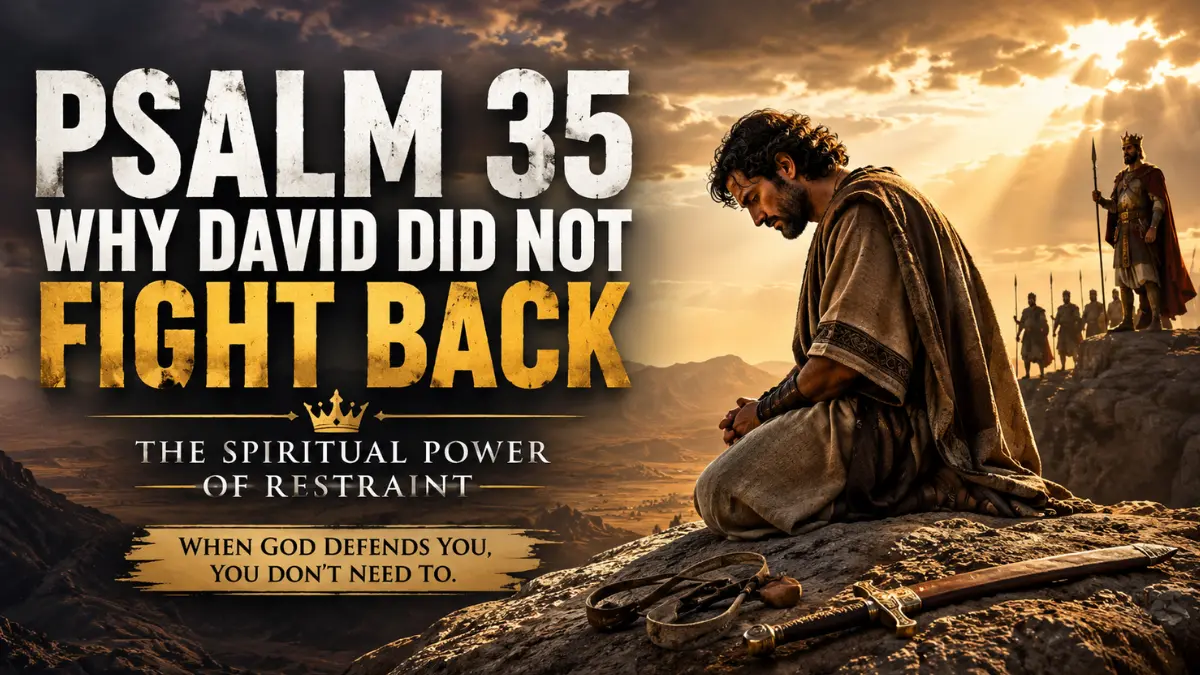
The Paradox: David was not a passive man. He was a warrior, a military leader, a giant-killer and a future king. He knew how to fight. He knew how to use a sword. Yet some of the most powerful moments in David’s life happened when he chose not to use the power available to him.
That is the paradox behind Psalm 35. David cries out to God but he does not take justice into his own hands.
Psalm 35 is David’s hidden blueprint for spiritual restraint. It shows that choosing not to fight back is not weakness. When the heart is surrendered to God, restraint becomes one of the highest forms of spiritual power.
Also Read: Rib Hebrew Meaning in Psalm 35 Explained
Context of the Cry: A Kingdom of Betrayal
The Wilderness Reality: Psalm 35 carries the emotional atmosphere of a man surrounded by hostility, accusation, and betrayal. David’s life was not under pressure because of one small misunderstanding. He was living under the shadow of a kingdom crisis.
Saul, the jealous and paranoid king of Israel, saw David as a threat. David had served Saul. David had fought Israel’s battles. David had honoured the king’s house. Yet Saul’s insecurity turned David into a target.
The wilderness became David’s classroom. The Judean desert was not only a place of physical survival; it was a place where David’s inner character was being tested. He was forced to live with danger, delay, injustice, and emotional exhaustion while still refusing to become the kind of man Saul had become.
The Pain of Betrayal: Psalm 35 becomes especially painful when David says that his enemies rewarded him evil for good. In verses 12–13, he remembers how he had shown compassion when others were weak. When they were sick, he wore sackcloth. He humbled himself with fasting. He prayed with the grief of someone who genuinely cared.
This was not the pain of being hated by strangers only. This was the deeper wound of being attacked by people David had once mourned over, prayed for, and treated with covenant kindness.
That makes his restraint more remarkable. It is one thing to ignore an enemy who never mattered to you. It is another thing to remain clean when someone you once loved, helped, or honoured turns against you.
The Missed Opportunities: David had more than one chance to end Saul’s life. In 1 Samuel 24, Saul entered the cave where David and his men were hiding. David could have killed him quietly. Instead, he only cut off a corner of Saul’s robe, and even that troubled his conscience.
Later, in 1 Samuel 26, David found Saul sleeping in the camp with his spear near his head. Again, the opportunity was perfect. David’s men saw it as divine permission. David saw it as a test.
He refused to strike the Lord’s anointed. He would not build his future throne through private revenge.
The Illusion of Self-Defence
Retaliation often appears reasonable at first. It feels like self-defence. It feels like justice. It feels like finally correcting what others have damaged.
But Psalm 35 exposes a hidden danger: when you fight the enemy with the enemy’s weapons, you slowly accept the enemy’s rules.
If David had answered Saul’s madness with murder, he may have won the immediate conflict but he would have lost something higher. He would have allowed Saul’s corruption to define his own response.
This is the trap of retaliation. It tells you that you are only protecting yourself but it quietly reshapes your character. It pressures you to exaggerate, manipulate, slander, scheme and justify whatever helps you win.
Preserving the Soul: David was not merely protecting Saul’s life. He was protecting his own soul.
If David had murdered Saul to secure the throne, his kingdom would have carried the stain of treason from the beginning. He may still have become king but the spiritual foundation of his reign would have been cracked.
The question was not only, “Can David defeat Saul?” The deeper question was, “What kind of man will David become before he receives the crown?”
Psalm 35 shows a man refusing to let injustice push him into impurity. David wanted deliverance but not at the cost of his conscience.
Character Over Convenience: David chose temporary vulnerability over permanent compromise.
That is not easy spirituality. That is disciplined faith. He remained exposed to danger longer than necessary because he refused to use an unlawful shortcut. He carried the pressure of being hunted rather than carry the guilt of becoming a murderer for the throne.
This is why restraint is not weakness in Psalm 35. Restraint is the ability to suffer without surrendering your integrity. It is the refusal to let someone else’s evil become your permission slip to sin.
Transferring the Burden of Justice
Psalm 35 opens with legal and military force: “Contend, Lord, with those who contend with me.” David is not simply venting emotion. He is bringing his case into God’s courtroom.
The word “contend” carries the idea of dispute, pleading and legal struggle. David is saying, in effect, “Lord, take up my case. Enter the conflict as the righteous Judge. Argue against those who are arguing against me.”
This is not shallow prayer. This is spiritual litigation. David is transferring the burden of justice from his own hands into the hands of God.
Stepping Out of the Judge’s Seat: The hardest part of betrayal is that we often want to become the judge, the witness, the lawyer and the executioner all at once. We want to explain everything, expose everything, correct everything and punish everyone who damaged us.
Psalm 35 teaches a different movement. David steps back so God can step forward.
When David refuses to kill Saul, he is not denying that Saul is wrong. He is refusing to take God’s position. He knows that God can defend him without David corrupting himself.
That is the spiritual handoff. You stop trying to control the verdict. You stop rehearsing revenge. You stop carrying a case that belongs in God’s court.
Active Surrender: Silence before critics is not always passivity. Sometimes it is active surrender.
David’s silence was not empty. It was filled with prayer, discipline and trust. He was not pretending nothing happened. He was placing the situation under divine jurisdiction.
This matters because biblical restraint is not the same as fear. Fear stays silent because it feels powerless. Faith stays restrained because it believes God is not powerless.
David’s prayer in Psalm 35 is bold but his hands remain clean. That is the balance. He does not suppress the pain but he refuses to weaponize the pain in a sinful way.
The Anatomy of Divine Intervention
Supernatural Logistics: Psalm 35:4–6 describes divine intervention with vivid force. David asks that his enemies be put to shame, turned back and made like chaff before the wind. He speaks of the angel of the Lord driving them away and pursuing them on a dark and slippery path.
This language shows that David believes God has forms of intervention that human beings cannot manufacture.
Human warfare depends on visible weapons: swords, strategies, alliances, rumors, pressure and counterattacks. Divine intervention can move through conscience, confusion, timing, exposure, consequences, circumstances and unseen spiritual authority.
David does not need to control every detail because God has access to the full field of reality.
The Historical Resolution: David never had to raise his hand against Saul.
Saul’s downfall came through his own choices, spiritual decline and the pressure of external enemies. On Mount Gilboa, Saul fell in battle against the Philistines. David did not need to assassinate him, trap him or campaign against him.
That matters deeply. David received the kingdom without staining his hands with Saul’s blood.
This is the clean victory Psalm 35 points toward. The righteous person may be falsely accused, hunted and delayed, but God is able to bring justice without requiring His servant to become unjust.
Modern Blueprint: How to Apply Psalm 35 Today
Step 1: Silence the Urge to Validate Yourself: Not every accusation deserves an immediate answer. Sometimes your consistent character over time becomes a stronger defence than frantic explanation. David did not build his reputation through constant self-protection. He let obedience speak longer than his enemies’ accusations.
Step 2: Ruthlessly Audit Your Weapons: Psalm 35 forces a serious question: what weapons are you tempted to use when you feel wronged?
For modern believers, the sword may look like corporate backstabbing, passive-aggressive emails, reputation damage, private gossip, public humiliation or strategic silence meant to punish. Restraint means dropping any weapon that would make you guilty while trying to prove you are right.
Step 3: Pray the Courtroom Prayer: David’s model is not emotional denial. It is legal surrender before God.
You can pray, “Lord, contend with what is contending against me. Judge what I cannot judge cleanly. Defend what I cannot defend without becoming bitter. Keep my hands clean while You handle what is beyond me.”
That is Psalm 35 in practice.

2 thoughts on “David’s Restraint in Psalm 35 and What It Means”