
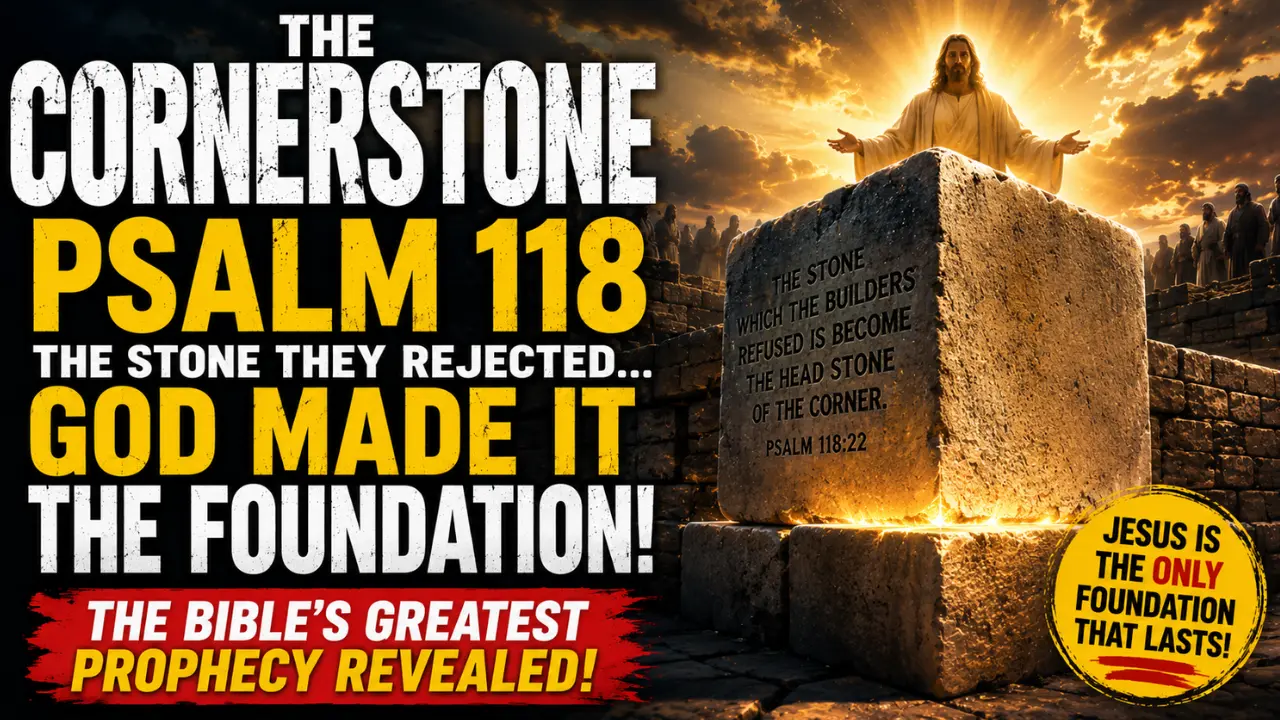

Psalm 118 does not present the cornerstone as a calm architectural detail. It places the image inside a song of distress, rescue, victory, procession, worship and divine reversal. The psalmist has been pressed by enemies, surrounded by opposition and brought to a place where human strength is not enough. Yet the Lord delivers him, opens the gates of righteousness, and turns his rejected condition into public praise. Into that movement comes the famous declaration: “The stone which the builders refused is become the head stone of the corner.”
The cornerstone meaning in Psalm 118 begins with rejection but it does not end there. The stone is examined by builders and deliberately refused, yet God makes it central to the structure. This is not merely a lesson about personal encouragement after being overlooked. It is a revelation of how God builds His kingdom. Human judgment rejects what God has chosen, but divine purpose overturns human evaluation, a reversal fulfilled most clearly in [Christ as the rejected stone who became the cornerstone — Jesus the Cornerstone in Psalm 118]. The rejected stone becomes the stone by which the whole building is aligned, supported and held together.
Psalm 118 as a Song of Deliverance
The cornerstone verse belongs to a larger psalm of thanksgiving. Psalm 118 opens with the repeated confession that the Lord is good and that His mercy endures forever. The speaker then describes distress, opposition and danger, but also the Lord’s intervention. The movement of the psalm is not from comfort to comfort but from pressure to rescue, from rejection to vindication and from danger to worship.
This context matters because the cornerstone image is not abstract theology. It rises out of deliverance. The rejected stone represents one who has been dismissed, opposed and treated as unfit, yet is publicly vindicated by God. The psalm moves toward the temple gates, sacrifice and praise, which means the rejected stone is connected to worship and covenant celebration. God’s rescue becomes visible before the gathered people, and the stone once refused now stands at the centre of God’s work, anticipating [the exaltation of Christ after rejection and suffering — From Rejected Messiah to Exalted King].
Why the Builders Matter
The builders in Psalm 118 are not random observers. Builders are people expected to know what belongs in a structure. Their role is evaluation, selection, measurement and placement. When builders reject a stone, they are making a judgment about its usefulness. They are saying, in effect, that this stone does not fit the building they intend to raise.
That detail gives the verse its sharp spiritual edge. The tragedy is not that untrained people failed to recognize the stone. The tragedy is that the supposed experts rejected what God had chosen. In biblical interpretation, the builders come to represent leaders, authorities, religious systems and human powers that claim discernment yet misjudge the work of God, a theme fulfilled in [the rejection of Jesus by the religious leaders of His day — Why Jesus Was Rejected by the Religious Leaders]. Their rejection exposes the limits of human wisdom when it is not surrendered to divine revelation.
Meaning of “Head Stone of the Corner”
The phrase “head stone of the corner” carries rich architectural meaning. It can suggest the chief stone that determines the corner of a foundation, the stone that joins walls together or even the exalted stone placed in a position of prominence. The exact architectural image has been discussed across generations but the spiritual meaning is clear: the refused stone becomes the decisive stone. It is no longer marginal. It becomes essential.
This layered meaning strengthens the passage rather than weakening it. If the image points to a foundation cornerstone, then the stone gives the building stability and alignment. If it suggests a capstone or chief stone, then the rejected one is exalted to honour and completion. In either case, Psalm 118 teaches the same truth: the stone rejected by human builders becomes central by the Lord’s doing. What people considered unusable becomes indispensable in God’s structure.
Why Rejection Is Part of the Prophecy
Rejection is not a side detail in Psalm 118. It is the very tension that gives the verse its prophetic force. The stone is not simply chosen; it is chosen after being refused. The builders’ rejection becomes the dark background against which God’s choice shines more brightly. Divine purpose does not merely succeed in spite of rejection. It reveals itself through the reversal of rejection.
This pattern appears repeatedly in Scripture. Joseph is rejected by his brothers before becoming an instrument of preservation. David is overlooked before becoming king. The prophets are resisted before their words are vindicated. Yet the pattern reaches its fullness in Jesus Christ, where [the crucified and rejected Savior becomes the risen cornerstone of God’s kingdom — How Jesus Fulfilled the Rejected Stone Prophecy] gives Psalm 118 its deepest fullfillment. He is examined by religious leaders, dismissed by the powerful, rejected by His own, condemned by human courts and crucified outside the city. The resurrection then reveals that the rejected One is God’s chosen foundation.
“This Is the Lord’s Doing”
Psalm 118 immediately explains the reversal: “This is the Lord’s doing; it is marvellous in our eyes.” That statement protects the reader from reducing the cornerstone image to human success, personal resilience or delayed recognition. The stone becomes central because God acts. The builders do not finally control the structure. The Lord does.
This phrase also reveals divine sovereignty. Human rejection cannot cancel God’s appointment. Human systems can misread the stone, remove it from their plans and declare it unsuitable, but they cannot overthrow what God has determined. The cornerstone stands because the Lord establishes it. That is why the verse produces wonder. It is marvelous because the outcome cannot be explained by human approval or natural promotion. It is the visible reversal of God’s hand.
“This Is the Day” and the Joy of Vindication
Psalm 118 continues, “This is the day which the Lord hath made; we will rejoice and be glad in it.” In context, this statement is tied to the Lord’s act of deliverance and vindication. The day is not merely an ordinary sunrise or a general encouragement to be positive. It is the day of God’s saving reversal, the day when the rejected stone is revealed as chosen, the day when divine mercy becomes public praise.
This matters for understanding Christ’s foundation. The New Testament sees the rejection and exaltation of Jesus as the great day of God’s redemptive action. The crucifixion looked like the builders had won, but the resurrection revealed the Lord’s doing. The stone once rejected was made central and the people of God rejoice because their foundation rests not on human acceptance but on God’s victorious act.
Jesus Applies the Cornerstone to Himself
The cornerstone meaning in Psalm 118 becomes unmistakable when Jesus applies the passage to Himself. In the Gospel accounts, He quotes the rejected stone verse while confronting religious leaders who oppose Him. By doing so, Jesus identifies Himself as the stone rejected by the builders and appointed by God. The leaders may think they are protecting the structure but they are rejecting the very One on whom God’s kingdom is built.
This connection gives Psalm 118 its Christ-centred depth. Jesus is not merely like the rejected stone. He fullfills the pattern. His rejection by the leaders, His suffering, His crucifixion and His resurrection reveal the full meaning of the psalm. The cornerstone is not an idea, principle, institution or religious tradition. The cornerstone is Christ Himself.
Peter and the Apostolic Witness
The apostles continue this interpretation. Peter uses the language of the rejected stone to proclaim that Jesus, crucified by human hands and raised by God, is the foundation of salvation. The same image appears in apostolic teaching about the church, where Christ is described as the chief cornerstone and believers are built together as a spiritual house.
This apostolic witness matters because it shows that the early church did not treat Psalm 118 as a vague metaphor. They saw it as a prophetic lens for understanding Jesus. The leaders rejected Him, God raised Him, and now every person must reckon with Him as the appointed foundation. Salvation, worship, identity and the people of God are all built upon the rejected and risen Christ.
Christ as Foundation
To call Christ the cornerstone means He is not an ornamental part of faith. He is not a decorative stone added to a structure already built by human effort. He is the foundation and alignment point of the entire spiritual building. Everything else must be measured in relation to Him.
This is where the cornerstone image becomes deeply confrontational. The cornerstone does not adjust itself to fit the building. The building must align itself to the cornerstone. Christ does not bend His identity, truth, holiness or authority to fit human preference. Instead, every doctrine, desire, ambition, identity, relationship and act of worship must be brought into alignment with Him.
The Stone That Joins the Walls
A cornerstone also carries the idea of joining and holding together. It creates coherence where separate walls meet. Without proper alignment at the corner, the structure becomes unstable and divided. This gives the image profound meaning for the church. Christ is not only the foundation beneath individual believers; He is the unifying centre of the whole people of God.
The church is not ultimately held together by culture, personality, politics, nationality, emotional preference or human leadership. It is held together by shared alignment to Christ. When that alignment weakens, confusion and division increase. When Christ is central, the spiritual house finds its true shape. The cornerstone gives unity without erasing holiness and stability without depending on worldly power.
False Foundations and Modern Spirituality
Psalm 118 remains urgent because people are still building on foundations that cannot bear eternal weight. Some build life on success, public approval, wealth, romance, reputation, ideology, self-expression or personal control. These foundations can look strong for a season but they shift under pressure. Suffering exposes them. Failure cracks them. Death finally proves that they were never strong enough to hold the soul, echoing [Jesus’ warning about building on sand instead of a rock-solid foundation — The Wise and Foolish Builders Explained].
Christ’s foundation is different because it is established by God, not constructed by human ambition. A life built on Christ does not become immune to storms but it rests on what cannot be destroyed by them. The cornerstone gives stability when circumstances change, identity when human approval disappears and hope when every earthly foundation begins to tremble.
The Warning of Rejecting the Stone
Psalm 118 offers comfort but it also gives a warning. The builders rejected the stone but their rejection did not make the stone less important. It only revealed that their judgment was wrong. To reject Christ does not weaken Christ. It leaves the rejected person without the foundation God has appointed.
This warning is especially serious because rejection can appear in more than one form. Some reject Christ openly. Others admire Him as a teacher while refusing His lordship. Some use His name while building on pride, control, ambition or self-righteousness. Others want the blessings of the kingdom without surrendering to the King. Psalm 118 exposes every attempt to build around the cornerstone instead of upon Him.
The Cornerstone and Personal Identity
The cornerstone image also speaks to identity. Foundations determine what can be safely built. If a person builds identity on achievement, appearance, ministry success, social approval or emotional security, life becomes fragile because those things can be removed. A cracked foundation makes every upper room unstable.
In Christ, identity rests on something deeper than performance or recognition. The rejected and risen Cornerstone gives believers a secure place to stand before God. This does not produce pride. It produces humility and peace. The believer is not self-founded. The believer is Christ-founded. The life being built is not held together by personal strength but by union with the One God has made central.
The Foundation That Will Be Tested
The final force of Psalm 118 is not merely that the cornerstone is beautiful but that it is necessary. Every structure eventually reveals its foundation. Time tests it. Storms test it. Pressure tests it. Judgment tests it. What is not aligned to God’s chosen stone cannot finally stand.
The rejected stone has become the head stone of the corner, and this is still marvelous in the eyes of faith. Christ stands as the foundation God has laid, the stone human wisdom misjudged, the center that holds the true house together and the measure by which every life is finally tested. The builders may reject Him, cultures may dismiss Him, and individuals may try to construct meaning without Him but the structure that endures is the one built on the Cornerstone God Himself has chosen.
