
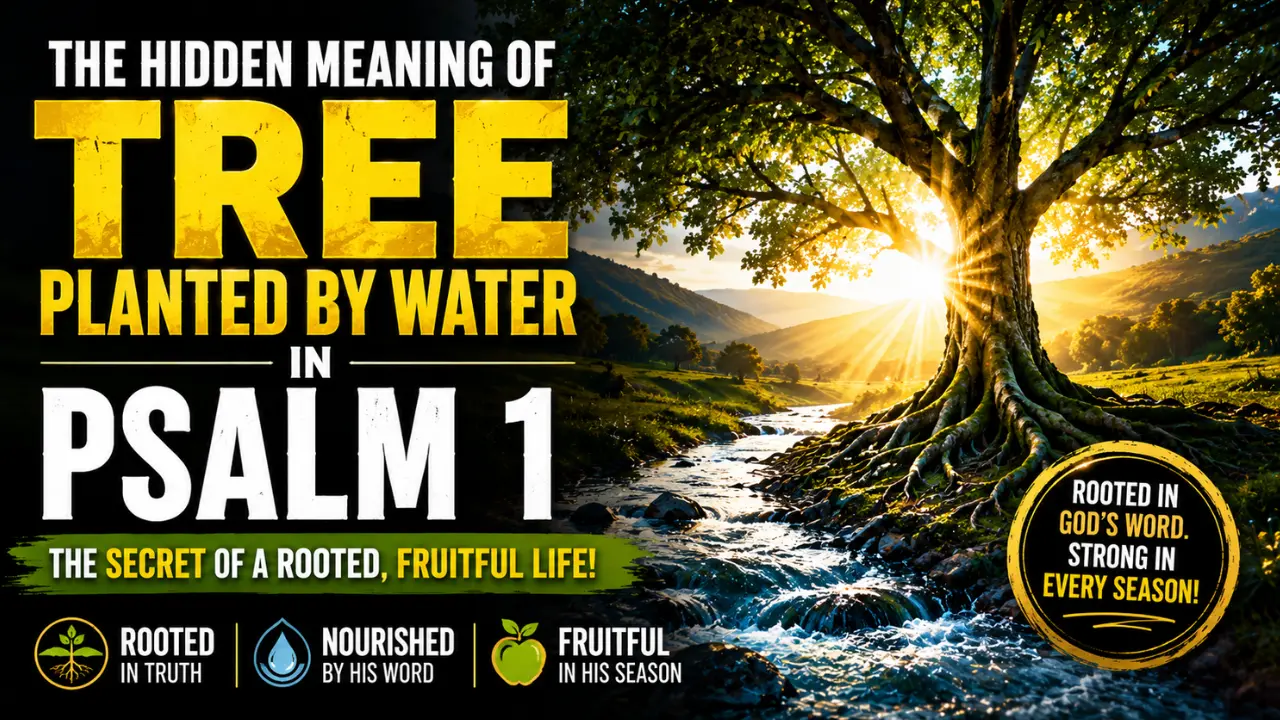

Psalm 1 does not begin with worship music, temple ceremony or emotional comfort. It begins with a choice. Before the Psalms lead readers into lament, praise, repentance and thanksgiving, Psalm 1 places two paths before the soul: the way of the righteous and the way of the wicked. One life becomes rooted, fruitful and enduring. The other becomes weightless, unstable and driven away.
This is why the image of the tree planted by streams of water carries such force. It is not decorative poetry. It is a picture of what happens when a person refuses the counsel of the wicked, rejects the path of sinners, avoids the seat of scoffers and instead delights in the law of the Lord. The tree represents a life shaped by God’s truth rather than carried by the pressure of the world, much like [the biblical meaning of spiritual roots and stability — What It Means to Be Rooted in God’s Word] reveals through Scripture.
In the ancient world, a tree near flowing water symbolized survival, strength and fruitfulness. Dry seasons could scorch the land but a tree with roots near steady streams could remain alive when everything around it weakened. Psalm 1 uses this image to show that spiritual endurance comes from hidden roots connected to God’s word.
Psalm 1 Begins With What the Righteous Refuse
Before Psalm 1 describes what the righteous person loves, it first describes what he rejects. He does not walk in the counsel of the wicked, stand in the way of sinners or sit in the seat of scoffers. The movement is deliberate. Walking, standing and sitting show a progression from casual influence to settled identity.
This matters because no one becomes spiritually rooted by accident. A life shaped by God must also be guarded from voices, habits and loyalties that pull the heart away from Him. The righteous person is not praised for isolation from people but for refusing to be formed by rebellion against God.
The tree planted by water is therefore not merely an image of blessing. It is the result of spiritual separation from destructive influence. Roots grow strong when the soul is not constantly drinking from poisoned streams.
Righteous Delight in the Law of the Lord
Psalm 1:2 gives the positive side of the righteous life: “his delight is in the law of the Lord and on His law he meditates day and night.” This delight is not cold religious duty. It is a deep love for God’s instruction, wisdom, character and will.
Biblical meditation does not mean emptying the mind. It means filling the heart with God’s truth until it shapes desire, thought, speech and action. The righteous person returns to Scripture not only for information but for formation, learning [how meditation on God’s word transforms the inner life — The Biblical Meaning of Meditating on Scripture] through continual reflection and obedience.
This is the hidden source behind the tree image. Fruitfulness begins before fruit appears. Stability begins before storms arrive. The visible life grows from an inward life continually nourished by divine truth.
What the Tree Planted by Water Symbolizes
Stability in an Unstable World
The tree in Psalm 1 symbolizes a life with spiritual weight. It is not blown about by every trend, fear, temptation or opinion. It stands because its strength exists beneath the surface.
This does not mean the righteous never struggle. Psalm 1 does not describe a painless life. It describes a grounded life. Storms may come, emotions may tremble, circumstances may change but the person rooted in God is not easily uprooted by what happens around him.
A shallow life depends on outward conditions. A rooted life depends on a hidden source.
Dependence on God as the Source
The tree is not alive because of itself. It is alive because of the water. This is central to the meaning of Psalm 1. Spiritual strength does not come from personality, intelligence, discipline or self-confidence alone. It comes from dependence upon God.
The streams represent the sustaining power of God’s truth and presence. The righteous flourish because they remain connected to what gives life. They are not self-sufficient; they are well-rooted.
This protects the passage from becoming moral self-improvement. Psalm 1 is not saying, “Try harder and become impressive.” It is saying, “Root your life in God and His truth will sustain what human strength cannot.”
Meaning of “Planted”
Planted Means Established With Purpose
Psalm 1 does not describe a wild tree that happens to grow near water. It describes a tree planted by streams. The word suggests intention, placement and stability. The righteous life is not drifting. It has been set in the place where life can be sustained.
This gives the image spiritual depth. A planted life is not ruled by restlessness. It is not always chasing new sources of identity, approval or satisfaction. It becomes established in God’s instruction and learns to remain where true nourishment flows.
There is quiet strength in being planted. Roots do not become deep through constant relocation. Spiritual maturity grows where the heart remains faithful to God’s word over time.
Planted Is the Opposite of Driven Away
Psalm 1 later says the wicked are like chaff that the wind drives away. This contrast is essential. The righteous are planted; the wicked are driven. One life is established by God’s truth. The other is carried by forces it cannot control.
Chaff has no root, no weight, no fruit and no lasting place. It may move quickly but it has no stability. Psalm 1 uses this sharp contrast to show the difference between spiritual substance and spiritual emptiness.
A planted life may grow slowly, but it endures. A rootless life may appear free but it is easily scattered, revealing [the difference between spiritual stability and spiritual emptiness — What the Bible Says About Spiritual Foundations].
The Meaning of “Streams of Water”
Continual Nourishment
The phrase “streams of water” suggests ongoing supply. The righteous person is not sustained by occasional religious emotion or rare moments of spiritual attention. The life described in Psalm 1 receives continual nourishment through delight and meditation in God’s law.
This is why the image is so practical. Spiritual dryness often comes when the soul is cut off from its source. A person may remain outwardly active, religious or successful while inwardly withering because the roots are no longer drawing life from God, much like [the spiritual danger of drifting away from God’s presence and truth — Signs of Spiritual Dryness in the Christian Life] warns throughout Scripture.
The streams point to steady dependence. God’s word is not a decorative addition to life; it is nourishment for the soul.
Life in Dry Seasons
Trees near water survive differently when heat comes. Their strength is not based only on what appears above ground. Their roots reach what the drought cannot easily touch.
This is how Psalm 1 describes spiritual endurance. A person rooted in God may still face sorrow, temptation, pressure and uncertainty, but the source beneath the surface remains secure. The strength of the righteous is not that trouble never comes. It is that trouble does not have the final authority over the soul.
“Yields Its Fruit in Its Season”
Fruit Comes Through Time and Rootedness
Psalm 1 says the tree “yields its fruit in its season.” This phrase teaches patience. Fruit does not appear instantly, constantly or artificially. It grows in the proper season from a healthy life.
Many believers become discouraged when growth feels slow. Psalm 1 corrects that impatience. God forms maturity through time, hidden roots, repeated obedience and steady nourishment. A fruitful life is rarely rushed.
The righteous person bears fruit not because of frantic striving but because the life within is being sustained by God.
Fruit Blesses Others
Fruit is never only for the tree. It becomes nourishment for others. In the same way, a life rooted in God begins to produce qualities that strengthen the people around it.
Wisdom, patience, kindness, courage, humility, truthfulness, generosity and faithfulness become visible over time. These are not decorations added to the Christian life. They are evidence that the roots are healthy, reflecting [the fruit that grows from a life shaped by God’s Spirit — The Fruit of the Spirit Explained].
Psalm 1 therefore connects private meditation with public fruit. What happens quietly in the soul eventually shapes relationships, decisions, speech and witness.
“Its Leaf Does Not Wither”
Endurance Without Denying Hardship
The promise that the leaf does not wither should not be misread as a promise of comfort without struggle. Scripture never teaches that righteous people avoid pain. Many faithful servants of God endured grief, persecution, weakness and loss.
The image means that spiritual vitality can remain even when outward circumstances become difficult. The righteous may suffer but they are not abandoned. They may be tested but they are not cut off from the source of life.
A green leaf in a dry season is a testimony. It shows that hidden nourishment is still flowing.
God Sustains What He Plants
The tree endures because the streams continue. This points beyond human effort to divine faithfulness. God sustains the life that is rooted in Him.
The righteous are not stronger because they are naturally superior. They endure because they are connected to the Lord’s instruction, presence and grace. Psalm 1 shows that spiritual permanence comes from God’s sustaining work, not human pride.
Contrast With Chaff
Chaff Looks Free but Has No Foundation
Psalm 1 gives a severe contrast: “The wicked are not so but are like chaff that the wind drives away.” Chaff was the dry husk separated from grain during threshing. It was light, rootless and easily scattered.
This image exposes the illusion of life apart from God. A rootless person may appear independent, flexible or successful for a time but without spiritual substance, there is no lasting foundation.
The righteous tree has roots, water, fruit and endurance. Chaff has movement but no life. It is driven, not established.
Direction Determines Destiny
Psalm 1 is not merely comparing personalities. It is comparing destinies. The righteous are known by the Lord but the way of the wicked will perish. The issue is not outward success but final standing before God.
This gives the psalm its weight. Every life is being shaped by a source. Every path is moving toward an end. Psalm 1 calls readers to examine what they are receiving, where they are standing and what is forming their hearts.
The Tree by Water in Jeremiah 17
Jeremiah 17:7–8 echoes Psalm 1 by describing the person who trusts in the Lord as a tree planted by water, sending out roots by the stream. This person does not fear when heat comes and his leaves remain green even in drought.
Jeremiah strengthens the meaning by connecting the image directly to trust. The blessed person is not the one who trusts in human strength but the one whose confidence is in the Lord. The water symbolizes more than religious habit; it represents dependence upon God Himself.
Together, Psalm 1 and Jeremiah 17 teach that spiritual endurance comes from trust, rootedness and continued life from God.
Jesus and the Fullfillment of Living Water
The imagery of water reaches its deepest fullfillment in Jesus Christ. In the New Testament, Jesus offers living water to the thirsty and speaks of rivers of living water flowing from those who believe in Him, revealing [what Jesus meant by living water in the Gospel of John — The Meaning of Living Water in Scripture] through the work of the Spirit.
Psalm 1 shows the blessed life as a tree sustained by streams. Christ reveals the source of that life fully. Apart from Him, the soul eventually dries out. In Him, believers receive life that does not depend on outward conditions for survival.
The tree planted by water ultimately points to a life rooted in God through Christ, nourished by His word and sustained by the Spirit.
Why Psalm 1 Still Speaks Today
Modern life often produces spiritual rootlessness. People are pulled by constant noise, shifting opinions, shallow identity, digital distraction and pressure to conform. Many appear busy and successful while inwardly exhausted.
Psalm 1 speaks directly to this condition. It teaches that lasting strength does not come from movement, visibility or approval. It comes from being planted in God’s truth.
A rooted life may look slow in a restless world, but it is the life that endures. The person who delights in God’s word becomes like a tree beside steady waters: nourished beneath the surface, fruitful in season and sustained when dry winds come.
Blessed Life in Psalm 1
Psalm 1 begins the Psalms by showing that worship cannot be separated from wisdom. The life that praises God must also be rooted in His instruction. The blessed person refuses destructive counsel, delights in divine truth and becomes established where real life flows.
The tree planted by water is one of Scripture’s clearest pictures of spiritual stability. Its roots deepen quietly. Its fruit appears in season. Its leaves remain alive because its source does not fail.
That is the meaning of Psalm 1. The righteous life is not weightless like chaff or restless like dust in the wind. It is planted, nourished, fruitful and known by the Lord.
