
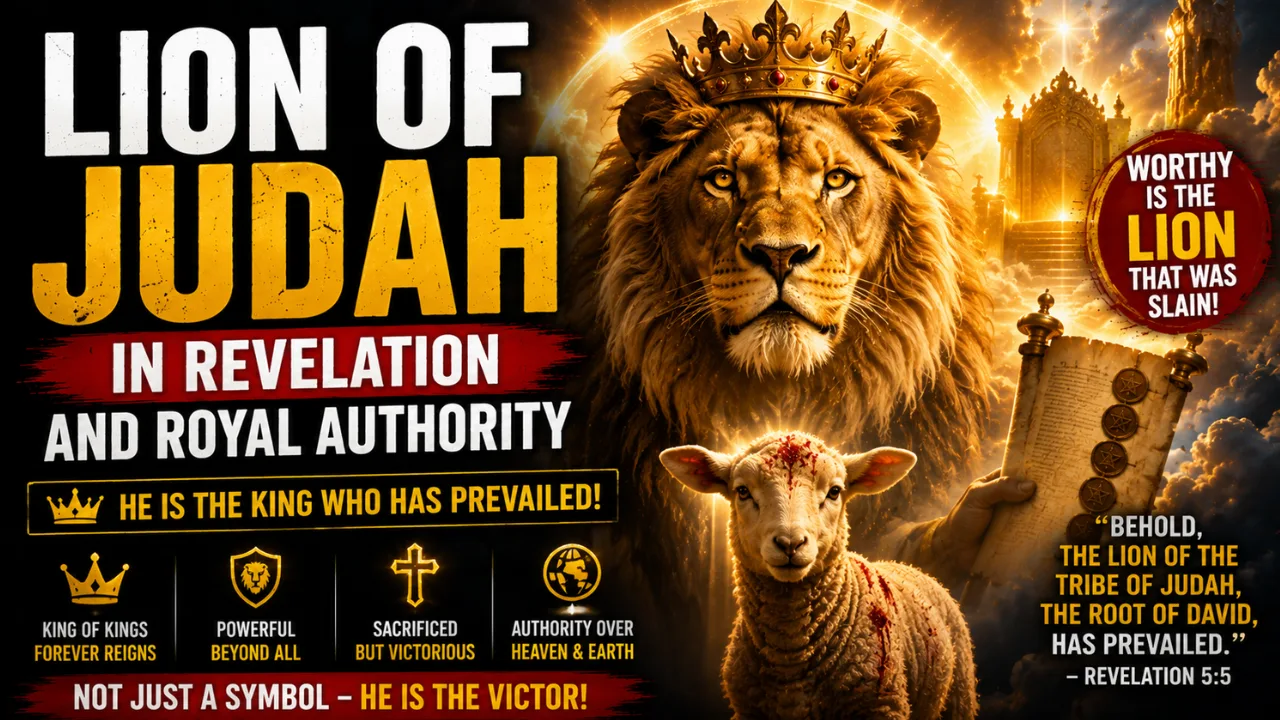

Among all the titles used for Christ throughout the Bible, few carry as much power, majesty, symbolism and prophetic depth as the title “The Lion of Judah.” The phrase immediately evokes images of kingship, authority, strength, victory, courage, dominion and royal power. Throughout Scripture, lions symbolized rulership and unstoppable strength but in Revelation the title reaches its fullest and most dramatic meaning when heaven announces Christ as the victorious Lion who alone possesses authority to open the sealed scroll. This imagery closely connects with [the symbolic meaning of lions in the Bible — What Does the Lion Symbolize in Scripture?].
The moment is one of the most emotionally powerful scenes in the entire book of Revelation.
John sees a scroll sealed with seven seals in the hand of the One seated upon the throne. A mighty angel asks who is worthy to open it but no one in heaven, on earth or beneath the earth is found worthy. John begins to weep because the scroll remains unopened, symbolizing humanity’s inability to fullfill God’s redemptive purposes or exercise rightful authority over history. This dramatic scene reinforces [the significance of the seven-sealed scroll in Revelation — The Meaning of the Scroll With Seven Seals].
Then one of the elders speaks:
“Do not weep. Behold, the Lion of the tribe of Judah, the Root of David, has prevailed.”
The announcement changes everything.
Yet what follows is deeply surprising. When John turns expecting to see a roaring lion, he instead sees a Lamb appearing as though it had been slain. This tension between lion and lamb becomes one of Revelation’s deepest theological revelations because it unveils the true nature of Christ’s authority, victory, kingship and divine power.
The Lion of Judah is not merely a symbol of aggression or earthly conquest. Revelation transforms the image into something far greater. The title reveals Christ as the rightful eternal king whose authority comes through holiness, sacrifice, resurrection, covenant fullfillment and ultimate victory over evil itself, highlighting [the victorious kingship of Christ in Revelation — Why Jesus Is Called the Lion of Judah].
The symbolism stretches backward through the entire biblical story, connecting Genesis, the promises to Judah, Davidic kingship, messianic prophecy and Revelation’s final vision of Christ reigning eternally over all creation.
The Title “Lion of Judah” Originates in Genesis
To understand the full meaning of the Lion of Judah in Revelation, it is necessary first to trace the symbol back to its earliest biblical roots. The imagery begins in Genesis 49 when Jacob blesses his sons before his death.
When speaking over Judah, Jacob declares:
“Judah is a lion’s whelp.”
He then describes Judah as a lion resting in strength and authority while also prophesying that the scepter would not depart from Judah. This passage became foundational for [the prophetic connection between Judah and the coming Messiah — The Prophecy of Judah’s Scepter in Genesis 49].
This moment became foundational for later messianic prophecy and established [Judah as the royal tribe within Israel’s history — Why the Tribe of Judah Was Important in the Bible].
Judah Was Associated With Kingship and Authority
Jacob’s blessing revealed that royal authority would emerge through the tribe of Judah. The imagery of the lion symbolized strength, rulership, courage, dominance and kingly authority within ancient culture.
Lions were feared because they represented unstoppable power. Ancient kingdoms often used lion imagery to symbolize royalty, conquest and supremacy. This broader symbolism helps explain [why lions represented authority throughout biblical imagery — Lion Symbolism in the Bible].
By connecting Judah to a lion, Scripture established an enduring prophetic symbol tied directly to kingship and future messianic expectation.
The Scepter Symbolized Royal Rule
Jacob’s prophecy specifically mentioned the scepter remaining with Judah. Throughout biblical history, the scepter symbolized governmental authority, rulership and kingly dominion.
This prophecy later became deeply significant because Israel’s royal line eventually emerged through Judah, especially through King David and his descendants. This connection highlights [the covenant between God and David’s royal line — The Davidic Covenant Explained].
The Lion of Judah therefore became associated not merely with tribal identity but with covenant kingship itself.
The Prophecy Pointed Toward the Messiah
Although the prophecy initially concerned Judah’s tribe, its fullest meaning extended beyond immediate history toward the coming Messiah who would establish eternal kingship.
The Lion symbolism gradually developed throughout Scripture into a messianic image connected to divine authority and covenant fullfillment.
David’s Royal Line Deepened the Lion Symbolism
The tribe of Judah became even more significant after God established His covenant with David. David himself came from Judah and God promised that his throne would continue through an everlasting royal line.
This covenant became central to Israel’s messianic hope.
The Messiah Was Expected to Come Through Judah
Throughout the Old Testament, prophets repeatedly connected the coming Messiah to David’s lineage and the tribe of Judah. The expectation grew that a future king would arise possessing divine authority, righteous judgment and eternal dominion.
The Lion of Judah therefore became increasingly connected to prophetic hope regarding God’s ultimate king.
The imagery carried themes of victory, restoration, justice and covenant fullfillment.
Earthly Kings Failed Repeatedly
Although David became Israel’s greatest king, many later rulers from Judah failed spiritually and morally. Corruption, idolatry, injustice and rebellion weakened the kingdom repeatedly.
This created growing longing for a greater king who would succeed where earthly rulers failed. The repeated failures of earthly rulers highlighted [humanity’s need for a perfect and righteous king — Why the World Needed the Messiah].
The prophetic expectation shifted increasingly toward a future eternal ruler whose kingdom would never collapse.
Revelation Reveals the Final Fullfillment of the Promise
By the time Revelation presents Christ as the Lion of Judah, the title carries centuries of prophetic expectation behind it. Revelation declares that the true eternal king has finally arrived and fully prevailed.
The long-awaited ruler from Judah now stands victorious over sin, death, Satan and every rebellious power opposing God’s kingdom.
Revelation Presents the Lion as Worthy to Open the Scroll
One of Revelation’s most important scenes occurs in chapter 5 when John sees the sealed scroll in heaven. The scroll likely symbolizes God’s redemptive plan, divine authority over history, judgment, inheritance, and the unfolding fullfillment of God’s purposes.
Yet no created being is found worthy to open it.
Humanity’s Inability Creates the Crisis
John weeps because no one possesses sufficient authority, holiness, righteousness or victory to open the scroll. The scene reveals humanity’s inability to redeem itself or restore creation independently.
The crisis emphasizes that only someone possessing perfect authority and complete victory can fullfill God’s purposes fully.
Then heaven announces the Lion of Judah.
The Lion Has “Prevailed”
The elder declares that the Lion of Judah “has prevailed.” The language communicates conquest, victory, triumph and authority.
This victory is central to understanding Christ’s kingship in Revelation.
Unlike earthly conquerors who gain authority through corruption, violence or oppression, Christ prevails through righteousness, holiness, sacrifice, resurrection and divine authority.
The Lion triumphs completely over evil itself, pointing toward [the final defeat of evil through Christ — How Jesus Defeats Evil in Revelation].
Heaven Recognizes His Unique Authority
The worthiness of Christ becomes one of Revelation’s major themes. Heaven worships Him because He alone possesses the authority necessary to redeem creation and execute divine judgment perfectly.
The Lion of Judah therefore symbolizes rightful kingship grounded in holiness and victory rather than mere force.
The Lion Appears as a Slain Lamb
One of the most surprising moments in Revelation occurs immediately after the Lion of Judah is announced. John turns expecting to see a lion, but instead he sees a Lamb appearing as though it had been slain.
This moment carries enormous theological depth and reveals [the paradox of Jesus as both Lion and Lamb — Why Jesus Is Called the Lion and the Lamb].
Revelation Combines Lion and Lamb Imagery
The Lion symbolizes authority, kingship, strength, victory and royal dominion. The Lamb symbolizes sacrifice, redemption, innocence, and covenant atonement.
Revelation intentionally joins these seemingly opposite images together in Christ.
The conquering Lion is also the sacrificial Lamb.
This reveals one of the deepest truths in Christian theology: Christ’s victory came through sacrificial love and redemption rather than worldly domination alone.
Divine Power Operates Differently Than Human Power
Human beings often associate power with intimidation, violence, control and force. Revelation radically reshapes that understanding.
Christ conquers through holiness, obedience, sacrifice, resurrection, truth and divine authority.
The Lion’s victory cannot be separated from the Lamb’s sacrifice, pointing toward [the redemptive power of Christ’s death and resurrection — Why the Resurrection of Jesus Matters].
The Cross and the Crown Remain Connected
Revelation never separates Christ’s kingship from His crucifixion. The scars of sacrifice remain connected to His eternal authority.
The Lion reigns precisely because the Lamb was faithful unto death and victorious through resurrection.
The Lion Symbolizes Royal Authority Over All Creation
Throughout Revelation, Christ is portrayed as ruler over kings, nations, history, heaven, earth and eternity itself. The Lion of Judah imagery reinforces His supreme authority.
Christ Possesses Ultimate Kingship
Earthly empires throughout Revelation appear intimidating temporarily. Beastly systems persecute believers, demand false worship and exercise corrupt authority.
Yet Revelation repeatedly reveals that these powers are temporary. This contrast reinforces [the temporary nature of worldly empires in biblical prophecy — Earthly Kingdoms vs God’s Eternal Kingdom].
The Lion of Judah stands above every empire, ruler, throne and kingdom.
His authority is eternal rather than temporary.
The Lion Defeats Every Opposing Power
Revelation portrays Christ triumphing over Satan, death, rebellion, corruption, false worship and every force opposing God’s kingdom.
The Lion imagery therefore symbolizes victorious dominion over all evil.
This victory is not partial or uncertain. Revelation presents Christ’s triumph as complete and eternal.
His Kingdom Cannot Be Shaken
Human kingdoms rise and collapse throughout history. Political systems change constantly. Nations appear powerful for seasons before fading away.
The Lion of Judah rules through an everlasting kingdom that cannot ultimately fail or collapse.
Lions Symbolized Fearlessness and Strength
In ancient culture, lions represented courage, fearlessness, majesty and overwhelming strength. They stood at the top of the animal kingdom as symbols of unstoppable authority.
Scripture uses this imagery intentionally for Christ.
The Lion Represents Unstoppable Victory
No enemy ultimately overcomes the Lion of Judah. Revelation presents Christ as completely sovereign over history itself.
Even when evil appears temporarily powerful, Revelation insists that Christ’s authority remains supreme.
This message carried enormous hope for persecuted believers facing oppressive governments and suffering.
The Lion Protects His Kingdom
Throughout biblical imagery, kings defended their people and established justice within their realms.
The Lion of Judah therefore symbolizes not only power but also righteous protection and covenant faithfulness toward His people.
Courage Flows From Knowing the True King Reigns
One of Revelation’s central purposes was encouraging believers not to fear earthly powers excessively because Christ already possessed ultimate authority.
The Lion imagery reassured believers that evil would not reign forever, reinforcing [finding courage through Christ’s eternal authority — Why Believers Can Have Courage in Difficult Times].
The Lion of Judah Is Connected to Final Victory
The title ultimately points toward Revelation’s larger message regarding Christ’s eternal triumph.
The Lion Brings God’s Kingdom to Completion
The unfolding judgments, victories and final restoration described in Revelation all move toward the complete establishment of God’s kingdom.
The Lion of Judah stands at the centre of that fullfillment.
His authority opens the scroll, defeats evil, judges righteously and restores creation fully.
Revelation Presents Christ as the True Eternal King
Every competing authority in Revelation eventually falls before Him. Babylon collapses. Beastly systems perish. Death is defeated. Satan is judged.
The Lion alone remains enthroned eternally.
The Final Vision Is One of Worship and Reign
Revelation ultimately moves toward heavenly worship surrounding the throne of God and the Lamb. The Lion’s victory establishes eternal peace, righteousness and restored creation.
His reign never ends.
Deeper Spiritual Meaning of the Lion of Judah
The Lion of Judah in Revelation ultimately symbolizes:
- Royal authority and eternal kingship
- Christ’s victory over evil
- Covenant fulfillment through Judah and David
- Divine strength and sovereignty
- The triumph of righteousness
- The authority to redeem creation
- Fearless and unstoppable dominion
- The union of sacrifice and victory
- The eternal reign of Christ
- God’s final kingdom established forever
Perhaps the most profound truth within Revelation’s Lion imagery is that Christ’s authority flows not from corrupt worldly power but from holiness, sacrifice, resurrection, truth and covenant faithfulness. This radically reshapes [the biblical understanding of true spiritual authority — The Difference Between Godly Authority and Worldly Power].
The Lion reigns because the Lamb was slain and victorious.
Revelation therefore transforms human understanding of kingship itself. True authority is not rooted merely in force or domination but in righteousness, redemption and divine victory over evil. The Lion of Judah stands as the eternal king whose kingdom cannot fail, whose authority cannot be challenged ultimately and whose reign brings final restoration to creation itself.
Frequently Asked Questions
Why is Jesus called the Lion of Judah?
Jesus is called the Lion of Judah because He came through the tribe of Judah and fulfilled the prophetic promises concerning the Messiah and eternal king. The lion symbol represents strength, rulership, courage and victorious authority. Revelation uses this title to reveal Christ as the rightful king whose kingdom will reign forever.
Where does the title Lion of Judah first appear in the Bible?
The imagery begins in Genesis 49 during Jacob’s blessing over his son Judah. Jacob describes Judah as a lion and prophesies that the scepter, representing royal authority, would remain with Judah. This prophecy later became connected to the coming Messiah through the lineage of King David.
What is the connection between the Lion and the Lamb in Revelation?
One of Revelation’s deepest symbolic moments occurs when John hears about the Lion of Judah but turns and sees a slain Lamb. This reveals that Christ’s victory came through sacrifice, redemption and resurrection rather than worldly violence or domination alone. The Lion represents kingship and authority, while the Lamb represents sacrifice and redemption. Together they reveal the fullness of Christ’s identity.
What does the Lion symbolize spiritually?
Spiritually, the lion symbolizes authority, courage, victory, kingship, strength, fearlessness and dominion. In Revelation, the Lion of Judah represents Christ’s supreme authority over heaven, earth, evil, death and all creation.
Why is the Lion of Judah important in Revelation 5?
Revelation 5 presents a sealed scroll that no one is worthy to open until the Lion of Judah is announced. This moment is important because it reveals Christ alone possesses the authority, holiness and victory necessary to fullfill God’s redemptive plan and bring history toward its final restoration.
