

People often use words like beliefs, rules and groups as if they all mean the same thing. In casual conversation, that may not seem like a big issue. But when you look more carefully these ideas point to very different ways people understand the world, behave in society and relate to authority.
That is where the difference between creed, code and cult becomes important.
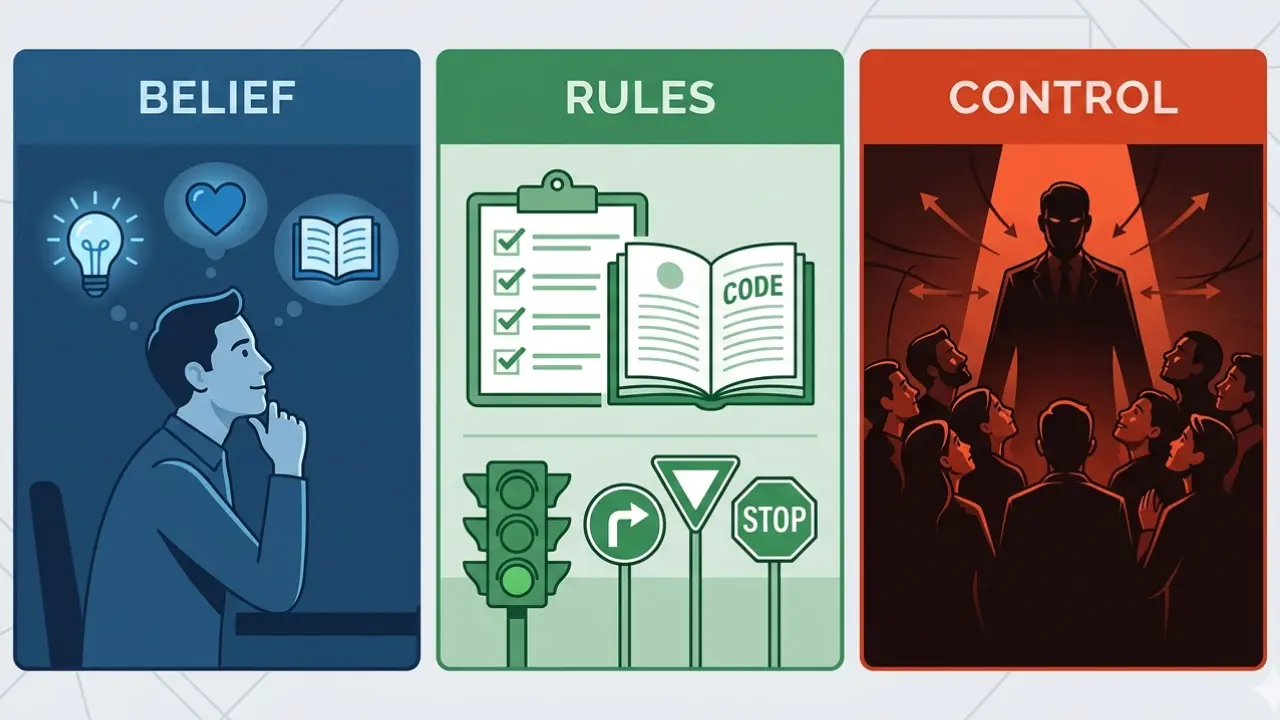
A creed is mainly about belief. A code is mainly about rules. A cult is mainly about control. They can sometimes overlap, which is why people confuse them, but they are not the same thing. Understanding the difference helps you think more clearly about religion, ethics, organizations, communities, ideologies and even online groups.
Why These Terms Get Confusing
Creed, code and cult are often confused because all three can influence how people think and act. They may all appear inside the same group, community, religion, movement or organization. For example, a group may have shared beliefs, clear rules and strong leadership at the same time. That overlap can make the terms feel interchangeable, even though each one describes something different.
The simplest way to begin is this: a creed answers the question, “What do we believe?” A code answers, “How should we behave?” A cult raises a more serious question: “Who controls what members believe and do?”
Different Meaning
A creed can shape decisions because beliefs influence values. If someone believes honesty is sacred, that belief may guide how they speak, work and build relationships. A code can shape decisions because rules define acceptable behaviour. Traffic laws, professional ethics, school rules and workplace policies all tell people what they are expected to do.
A cult can also shape decisions, but usually in a more controlling way. It may not simply offer beliefs or rules; it may pressure people to surrender independent judgment. That is where the difference becomes serious.
Where Confusion Starts
The key difference is not whether influence exists. All three involve influence. The difference is the type and level of influence.
A creed influences from the inside through belief. A code influences from the outside through rules. A cult influences through control, often using authority, pressure, emotional dependency, fear or isolation.
That is why it is inaccurate to call every strong belief a cult or every strict rule a cult. Strong beliefs and strict rules can exist in healthy systems. The problem begins when people lose freedom to question, think independently or leave.
Creed vs Code
The easiest comparison starts with creed and code. These two are often connected, but they are not the same. A creed tells people what is true, meaningful or valuable. A code tells people how to act.
A creed may inspire a code, but it does not automatically become one. For example, someone may believe that human life has dignity. That is a creed-like belief. From that belief, a society may create laws or ethical rules about protecting people. Those rules become a code.
What Is a Creed
A creed is a statement or system of belief. It can be formal, like a religious creed or informal, like a personal worldview. It gives people a sense of meaning, identity and direction.
Creeds often answer big questions: What is right? What is true? What matters most? What kind of person should I become?
A religious creed may define belief in God, salvation, morality or spiritual purpose. A philosophical creed may define truth, justice, reason or human nature. A personal creed may be as simple as “I believe in fairness,” “I believe hard work matters,” or “I believe people should be treated with respect.”
The important point is that a creed primarily shapes the way a person sees life.
What Is a Code
A code is a system of rules or standards for behaviour. It is less about what someone believes internally and more about what someone is expected to do externally.
A legal code tells people what is allowed or prohibited by law. A moral code tells people what is considered right or wrong. A professional code tells workers how to act in a responsible way. A cultural code tells people what behaviour is acceptable in a community.
You may follow a code even if you do not personally agree with every part of it. For example, you may obey a workplace dress code because it is required, not because it expresses your deepest beliefs. You may follow traffic rules because they keep roads safe and because breaking them has consequences.
Creed = what you believe.
Code = what you follow.
What Is a Cult
The word “cult” is often used carelessly. People sometimes use it to describe any unusual belief, intense fandom, unpopular religion, or tight-knit group. That is not a careful use of the term.
A cult is not defined merely by being different. It is not simply a group with strange ideas. The more important issue is control. A cult-like system usually involves strong authority, limited questioning, emotional dependence and pressure to conform.
Not Just Belief
Unusual beliefs alone do not make a group a cult. Throughout history, many beliefs that once seemed strange later became accepted, respected, or at least understood. A society should be careful not to label every unfamiliar belief as dangerous.
The real question is not, “Are the beliefs unusual?” The better question is, “Are people free to question, disagree and leave?”
A healthy belief system may have strong convictions, but it still allows personal conscience. It may teach certain truths, but it does not need to destroy someone’s independence. A cult-like system often does the opposite. It tries to make the group or leader the main source of truth.
Real Difference Is Control
A cult usually controls more than belief. It may control relationships, information, money, time, identity and emotional loyalty. Members may feel that leaving means betrayal, punishment, rejection or personal failure.
There may be one dominant leader who cannot be questioned. There may be pressure to cut off outsiders. Members may be told that criticism is dangerous, evil or proof of disloyalty. Over time, the person may stop trusting their own judgment.
That is what makes cults different from ordinary creeds or codes. A creed can guide belief. A code can guide action. A cult tries to control the person.
How Power Works
One useful way to compare creed, code and cult is to ask where authority comes from. Authority is not automatically bad. Every society, organization, and community needs some kind of structure. The issue is whether authority is transparent, accountable and limited.
A healthy system can have leadership. It can have rules. It can have shared beliefs. But people should still have room to question, think, disagree and make informed choices.
Source of Authority
In a creed, authority often comes from belief itself. People accept a creed because they think it is true or meaningful. The source may be scripture, tradition, philosophy, conscience or personal conviction.
In a code, authority usually comes from institutions or social agreement. Laws come from governments. Workplace rules come from employers. Professional standards come from recognized bodies. Cultural codes come from shared expectations.
In a cult, authority is usually concentrated. A leader, inner circle or controlling system may claim special knowledge or unquestionable power. Instead of inviting understanding, it demands loyalty.
How People Follow
People follow a creed because they believe it. People follow a code because it is expected, useful or required. People follow a cult-like system because pressure and dependency make resistance difficult.
That difference matters. Belief can be sincere. Rules can be necessary. But control becomes harmful when it weakens a person’s freedom to think and choose.
| Focus | Creed | Code | Cult |
|---|---|---|---|
| Core idea | Belief | Rules | Control |
| Main question | What is true? | What should I do? | Who must I obey? |
| Source of influence | Conviction | Standards or institutions | Centralized authority |
| Freedom level | Usually higher | Moderate, depending on context | Often limited |
Differences in Simple Terms
The cleanest distinction is this: creed is about belief, code is about behaviour and cult is about control. That does not mean creeds never affect behaviour or codes never reflect belief. They often do. But their primary function is different.
A creed gives meaning. A code gives structure. A cult takes control.
Belief vs Rules vs Control
A creed shapes what people think is true. It forms values and identity. It may help people understand life, morality, purpose and belonging.
A code shapes what people do. It creates order by setting expectations. It can prevent chaos, protect people and make cooperation possible.
A cult shapes both thought and behavior through control. It may use belief and rules, but the deeper issue is domination. Members are not simply guided; they are pressured to submit.
Freedom vs Pressure
Freedom is one of the clearest dividing lines.
In a healthy creed, people can reflect, ask questions and grow in understanding. In a healthy code, people understand the rules and the reasons behind them. In a cult-like system, questions are treated as threats.
This does not mean every rule is oppressive. Rules are part of life. The difference is whether the rule protects order or protects power. A good code helps people live together. A controlling system uses rules to make people dependent.
Creed shapes thinking.
Code shapes actions.
Cult controls both.
When It Becomes a Problem
The difficult part is that systems do not always start as cult-like. A group may begin with sincere beliefs or practical rules, then slowly become more controlling. This shift can happen in religious groups, political movements, self-improvement communities, online spaces or even organizations.
The warning sign is not intensity alone. People can be deeply committed to a belief or disciplined in following a code. The warning sign is when commitment becomes control.
Crossing the Line
A creed can become dangerous when it stops allowing honest thought. A code can become harmful when rules exist mainly to protect authority rather than serve people. A group becomes more cult-like when loyalty matters more than truth.
This shift often happens gradually. First, questioning is discouraged. Then criticism is framed as betrayal. Then outside voices are treated as enemies. Eventually, members may feel that their identity depends entirely on the group.
At that point, the system is no longer simply offering belief or structure. It is controlling the person’s independence.
Common Warning Signs
Some common warning signs include unquestionable leadership, fear of leaving, pressure to cut off outside relationships, punishment for doubt and rules that apply differently to leaders than to ordinary members.
Another major warning sign is manipulation of information. If a group tells people not to read outside sources, not to speak with critics or not to trust their own judgment, that is a serious concern.
Healthy systems do not need to trap people. They can stand up to questions.
Further Ideas Worth Exploring
Why It Matters
Understanding the difference between creed, code and cult is not just about vocabulary. It helps you evaluate the systems around you more clearly. It also helps you avoid unfair judgments.
Not every religion is a cult. Not every strict rule is abusive. Not every passionate community is dangerous. At the same time, harmful control can hide behind noble beliefs, impressive rules or inspiring language.
Seeing Systems Clearly
When you know the difference, you can ask better questions. Is this system asking me to believe something, follow something or surrender control? Are questions welcome? Are leaders accountable? Can people leave without fear? Are rules applied fairly?
These questions make your judgment sharper.
Staying Independent
The goal is not to reject every belief or rule. Human beings need meaning, structure and community. The goal is to recognize when a system stops helping people and starts controlling them.
A creed can give direction. A code can create order. A healthy community can provide belonging. But personal judgment still matters.
When you understand the difference, you are less likely to confuse belief with obedience, rules with truth or belonging with control.
