
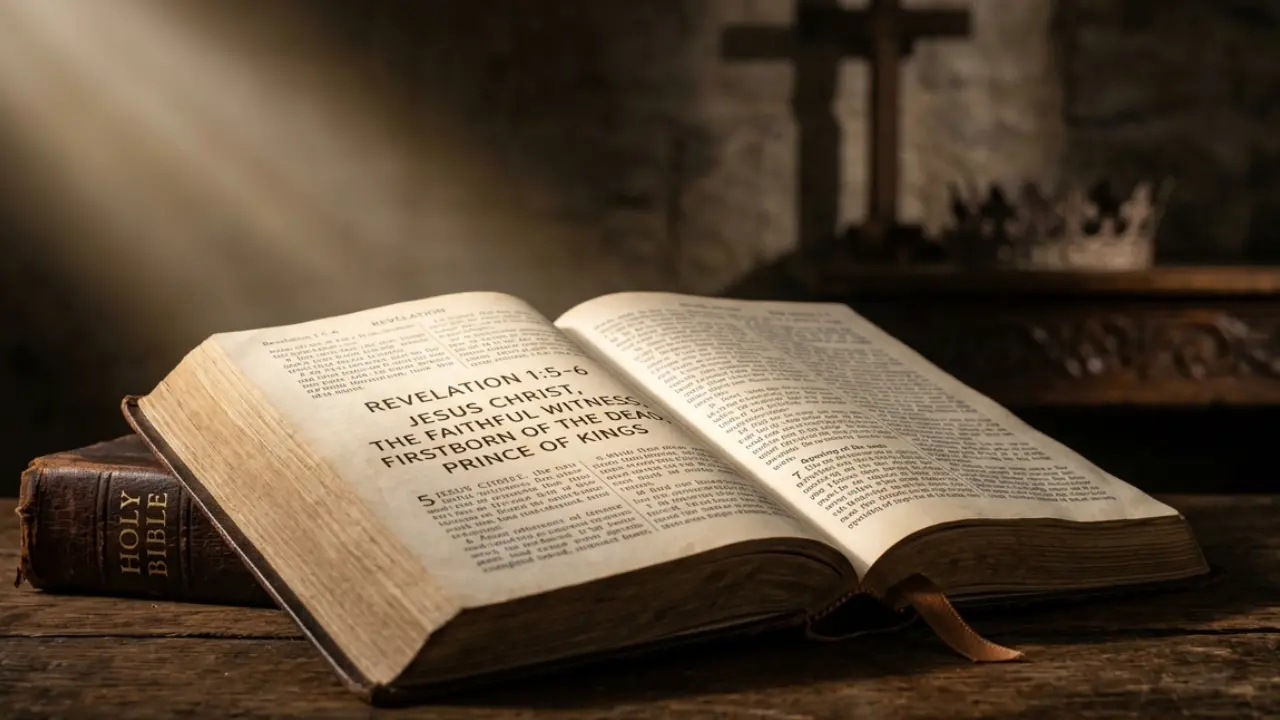

Revelation 1:5 is one of those verses that feels larger than itself. The words are brief but they open into something vast. John is still in the opening greeting of the book, yet he is already telling the church exactly who Jesus is. That matters because Revelation can easily be approached in the wrong way. Many readers rush to the symbols, the beasts, the judgments and the questions about the end. John does not begin there. He begins with Christ.
That is not accidental. Before believers are asked to look at a troubled world, they are told to look at their Lord. Before the visions grow intense, Jesus is named in a way that gives strength, clarity and peace. Revelation 1:5 does not present a distant figure wrapped in mystery. It presents a living Savior who can be trusted completely, who has already conquered death, who reigns above every power on earth and who has personally acted to save His people from their sins.
The verse says, in part, that Jesus Christ is “the faithful witness, the firstborn of the dead and the ruler of kings on earth,” and then it says, “To him who loves us and has freed us from our sins by his blood.” That is not a random set of titles. It is a carefully ordered portrait. John moves from who Jesus is to what Jesus has done. He shows His truthfulness, His victory, His authority, His love and His redeeming work.
Whole Verse Points to Jesus
The first title in the verse is “the faithful witness.” That title is full of comfort because it tells the church that Jesus is utterly trustworthy. A witness speaks what is true. Jesus does that without weakness, confusion or compromise. He does not guess at truth. He does not exaggerate it. He does not soften it when it becomes costly. He is the faithful witness.
This means Jesus reveals God exactly as God is. If anyone wants to know the Father, there is no more reliable place to look than the Son. Jesus never misrepresented the character of God. His words were true. His actions were true. His obedience was true. Even His silence in certain moments was true. Everything about Him bore honest witness to the holiness, mercy, justice and love of God.
That title also carries a deeper force. Jesus was not faithful only when people welcomed Him. He remained faithful when His witness brought rejection. He spoke the truth when crowds turned away. He spoke the truth when religious leaders hardened themselves against Him. He spoke the truth when false accusations closed around Him. He spoke the truth all the way to the cross.
His witness was costly
This is where the title becomes especially precious. Many people can sound brave when there is little at stake. Jesus remained faithful when faithfulness led straight into suffering. His witness was not made from a safe distance. It was sealed in obedience, sorrow and sacrifice.
That would have mattered deeply to the first readers of Revelation. Some of them were already paying a price for belonging to Christ. Others would pay more later. When John calls Jesus the faithful witness, he is not giving them a cold doctrine. He is reminding them that their Lord has already walked the path of costly faithfulness before them.
Why this still steadies believers now
The modern church lives in a loud world. Every day brings new voices, new claims, new pressures and new attempts to reshape truth. In that kind of world, Revelation 1:5 still speaks with simple force: Jesus Christ is the faithful witness. He is not one more voice competing in the crowd. He is the One whose testimony stands over the crowd.
That means believers do not need to live in confusion. They are not left to piece together reality from broken fragments. Christ has spoken truthfully about God, sin, salvation, judgment and eternal life. His witness does not shift with the age.
He Did Not Stay in the Grave
The second title is “the firstborn from the dead.” This phrase has to be read carefully because it is often misunderstood. It does not mean that Jesus was created. In Scripture, “firstborn” often speaks of rank, honour, and pre-eminence. Here it points to His supremacy in resurrection. Jesus is the risen One who stands first over death because He has defeated it.
That does not mean He was the first person ever brought back to life. Scripture records other restorations to life before the resurrection of Christ. But those people returned to ordinary life and later died again. Jesus rose in triumph, never to die again. His resurrection was not temporary relief. It was a decisive victory.
Death Is No Longer Final
Death still hurts. Scripture never treats it lightly. It breaks families, ends earthly fellowship and reminds the world that sin has brought terrible ruin. Yet Revelation 1:5 says that death no longer holds the highest place in the story. Jesus entered the grave and came out in glory. He did not barely escape it. He overcame it.
That means the grave is no longer the final authority over those who belong to Him. Because Christ is the firstborn from the dead, His people have more than comforting ideas. They have resurrection hope rooted in a real Person. Christian hope is not a mood. It is not optimism painted over grief. It stands on the risen Jesus.
What this means for wounded hearts
This title meets believers in places where pain often runs deepest.
- At the graveside, it says death is not the end.
- In suffering, it says the worst enemy has already been struck down.
- In fear, it says Christ has gone ahead of His people and returned victorious.
- In weakness, it says hope is anchored in the risen Lord, not in human strength.
For the early church, this would have been life-giving truth. For believers today, it still is. A Savior who remained in the tomb could inspire admiration at best. A Savior who rose from the dead gives living hope.
World Is Not Running Itself
John then calls Jesus “the ruler of the kings of the earth.” With that phrase, the verse expands from resurrection victory to present authority. Jesus is not only alive. He reigns. He is not merely above private spiritual life. He stands above public power as well.
This title cuts through the illusion that earthly rulers are ultimate. Kings, governments, empires and systems may appear enormous, but none of them sit at the true centre of history. Christ does. Their authority is real, but it is limited. Their power is visible, but it is passing. His rule is higher than all of it.
For the first readers, this was no small claim. They lived in the shadow of imperial power. Rome looked untouchable. Its reach stretched wide. Its threats were serious. Yet John names Jesus, not Caesar, as the ruler of the kings of the earth. That is one of the quiet triumphs of the verse. It puts the whole world back in proper order.
Earthly rulers are not the final word
Revelation does not deny that human governments can do great harm. They can oppress, punish, deceive and persecute. But this verse refuses to let the church think that visible power is final power.
Jesus rules over:
- rulers who are admired
- rulers who are feared
- rulers who are unjust
- rulers who believe they answer to no one
Every throne on earth is beneath His throne. Every crown is temporary before His. Every act of power will one day be measured by His justice.
His kingship is a present reality
John does not say Jesus will someday become ruler of the kings of the earth. He speaks of Him that way now. That is important. Christ is not waiting to be Lord. He is Lord. His reign does not begin only when the world finally notices it. His reign is already true.
That gives the church stability in unstable times. When history feels chaotic, Revelation 1:5 reminds believers that Christ has not lost control. He has not stepped away from His throne. He is not trying to recover authority. He reigns now, even when the nations rage and the proud speak as though they are untouchable.
His Greatness Is Personal
After these great titles, the verse turns in a way that feels almost startling: “to him who loves us.” That line brings the glory of Christ into the life of the believer with warmth and tenderness. The One who is the faithful witness, the risen Lord and the ruler of earthly kings is also the One who loves His people.
That matters because majesty can seem overwhelming if it is not joined to mercy. A powerful ruler without love would leave sinners terrified. But Revelation 1:5 does not reveal Christ as distant in His greatness. It reveals Him as loving in His greatness.
His love is personal
John does not merely describe an abstract love that belongs to Christian doctrine in general. He says, “who loves us.” That language is close, direct and pastoral. The church is not forgotten in the glory of Christ. His exaltation has not pushed His people to the edge of His attention. He loves them.
That is one of the sweetest parts of the verse. The Savior who governs kings also holds His people near. His authority is not mechanical. His rule is not cold. His heart toward the church is full of love.
His love is not stuck in the past
It is easy for believers to think of Christ’s love only in historical terms. Yes, He loved His people at the cross. Yes, He loved them in His earthly ministry. But Revelation 1:5 speaks of Him as the One who loves us. The love of Christ is not a relic. It is living, active and present.
This is a needed word for tired believers. There are seasons when faith feels weak, prayers feel heavy and the heart feels slow. In those moments, this verse does not point first to the believer’s grip on Christ. It points to Christ’s love for the believer.
Love Took Action at the Cross
John does not leave Christ’s love undefined. He goes on to say that Jesus “has freed us from our sins by his blood.” This is the heart of the verse’s saving message. Love is not expressed here as mere feeling. It is shown in decisive action.
The deepest human problem is sin. Sin is not a small flaw or an unfortunate weakness. It brings guilt before God, corruption within the heart, slavery in the soul and judgment that sinners cannot escape on their own. Revelation 1:5 speaks directly to that condition and says that Jesus has freed His people from their sins.
Freedom came through sacrifice
The words “by his blood” tell the whole story in a short phrase. Christ did not save by offering advice. He did not save by pointing toward a better path while leaving sinners to rescue themselves. He saved by giving Himself. His blood points to His sacrificial death, His atoning work and the price He willingly paid.
That phrase should never become ordinary to the reader. It reveals both the seriousness of sin and the greatness of divine love. Sin was so serious that it required the death of the Son of God for sinners to be set free. Divine love was so great that the Son of God gave Himself willingly.
What this freedom includes
The freedom Christ gives is rich and deep.
- Freedom from guilt before God
- Freedom from condemnation
- Freedom from sin’s rightful claim to rule
- Freedom to belong to God as a cleansed people
This does not mean believers never struggle with sin again. It does mean sin is no longer their master and condemnation is no longer their future. Christ has acted decisively for them.
One Complete Picture of Jesus
- One reason Revelation 1:5 is so powerful is that each phrase strengthens the others. John is not stacking impressive titles at random. He is giving the church a complete view of Jesus.
- He is the faithful witness, so His word can be trusted.
- He is the firstborn from the dead, so death has been defeated.
- He is the ruler of the kings of the earth, so no earthly power is ultimate.
- He loves His people, so His greatness is not distant.
- He has freed them from their sins by His blood, so His love is not sentimental but saving.
This is the Jesus who stands at the front of Revelation. Not a vague religious symbol. Not a distant heavenly figure. Not a moral teacher whose memory survived Him. Revelation opens with the living Christ who tells the truth, conquered the grave, rules the world, loves His church and redeemed her at the cost of His own blood.
What the verse refuses to let readers do
- This verse does not allow a reduced view of Jesus.
- It does not allow a Jesus who is loving but not sovereign.
- It does not allow a Jesus who is powerful but not tender.
- It does not allow a Jesus who speaks truth but never bleeds for sinners.
- It does not allow a Jesus who rose from the dead yet remains detached from His people.
Revelation 1:5 brings all of that together in one radiant picture. The church is meant to read the rest of Revelation in the light of this Christ.
Why Revelation 1:5 Still Matters
Revelation 1:5 continues to hold the heart because it speaks to real needs with real truth. When confusion rises, it says Jesus is the faithful witness. When fear of death grows, it says Jesus is the firstborn from the dead. When the world seems ruled by proud and hostile powers, it says Jesus is the ruler of the kings of the earth. When guilt presses hard on the conscience, it says Jesus loves His people and has freed them from their sins by His blood.
That is why this verse does not feel like a formal introduction and nothing more. It feels alive. It turns the eyes of the church away from appearances and back toward Christ Himself. And once the eyes land there, everything else in Revelation begins to make sense.
Related Posts You May Want to Read Next
- Revelation 1 Changes the Way the Whole Book Should Be Read
- Revelation 1:1 Meaning Explained for Clear Bible Study
- Key meaning behind Revelation 1:2 explained simply
- Why Revelation 1:3 Is Called a Blessed Verse
Frequently Asked Questions
Why is Jesus called the faithful witness in Revelation 1:5?
Jesus is called the faithful witness because everything He revealed about God was true. He spoke the truth perfectly, lived the truth fully and remained faithful even in suffering and death.
What does “the firstborn from the dead” mean in Revelation 1:5?
It means Jesus is supreme in resurrection. He defeated death and rose never to die again. The phrase does not mean He was created. It points to His victory, rank and pre-eminence.
How does Revelation 1:5 show the love of Jesus?
The verse says Jesus loves His people and has freed them from their sins by His blood. His love is not only spoken. It is proven through His sacrifice on the cross.
What does it mean that Jesus freed us from our sins by His blood?
It means Jesus saves His people through His sacrificial death. His blood points to the cross, where He paid the price for sin so that believers could be forgiven, cleansed and brought near to God.
Why is Revelation 1:5 important for believers today?
This verse gives believers confidence in who Jesus is. It brings truth for the confused, hope for the grieving, courage for the fearful and assurance for those burdened by sin.
