

Have you ever heard the phrase “born again” and wondered whether Catholics believe in it the same way other Christians do?
This question often creates confusion because the phrase is widely used, yet not always explained with clarity across different Christian traditions.
Many people assume that being “born again” belongs only to certain groups, while others believe it has a completely different meaning within Catholic teaching.
The truth is more nuanced, and understanding it requires looking carefully at how the concept is defined, experienced and lived out.
What Does “Born Again” Actually Mean
Before exploring the Catholic perspective, it is important to clarify the phrase itself.
The idea of being “born again” comes directly from Scripture, where it refers to a form of spiritual renewal rather than physical rebirth.
It describes a transformation that changes a person’s relationship with God and their way of living.
However, this is where interpretations begin to differ.
Some understand it as a single emotional or spiritual moment.
Others understand it as a deeper process that unfolds through specific means.
The Catholic Church takes a distinct approach.
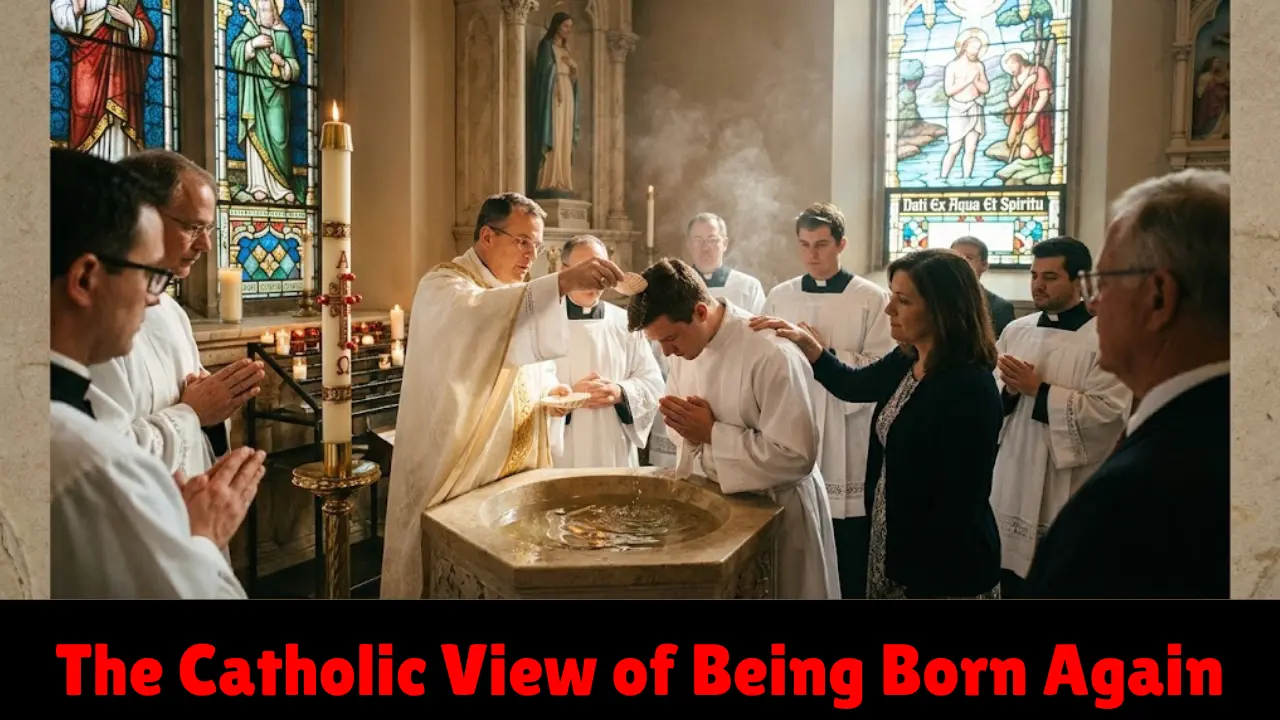
New Birth Begins with Baptism
In Catholic teaching, being “born again” is not separated from a specific sacrament.
It is directly connected to baptism.
Baptism is understood as the moment when:
- A person is spiritually reborn
- A new life begins
- A relationship with God is initiated
This is not viewed as symbolic only.
It is understood as an actual spiritual transformation.
Why Baptism Holds Central Importance
Baptism is seen as:
- The beginning of spiritual life
- The entry into the Christian community
- The foundation for future growth
This means that being “born again” is not based on feeling alone.
It is rooted in a defined spiritual event.
Event vs Experience
One of the most important differences in understanding comes from this distinction.
| Perspective Type | Focus |
|---|---|
| Experience-based | Emotional or personal moment |
| Catholic view | Sacramental beginning with ongoing growth |
In Catholic teaching:
- The event happens at baptism
- The experience unfolds over time
This creates a two-part understanding.
Process That Follows the New Birth
Being “born again” is not seen as complete at one moment.
It is the beginning of a lifelong process.
This process includes:
1. Growth in Understanding
After baptism, a person continues learning.
They develop awareness of faith, values, and purpose.
2. Transformation of Life
Change is expected to become visible over time.
This includes:
- Decisions
- behavior
- priorities
3. Ongoing Renewal
The idea of renewal continues beyond the initial moment.
It involves returning, reflecting, and growing repeatedly.
The Role of Free Will
Another important aspect of the Catholic view is participation.
Being “born again” is not passive.
It involves:
- Cooperation
- intentional living
- personal response
This means that the initial transformation must be lived out.
It is not automatic.
Misunderstanding One
This is one of the most common misconceptions.
The reality is:
- Catholics do believe in being born again
- They define it differently
- They connect it to baptism and ongoing growth
The difference is not belief, but interpretation.
Misunderstanding Two
Many people expect a dramatic moment.
While such experiences can happen, they are not required in Catholic teaching.
The focus is on:
- Transformation
- commitment
- consistency
This creates a more structured understanding.
The Timeline of Spiritual Growth
To better understand the Catholic view, it helps to see it as a timeline.
Stage One: Beginning (Baptism)
- Spiritual life begins
- Identity is established
Stage Two: Development
- Understanding grows
- Choices begin to reflect belief
Stage Three: Maturity
- Faith becomes integrated into daily life
- Transformation becomes more visible
Stage Four: Ongoing Renewal
- Reflection continues
- Growth does not stop
Comparison
To make this clearer, here is a structured comparison:
| Element | Catholic View |
|---|---|
| Starting Point | Baptism |
| Nature of Change | Real spiritual transformation |
| Timing | Begins at a moment, continues over time |
| Focus | Process and development |
| Role of Person | Active participation |
Why This View Emphasizes Stability
The Catholic approach creates stability because:
- It is not dependent on emotions alone
- It provides a clear starting point
- It allows for gradual development
This helps avoid confusion.
It gives structure to spiritual growth.
How This Changes Daily Life
Understanding this perspective affects how a person lives.
It shifts focus from:
- Seeking a single moment
- expecting immediate change
To:
- living consistently
- growing gradually
- reflecting regularly
A Practical Reflection
If you want to apply this understanding, consider these questions:
- What does growth look like over time
- How do your choices reflect transformation
- Where do you see gradual change
These questions shift focus from moment to process.
Why This Perspective Feels Different
This approach may feel different because it:
- removes pressure for instant experience
- emphasizes long-term growth
- focuses on structure rather than spontaneity
This difference can be helpful.
It creates clarity.
Identity Before Experience
One of the most important ideas in the Catholic view is this:
Identity comes before experience.
You are considered “born again” through baptism.
Your experience grows into that identity over time.
This reverses the common expectation.
A Beginning That Continues
The Catholic view of being born again is not about a single moment that defines everything.
It is about a beginning that continues.
It starts with baptism.
It grows through life.
It develops through reflection and action.
This creates a complete and balanced understanding.
You may also want to explore:
- Born Again Christian vs Catholic
- Adult Baptism vs Infant Baptism Explained
- Similarities Between Toltec Wisdom and Christianity
- 5 Powerful Lessons Christians Can Learn From Romans 8:28
Frequently Asked Questions
Do Catholics believe in being born again?
Yes, Catholics believe in being born again, primarily through the sacrament of baptism.
What does being born again mean in Catholic teaching?
It means spiritual rebirth that begins at baptism and continues through a life of faith and growth.
Is being born again a one-time experience in Catholicism?
It begins at a specific moment, but it is lived out as an ongoing process of transformation.
How is the Catholic view different from other Christians?
Catholics connect being born again to baptism, while others may emphasize a personal conversion experience.
Why is baptism important for being born again?
Baptism is seen as the moment when spiritual life begins and a person enters into a new relationship with God.

1 thought on “The Catholic View of Being Born Again: What It Really Means”