
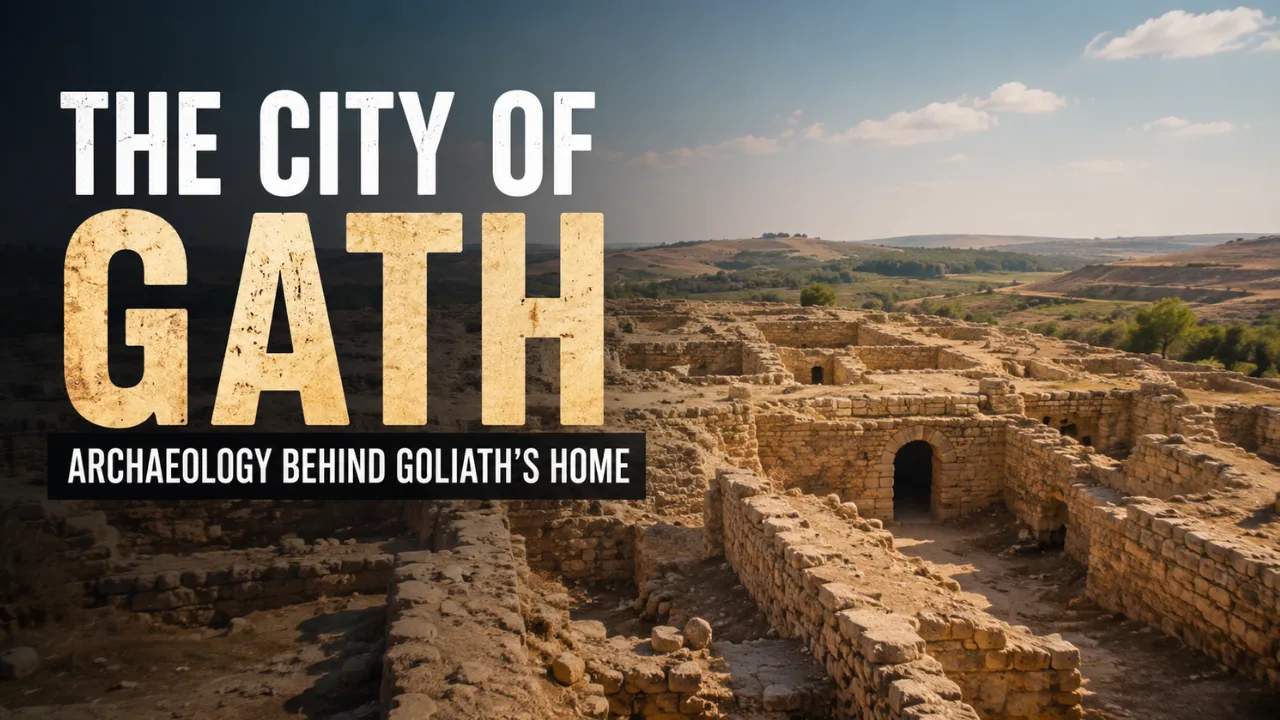

The city of Gath appears in the Bible as the Philistine home of Goliath, the warrior whom David defeated in the Valley of Elah. Archaeologists have not found Goliath’s remains, weapons or personal belongings but excavations have uncovered the ruins of a powerful Philistine city that closely matches the biblical setting.
Most archaeologists identify ancient Gath with Tell es-Safi, also called Tel Zafit, a large archaeological mound in central Israel. Its location, size, Philistine material culture, settlement history, fortifications, inscriptions and destruction layers make it the strongest candidate for biblical Gath.
The discoveries do not prove every detail of Goliath’s story. They do, however, reveal that his reported hometown was a major fortified centre with the wealth, population, military influence and regional importance that the Bible assigns to it.
Where Was the Biblical City of Gath?
Gath belonged to the five major cities of the Philistines, along with Gaza, Ashkelon, Ashdod and Ekron. Joshua 13:3 lists these cities under five Philistine rulers, which suggests that each city governed its own territory while sharing a broader Philistine identity.
Unlike Gaza, Ashkelon and Ashdod, Gath did not stand directly on the Mediterranean coast. It occupied the inland border region between the Philistine coastal plain and the Judean foothills, often called the Shephelah.
This position gave Gath strategic importance. The city stood near routes connecting the coastal plain with the hill country of Judah. Anyone who controlled this region could influence trade, military movement, agriculture and access to the interior.
Tell es-Safi lies approximately halfway between the coastal region near Ashkelon and the Judean foothills. At its greatest extent, the settlement covered about 40 hectares, or roughly 100 acres, making it one of the largest ancient sites in the region.
Its location also helps explain why Gath appears repeatedly in accounts involving conflict between the Philistines and Israel.
Also Read: Why Jesus Washed His Disciples’ Feet in John 13
How Does Gath Appear in the Bible?
The Bible presents Gath as more than the birthplace of one famous warrior. It repeatedly connects the city with Philistine power, military strength, political refuge, and conflict along Israel’s western border.
After the Philistines captured the ark of the covenant, they moved it from Ashdod to Gath in 1 Samuel 5:8. The people of Gath then experienced the same severe affliction that had struck Ashdod.
In 1 Samuel 17:4, Goliath enters the account as “a champion named Goliath, who was from Gath.” His armour, weapons, military confidence, and role as a representative warrior fit the Bible’s wider presentation of Gath as a major Philistine stronghold.
David later fled to Achish, the king of Gath, while escaping from Saul. His first visit placed him in immediate danger because the servants of Achish recognized him as the Israelite warrior celebrated for defeating Philistines. David escaped after pretending to be insane, as described in 1 Samuel 21:10–15.
During a later period, David returned to Achish with his followers and received the town of Ziklag as a place to live. This account in 1 Samuel 27 shows that relations between neighbouring peoples could involve political agreements and personal alliances, even during periods of wider hostility.
Gath therefore stood at the centre of several biblical themes. It represented Philistine military power, but it also served as a place where Israelite and Philistine leaders interacted, negotiated, competed, and sometimes cooperated.
Why Do Archaeologists Identify Tell es-Safi as Gath?
Scholars once debated several possible locations for Gath. Today, most identify Tell es-Safi as the most convincing candidate because several independent forms of evidence point toward the same conclusion.
| Archaeological evidence | Why it matters |
|---|---|
| Strategic border location | Tell es-Safi stands between the Philistine plain and the Judean foothills, matching Gath’s biblical role |
| Exceptional settlement size | The site could support the population, government, economy and military activity expected of a major Philistine city |
| Philistine material culture | Pottery, architecture, cultic remains and household objects connect the settlement with the Philistine cultural world |
| Iron Age occupation | The city flourished during the periods associated with the biblical accounts of the Philistines |
| Major destruction layer | Evidence of a ninth-century BC attack fits the historical setting of Hazael’s capture of Gath in 2 Kings 12:17 |
| Later decline | The site lost much of its earlier importance after the destruction, which helps explain Gath’s reduced role in later history |
No single discovery identifies the site beyond all possible doubt. Archaeologists build the identification from the combined strength of geography, chronology, settlement scale, historical references and excavated material.
Tell es-Safi fits these requirements more closely than the other proposed locations.
What Have Archaeologists Found at Gath?
Excavations at Tell es-Safi began as a long-term modern project in 1996 under the direction of archaeologist Aren Maeir and researchers from Bar-Ilan University. The work expanded across both the upper mound and the extensive lower city.
Archaeologists uncovered city gates, fortifications, houses, public buildings, temples, cultic areas, workshops, pottery, tools, animal remains, and objects connected with everyday life. These discoveries show that Gath functioned as an organised urban centre rather than a small rural settlement.
A Large Upper and Lower City
The visible mound represents only part of ancient Gath. Surveys and excavations revealed that the settlement extended into a broad lower city around the central hill.
This discovery changed how scholars understood Gath’s size. The city had room for residential districts, public buildings, craft production, storage facilities, religious activity, and defensive structures.
A settlement of this scale required organised leadership and access to substantial resources. Its inhabitants had to build and maintain walls, manage water and food supplies, support specialised workers, and protect the surrounding territory.
Fortifications and City Gates
Archaeologists found substantial defensive structures from different periods of the city’s history. These included fortification walls and remains connected with an Iron Age gateway.
A city gate served several purposes in the ancient world. It controlled entry, strengthened the city’s defences, regulated trade, and created a public space where officials could conduct business.
The size of Gath’s defensive systems reflects the danger of living in a contested border region. Philistines, Judahites, Arameans, Egyptians, and Assyrians all competed for influence in the southern Levant at different times.
Houses, Temples, and Daily Life
The excavations also uncovered evidence that reveals how people lived inside Gath. Residential buildings contained pottery vessels, food remains, tools, storage areas, and objects associated with household work.
Researchers found public and cultic areas that provide evidence of Philistine religious practices. The material does not present Philistine culture as isolated or unchanging. Instead, it shows a society that combined local Canaanite traditions with influences connected to the Aegean world and neighbouring peoples.
Over generations, the inhabitants of Gath adopted, adapted, and blended different cultural practices. Archaeology therefore reveals a more complex Philistine society than the image of a single hostile group sometimes created by a surface reading of biblical warfare.
Also Read: If God Is Good Why Do Bad Things Happen?
How Powerful Was Gath During the Time Associated With Goliath?
The David and Goliath account belongs to the period when Israel’s monarchy was beginning to develop, traditionally placed around the eleventh or early tenth century BC. Archaeology cannot use the story itself to establish an exact date for Goliath or David’s battle.
However, the Iron Age remains at Tell es-Safi show that Gath had already developed into an important Philistine centre during the broader period in which the biblical story takes place.
The city’s scale matters when reading 1 Samuel 17. Goliath did not come from an unknown village or an isolated military camp. The text connects him with one of Philistia’s most influential cities.
Gath could draw on agricultural land, trade routes, skilled metalworkers, organised leadership, and a large population. These conditions would have supported a strong military tradition and the equipment required for heavily armed warriors.
This archaeological setting does not prove that Goliath personally carried the weapons described in 1 Samuel. It shows that the biblical author placed him within a believable Philistine urban and military environment.
What Is the Goliath Inscription?
One of the most widely discussed discoveries from Tell es-Safi came from a pottery fragment bearing an early alphabetic inscription. Researchers dated the inscription to the late Iron Age I or early Iron Age IIA, close to the general period associated with the rise of the Israelite monarchy.
The fragment contains letters that scholars have interpreted as two personal names, commonly represented as “‘LWT” and “WLT.” Researchers noticed that these names share linguistic features with the name Goliath, although neither name reads exactly as “Goliath.”
Some popular reports have described the object as proof of Goliath. That description goes beyond the evidence.
The pottery fragment does not mention David, a battle, a giant, or the biblical Goliath. It does not identify its owner as a warrior, and it comes from a period that scholars cannot connect securely with Goliath as an individual.
Its real importance lies elsewhere. The inscription shows that personal names resembling the linguistic form of “Goliath” existed within the cultural environment of ancient Gath.
This makes the biblical name appropriate to its Philistine setting. It supports the cultural background of the account without proving the existence of the particular man described in 1 Samuel 17.
Did Archaeologists Find Evidence of Gath’s Destruction?
One of the clearest archaeological discoveries at Tell es-Safi involves the violent destruction of the city during the ninth century BC.
Second Kings 12:17 states that Hazael, king of Aram, attacked Gath and captured it before turning his attention toward Jerusalem. Excavators found an extensive destruction layer that scholars commonly connect with this campaign.
They also identified a large siege system surrounding part of the city. The system included a human-made trench designed to restrict movement, prevent escape, and weaken the city’s defences. The excavation project describes it as the earliest known archaeological example of this type of siege system.
The destruction affected a wide area of Gath. Buildings collapsed, objects remained in ruined rooms, and the city lost the level of power it had enjoyed before the attack.
Archaeology cannot recover the names of every commander or soldier involved. However, the date, scale, and character of the destruction fit the general historical setting described in 2 Kings 12.
Careful interpretation therefore describes the discovery as archaeological evidence consistent with Hazael’s attack, rather than absolute proof that every detail of the biblical account has been independently verified.
What Happened to Gath After Hazael’s Attack?
Gath continued to experience settlement after the ninth-century destruction, but it never fully recovered its earlier position as a dominant Philistine centre.
Later remains show increasing Judahite influence at the site, especially during the eighth century BC. Archaeologists connect this development with Judah’s westward expansion during the period of kings such as Hezekiah.
The Assyrian campaigns that followed reshaped the political order of the entire region. Philistine cities faced military pressure, tribute demands, changes in leadership, and shifting alliances.
Gath’s decline may explain why it plays a less prominent role in later biblical and historical accounts. Other Philistine cities, particularly Gaza, Ashkelon, Ashdod, and Ekron, remained more visible in records from later centuries.
The city did not disappear completely. Different communities occupied the site during later periods, but the great Philistine city associated with Goliath had passed from regional power into memory.
Does Archaeology Prove That Goliath Existed?
No archaeological discovery currently proves the personal existence of Goliath. Researchers have not found a monument, burial, weapon, or inscription that securely identifies him.
Archaeology can establish the reality of places, settlement patterns, cultural practices, destruction events, trade systems, and historical environments. It usually struggles to identify individuals unless surviving texts name them clearly and come from a reliable archaeological context.
The evidence from Gath supports several parts of the world behind the biblical narrative:
- A large Philistine city existed at the appropriate location.
- The city flourished during the Iron Age.
- Its inhabitants built strong defences and maintained an organised urban society.
- Personal names with linguistic similarities to Goliath existed in its cultural environment.
- The city experienced major warfare and destruction.
- Gath stood in a border region where Philistines and Israelites frequently interacted.
None of these findings proves that David fought Goliath exactly as 1 Samuel describes. At the same time, the discoveries do not treat Gath as a fictional location created only for the story.
Archaeology places the narrative within a recognisable historical landscape.
What Gath Reveals About the Story of David and Goliath
The archaeology of Gath helps modern readers understand the unequal balance of power in 1 Samuel 17.
David comes from Bethlehem in the hill country of Judah. Goliath comes from a large fortified Philistine city positioned near important routes and productive land. The confrontation therefore represents more than a contest between a young shepherd and an experienced warrior.
It reflects a wider struggle between communities with different levels of military organisation, political influence, and access to resources.
The ruins of Gath also help explain why the Philistines inspired fear. Their major cities could support armies, protect specialised industries, and project power into the neighbouring foothills.
Yet Gath’s later destruction adds another dimension to its history. A city that once appeared strong enough to threaten Judah eventually fell to another expanding kingdom. Its walls, gates, and military resources could not guarantee permanent security.
The biblical Gath and the archaeological Tell es-Safi do not align because researchers found an object labelled “Goliath’s home.” They align because geography, settlement size, Philistine culture, historical chronology, and evidence of warfare converge at the same site.
That evidence cannot answer every question about Goliath. It does something more historically responsible: it reveals the real city that stood behind his biblical identity and restores Gath to the larger world of Philistia, Judah, and the ancient Near East.
People Also Ask
Was Gath really Goliath’s hometown?
The Bible identifies Goliath as a warrior from Gath in 1 Samuel 17:4. Archaeology confirms that Gath existed as a large and powerful Philistine city, but no discovery directly identifies Goliath as a historical resident.
What did archaeologists find at ancient Gath?
Excavations uncovered extensive fortifications, city gates, houses, religious areas, pottery, tools, food remains, workshops, inscriptions, and evidence of a large lower city. These discoveries show that Gath functioned as an important Philistine urban centre.
Did archaeologists find an inscription naming Goliath?
Archaeologists found a pottery fragment containing names that resemble the linguistic form of “Goliath.” The inscription does not name the biblical warrior, but it shows that similar names existed within the cultural world of ancient Gath.
Does archaeology prove that Goliath existed?
Archaeology does not currently prove Goliath’s personal existence. It supports the historical setting of the account by confirming the city, Philistine culture, settlement size, military strength, and naming traditions associated with Gath.

2 thoughts on “City of Gath and Archaeology Behind Goliath’s Home”