
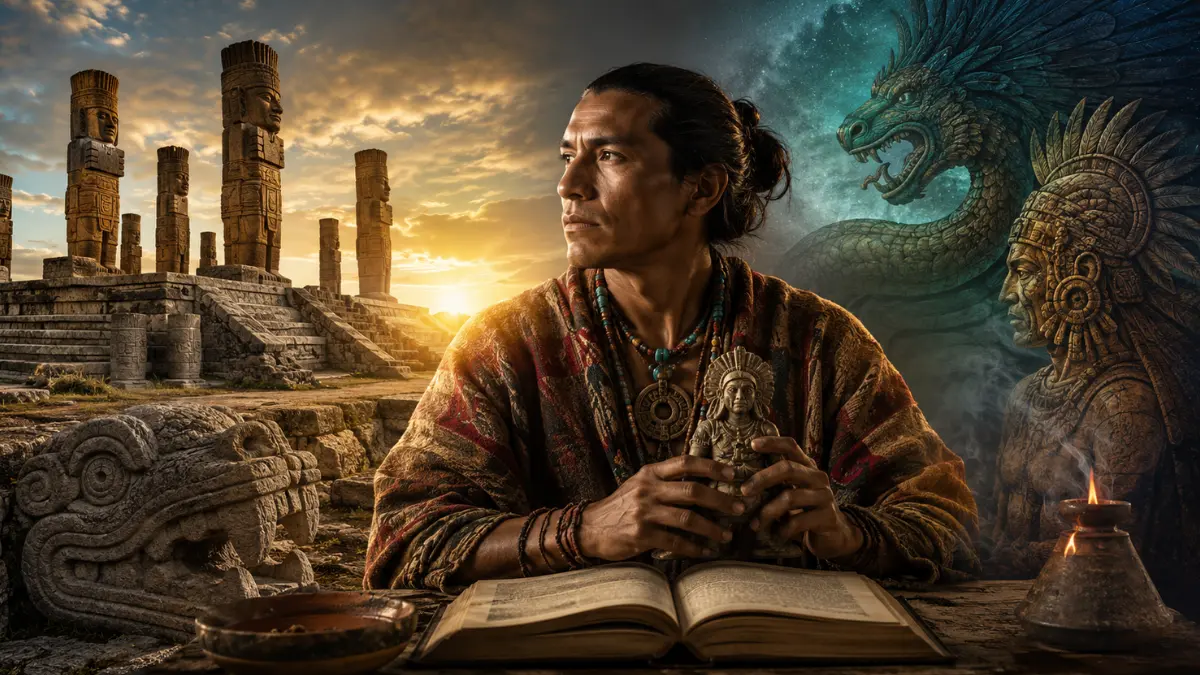

Toltec wisdom beliefs are often described as teachings about awareness, personal freedom, careful speech and freedom from fear. The clearest answer is that the phrase now refers to two different subjects: the religion of the historical Toltecs and a modern spiritual system associated especially with Don Miguel Ruiz.
These subjects are connected in modern writing but they are not identical. The historical Toltecs lived in Mesoamerica and practiced a religion shaped by deities, temples, offerings, warriors and sacred cycles. Modern Toltec wisdom focuses more on beliefs, emotional reactions, personal agreements and conscious living.
Keeping those meanings separate helps readers understand Toltec history without presenting modern teachings as a fully preserved ancient creed.
What Are Toltec Wisdom Beliefs?
The phrase “Toltec wisdom beliefs” is used in two main ways.
The first meaning concerns the historical people connected with Tollan-Xicocotitlan, now known as Tula in the Mexican state of Hidalgo. Historians and archaeologists study their buildings, carved images, ceremonial objects and burials to understand their religious world.
The second meaning refers to modern Toltec-inspired spirituality. This is the form many readers know through Don Miguel Ruiz and The Four Agreements. It speaks about inherited beliefs, personal agreements, awareness, fear and emotional freedom.
The problem begins when modern concepts are described as though they appear directly in surviving records from ancient Tula. No surviving firsthand text gives historians a complete statement of what the people of ancient Tula believed. Modern Toltec teachings should therefore be identified as modern interpretations rather than a word-for-word ancient system.
Who Were the Historical Toltecs?
The Toltecs were a Mesoamerican people strongly associated with Tula. The city became an important political, commercial and ceremonial center during the early Postclassic period, reaching its greatest influence between roughly the tenth and twelfth centuries.
Tula included pyramids, plazas, ball courts, administrative buildings, residential areas and ceremonial structures. Its art contains images of warriors, feathered serpents, felines, birds and celestial symbols.
Later Mexica traditions remembered the Toltecs as builders, artists and bearers of civilization. The word “Toltec” could also describe a skilled artisan or cultured person.
This admiration complicates Toltec history. Some accounts combine political memory, sacred tradition and legend. Archaeology confirms that Tula was a major center, but it cannot confirm every later story about Toltec rulers, priests or secret wisdom lineages.
What Did the Ancient Toltecs Believe?
Ancient Toltec religion belonged to the wider religious world of central Mexico. It involved sacred powers, celestial cycles, ritual offerings, political authority and the close relationship between religion and warfare.
Historians do not possess one complete Toltec creed. They reconstruct the religious picture through architecture, sculpture, iconography, burials and materials found in ceremonial settings.
Quetzalcoatl and the Morning Star
Quetzalcoatl, the Feathered Serpent, held an important place in traditions connected with Tula. The name may refer to a deity, a religious title, a legendary ruler or several layers of tradition joined over time.
Tula also contains imagery connected with Tlahuizcalpantecuhtli, an aspect of Quetzalcoatl associated with Venus as the morning star. The movement of Venus carried ritual importance in Mesoamerica and became connected with sacred time, conflict, renewal and rulership.
Later stories sometimes describe Quetzalcoatl only as a peaceful teacher. The historical tradition is more complex because religious, political and legendary meanings became intertwined.
Temples, Offerings and Sacred Space
Religion shaped the design of Tula. Temples, altars, processional spaces and ceremonial buildings placed sacred activity near political and public life.
Archaeologists have found ceramics, stone and shell objects, ritual burials and other materials in ceremonial contexts at and around Tula. A Chac Mool sculpture at the site holds a vessel understood as a receptacle for offerings to the gods.
Evidence also shows that sacrifice formed part of the wider ceremonial world associated with Tula. Individual features require care, however. The skull rack found at the site may have been built during a later Mexica occupation and should not alone be treated as proof of every Toltec practice.
Warriors and Religious Authority
The famous Atlantes of Tula are large stone warrior columns that once supported a temple roof. They carry weapons and ritual objects, showing that military identity, sacred symbolism and political authority could operate together.
Other carvings show armed warriors or priests, feathered serpents and animals linked with power and sacrifice. These images reveal a public, ceremonial religion closely connected with the authority of the city.
This ancient setting differs greatly from the modern image of Toltec wisdom as a collection of personal-growth principles.
Are the Four Agreements Ancient Toltec Rules?
The Four Agreements are modern teachings described by Don Miguel Ruiz as being based on ancient Toltec wisdom. They are not four rules recovered word for word from an ancient Toltec text.
Ruiz published The Four Agreements in 1997. The book teaches readers to be impeccable with their word, not take anything personally, not make assumptions and always do their best.
No surviving inscription or manuscript from ancient Tula contains those four statements in their present form. The most accurate description is that they form a modern Toltec-inspired code of conduct.
This distinction does not decide whether the principles are helpful. It separates a modern spiritual framework from what historians can establish about ancient Tula.
Readers seeking a detailed explanation can explore the four rules of Toltec wisdom.
What Does Modern Toltec Wisdom Teach?
In Ruiz’s modern Toltec framework, people often suffer because they accept limiting beliefs and unconscious agreements. These agreements shape how they judge themselves, interpret other people and respond to fear.
The Dream and Domestication
Ruiz describes society as a shared dream made from beliefs, rules and expectations. Children enter this dream before they can evaluate it for themselves.
He uses the term “domestication” for the process through which families and communities teach acceptable behavior through reward, punishment, praise and rejection.
A person may eventually accept beliefs such as “I must never fail,” “I am not worthy,” or “Everyone must approve of me.” Modern Toltec practice encourages the person to identify these agreements and replace them with more deliberate ones.
These terms belong to Ruiz’s modern framework. They should not be presented as phrases directly documented in the religion of ancient Tula.
Awareness and Personal Responsibility
Modern Toltec wisdom emphasizes observing assumptions, fears and reactions instead of automatically obeying them. Awareness creates space between an event and a person’s response.
It also emphasizes personal responsibility. A person can examine their words and behavior even when they cannot control other people.
This principle needs balance. Personal responsibility should not blame victims, deny injustice or suggest that every painful event is created by a person’s thoughts. Honest self-examination should not erase external reality.
Speech and Assumptions
Ruiz gives speech a central role because words can spread shame, gossip, manipulation or needless conflict. They can also express truth, respect and care.
Avoiding assumptions means recognizing the difference between facts and interpretations. It encourages clear questions rather than silent expectations or invented motives.
Not taking things personally does not require emotional numbness. It asks a person not to treat every opinion as a final judgment of their worth.
Is Modern Toltec Wisdom a Religion?
Modern Toltec wisdom is usually presented as a spiritual philosophy or path of personal transformation rather than an organized religion.
It has teachers, books, practices and claims about spiritual reality, but it does not have one universally accepted creed or central institution. Different teachers may use Toltec language in different ways.
It would therefore be misleading to call modern Toltec wisdom merely ancient religion. It would also be misleading to call it only neutral self-help. Some forms stay close to practical advice, while others include broader spiritual teachings.
The modern system remains popular because its memorable principles address criticism, assumptions, emotional reactions and dependence on approval. The separate guide on why Toltec wisdom appeals to modern readers examines that subject in detail.
What Should Christian Readers Keep in Mind?
Christians may recognize practical observations about careful speech, unsupported assumptions, self-examination and emotional discipline. Similar wording, however, does not mean two spiritual systems share the same foundation.
Christianity grounds truth and transformation in God, Scripture, sin, grace and Jesus Christ. Modern Toltec spirituality usually places greater emphasis on awareness, perception and changing personal agreements.
A Christian can test an individual idea without treating Toltec spirituality as equal to biblical authority. Awareness may expose a harmful habit, but Christianity does not teach that self-awareness can forgive sin, reconcile a person to God or replace salvation through Christ.
The guide on whether Toltec wisdom is biblical explains those boundaries. Readers examining common themes can also explore the similarities between Toltec wisdom and Christianity.
What Is the Most Accurate Way to Understand Toltec Wisdom?
The most accurate approach distinguishes history from modern spirituality.
Ancient Toltec religion belonged to the ceremonial and political world of Tula. It involved deities, temples, offerings, sacred imagery, warriors and celestial cycles.
Modern Toltec wisdom is a contemporary spiritual framework associated especially with Don Miguel Ruiz. It discusses inherited beliefs, personal agreements, careful speech, assumptions and emotional freedom.
The modern system may draw inspiration and identity from Toltec tradition. It should not be presented as a complete transcript of what every historical Toltec believed.
Keeping the distinction clear respects Mesoamerican history and allows modern teachings to be evaluated honestly.
