
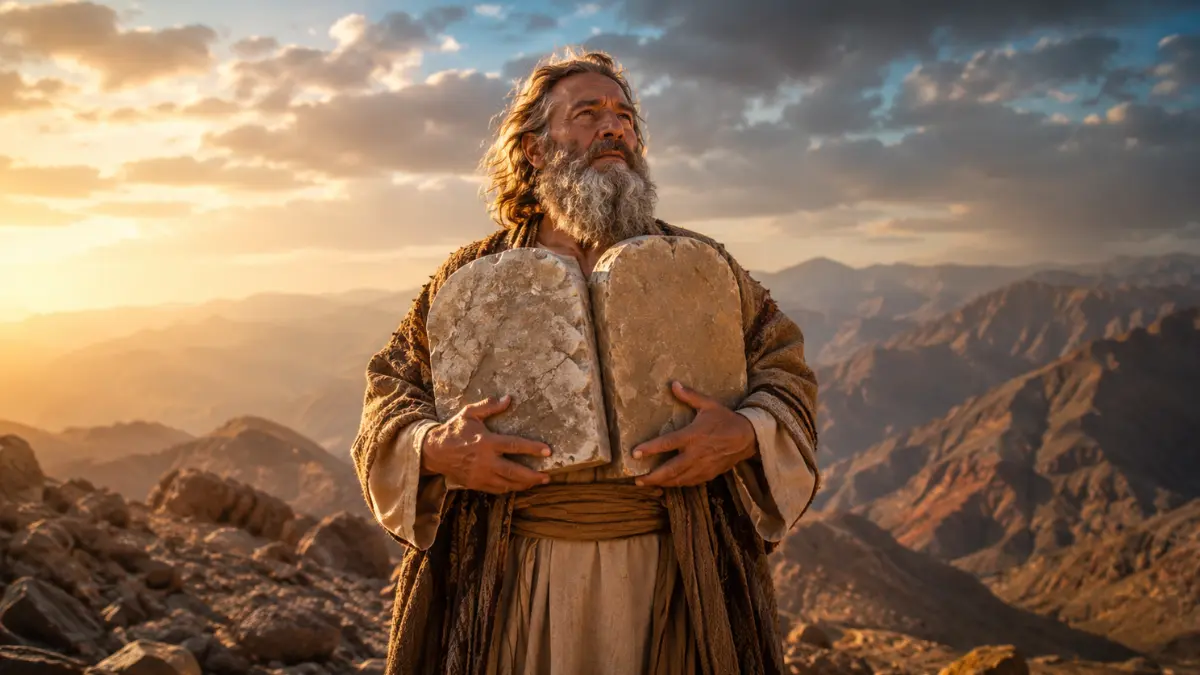

The Ten Commandments in Exodus 34 were written on replacement tablets after Moses broke the first tablets because of Israel’s worship of the golden calf. The wider biblical account indicates that the second tablets contained the same Ten Commandments God had given before, not an unrelated set of commands.
Exodus 34 can still confuse readers because the chapter also records instructions about festivals, sacrifices, Sabbath observance and separation from idolatry. Exodus 34:27–28 also raises a genuine question about who wrote which words.
Reading Exodus 34 alongside Deuteronomy 10 shows the main answer: God renewed the Sinai covenant, restored the tablets and called Israel back to the covenant they had violated.
Why Were the First Tablets Broken?
Moses received the first stone tablets after meeting with God on Mount Sinai. Exodus describes them as tablets inscribed by God and containing the covenant words proclaimed to Israel.
While Moses remained on the mountain, the Israelites became impatient. They asked Aaron to make a visible god to lead them. Aaron collected their gold and formed a calf.
The people offered sacrifices before the image, celebrated around it and connected it with their deliverance from Egypt. This rebellion directly violated their promise to worship the Lord alone.
When Moses descended and saw the calf and the celebration, he threw down the tablets and broke them at the foot of the mountain.
The broken tablets became a fitting visible sign of Israel’s covenant violation. The people had agreed to obey God, yet they rejected the covenant’s most basic demand before Moses had even returned to the camp.
The problem was not merely that Israel used the wrong religious symbol. They transferred honour belonging to God to something made by human hands.
This failure explains why Exodus 34 strongly emphasizes loyalty in worship. For a broader explanation, read about Israel’s worship of the golden calf and biblical idolatry.
Were the Second Tablets the Same as the First?
Yes. The strongest biblical clarification says that the replacement tablets contained the same Ten Commandments written before.
In Exodus 34:1, God told Moses to cut two stone tablets like the first ones. God also said that He would write on them the words that appeared on the tablets Moses had broken.
Deuteronomy 10:4 later gives an even clearer explanation. Moses recalled that God wrote on the second tablets the same words He had written on the first tablets: the Ten Commandments proclaimed from the mountain.
God therefore did not replace the first tablet inscription with a completely unrelated set of commands.
The second tablets restored the covenant testimony that Israel’s rebellion had disrupted. Their replacement showed continuity between the original covenant at Sinai and the covenant renewal that followed the golden calf.
The full setting of the first tablets belongs to the original covenant at Mount Sinai.
Why Does Exodus 34 Seem to Contain Different Commandments?
Exodus 34:11–26 records instructions involving pagan altars, religious treaties, cast idols, the Feast of Unleavened Bread, firstborn animals, Sabbath observance, annual festivals, sacrifices and firstfruits.
These instructions appear shortly before Exodus 34:28 refers to “the words of the covenant” and “the Ten Commandments.” This has led some readers and scholars to understand the commands in Exodus 34:11–26 as a separate ritual or worship-focused list.
The difficulty deserves acknowledgment because Exodus 34 does not present the material in exactly the same order as Exodus 20.
However, Exodus 34:1 states that the replacement tablets would carry the words written on the first tablets. Deuteronomy 10:4 identifies those words as the same Ten Commandments proclaimed earlier.
The most natural conclusion from the wider biblical account is that the second tablets contained the original Ten Words, while Exodus 34 also recorded additional covenant-renewal instructions.
Those added instructions were especially relevant after the golden calf. Israel had demonstrated how easily false worship, visible idols and surrounding religious practices could draw the nation away from God.
God therefore warned them against:
- Making treaties that would lead to idolatry
- Worshiping other gods
- Creating cast idols
- Adopting pagan religious customs
- Neglecting the worship obligations of the covenant
These instructions did not replace Exodus 20. They applied covenant loyalty directly to the danger Israel had just revealed.
What Does “Ten Commandments” Mean in Exodus 34:28?
The expression translated “Ten Commandments” can also be rendered “Ten Words.” It refers to the foundational covenant words God gave to Israel.
Exodus 34:28 creates an interpretive question because the previous verse commands Moses to write “these words,” and verse 28 then says that “he wrote” the covenant words on the tablets.
Read by itself, that wording can appear to identify Moses as the writer of the tablet inscription or connect the Ten Words directly with the preceding worship instructions.
Deuteronomy 10:4 provides the clearest biblical clarification. It says that the Lord wrote on the replacement tablets the same Ten Commandments He had written before.
The wider narrative therefore distinguishes between two related acts:
- Moses recorded the covenant instructions God spoke.
- God inscribed the Ten Commandments on the replacement tablets.
Exodus 34 records both the renewal instructions and the restoration of the tablets. This explains why the chapter contains more than a simple repetition of Exodus 20.
Readers comparing later Christian arrangements of the Ten Commandments can also explore how Christian traditions number the commandments differently.
Who Wrote the Second Tablets?
Moses prepared the replacement stones, while the wider biblical account attributes the inscription of the Ten Commandments to God.
The first tablets were prepared and written by God. After Moses broke them, God instructed him to cut two new tablets shaped like the first ones.
Moses brought the blank stones up the mountain. God then renewed the covenant and restored its written testimony.
Exodus 34:27 separately tells Moses to write the covenant instructions God had spoken. The following verse can seem grammatically ambiguous, but Exodus 34:1, Deuteronomy 4:13, and Deuteronomy 10:4 identify God as the one who wrote the Ten Words on the tablets.
The sequence can be summarized clearly:
- God wrote the first tablets.
- Moses broke them after seeing Israel’s idolatry.
- Moses cut two replacement tablets.
- God wrote the same Ten Commandments again.
- Moses carried the tablets back to the people.
Moses prepared the material and recorded God’s spoken instructions but the authority and covenant message came from God.
Did Exodus 34 Establish a Different Sinai Covenant?
No. Exodus 34 renewed the covenant Israel had already violated rather than establishing an unrelated Sinai covenant.
The people remained the nation God had delivered from Egypt. The destination, covenant identity, and foundational commands did not change.
What changed was Israel’s condition. They had broken their promise through idolatry and now required judgment, intercession, forgiveness, and restoration.
The covenant renewal included:
- Replacement tablets
- Renewed warnings against idolatry
- Reaffirmed worship responsibilities
- God’s continued presence with Israel
- A renewed call to obedience
God did not treat the golden calf as insignificant. The rebellion brought serious consequences.
At the same time, He did not abandon His covenant purpose. Moses interceded, God showed mercy, and the relationship continued.
The second tablets therefore represented restoration, not replacement.
Where Were the Second Tablets Kept?
Moses later placed the replacement tablets inside the Ark, as recorded in Deuteronomy 10:5.
The first tablets had been shattered at the foot of the mountain. The second tablets were preserved as an enduring covenant testimony.
Their place inside the Ark showed their central importance in Israel’s relationship with God. The tablets testified to the commands Israel had received and to the covenant God had renewed after their rebellion.
The broader history of the tablets inside the Ark belongs to the separate account of the Ark of the Covenant.
What Did the New Tablets Mean?
The direct meaning of the replacement tablets concerns Israel’s covenant restoration after the golden calf.
They showed that God took idolatry seriously. Israel could not violate the covenant and continue as though nothing had happened.
They also showed that judgment was not the end of the story. God allowed Moses to return to the mountain, instructed him to prepare new stones, and restored the covenant words.
The new tablets revealed several important truths within the passage.
God’s commands remained consistent: He did not weaken the covenant standard after Israel failed.
Israel’s sin had real consequences: The original tablets were broken, people faced judgment, and the nation’s relationship with God required restoration.
Intercession mattered: Moses pleaded for the people and asked God to continue with them.
Mercy did not excuse rebellion: God restored the covenant relationship without removing its demands.
Restoration remained possible.: The broken tablets did not become the final symbol of Israel’s future. God provided replacement tablets and continued leading the nation.
The passage does not teach that repentance automatically removes every consequence. Israel continued to experience the results of its choices.
It does show that God’s purpose could continue after serious failure without declaring that failure acceptable.
The Covenant Was Renewed
The Ten Commandments in Exodus 34 belonged to the restoration of the Sinai covenant after Israel’s rebellion with the golden calf.
God did not introduce an unrelated commandment list. The wider biblical account identifies the replacement inscription as the same Ten Commandments given before. Exodus 34 also records renewed worship instructions that directly addressed Israel’s failure.
The first tablets were broken after the covenant was violated. The second tablets showed that God’s judgment did not cancel His mercy or His purpose.
Exodus 34 is therefore the account of a covenant broken by human rebellion and renewed by God without weakening the call to faithfulness.
People Also Ask
Did God Change the Ten Commandments After the Golden Calf?
No. Exodus 34:1 says the replacement tablets would contain the words written on the first tablets. Deuteronomy 10:4 identifies them as the same Ten Commandments proclaimed earlier.
Why Does Exodus 34 Include Different-Looking Commands?
Exodus 34 includes covenant-renewal instructions about worship, festivals, idols and Israel’s relationship with surrounding nations. These instructions addressed Israel’s recent failure but did not replace the original tablet inscription.
Did Moses or God Write the Second Tablets?
Moses cut the replacement stones and recorded the covenant instructions God spoke. Deuteronomy 10:4 attributes the inscription of the Ten Commandments on the tablets to God.
What Does Exodus 34:28 Mean by the Ten Commandments?
It refers to the covenant’s Ten Words. Although the immediate wording creates an interpretive question, Deuteronomy 10:4 clarifies that the replacement tablets contained the same Ten Commandments written before.
Why Were the First Tablets Broken?
Moses broke them after seeing Israel worship the golden calf. Their destruction became a visible sign that Israel had violated the covenant.

2 thoughts on “Ten Commandments in Exodus 34: Were They the Same?”