
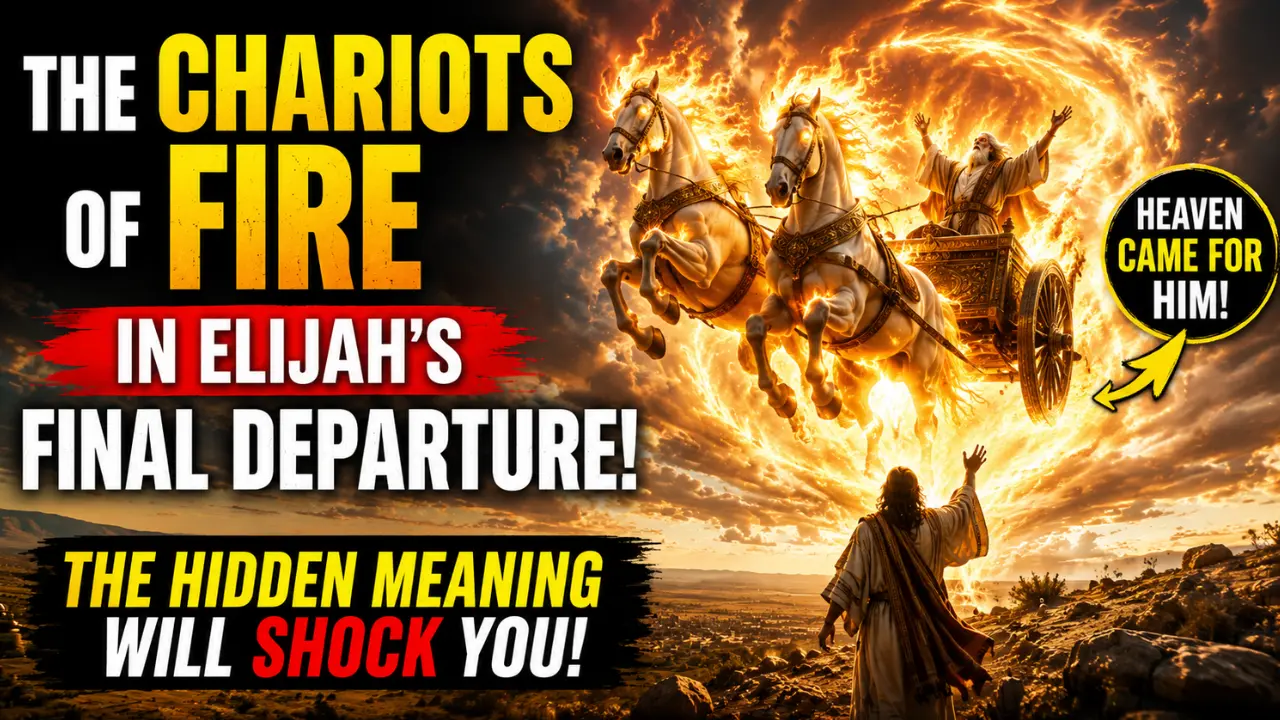

One of the most dramatic moments in the Old Testament unfolds in 2 Kings 2 when the prophet Elijah is taken from earth in a whirlwind while chariots of fire and horses of fire appear between him and Elisha. The scene feels almost overwhelming in its intensity. Prophetic tension fills the chapter from the beginning. Elijah travels from place to place while Elisha refuses to leave his side, knowing something historic is approaching.
Then suddenly heaven interrupts the ordinary world.
The prophet who confronted kings, called down fire, challenged idolatry and stood boldly before national rebellion does not die in an ordinary way. Instead, fiery chariots appear, the two prophets are separated and Elijah is carried away in a whirlwind into heaven.
The imagery is unforgettable because the chariots of fire symbolize far more than supernatural transportation. They reveal divine power, heavenly warfare, God’s protection, prophetic authority, holy transition and the reality that unseen spiritual realms surround earthly events far more than human eyes normally perceive, much like [how Scripture repeatedly unveils unseen heavenly realities operating behind visible human history — What the Bible Reveals About the Invisible Spiritual Realm].
The moment became one of Scripture’s clearest reminders that heaven is not distant from history. The unseen kingdom of God can suddenly break into visible reality.
Why Fire Surrounds Elijah’s Ministry
The fiery imagery in Elijah’s departure did not appear randomly. Fire had followed Elijah’s prophetic ministry repeatedly, making the chariots of fire feel like the climax of themes already surrounding his life.
Fire as a Sign of Divine Authority
Earlier in Elijah’s ministry, fire fell from heaven on Mount Carmel during the confrontation with the prophets of Baal. That moment publicly revealed that the God of Israel alone possessed true authority and power.
Fire also appeared when soldiers sent by King Ahaziah approached Elijah arrogantly and judgment came down from heaven. Throughout Elijah’s story, fire became associated with divine holiness, prophetic authority, judgment against rebellion and the unmistakable presence of God.
The chariots of fire therefore did not emerge from nowhere. Elijah’s ministry had long carried the atmosphere of heavenly fire surrounding it, much like [how fire in Scripture repeatedly symbolizes God’s holiness, judgment and manifest presence — The Spiritual Meaning of Fire in the Bible].
Fire and the Holiness of God
In Scripture, fire often symbolizes holiness, purification, judgment, glory and divine presence. Fire can illuminate, consume, protect and purify simultaneously. The fiery chariots surrounding Elijah’s departure carried this same layered symbolism.
The scene was not merely spectacular. It reflected the overwhelming holiness and power connected to the God Elijah served throughout his prophetic life.
The Chariots and Horses of Fire
The text specifically describes chariots of fire and horses of fire separating Elijah and Elisha before Elijah is taken upward in the whirlwind.
Symbols of Heavenly Warfare
In the ancient world, chariots represented military strength, royal authority, speed and national power. Armies trusted chariots as symbols of battlefield dominance. Yet the fiery chariots in Elijah’s departure did not belong to an earthly kingdom.
They symbolized the armies of heaven.
This imagery reveals an important biblical truth: the ultimate power behind history does not belong to earthly rulers alone. Spiritual realities surround human events even when people cannot perceive them directly.
The chariots of fire therefore symbolized divine protection, heavenly authority and the reality of God’s unseen kingdom operating beyond earthly vision, much like [how Scripture portrays heavenly armies and angelic forces surrounding God’s people even when invisible to human sight — What the Bible Says About Heavenly Hosts and Angelic Armies].
A Barrier Between Elijah and Elisha
The fiery chariots also separated Elijah from Elisha before the departure occurred. This detail matters because the transition between prophets was not merely emotional or organizational. Heaven itself marked the moment.
Elijah’s departure was not human abandonment or accidental loss. The separation came through divine intervention. The heavenly realm itself stood between the old prophetic season and the new one beginning through Elisha.
The Whirlwind Carrying Elijah
Although many people focus on the fiery chariots, Scripture specifically says Elijah went up by a whirlwind into heaven.
The Wind and the Power of God
Throughout the Bible, wind often symbolizes the invisible movement and power of God. Storm imagery regularly accompanies moments of divine revelation, judgment or overwhelming majesty.
The whirlwind therefore reflected unstoppable divine power. Elijah was not escaping death through personal ability. God Himself carried the prophet beyond ordinary earthly experience.
A Departure Unlike Ordinary Death
Elijah’s departure stands apart from normal human death narratives in Scripture. This uniqueness gave Elijah extraordinary prophetic significance within biblical tradition.
The event communicated that Elijah’s ministry belonged to a larger divine purpose extending beyond ordinary earthly limitation. His departure became a sign that God’s authority over life itself exceeded normal human expectation.
Elisha Watching the Departure
One of the most emotional dimensions of the story is Elisha witnessing Elijah’s departure personally.
Refusing to Leave Elijah
Throughout the chapter, Elijah repeatedly tells Elisha to remain behind, yet Elisha refuses every time. This persistence reveals devotion, loyalty, spiritual hunger and recognition that a sacred transition was approaching.
Elisha understood that proximity mattered. He did not want distance during the final moments of Elijah’s ministry.
“My Father, My Father”
As Elijah is taken away, Elisha cries out:
“My father, my father, the chariot of Israel and its horsemen!”
This statement carries deep emotional and symbolic meaning. Elijah represented more than an individual prophet. He was described as the true defence and spiritual strength of Israel.
The phrase suggests that heaven’s power working through one faithful prophet mattered more than military force alone.
The Mantle Falling to Elisha
After Elijah’s departure, his mantle falls to Elisha.
The Transfer of Prophetic Authority
The mantle symbolized prophetic calling, authority and divine commission. Elijah’s departure did not end God’s work. The ministry continued through Elisha.
This moment is important because the story does not focus only on supernatural spectacle. It also emphasizes continuation. God’s purposes move forward across generations, much like [how Scripture repeatedly shows God raising new servants to continue His work across different generations of faithfulness — How God Passes Spiritual Responsibility Across Generations].
Power Connected to God
Elisha later strikes the Jordan River with Elijah’s mantle and asks, “Where is the Lord God of Elijah?” The river parts just as it had for Elijah.
This detail matters deeply because the power was never magical property attached merely to Elijah as an individual. The true source remained God Himself.
The mantle represented continuation of divine calling, not celebrity spirituality centred on one human figure.
The Chariots of Fire and the Unseen Kingdom
The imagery of fiery chariots appears elsewhere in Scripture and connects strongly to unseen spiritual realities.
Elisha’s Vision of Heavenly Armies
Later in Elisha’s ministry, a servant panics when enemy armies surround the city. Elisha prays that the servant’s eyes would be opened and suddenly the mountains appear filled with horses and chariots of fire surrounding Elisha.
This connection is important because it reveals that the fiery chariots in Elijah’s departure were not isolated symbolism. They represented the armies of God surrounding His servants continually.
The biblical message is profound: human beings often see only visible danger while remaining blind to the spiritual realities surrounding them.
Heaven Closer Than It Appears
The chariots of fire remind readers that Scripture presents heaven and earth as deeply connected realities rather than completely separated worlds. The kingdom of God can intersect visibly with human history at any moment according to divine purpose.
Elijah’s Departure and the Fear of Death
The story also speaks powerfully to human fear surrounding death and mortality.
A Prophet Carried by God
Elijah’s departure portrays a servant of God being carried by divine power rather than abandoned to chaos. The imagery is filled not with terror but with heavenly authority and movement toward glory.
This does not eliminate the reality of death elsewhere in Scripture but it does proclaim God’s sovereignty beyond human mortality.
Hope Beyond Earthly Limitation
Elijah’s ascent became associated with hope, future restoration and expectation within Jewish tradition. Elijah later appears during the Transfiguration of Christ, further reinforcing his continuing prophetic significance.
The story therefore became larger than one individual departure. It pointed toward the reality that earthly life does not fully contain God’s purposes.
The Chariots of Fire and Christ
The imagery surrounding Elijah ultimately points forward toward Christ in several important ways.
Ascension and Heavenly Glory
Like Elijah, Christ also ascended after His earthly ministry, though the meanings are profoundly different. Elijah was carried upward by the power of God, while Christ ascended in His own divine authority as the risen Son. Elijah departed as a faithful prophet but Christ ascended as the conquering Lord over death itself.
Both moments nevertheless connected heaven and earth dramatically before witnesses, revealing that the kingdom of God reaches beyond the visible world.
Divine Power Beyond Earthly Kingdoms
The fiery chariots revealed heavenly authority greater than earthly armies. Christ’s kingdom likewise operates beyond worldly systems of force, political dominance and military power.
Earthly kingdoms rise through visible strength but the reign of God moves with a deeper authority that cannot be measured merely by armies, wealth or political control.
Presence of Heaven Around God’s Servants
The chariots of fire also point toward the biblical reality that believers are never abandoned to merely visible circumstances. God’s presence surrounds His people even when unseen.
The New Testament continues this theme by presenting spiritual realities existing beyond ordinary human sight.
When Heaven Is Closer Than We Think
The chariots of fire still matter because modern life often reduces reality to only what can be physically measured or immediately seen. Elijah’s departure confronts that assumption directly.
Scripture presents a world alive with heavenly presence, divine authority, spiritual conflict and unseen realities beyond ordinary perception.
The story also challenges fear-driven living. Political systems, earthly crises, visible threats and human power structures do not define final reality. Behind the visible world stands the kingdom of God with authority far greater than anything human beings can build or destroy.
The fiery chariots remind believers that God’s power surrounds His purposes even when human eyes cannot fully perceive it.
When the Prophet Vanished Into the Whirlwind
The chariots of fire in Elijah’s final departure symbolized heavenly authority, divine protection, prophetic transition, unseen spiritual reality and the overwhelming power of God breaking visibly into human history.
As fire blazed between Elijah and Elisha and the whirlwind carried the prophet upward, the ordinary world suddenly gave way to a glimpse of heaven’s unseen kingdom.
The story remains one of Scripture’s most unforgettable reminders that behind earthly events stands a greater reality filled with divine majesty, heavenly armies and the God whose power reaches far beyond the limits of human sight.
