

You think you know Psalm 23—until you see it through a shepherd’s eyes.
It is one of the most quoted passages in the Bible, repeated so often that it fades into the background. But what if we have been missing its real meaning all along?
When a man who actually lived with sheep explains it, the psalm stops sounding gentle—and starts feeling real.
The Shepherd and the Sheep
Keller’s first point is simple: sheep are not smart.
They wander into danger, eat the wrong things and panic easily.
But they know one thing well — the voice of their shepherd.
That hit me hard.
I spend so much of my life trying to control everything — worrying, planning, pushing.
Maybe peace does not come from having all the answers.
Maybe it comes from knowing one voice.
If you want to explore this idea more deeply, I wrote about it here: The Lord Is My Shepherd — Psalm 23 Meaning.
“I Shall Not Want” — The Hardest Sentence to Believe
Keller explains that a good shepherd walks miles ahead of his flock before they ever move — scouting for safe grass, testing the water.
The sheep don’t know that. They just follow.
That image stayed with me for days.
How often do I panic because I can’t see what’s next — while God’s already out there preparing it?
“I shall not want” isn’t arrogance. It’s quiet trust.
It’s the sigh you breathe when you finally stop trying to run your own world.
Here’s a deeper reflection: I Shall Not Want — Psalm 23:1 Explained.
Green Pastures and Still Waters
Keller noticed that sheep only lie down when they feel completely safe — no fear, no hunger, no tension.
That line made me laugh. I’m the same way.
Even when I’m lying down, my mind’s still running marathons.
Maybe that’s why the Shepherd sometimes slows us down — not to frustrate us, but to protect us.
Still waters aren’t random; they’re carved out by care.
If you’ve read Psalm 23 but never felt it, take a few minutes with this reflection: You Have Read Psalm 23 — But Have You Ever Felt Its True Meaning?.
The Valley of Shadows
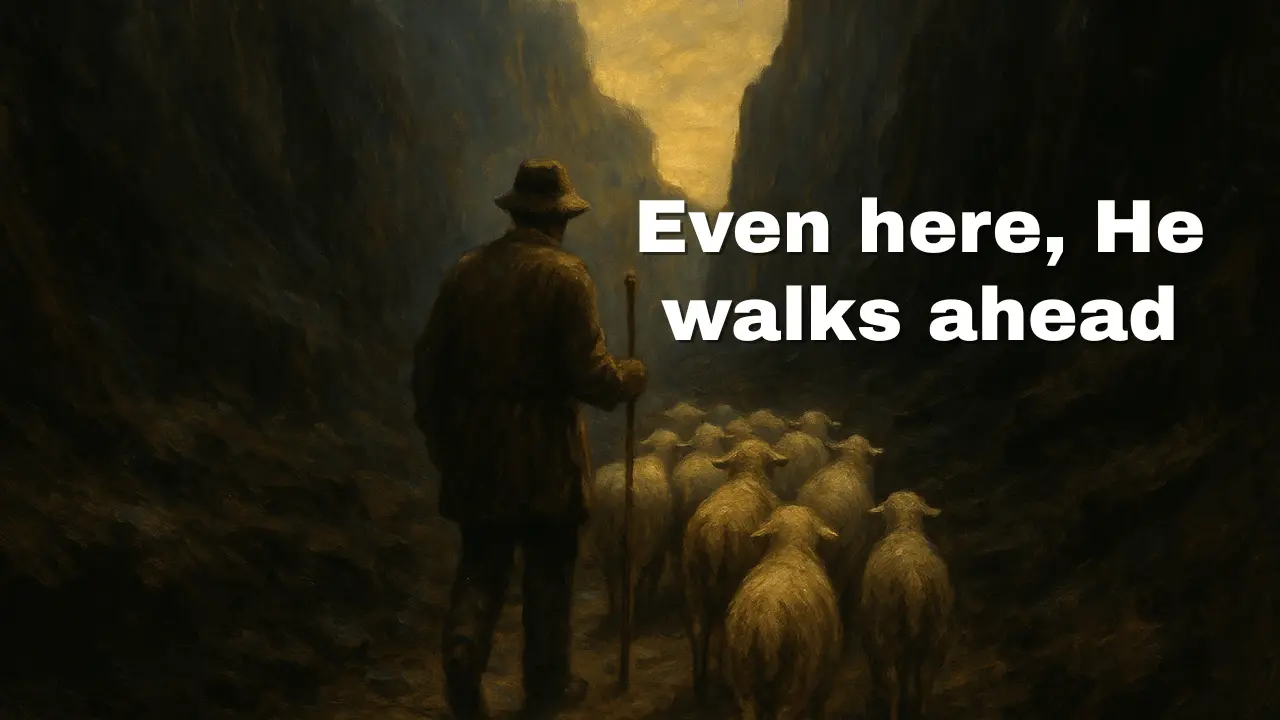
Every shepherd leads their flock through dark valleys — steep, narrow, and dangerous.
Keller said the sheep don’t understand the path, but they keep moving because they can see him.
That changed how I read, “I will fear no evil.”
It’s not that fear disappears; it’s that presence makes it bearable.
You don’t have to understand every valley — you just need to know who’s walking ahead.
Sometimes the answer to “why is this happening?” is simply “because the next pasture is on the other side.”
Oil on the Head
In the summer, Keller poured oil on his sheep’s heads to keep away flies and infections.
It sounds small, almost silly — but that’s what grace often looks like.
It’s not always a miracle.
Sometimes it’s a friend who texts when you’re spiraling.
Sometimes it’s a quiet day when nothing goes wrong.
Sometimes it’s just a good night’s sleep.
We underestimate how often God protects us from the tiny things that could’ve broken us slowly.
Goodness and Mercy
Keller ends with the image of two loyal sheepdogs — Goodness and Mercy — following the flock.
I love that picture.
Grace doesn’t trail behind lazily; it chases you.
When I look back, I can see it — the narrow escapes, the unexpected kindness, the closed doors that turned out to be protection.
That’s goodness and mercy.
They’ve been following me the whole time.
More Than a Book About Sheep
Keller’s writing isn’t dramatic. It’s gentle, slow, and full of attention.
He doesn’t preach; he observes.
That’s what makes this book so quietly healing.
It’s about care — the kind that notices before you ask, that protects when you’re unaware, that keeps leading when you’ve stopped believing.
In a world obsessed with control, Keller’s shepherd reminds you it’s okay to be led.
If you’d like to read the original, it’s still published by Zondervan.
Or simply revisit the psalm itself on Bible Gateway.
Before You Close This Tab
Try this tonight:
Read Psalm 23 slowly — not as a verse to memorize, but as a conversation.
After each line, ask: Where is this true in my life today?
You’ll notice something shift.
The psalm that once felt distant suddenly sounds like it’s speaking directly to you.
And that’s when you realize:
It was never about the sheep.
It’s always been about the Shepherd.
FAQ — A Shepherd Looks at Psalm 23
What is A Shepherd Looks at Psalm 23 about?
It’s a reflection by W. Phillip Keller — a real shepherd who spent years caring for sheep. He takes each verse of Psalm 23 and shows how deeply it mirrors the way God cares for us. It’s not theory; it’s experience. That’s what makes it powerful.
Why does Psalm 23 still speak to people today?
Because everyone knows what it’s like to feel lost or tired. Psalm 23 reminds us that we’re seen, guided, and protected — even when life feels dark. It’s one of those passages that meets you where you are and gently brings peace.
What does “I shall not want” mean in Psalm 23:1?
It means we can rest in trust. God goes ahead of us — preparing what we need before we even know to ask. “I shall not want” isn’t about having everything; it’s about not lacking peace because the Shepherd’s already there.
Who was W. Phillip Keller?
Keller was both a shepherd and a pastor. He wrote from the fields — not an office. His words carry a quiet wisdom that only comes from living close to creation and close to God.
How can I apply Psalm 23 to my own life?
Read it slowly. After each line, ask, “Where is this true for me right now?” You’ll start to notice small ways God’s been leading all along — sometimes in the background, sometimes right in front of you.
