
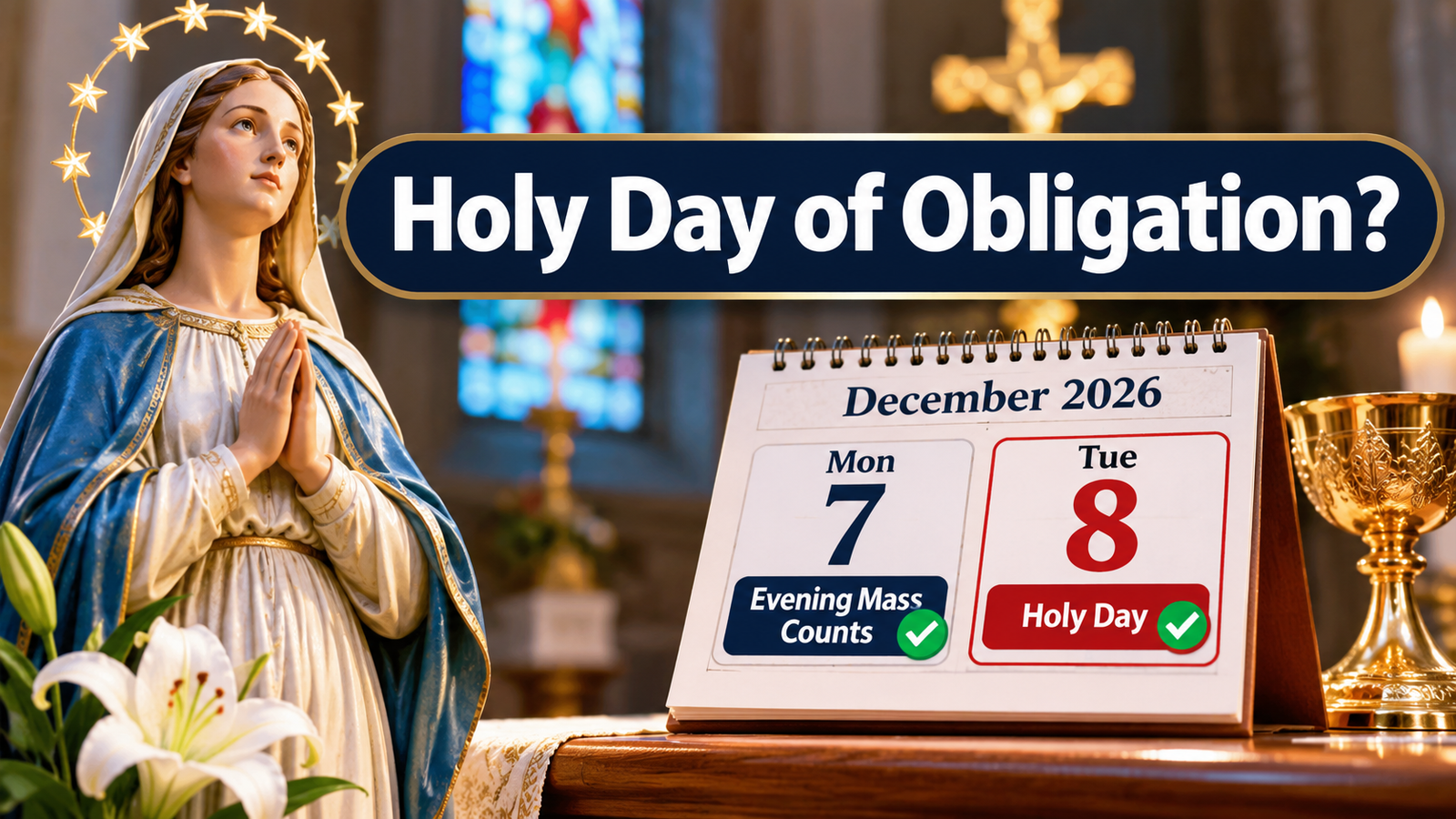

Tuesday, December 8, 2026, is a holy day of obligation for Latin Church Catholics in the United States. The Church celebrates the Solemnity of the Immaculate Conception, and Catholics are ordinarily required to participate in Mass unless a serious reason or an appropriate dispensation excuses them.
A Catholic Mass on Monday evening, December 7, can fulfill the December 8 obligation. However, attending Mass on Sunday, December 6 or Monday morning, December 7, does not satisfy this separate requirement.
Why December 8 Is Obligatory
The Solemnity of the Immaculate Conception celebrates the Catholic belief that Mary was preserved from original sin from the first moment of her conception. The observance is especially significant in the United States because Mary, under the title of the Immaculate Conception, is recognized as the country’s patroness.
The United States Conference of Catholic Bishops identifies December 8 as one of the designated holy days of obligation. Although the obligation is removed for certain other solemnities when they fall on a Saturday or Monday, the Immaculate Conception is not included in those exceptions.
In 2026, the solemnity falls on a Tuesday, so Catholics can fulfill the obligation by participating in Mass that day or during the preceding evening. These requirements are established in the USCCB’s official holy-day norms.
Observing a holy day also involves more than attending Mass. Canon 1247 directs Catholics to avoid work and activities that interfere with worship, the religious celebration, and appropriate rest, although necessary family responsibilities and important services may still require attention.
Can December 7 Mass Count?
Yes, attending a Catholic Mass on Monday evening, December 7, 2026, can satisfy the obligation for the Immaculate Conception. Under Canon 1248 §1, Catholics may fulfill their Mass obligation on the holy day itself or during the evening immediately preceding it.
Many parishes schedule an evening celebration before major solemnities, commonly called a vigil Mass. This allows Catholics with commitments on Tuesday to participate in an eligible Mass on Monday evening instead.
The Mass does not necessarily have to be labelled a vigil to fulfill the obligation. Canon law refers to participation in a Mass celebrated in a Catholic rite during the qualifying period, rather than requiring a particular name or liturgical label.
Someone who attends an eligible Monday evening Mass has fulfilled the December 8 Mass obligation and does not need to attend another Mass on Tuesday for that purpose. A Monday morning Mass, however, falls outside the permitted period and can not satisfy the following day’s requirement.
Which Mass Dates Count?
Sunday, December 6, 2026, is the Second Sunday of Advent and carries its own Mass obligation. Attending that Sunday does not fulfill the separate requirement for the Immaculate Conception, which occurs two days later.
The distinction becomes clearer when the relevant dates are compared. The following table shows which Mass attendance periods qualify for the December 8 obligation.
| Date | Counts for December 8? |
|---|---|
| Sunday, December 6 | No |
| Monday morning, December 7 | No |
| Monday evening, December 7 | Yes |
| Tuesday, December 8 | Yes |
| Wednesday, December 9 | No |
For example, a Catholic who attends Sunday Mass on December 6 and another eligible Mass on Monday evening, December 7, fulfills both obligations. The Sunday celebration satisfies the ordinary Sunday requirement, while the Monday evening celebration satisfies the Immaculate Conception obligation.
Catholics are not required to attend their usual parish to fulfill the obligation. They may participate in a qualifying Mass at another Catholic church, provided the celebration meets the requirements of Church law.
What Time Does Evening Begin?
Canon 1248 permits attendance during the evening before a holy day but does not specify an exact starting hour. This distinction matters when a parish offers a Mass in the afternoon rather than later in the evening.
The Archdiocese of Newark provides a specific example of how the rule is applied. Its Mass scheduling policy states that vigil Masses for holy days of obligation must not begin before 4 p.m.
Newark’s policy relies on canonical commentary interpreting the preceding evening as beginning at 4 p.m. However, this does not mean Canon 1248 itself establishes that hour or that every American diocese has issued identical scheduling instructions.
A confirmed example for December 2026 is available at the Basilica of the National Shrine of the Immaculate Conception in Washington, DC. Its official schedule lists a 5:15 p.m. vigil Mass on Monday, December 7, in the Crypt Church, followed by several Masses on Tuesday, December 8.
The National Shrine’s December 2026 Mass schedule also identifies the principal solemn Mass at 12:10 p.m. on Tuesday. These arrangements apply to that particular church and should not be treated as a schedule followed by every parish.
For readers considering an unusually early Monday afternoon Mass, the safest approach is to consult the local parish or diocese. An officially announced evening vigil generally provides a clearer option than assuming that any afternoon Mass automatically qualifies.
If You Cannot Attend
The Catholic Church recognizes that serious circumstances can prevent someone from attending Mass. Illness, necessary care for infants and other genuine impediments may excuse a person from the obligation.
Paragraph 2181 of the Catechism of the Catholic Church explains that Catholics may be excused for a serious reason or through an appropriate dispensation. Individual circumstances can differ, so those facing uncertainty may benefit from speaking with their parish priest.
Work responsibilities and family commitments can sometimes make attendance difficult, particularly when someone has limited control over their schedule. However, ordinary inconvenience does not automatically remove the obligation, especially when suitable Monday evening or Tuesday Masses are available.
Watching Mass online does not ordinarily fulfill the requirement for in-person participation. Nevertheless, a livestream can provide spiritual encouragement for someone who is legitimately unable to attend church, even though the broadcast itself does not satisfy the attendance obligation.
Canon 1248 §2 encourages suitable prayer or participation in an available Liturgy of the Word when attending Mass becomes impossible for a grave reason. These practices offer meaningful ways to observe the day spiritually without being presented as automatic substitutes for Mass when attendance is reasonably possible.
Check Your Parish Schedule
Catholics preparing for December 8 should review their parish’s special Mass schedule before Monday evening. Some churches may offer several celebrations, while others may have limited opportunities depending on local arrangements.
The most useful sources are official parish bulletins, diocesan announcements and parish offices. These can confirm available Mass times and clarify whether an early Monday celebration qualifies for the holy day obligation.
For Latin Church Catholics in the United States, December 8, 2026, is a holy day of obligation, and an eligible Monday evening Mass on December 7 can fulfill it. Checking the local schedule in advance allows Catholics to make suitable arrangements and participate in the Solemnity of the Immaculate Conception without unnecessary uncertainty.
