
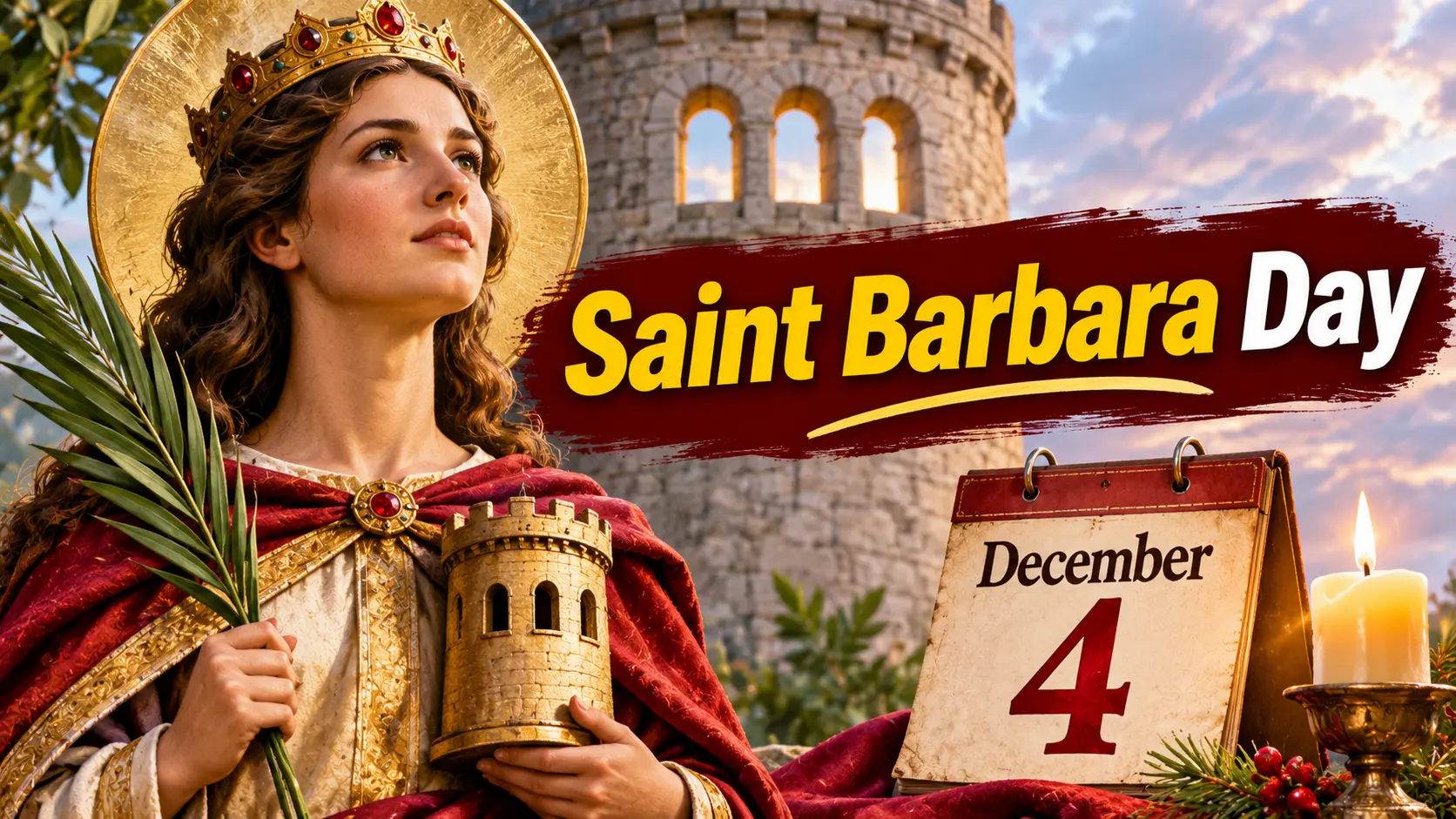

Every December 4, many Christians remember Saint Barbara, a woman traditionally honoured for refusing to abandon her faith despite opposition from her own father. Her story has been preserved for centuries, particularly in Eastern Orthodox and Catholic traditions, where she became associated with martyrdom, courage and religious faithfulness.
Although her name is familiar in Christian history, much of her life remains uncertain. The traditional account describes a young woman imprisoned in a tower, persecuted for becoming a Christian, and eventually executed but surviving historical records do not independently confirm these events.
Christians remember Saint Barbara on December 4 because the date became established as her traditional feast day. The commemoration honours the Christian faithfulness attributed to her, while the historical evidence tells us considerably more about the development of her remembrance than about the details of her life.
Who Was Saint Barbara?
Saint Barbara is traditionally remembered as an early Christian woman who suffered martyrdom after refusing to renounce her faith. In Eastern Orthodox Christianity, she is honoured as the Great Martyr Barbara, a title reflecting her importance within the church’s tradition of remembering Christian martyrs.
Accounts of her life generally place her in the third or early fourth century, during an era when Christians faced periods of persecution within the Roman Empire. However, the surviving evidence does not establish precisely when she lived or under which Roman emperor her alleged martyrdom occurred.
According to the familiar story, Barbara was the daughter of Dioscorus, a wealthy pagan who strongly opposed Christianity. She is said to have embraced the Christian faith despite his objections and remained committed to her beliefs when he demanded that she abandon them.
Different versions of her story associate her with locations such as Heliopolis and Nicomedia. These geographical differences are among the reasons historians can not confidently reconstruct her biography.
Nevertheless, devotion to Barbara became firmly established in Christian communities. Her name appeared in religious calendars, churches were dedicated to her and accounts of her martyrdom were preserved through generations.
The Orthodox Church in America continues to commemorate Barbara alongside the martyr Juliana, preserving the traditional account of their suffering as part of its religious observance.
Why December 4?
December 4 is Saint Barbara’s traditional feast day in many Christian calendars. The date became associated with the remembrance of her martyrdom, although there is no surviving contemporary evidence establishing that she died on that particular day.
Early Christians commonly commemorated martyrs on dates associated with their deaths. These observances gradually became part of local religious calendars and martyrologies, which recorded the names and remembrance dates of Christian martyrs.
However, Barbara’s commemoration did not always appear on December 4. The Catholic Encyclopedia records that most ninth-century Western martyrologies placed her remembrance on December 16, while December 4 became the established date in Greek and Roman calendars.
This difference reveals an important aspect of the historical record. December 4 is a date preserved through Christian liturgical tradition rather than an anniversary that historians can independently verify.
Over time, December 4 became widely recognized as Saint Barbara’s Day. Communities that honoured her used the occasion to remember the faithfulness and courage described in her traditional martyrdom account.
The date remains important in Eastern Orthodox Christianity and in Catholic communities that preserve her commemoration. Some Orthodox churches following the older Julian calendar observe the corresponding church date on December 17 according to the Gregorian calendar currently used in civil life.
The Orthodox Church in America’s liturgical calendar identifies December 4 with the commemoration of Great Martyr Barbara and Martyr Juliana.
Although the precise historical origin of the date cannot be established, its significance within Christian tradition is clear. December 4 became the recognized occasion for remembering Barbara and the martyrdom attributed to her.
Her Traditional Story
The best-known account of Saint Barbara begins with her father, Dioscorus, who is described as a wealthy pagan determined to keep his daughter isolated from the outside world. According to the legend, he placed her in a tower and attempted to control her contact with others.
Despite her circumstances, Barbara is said to have become a Christian. The surviving versions differ in how she encountered Christianity but they agree that her religious conversion brought her into conflict with her father.
One particularly recognizable detail concerns a bathhouse Dioscorus was having constructed. The story says that Barbara arranged for three windows to be installed instead of the two originally planned, using them to symbolize the Christian belief in the Holy Trinity.
When her father discovered that she had embraced Christianity, he reportedly demanded that she renounce her new faith. Barbara refused and the confrontation eventually led to her being handed over to the authorities.
According to the traditional narrative, Barbara endured severe punishment because she would not abandon Christianity. Some versions also describe another Christian woman named Juliana, who witnessed Barbara’s suffering and was subsequently martyred.
The story reaches its conclusion when Barbara is condemned to death and her father personally carries out her execution. Later accounts add that Dioscorus was struck by lightning afterward, an event interpreted within the legend as divine punishment.
This dramatic ending contributed to Barbara’s later association with lightning, fire and sudden death. It also helps explain why she eventually became a patron saint of miners, artillery personnel and others whose occupations involved serious physical danger.
The tower and its three windows became familiar symbols in Christian artistic depictions of Barbara. These images reflect the traditional account of her life rather than providing independent evidence for the events described.
The story is preserved in the Orthodox account of Saint Barbara’s martyrdom and in later Western Christian literature. Its importance lies in the longstanding religious tradition surrounding her, although the events themselves cannot be treated as historically verified.
What Historical Records Show
The historical evidence for Saint Barbara is much more limited than the detailed accounts of her life might suggest. No surviving contemporary biography establishes her birthplace, conversion, imprisonment or execution.
The Catholic Encyclopedia explains that Barbara’s name does not appear in the authentic early historical authorities it examines or in the original recension of the martyrology traditionally attributed to Saint Jerome. This absence makes it difficult to connect the familiar story with reliable evidence from the period in which she supposedly lived.
There is, however, evidence that her veneration had become established by the early medieval period. The encyclopedia describes her remembrance as widespread from approximately the seventh century, when legendary accounts of her martyrdom were already circulating.
One early Western reference appears in the Martyrologium Romanum parvum, generally dated to around the year 700. It identifies Barbara as a virgin and martyr and associates her with Tuscany, although this does not establish that Tuscany was actually her birthplace or the location of her death.
Other traditions provide different geographical settings, including Heliopolis, Nicomedia, Rome and Antioch. These variations demonstrate how her remembrance developed in different Christian communities without preserving a consistent, verifiable account of her life.
The surviving narratives also differ in their historical settings and details. Consequently, historians cannot confidently establish the precise circumstances of Barbara’s alleged martyrdom or determine how closely the later stories reflect actual events.
The Catholic Encyclopedia’s historical examination of Saint Barbara documents these difficulties while also acknowledging the substantial history of her veneration.
The strongest historical evidence concerns the centuries-old Christian remembrance of Saint Barbara, not the specific events described in her traditional biography.
This distinction does not prove that a Christian martyr named Barbara never existed. It means that the available sources do not allow historians to verify the familiar details of her life or establish a reliable account of her death.
How Christians Remember Her
Saint Barbara’s commemoration remains particularly important in Eastern Orthodox Christianity. Churches honour her as the Great Martyr Barbara and December 4 appears in the liturgical calendar alongside the remembrance of Martyr Juliana.
Traditional hymns and religious services commemorate the steadfast faith attributed to Barbara. The emphasis is on her witness as a Christian martyr rather than on establishing the historical accuracy of every detail preserved in the narrative.
Roman Catholic observance has a different calendar history. Barbara’s commemoration appeared in earlier editions of the universal General Roman Calendar, but it was removed during the reforms introduced in 1969.
Those reforms sought to give greater prominence in the universal calendar to commemorations of wider significance and to address historical questions surrounding some traditional saints’ accounts. The uncertainty surrounding Barbara’s biography was relevant to her removal, although the reform itself involved broader liturgical considerations.
Importantly, removal from the universal calendar did not mean that the Catholic Church declared Barbara nonexistent or prohibited local devotion to her. Her remembrance continued in particular communities and religious traditions.
The Vatican’s 1969 calendar reform document explains the broader principles behind the changes, while Vatican News continues to identify Saint Barbara among those remembered on December 4.
Many Protestant communities do not observe individual saints’ feast days, although practices vary between denominations. December 4 is therefore not a universal Christian celebration, even though Saint Barbara’s remembrance has a longstanding place in several Christian traditions.
Her patronage also contributes to the continued observance of the day. Mining communities, artillery units and other groups historically associated with dangerous occupations have maintained customs honouring Barbara, reflecting her traditional association with protection against sudden danger.
These religious and occupational traditions help explain why her name remains familiar long after the period in which she is believed to have lived.
December 4 Customs
Saint Barbara’s Day is observed differently across Christian communities. Alongside religious services, some regions have developed family customs that remain associated with her December 4 feast.
In Germany, Austria, and parts of Central Europe, a familiar tradition involves cutting branches from cherry trees or other flowering plants on December 4. Families place the branches indoors in water, hoping they will produce blossoms around Christmas.
The branches are known as Barbarazweige or Barbara branches. Their association with the feast developed through traditions connecting Barbara with a flowering branch and they remain a recognizable part of seasonal customs in some communities.
In parts of the Middle East, including Lebanon, Syria and Jordan, Christians observe Saint Barbara’s Day through a celebration commonly called Eid il-Burbara. Families prepare a sweet wheat-based dish known as Burbara, often sharing it with relatives and neighbours.
Some communities also have customs involving children dressing in costumes. These practices are associated with local versions of Barbara’s story, particularly traditions describing her attempts to escape persecution.
A Catholic News Service report on Saint Barbara’s Day documents these Central European and Middle Eastern customs and their continued place in local celebrations.
Although the practices differ, they remain closely connected to the same December 4 remembrance. They show how Saint Barbara’s traditional story became part of both Christian religious observance and regional family customs.
Why She Is Remembered
Christians remember Saint Barbara on December 4 because generations of believers preserved that date as her traditional feast day. Her story came to represent steadfast Christian faith under persecution, and her commemoration remained important in churches and communities that honoured her as a martyr.
What can be historically established is more limited than the traditional narrative suggests. Her veneration has a documented history extending back many centuries but the surviving evidence does not establish precisely when she lived, where she died or whether the familiar events of her martyrdom occurred as later accounts describe them.
December 4 remains significant because of the longstanding Christian tradition of remembering Saint Barbara, even though the historical details of her life remain uncertain. Her feast continues to connect religious observance, centuries of Christian remembrance and the communities that preserve customs associated with her name.
Frequently Asked Questions
Who was Saint Barbara?
Saint Barbara is traditionally honoured as an early Christian martyr who refused to abandon her faith despite opposition from her father. Her familiar biography comes from later Christian accounts and historians cannot independently establish the main events described in those narratives.
How did Saint Barbara reportedly die?
According to the traditional Christian account, Barbara was condemned to death for refusing to renounce Christianity and her father carried out the execution. The story also describes him being struck by lightning afterward, but these events can not be independently confirmed from contemporary historical sources.
What traditions are associated with Saint Barbara’s Day?
Some Central European communities place flowering branches in water on December 4, hoping they will bloom around Christmas. In parts of the Middle East, Christian families prepare a sweet wheat dish called Burbara, while some communities also observe the occasion through religious services and family celebrations.
