
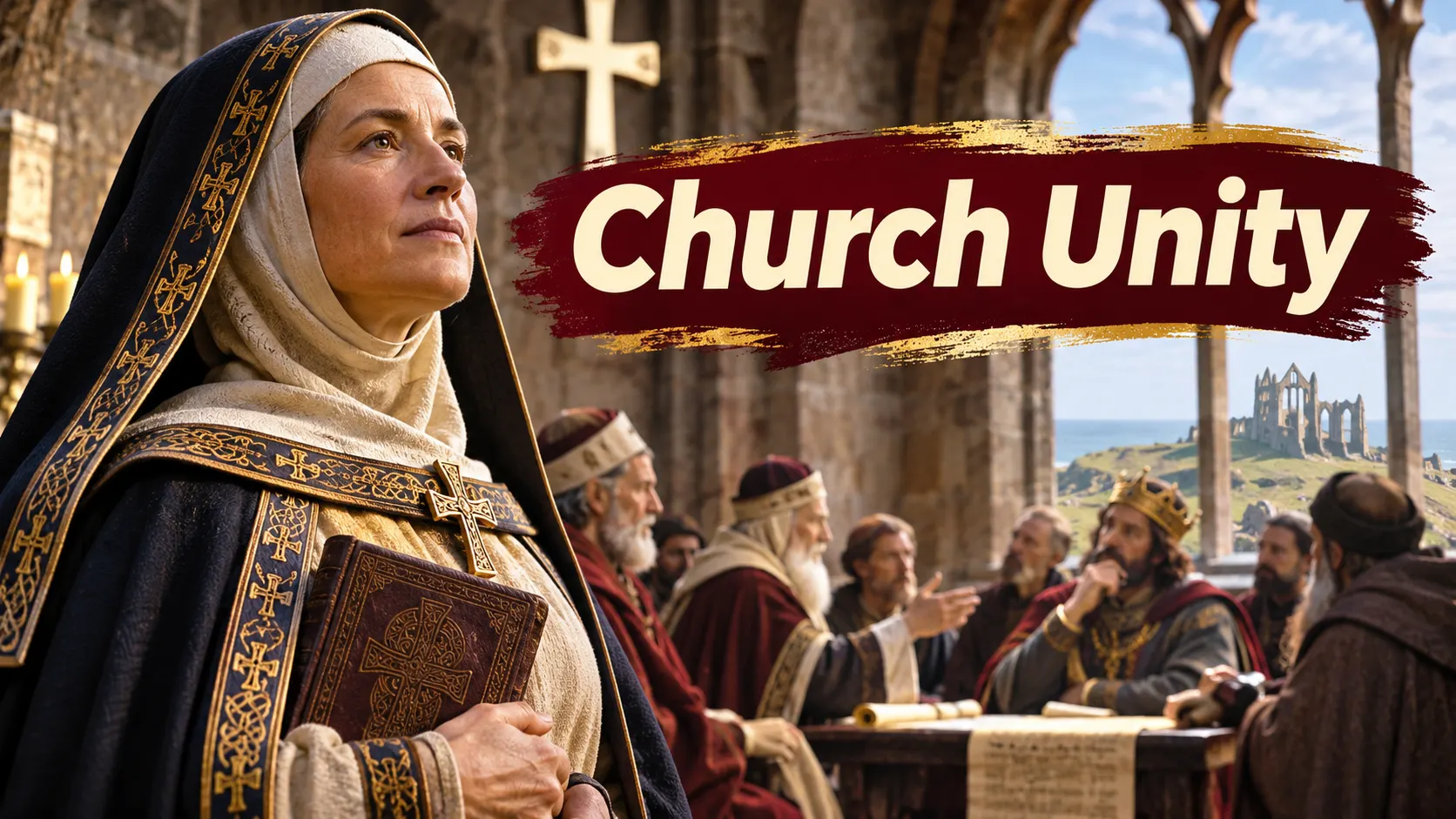

St. Hilda of Whitby was an influential Christian abbess whose monastery hosted the Synod of Whitby in AD 664, a gathering that helped shape the future of Christianity in England. The synod addressed a major disagreement over the date of Easter and established the Roman method of calculating the celebration in Northumbria.
Hilda supported the Irish Christian tradition during the dispute but King Oswiu ultimately decided in favour of Roman practice. Her contribution to church unity extended beyond the outcome of the meeting. Through her leadership at Whitby, she helped sustain a respected religious community during a period when English Christianity was developing more consistent practices and stronger connections between churches.
Who Was St. Hilda of Whitby?
St. Hilda, also known as Hild, was born around AD 614 into the royal family of Northumbria, an Anglo-Saxon kingdom in northern England. She was related to King Edwin of Northumbria and became a Christian during the early expansion of Christianity across the region.
Hilda was baptised in AD 627 through the Christian mission associated with Paulinus, who followed Roman customs. Later, she came under the spiritual influence of Bishop Aidan of Lindisfarne, whose missionary community followed Irish Christian traditions.
Her experience with these different Christian communities became particularly significant during the religious controversies of the seventh century. Although the traditions differed in certain practices, both had contributed to the establishment of Christianity in Northumbria.
Hilda entered religious life around the age of thirty-three and eventually became abbess at Hartlepool. She later took charge of the monastery at Whitby, then known as Streanaeshalch, which developed into an important centre of Christian learning and worship.
Whitby was a double monastery, accommodating both monks and nuns under Hilda’s leadership. Its reputation extended beyond Northumbria, making it a suitable location for the important religious gathering that would take place in 664.
Why Was the Synod of Whitby Held?
The Synod of Whitby was held because Christians in Northumbria disagreed about the correct method for calculating Easter. Those following Irish missionary traditions used a different calculation from Christians influenced by Rome and continental Europe.
The disagreement did not concern whether Jesus Christ had risen from the dead. Both communities recognised His resurrection as central to Christianity, but their different calendars sometimes placed Easter on different Sundays.
This division became particularly noticeable within the Northumbrian royal household.
King Oswiu followed the Irish tradition, while his wife, Queen Eanflæd, observed the Roman calculation. According to the eighth-century historian Bede, the difference sometimes meant that the king was celebrating Easter while the queen and her household were still observing the fasting period before it.
Such conflicting observances created practical and religious difficulties within a kingdom whose Christian communities were becoming increasingly connected.
The controversy also involved differences in clerical customs, particularly the form of tonsure worn by religious leaders. However, the date of Easter remained the central issue requiring a common decision.
King Oswiu therefore called a gathering of church leaders at Whitby in AD 664 to settle the disagreement and establish which tradition Northumbria should follow.
Hilda’s Role at the Synod
As abbess of Whitby, Hilda governed the monastery where the synod assembled. The meeting brought together influential religious figures and members of the Northumbrian royal family, demonstrating the importance of both the controversy and the community hosting it.
Among those present were Bishop Colmán of Lindisfarne, who defended the Irish Easter calculation, and Wilfrid, who argued for the Roman tradition. King Oswiu presided over the discussion and considered the competing claims.
Hilda’s participation is recorded in Bede’s Ecclesiastical History of the English People, one of the principal historical sources concerning the synod.
Why Hilda Supported the Irish Tradition
Hilda supported the Irish position associated with the missionary work of Aidan and the traditions maintained at Lindisfarne and Iona. Bede identifies her and her followers among those who favoured this practice.
Her position reflected the religious influences that had shaped her monastic life. Aidan’s missionary work had helped establish Christianity in Northumbria, and the customs associated with his community remained important to many Christians.
Colmán defended the Irish calculation by appealing to inherited religious practices and the authority of earlier Christian teachers. His argument emphasised continuity with the traditions through which Christianity had taken root in the region.
Wilfrid challenged this position by appealing to the wider practice of the Church and the authority associated with Rome. He argued that Northumbria should follow the Easter calculation observed across much of Western Christianity.
Although Hilda supported Colmán’s position, the surviving historical account does not record her delivering the principal arguments. Her role is established through her participation and support rather than through a documented speech.
Who Made the Final Decision?
King Oswiu made the final decision after hearing the competing arguments.
A decisive point arose when Wilfrid appealed to the authority of the apostle Peter, drawing upon Matthew 16:18–19. In this passage, Jesus speaks about building His Church and giving Peter the keys of the kingdom of heaven.
Oswiu accepted the argument concerning Peter’s authority and ruled that Northumbria should follow the Roman calculation of Easter.
This decision went against the position supported by Hilda and Colmán. Nevertheless, it marked a turning point in the development of common religious practices within the Northumbrian church.
How Did the Synod Change Church Unity?
The Synod of Whitby helped bring Northumbria into closer alignment with the Easter observances followed across much of Western Christianity.
Before the meeting, Christians living within the same kingdom could celebrate one of their most important religious festivals on different dates. The decision established a common calculation and reduced a significant source of division.
The change also reflected the growing connections between English Christian communities and the wider Western Church.
However, the outcome was not accepted by everyone.
Did the Decision End the Division?
The synod established a common practice, but it did not immediately resolve every disagreement between the Irish and Roman traditions.
Bishop Colmán and some of his followers rejected the decision and departed from Lindisfarne. Other religious leaders accepted the Roman calculation and continued their ministries within Northumbria.
The outcome therefore created greater consistency in religious observance while also leading to separation among those who disagreed.
This distinction matters when considering Hilda’s contribution. The synod was an important step toward common church practices, but its results should not be confused with universal agreement among all participants.
The gathering also demonstrated the growing importance of shared ecclesiastical arrangements in England. Christian communities that had developed under different missionary influences were increasingly being drawn into closer relationships.
Whitby became an important moment in that process, and Hilda’s monastery stood at the centre of the discussion.
How Did Hilda Contribute to Church Unity?
Hilda’s contribution to Christian unity is best understood through her leadership of the monastery at Whitby and the influence of the religious community she governed.
The synod was held in a place already recognised for its spiritual discipline, education, and importance within Northumbrian Christianity. Hilda’s authority as abbess helped make Whitby one of the leading religious centres of its time.
Her influence was not limited to the events of AD 664. The community she led continued to contribute to the development of Christianity through religious instruction and the training of future church leaders.
A Community Built on Shared Faith
Bede describes Hilda’s monastery as a community shaped by charity, peace, devotion, and shared responsibility.
Its members lived under common religious discipline and were encouraged to place the needs of the community above personal possessions and interests. Bede particularly admired the harmony and spiritual commitment maintained under her leadership.
This approach reflected the biblical description of the early Christian community in Acts 4:32, where believers are presented as united in heart and mind.
The connection is meaningful because Hilda’s monastery brought people together around shared worship, learning, and service. Christian unity was expressed through daily relationships rather than treated solely as a question of formal church authority.
Her leadership demonstrated how a religious community could maintain a common spiritual purpose while participating in a wider church that was experiencing disagreement.
Training Future Church Leaders
One of Hilda’s most important contributions was the education and spiritual formation provided at Whitby.
Bede records that five men associated with her monastery later became bishops. Their advancement reflected the quality of religious instruction available within the community and its influence on the wider English Church.
Among those associated with Whitby were Bosa, Aetla, Oftfor, John of Beverley, and Wilfrid of York. Their subsequent ministries extended the influence of Hilda’s monastery beyond its immediate surroundings.
The education of future clergy was especially significant during a period when English Christian communities were establishing more consistent religious structures.
By preparing leaders for responsibilities beyond Whitby, Hilda helped strengthen the institutions through which Christianity continued to develop in England.
Her influence therefore reached across generations, rather than depending upon the outcome of a single religious controversy.
Hilda’s Leadership After the Synod
Hilda continued governing Whitby after the synod and remained an influential Christian leader until her death in AD 680.
Her continued ministry is significant because the decision at Whitby had favoured a tradition different from the one she supported. Her religious influence nevertheless remained closely associated with the monastery and its contribution to Christian learning.
Bede records that kings and princes sought Hilda’s advice, reflecting the respect she commanded during her lifetime.
Her leadership was also marked by the encouragement of religious learning and spiritual gifts. One notable example was Cædmon, a member of the Whitby community who became known for composing Christian poetry in Old English.
Hilda recognised his ability and supported his religious instruction, allowing his gift to develop within the monastery.
Although Cædmon’s story was not directly connected to the Easter controversy, it illustrates the kind of Christian community Hilda maintained. Whitby continued to be a place where religious teaching and spiritual development could flourish.
The lasting influence of such a community was an important part of the Church’s development during a period of changing religious practices.
What Does Hilda Teach About Christian Unity?
Hilda’s life illustrates that Christian unity involves more than securing agreement during religious debates.
At Whitby, she supported an established tradition that was ultimately rejected by the king. Yet her wider contribution to Christianity continued through teaching, service, and the spiritual formation of others.
Her example can be considered alongside Ephesians 4:2–3, where Paul encourages believers to practise humility, gentleness, patience, and love while preserving the unity of the Spirit.
These biblical principles offer a meaningful perspective on the Christian community Hilda sought to maintain.
The historical events also demonstrate that religious differences cannot always be resolved without disappointment or separation. The Synod of Whitby established a common practice, but some participants chose not to accept the ruling.
For Christians reflecting on Hilda’s legacy, an important lesson is that commitment to religious convictions and responsibility toward the wider Christian community are both significant.
Her influence was expressed through the people she taught, the monastery she governed, and the continuing work of the Church in Northumbria.
Why Is St. Hilda Remembered on November 19?
The Church of England commemorates St. Hilda of Whitby on November 19, remembering her leadership and contribution to early English Christianity.
The Church’s official prayer for her commemoration recognises the new life and unity associated with her ministry and asks that Christians follow her example in seeking reconciliation among those who are divided.
This emphasis reflects the enduring connection between Hilda’s life and the pursuit of Christian unity.
Her remembrance is particularly appropriate because she lived during a period when different missionary traditions were becoming part of a more closely connected English Church.
The Synod of Whitby remains one of the most important events associated with her monastery, but her legacy rests on more than hosting that historic gathering.
St. Hilda helped establish Whitby as a respected centre of worship, education, and Christian leadership. Although she did not determine the outcome of the synod, her influence continued through the community she guided and the religious leaders formed under her care.
Her story remains a reminder that church unity is sustained not only through important decisions, but also through patient leadership, shared faith, and the continuing work of building Christian communities.
